
- Release Year: 2003
- Platforms: PlayStation 2, Windows, Xbox
- Publisher: Vivendi Universal Games, Inc.
- Developer: Magenta Software Ltd.
- Genre: Action
- Perspective: Third-person
- Game Mode: Single-player
- Gameplay: Jumping, Platforming, Side-scrolling
- Setting: Fantasy, Whimsical
- Average Score: 44/100
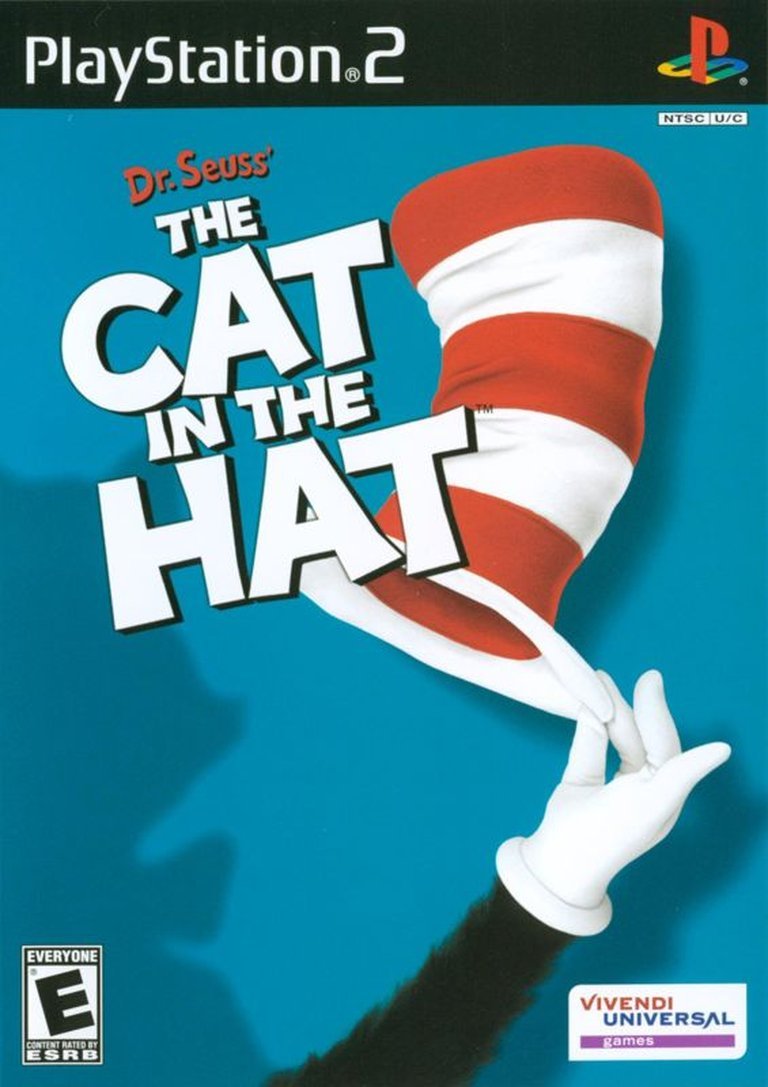
Description
In Dr. Seuss’ The Cat in the Hat, players take on the role of the mischievous Cat released from a magical box by Conrad and Sally, who were tricked by Mr. Quinn. Set in a whimsical house filled with chaotic magic and fantastical landscapes inspired by the Dr. Seuss movie, the Cat must team up with the children to restore order by retrieving three pieces of the Crab Lock and sealing the box to contain the unleashed magic, exploring rooms and areas beyond those shown in the film.
Gameplay Videos
Dr. Seuss’ The Cat in the Hat Free Download
Guides & Walkthroughs
Reviews & Reception
ign.com : a formulaic platformer that’s about as enjoyable as the film.
metacritic.com (40/100): Generally Unfavorable
gamespot.com (38/100): The Cat in the Hat just does not work as a generic run-and-jump game.
Dr. Seuss’ The Cat in the Hat: Review
Introduction
Imagine a world where the whimsical chaos of Dr. Seuss’s iconic feline bursts forth not from the pages of a beloved children’s book, but from the flickering screen of a console, umbrella in paw and mischief on the wind—only to stumble into a generic platforming routine that feels more like a rainy day indoors than a riotous adventure. Released in November 2003 to coincide with the live-action film adaptation starring Mike Myers, Dr. Seuss’ The Cat in the Hat promised to capture the anarchic spirit of Theodor Geisel’s timeless tale, blending Seussian absurdity with interactive fun for young players. Yet, as a product of the mid-2000s licensed game boom, it largely fizzles, offering a colorful but shallow experience that prioritizes movie tie-in hype over inventive gameplay. This review delves exhaustively into the game’s mechanics, narrative, and cultural footprint, arguing that while it occasionally evokes the source material’s playful essence, it ultimately embodies the pitfalls of rushed Hollywood adaptations, serving as a cautionary footnote in video game history rather than a celebrated one.
Development History & Context
The development of Dr. Seuss’ The Cat in the Hat unfolded against the backdrop of the early 2000s gaming landscape, a era dominated by the sixth-generation consoles like the PlayStation 2 and Xbox, where licensed titles flooded the market to capitalize on blockbuster films. Published by Vivendi Universal Games—a powerhouse formed from the 2002 merger of Vivendi and Universal, which handled numerous movie-based properties—the game was rushed to align with the November 2003 theatrical release of the film directed by Bo Welch. This tight timeline, typical of tie-in productions, often led to uneven quality, as developers balanced fidelity to the source with limited resources.
For the PlayStation 2 and Xbox versions, British studio Magenta Software Ltd. took the helm. Founded in 1998, Magenta specialized in mid-tier action and adventure games, with credits including The Weakest Link (2000) and later titles like Van Helsing (2004). Led by creative director Michael Mika Sr. and executive producers Andrew Ayre and Jeff Vavasour, the team’s vision centered on translating the film’s chaotic magic into a 2.5D platformer, emphasizing exploration of a distorted household. Key contributors included lead programmer Dale Van Mol and lead artist Tony Rodriguez, who aimed to infuse Seussian whimsy through vibrant, surreal levels. However, technological constraints of the time—such as the PS2’s reliance on Emotion Engine for 3D rendering and Xbox’s more robust NV2A GPU—meant compromises in animation fluidity and detail, resulting in a game that feels more like a PS1-era holdover than a next-gen showcase.
The Windows and Game Boy Advance (GBA) ports were handled by Canadian developer Digital Eclipse, known for ports and family-friendly titles like Disney’s Lilo & Stitch (2002). Directors Paul Johnson and Dave Allsopp, along with producers Jared Brinkley and Stephen Townsend, adapted the core formula for PC’s mouse/keyboard inputs and GBA’s portable constraints, but the GBA version suffered from even simpler visuals to fit the handheld’s hardware. Composer Keith Leary of Game Audio Ltd. provided a soundtrack blending jazzy, upbeat tunes with Seussian flair, though repetition marred its impact.
The broader context was a glut of movie-licensed games, from The Lord of the Rings successes to flops like The Cat in the Hat‘s contemporaries (Lara Croft Tomb Raider: The Angel of Darkness). With ESRB’s “Everyone” rating targeting kids aged 8-12, the game navigated a post-Grand Theft Auto III landscape where family-oriented titles competed for shelf space amid rising graphical demands. A planned GameCube version was scrapped, likely due to resource allocation toward more viable platforms, underscoring Vivendi’s pragmatic approach. Ultimately, the creators’ vision—to “bring the wacky fun home from the movie,” as the ad blurb stated—clashed with the era’s rushed development cycles, yielding a product that prioritized accessibility over ambition.
Narrative & Thematic Deep Dive
At its core, Dr. Seuss’ The Cat in the Hat adapts the 2003 film’s plot, diverging slightly from Geisel’s 1957 book to incorporate cinematic expansions while retaining the thematic heartbeat of imagination run amok. The story unfolds on a stormy day, with siblings Conrad (voiced by Chase Chavarria) and Sally (Andrea Bowen) confined to their home under the watchful eye of their goldfish (Nolan North). Enter the Cat in the Hat (Chris Edgerly, channeling Mike Myers’ manic energy), whose arrival via a magical crate unleashes pandemonium when neighbor Larry Quinn (Fred Tatasciore) steals the Crablock—a crab-shaped seal containing boundless Seussian magic.
Plot Breakdown
The narrative is structured as a quest to reclaim the three pieces of the Crablock and corral the escaped magic, which warps the household into fantastical realms: living rooms become Venusian traps, kitchens morph into gooey abysses, and garages twist into industrial nightmares. The Cat, guided by the fish’s nagging propriety, navigates 10 levels (plus a secret bonus stage) across a hub world of the corrupted house. Boss fights pit the Cat against Quinn’s mechanized contraptions, where projectiles target exhaust ports to dismantle them and snag Crablock shards. In a twist for replayability, revisiting bosses swaps Quinn for Thing One and Thing Two as pilots, injecting sibling rivalry into the chaos.
The GBA version simplifies this: Conrad accidentally removes the lock, eliminating Quinn and streamlining the plot into pure child-led mischief. Cutscenes, drawn from the film, intersperse levels with dialogue-heavy vignettes, like the Cat’s rhyming monologues (“Cat-Hat. In French, Chat-Chapeau. In Spanish, I’m a Gato in a Sombrero!”). These moments highlight the Cat’s role as chaos-bringer-turned-savior, culminating in the magic’s resealing just as Mom returns, restoring order.
Character Analysis
The Cat embodies Seuss’s trickster archetype—cheeky, inventive, and unapologetically disruptive—using his umbrella as a multi-tool for gliding, slamming, and bubbling enemies. Conrad and Sally serve as narrative foils: Conrad’s rebellious streak mirrors the Cat’s anarchy, while Sally’s caution echoes the fish’s moral compass. Quinn, the film’s villainous addition, amplifies themes of adult greed, hoarding magic for power in a subversion of Seuss’s child-centric world. Supporting cast like Thing One and Thing Two add comic relief, stealing keys for bonus challenges, while the fish provides tutorial-like scoldings.
Thematic Exploration
Dr. Seuss’s works often probe the tension between imagination and restraint, and the game echoes this through the magic’s dual nature: liberating yet destructive. The Crablock symbolizes boundaries—unleashed magic floods the world with wonder (floating furniture, anthropomorphic objects) but risks catastrophe, critiquing unchecked creativity. Environmental themes subtly emerge in levels like polluted garages, nodding to Seuss’s conservationist undertones in books like The Lorax. However, the film’s live-action tone injects slapstick humor over poetic depth, and the game’s dialogue, while witty in spots, lacks the rhythmic genius of Geisel’s verse, reducing themes to surface-level fun. This adaptation ultimately celebrates restoration over revolution, aligning with family-friendly goals but diluting the book’s subversive edge.
Gameplay Mechanics & Systems
Dr. Seuss’ The Cat in the Hat is a 2.5D platformer at heart, with side-scrolling levels rendered in faux-3D environments, but its mechanics feel derivative, echoing PS1 classics like Pandemonium (1996) more than innovating for the era. The core loop revolves around exploration, collection, and combat in corrupted household “worlds,” accessible via a hub that unlocks progressively (living room first, then upstairs, kitchen, and garage).
Core Gameplay Loops
Players control the Cat in third-person perspective, traversing levels by jumping across platforms, gliding with the umbrella (a double-jump/parachute hybrid), and ground-slamming to stun foes or shatter obstacles. The primary objective: gather colored magic clusters (red for high value, blue for low) to meet entry thresholds and fully cleanse stages, restoring the hub’s normalcy. Each level demands multitasking—collect 100% magic, defeat all enemies by trapping them in bubbles (formed via umbrella suction) and popping them, and snag four keys from Thing 1 and Thing 2 to unlock bonus doors yielding gems and extra magic. Failure to complete these blocks progression, turning levels into tedious backtracks.
Boss fights break the monotony: three (or two on PC) encounters against Quinn’s machines require dodging projectiles and firing bubbled enemies into weak points, a QTE-lite rhythm not unlike Jak and Daxter. A secret “Mystical Mirror” level, unlocked by all gems, offers a reflective twist on platforming. The GBA version adds scuba-diving stages for Crablock pieces and a cleaning-machine chase bonus, but simplifies controls for the handheld’s D-pad.
Combat, Progression, and UI
Combat is non-lethal and kid-friendly: suck up enemies or explosive goo into bubbles for ranged attacks, restoring the Cat’s five-hit-point health (tracked via hat rings) with cupcakes. Lives are finite, with hearts for refills; depletion restarts at checkpoints. No deep progression system exists—upgrades are absent, making the Cat’s toolkit static. UI is clean but cluttered: a magic counter in the corner, health via the hat, and minimaps for key/enemy tracking. Controls are responsive on consoles (analog stick for fluid jumps), but PC’s keyboard setup feels clunky without configurable remapping, a noted flaw in reviews.
Innovative or Flawed Systems
Innovations are sparse; the bubble mechanic adds puzzle-like strategy (e.g., chaining bubbles for multi-hits), and hub-based gating encourages non-linear exploration (e.g., upstairs after Level 4). Yet flaws abound: levels repeat fetch-quest tropes—collect X, clear Y—without variety, leading to repetition across 13 stages. Collision detection bugs (e.g., imprecise platform edges) and pixelated backgrounds frustrate precision jumps. Checkpoints are forgiving for kids, but the lack of difficulty scaling alienates older players, while no co-op or multiplayer limits replayability. On GBA, cartridge saves (three slots) enable progress tracking, but mushy sprites and repeated tunes amplify tedium. Overall, the systems prioritize ease over engagement, making it “addictive” for short bursts but forgettable long-term.
World-Building, Art & Sound
The game’s world-building transforms the mundane suburban home into a Seussian fever dream, where everyday objects—couches, lamps, appliances—mutate via escaped magic into vibrant, hazardous biomes. This hub-and-spoke structure fosters immersion, with progression visually restoring order: warped rooms revert to normalcy upon 100% collection, symbolizing thematic cleanup. Levels like “Venus Cat Trap” (a starry, plant-filled attic) or “Gooey Garage” evoke the book’s absurdity, expanding on film sets with unseen rooms (e.g., a basement labyrinth). Yet, the scale feels confined, lacking the boundless invention of Seuss’s illustrations.
Visual Direction and Atmosphere
Art direction by Boyd Burggrabe channels Geisel’s style—bold colors, exaggerated proportions, and quirky creatures (e.g., zizzer-zazzer-zuzz-like foes)—but execution varies by platform. PS2/Xbox versions boast vivid 3D models with cel-shaded edges, oversized sprites, and dynamic backgrounds (e.g., swirling magic vortices), creating a toy-box whimsy. However, low-res textures and stiff animations (Cat’s glide looks labored) betray budget limits, with some levels feeling “mushy” or unfinished. Windows ports suffer pixelation on higher resolutions, while GBA’s 2D sprites capture personality (detailed Cat animations) but mushy levels lack definition, like “sketches” rather than polished art. Atmosphere shines in surreal transitions—household items pulsing with life—but hazards (bottomless pits, spike traps) clash with the lighthearted tone, occasionally veering into frustration.
Sound Design
Keith Leary’s score, blending bouncy jazz and orchestral whimsy, enhances the playful vibe with catchy motifs (e.g., a rhyming chase theme) that loop without grating—though repetition in long levels irks. Sound effects pop: bubbly pops, umbrella whooshes, and Seussian squelches add tactility. Voice acting, pulled from the film, delights—Edgerly’s Cat quips with Myers-esque flair (“What joy they felt, what could be higher?”), while North’s fish nags effectively. Dialogue is sparse but integral, with subtitles aiding clarity. On GBA, sound is tinny but serviceable, lacking the consoles’ depth. Overall, audio elevates the experience, making quiet moments feel alive and chaotic ones exhilarating, though it can’t salvage repetitive gameplay.
Reception & Legacy
Upon release, Dr. Seuss’ The Cat in the Hat garnered middling to poor reviews, emblematic of licensed games’ reputation for mediocrity. Aggregates reflect this: Metacritic scores of 56/100 for PS2/Xbox, 40/100 for PC/GBA; GameRankings at 50-52% for consoles, dipping to 19.5% on PC. Critics praised its kid-friendly accessibility and visual charm but lambasted repetition and lack of innovation.
Critical and Commercial Reception
Launch coverage highlighted its film synergy, with GameZone awarding PS2 7.2/10 for “easy, yet interesting gameplay” and vibrant worlds, while KidZone lauded Windows at 8/10 for capturing “the essence of Seuss.” Positive outliers like Feibel.de (83% for Windows) celebrated “wundervollen Fantasielandschaften” (wonderful fantasy landscapes) and witty characters. However, outlets like PC Zone (30%) decried it as “steaming effluent,” citing bugs, drab graphics, and poor level design; 4Players.de (26-28%) called it a “schlechte Kopie” (bad copy) of Pandemonium, unfit even for young players. IGN (6/10) noted it “relies on a name over gameplay,” while GameSpot (3.8/10 for GBA) deemed it a “generic punch-and-run” exemplifying licensed flops. Commercially, it sold modestly—used copies now fetch $9-12 on eBay—bolstered by holiday bundling but overshadowed by hits like Prince of Persia: The Sands of Time.
Player reception mirrors critics: MobyGames’ 3.1/5 average from 10 ratings, with some praising simplicity for kids, others slamming tedium. Awards were dubious; 4Players named it 2004’s “Biggest Console Disaster,” underscoring its infamy.
Evolving Reputation and Industry Influence
Over two decades, the game’s reputation has solidified as a punchline for rushed tie-ins, occasionally revisited in retrospectives on Seuss adaptations (e.g., alongside The Grinch (2000) GBC game). Nostalgia communities on forums like Reddit note its charm for ’90s kids, but it’s largely forgotten, with no remakes or ports. Influence is negligible—Magenta’s team moved to darker fare like The Chronicles of Riddick (2004), while Digital Eclipse thrived on better licenses (Teenage Mutant Ninja Turtles). It exemplifies the era’s pitfalls: prioritizing speed over quality, contributing to skepticism toward movie games and pushing publishers toward original IP. In Seuss’s canon, it pales against educational titles like Dr. Seuss’ ABC (1995), but serves as a relic of how Hollywood’s whimsy often translates poorly to pixels.
Conclusion
Dr. Seuss’ The Cat in the Hat captures fleeting sparks of its source’s magic—through colorful worlds, rhyming quips, and a dash of household havoc—but ultimately succumbs to the drudgery of repetitive platforming and underdeveloped systems, a victim of its era’s licensed game curse. Its narrative faithfully adapts the film’s chaos-vs-order theme, bolstered by solid art and sound, yet gameplay loops feel like obligatory chores rather than inventive play. While accessible for young audiences and a harmless rental for Dr. Seuss fans, it earns a middling 5.5/10, a curiosity in video game history rather than a classic. In the annals of interactive storytelling, it reminds us: fun must be more than fun; it must know how to be had, lest it leave players with nothing but a soggy hat.