
- Release Year: 2023
- Platforms: Windows
- Genre: Adventure
- Perspective: 3rd-person
- Game Mode: Single-player
- Gameplay: Open World, Platform, Puzzle elements, Sandbox
- Setting: Contemporary
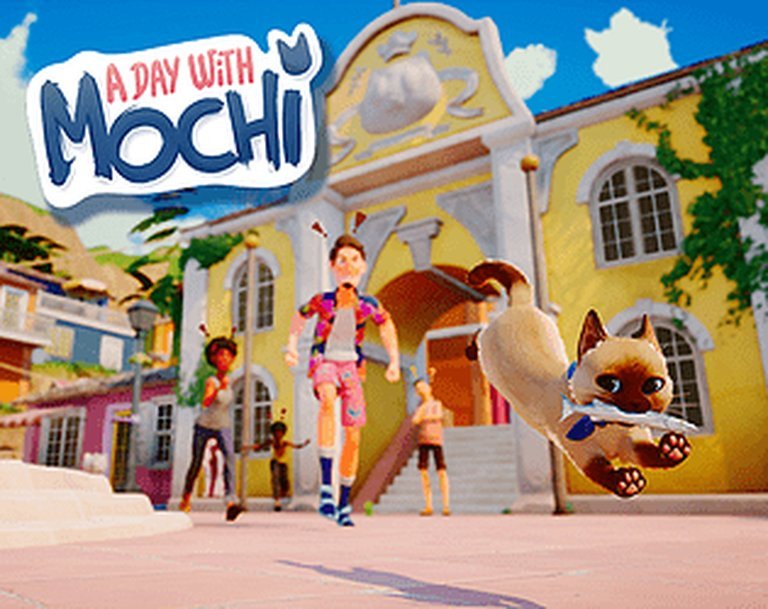
Description
A day with Mochi is a tiny open-world sandbox adventure game set in a contemporary environment, where players control a cute yet malicious cat. With real-time gameplay, platforming, puzzle elements, and a comedic narrative, it offers a whimsical and interactive exploration from a feline perspective in a sandbox world.
A Day with Mochi: A Feline Sandbox Masterclass in Student Game Development
Introduction: The Purr-fect Storm of Cute Chaos
In the crowded landscape of indie games, few titles capture a specific, universally relatable fantasy with such unadulterated glee as A Day with Mochi. This 2023 release from the French student collective San Felicete Studio is predicated on a deceptively simple premise: you are a cat. Not a heroic cat, not a doomed cat, but a cute, mischievous, and fundamentally free cat on a tropical holiday. Yet, within this slender conceit lies a densely packed sandbox of systemic interactions, player-driven narrative, and pure, unscripted mayhem. This review argues that A Day with Mochi transcends its status as a “student project” to become a landmark in playful, physics-driven design and atmospheric world-building. It successfully merges the comforting fantasy of feline indolence with the empowering chaos of a Goat Simulator-style sandbox, all wrapped in a stunningly polished and cohesive visual package that belies its nine-month development cycle. It is not just a game about being a cat; it is a meticulously crafted toy box where the primary instruction is “be yourself.”
1. Development History & Context: The Academic Crucible
The Studio & The Vision
A Day with Mochi was developed by San Felicete Studio, an 11-person team of students in their fifth and final year at Rubika Supinfogame in France. The project was their graduation capstone, a “polished vertical slice” conceived and executed over a rigorous nine-month period from 2022 to 2023. The core pitch—”play a cat on a touristic island and create chaos”—was established early and fiercely guarded, as noted by Lead Level Designer Arthur Galland: “We had a clear vision of the game from the beginning and everyone never lost it during the project.” This singular focus was paramount in navigating the immense challenge of building an open world from scratch.
Technological Constraints & Ambitious Tools
The team chose Unreal Engine 5, leveraging its cutting-edge features like Nanite for dense geometry, Lumen for dynamic global illumination, and the World Partition system for managing their open island. This was a bold, risky choice for a student team, as Simon Gonand (Lead Programmer) notes, but one that provided “a lot about the engine, its strength and good practice.” The constraint was time, not technology. Their solution was a hybrid C++/Blueprint architecture: Gonand built a robust, performance-critical framework in C++, while exposing “higher level” systems to designers via Blueprints. This created a “natural boundary” allowing systems designers to implement gameplay without breaking core code—a crucial pipeline for a small team.
The Pre-Production Pivot
The initial pre-production phase (three months) involved extensive reference gathering. Galland’s team studied Nassau for architecture and Cinque Terre for organic urban layout. A critical benchmark analysis of games like Stray and A Short Hike guided their philosophy: minimize HUDs, rely on landmarks, and use contrast for navigation. However, after their first production block, they realized a fatal flaw. As Galland candidly states, they “were lacking control over the player experience” with a full macro-map, leading to a “lack of guidance, no macro-objective.” This triggered a major scope and design philosophy shift mid-project. They scrapped the full island, refocusing on a polished central hub with distinct, thematic districts (Harbor, Park, Residential, Shopping). The new mantra was: “A game element has to be polished or it will not be in the production demo.” This drastic cut, though painful, was instrumental in achieving cohesion.
2. Narrative & Thematic Deep Dive: Structure from Chaos
A Day with Mochi eschews a traditional linear narrative. Instead, its “story” is an emergent, player-authored chronicle of mischief set against the backdrop of a vibrant, postcard-like town.
The Plot Engine: The Polaroid System
The narrative driver is the photo album. Mochi, a newcomer to San Felicete, is tasked by local feline friends with causing specific forms of chaos. Each successful task—replacing toothpaste with ketchup, scaring a tourist, setting a banner on fire—earns a unique Polaroid photograph. These are not mere collectibles; they are tangible narrative tokens, a scrapbook of Mochi’s antics. The island’s cats act as quest-givers, their simple, often humerous requests framing the world’s reactivity. Completing tasks for a cat may unlock new activities or dialogue, creating a faint but satisfying web of inter-cat relationships.
Characters: A Cast of Reactors
The human Non-Player Characters (NPCs) are not deep individuals but archetypal reactors. There’s the flustered tourist, the oblivious shopkeeper, the grounds-keeper. Their purpose is to provide a spectrum of reactions—from amused charm to furious annoyance—based on Mochi’s actions. The true “characters” are the other cats who populate the island. Each has a distinct look and a task to assign, serving as both landmarks and narrative nodes. Calling them with the press of a button (Y on a controller) is the game’s equivalent of opening a quest log, reinforcing their role as guides and peers in this feline fantasy.
Themes: The Catharsis of Consequence-Free Rebellion
The game’s core themes are woven into its mechanics:
* Feline Empowerment: The entire experience is about inhabiting the cat id—the urge to knock things over, climb to inaccessible heights, swipe at objects, and sleep in sunbeams. The controller is designed to make these actions “simple and funny,” as 3C Designer Antoine Grugeon states.
* Systemic Storytelling: There is no scripted cutscene where Mochi is praised or scolded. The “story” of scaring a human into dropping their ice cream is told entirely through physics, animation, and sound. The Polaroid, appearing moments later, is the game’s winking acknowledgment of that story.
* The “Chill” Sandbox: The tropical setting, chill soundtrack (implied by user reviews and the “Cat-astrophic – Cute – Chill” design intention), and absence of a “Game Over” state create a pressure-free environment. The theme is not about winning, but about experimenting.
3. Gameplay Mechanics & Systems: The Symphony of Swipe and Scale
The genius of A Day with Mochi lies in its deceptively simple control scheme married to a deeply interconnected object attribute system.
The 3C: Character, Camera, Controls
Grugeon’s primary responsibility was the “cat controller.” His three intentions were simplicity, freedom, and fluidity.
* Character (Movement): The cat’s movement is a blend of direct input and animation-driven momentum. Actions like a quick “paw slash” (LB/RB), a satisfying “meow” (B), and a fluid jump (A) are mapped intuitively. The * Right Trigger (RT) for “Grab/Pull”* is the keystone mechanic, allowing Mochi to interact with a vast array of objects—from pulling a chair to toppling a stack of boxes.
* Camera: The third-person camera is tuned for a “chill” experience, offering sufficient freedom to survey the clustery environments without disorienting the player. Its movement is smoothed to match the game’s relaxed pacing.
* Controls: The mandatory gamepad requirement is a defining, if risky, choice. It forces an analog, tactile relationship with Mochi’s movements, making the subtlety of a trigger pull or stick tilt feel more physical and immersive than mouse/keyboard could allow.
The Systemic Heart: Attributes & Objects
The World isn’t just a backdrop; it’s a playground of interacting properties. System Designers Luc Vidal and Arthur Spellani created a framework where objects possess various attributes (e.g., magnetic, electronic, fragile, flammable). These attributes dictate how objects can be used and how they affect the world.
* Example: A metal trash can (magnetic) might be pulled with RT towards a fan (electronic), creating an impromptu projectile. A sign (flammable) near a candle (heat source) can be set ablaze, causing panic.
* This system turns the environment into a giant puzzle box. Players learn not specific object uses, but category uses. The “magnetic” attribute applies to all metal objects, teaching through systemic discovery.
Progression & The Open Loop
There is no traditional progression (levels, XP, stats). Progression is accomplishment-based and self-directed:
1. Explore the island, discovering districts and landmarks.
2. Encounter a cat with an exclamation mark.
3. Accept a task (e.g., “Scare the fisherman”).
4. Use the environment and object attributes to achieve the goal.
5. Receive a Polaroid, adding it to your album and often unlocking the next vague hint or new cat interaction.
The “Call Your Friends” (Y button) function is a brilliant masterstroke. When directionless, players can summon local cats who will point toward nearby activities, seamlessly generating new objectives without a waypoint clogging the screen. This maintains the “no game over, don’t worry about getting lost” philosophy.
Flaws & Friction
The system isn’t perfect. The lack of a save function (as confirmed by developer Nescafeine on itch.io) is a significant oversight for a game with collectibles. A crash or forced quit erases your Polaroid album progress. Additionally, some users (like tsuneko on itch.io) reported camera clipping bugs on lower-end GPUs, a testament to the ambitious rendering tech potentially outpacing optimization for all hardware. These are the scars of a compressed development timeline.
4. World-Building, Art & Sound: Painting San Felicete
The Island of San Felicete
The world is the game’s true star. Galland’s level design team translated their references into a cohesive, non-gridded tropical town. Key design pillars were:
* Reinforce the Cat Fantasy: Pathways are designed for feline traversal—tight alleys, climbable rooftops, narrow ledges, and high perches. White outlines on platforms and vegetation as obstacles subtly guide the player’s path without breaking immersion.
* Organic City: The district-based approach (Harbor, Park, etc.) creates clear visual and thematic shifts. The Park is lush with vegetation and focuses on “electronic” objects (fountains, lights), while the Harbor has industrial textures and water-based puzzles.
* Landmarks & Triangulation: The team employed “different shapes and sizes of buildings” and unique structures (a Cat Tower, a Traveler’s Palm) to help players orient themselves without a mini-map, a challenge for an open world sans-HUD.
Visual Direction: A Postcard Come to Life
The art team (Zoé Gerard, Chloé Plumey, Léo Gosselet, Inès Pouille, Yanis Habib) created a world that feels both stylized and tangible. The use of UE5’s Lumen gives the island a warm, sun-drenched glow with soft shadows, enhancing the “postcard” aesthetic. The color palette is vibrant but harmonious—pastel buildings against deep blue sea and green foliage. Character animation, led by Habib, is critical. Mochi’s idle animations (grooming, curious head tilts) and movement transitions (the stretch before a leap) sell the feline fantasy. The Polaroid images that populate the album are a delightful 2D touch by Salma Hoï and Lucas Rea, their rough, instant-film aesthetic providing a satisfying “capture” moment.
Sound Design: The Soundtrack of Mischief
Rose Bleue’s sound design is a masterclass in diegetic and ambient cues. The crash of a falling vase, the hiss of a scared human, the contented purr after a successful jump—all are crisp and informative. The background music is noted by players as “chill” and fitting, providing a relaxed, vacation-like atmosphere that contrasts with the on-screen chaos, reinforcing the “do no harm, take no responsibility” vibe of being a cat.
5. Reception & Legacy: The Quiet Triumph
Critical & Commercial Reception
Formally, the game has no MobyScore and has been “Collected By” only 2 players on MobyGames, indicating extremely niche awareness within traditional critic circles. There are no professional critic reviews listed on the site. Its commercial release was a free download on itch.io on October 8, 2023. Its reception is thus almost entirely through player-word-of-mouth on its itch.io page and platforms like Kotaku/Backloggd where it has a listing but no reviews.
Player Response: A Cult Following of Chill
The itch.io user reviews are overwhelmingly positive and illuminating:
* Kitsu259 praises its “relaxing environment” and “funny” naughty tasks, highlighting exploration and hidden “mystery signs and beautiful murals.”
* tsuneko (catlover_mimi), a self-proclaimed cat lover, declares it “the cutest and most relaxing game I have ever played,” specifically lauding Mochi’s authentic movement and the Polaroid art. This speaks directly to the game’s core fantasy fulfillment.
* DitoMido, a streamer, compares its mayhem favorably to Goat Simulator and its central plaza to Super Mario Sunshine‘s Isle Delfino, placing it in a prestigious lineage of chaotic sandboxes.
* A common refrain is the utility of the “Press Y to call friends” mechanic to avoid getting lost.
Legacy: A Benchmark for Student Projects and Feline Games
A Day with Mochi’s legacy is two-fold:
1. As a Pedagogical Triumph: It stands as a textbook example of what a focused, well-managed student team can achieve. The documented pivot from an over-scoped macro-map to a polished district-based design is a case study in agile, reality-based development. The clear separation of C++/Blueprint roles and the creation of rational design tools (Galland’s challenge spreadsheet, attribute lists) are practices any aspiring developer should study.
2. In the Indie Ecosystem: It entered a small but growing niche of “cat simulation” games (Stray being the AAA benchmark). Where Stray is a narrative-driven adventure, Mochi is a pure, systemic sandbox. Its influence is likely to be seen not in direct clones, but in its demonstration that a simple fantasy, executed with systemic depth and artistic cohesion, can be more fulfilling than a bloated open world. It validates the “small, polished, playful” approach to game design.
6. Conclusion: An Essential, If Ephemeral, Experience
A Day with Mochi is not without flaws—the save system omission is glaring, and its technical demands can cause issues. Yet, within the pantheon of video game history, its place is secure and specific. It is the definitive “chill chaos” sandbox, a game that understands the appeal of its premise down to the bones and builds a delightful, reactive toy box around it. From the fluid, intentional cat controller to the beautifully articulated world of San Felicete, every major system serves the core fantasy of being a cute agent of anarchy.
Its historical importance lies less in revolutionizing a genre and more in perfecting a micro-genre and doing so under the intense constraints of academia. It proves that with a locked-in vision, smart systemic design, and an unwavering focus on player fantasy, a team of students can create an experience that rivals—and in terms of pure, unadulterated playful freedom, surpasses—many larger productions. A Day with Mochi is a love letter to cats, to sandbox play, and to the power of a well-defined scope. It is a must-play for any game designer, any fan of feline antics, and anyone who believes that video games, at their best, are fundamentally about the joy of experimentation in a world that feels alive. It is, in the truest sense, a masterclass.