
- Release Year: 2018
- Platforms: Linux, Macintosh, Windows
- Publisher: Sekai Project, Inc.
- Developer: Afterthought Studios
- Genre: Simulation
- Perspective: 1st-person
- Gameplay: Visual novel
- Setting: Fantasy
Description
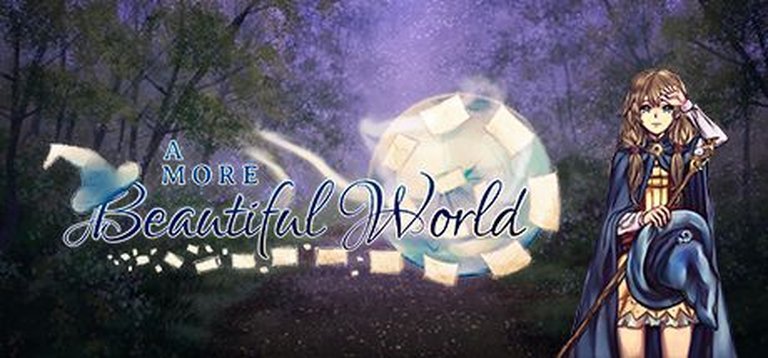
A More Beautiful World is a kinetic visual novel set in the fantasy realm of Gallantia, where magic was lost following a civil war between ancient wizards and human armies. Players follow Violetta, the Witch of Everlasting Journeys, on an expansive journey through a historically rich setting as she investigates whether humanity has thrived in the absence of miracles. Inspired by works like ‘Spice and Wolf’, the story emphasizes relationships, money, and politics, weaving in allusions to real-world history and classical literature to explore themes of hope and despair.
A More Beautiful World Cracks & Fixes
A More Beautiful World Guides & Walkthroughs
A More Beautiful World: Review – The Unfinished Symphony of a Wandering Witch
Introduction: A Phantom of the Visual Novel World
To encounter A More Beautiful World in the annals of gaming history is to find a ghost—a beautifully rendered, ambitiously conceived phantom that haunts the periphery of the visual novel landscape. Released into Steam Early Access in September 2018 by publisher Sekai Project and developer Afterthought Studios, this kinetic visual novel promised an epic, politicized fantasy journey inspired by the cerebral world-building of Spice and Wolf and Maoyuu Maou Yuusha. Yet, what arrived was less a completed world and more a poignant, fragmented artifact—a testament to grand vision clashing with the harsh realities of indie development. This review argues that A More Beautiful World is not a game to be judged by its completion, but by the profound ambition of its design and the tragic, instructive story of its curtailment. It stands as a fascinating case study in crowdfunded aspiration, where the gap between promise and product reveals as much about the medium’s challenges as the narrative itself.
Development History & Context: Ambitious Roots in a Crowded Garden
The Studio and the Vision: Afterthought Studios was, and remains, a small, globally distributed collective of “visual novel enthusiasts” rather than a traditional studio. Headed by Singapore-based writer Darren Kwok, the team assembled talent from across the industry: composer Steven Melin (with credits on Gears of War 3), voice acting studio Sound Cadence (Amber Lee Connors), and artists from the successful Fervent visual novel team. This model—a virtual studio hiring specialists—is common in indie dev but relies heavily on cohesive leadership and sustained momentum. Kwok’s stated goal was to create “stories that will touch the hearts of our readers and let them take away a lesson or two,” aiming for literary weight with allusions to classical works and real-world history (China, Europe, the Americas).
Technological and Market Context: The game was built in Ren’Py, the ubiquitous, accessible engine for narrative-centric games. This choice lowered the technical barrier but placed the burden of distinction entirely on writing and art. The team successfully Kickstarted the project in early 2016, a period of immense growth for visual novels on Steam following Sekai Project’s localization push. However, the market was also becoming saturated with low-effort “otome” and fantasy VNs, making it harder for a ambitious, politically-minded narrative to stand out without a massive marketing push.
The Early Access Crucible: A More Beautiful World entered Early Access on September 28, 2018. The provided demo and store description outlined a four-Act structure, with Act I complete. Community discussions from 2018 onward, however, paint a picture of growing concern. Questions like “Project Still Active?” (Jan 2022) and “How is the progress going so far?” (Oct 2018) went unanswered for months. A persistent, game-breaking “Voice Bug (Volume resets everytime)” was reported as late as April 2020 and remained “Verifying.” On VNDB, the title is chillingly cataloged as “Unfinished, no ongoing development.” This suggests development quietly halted after the Early Access release, likely after Act I or the beginning of Act II, with core bugs unfixed. The “Games pulled from digital storefronts” tag on MobyGames further implies the game may have been delisted at some point, though Steam records show it remains available as of the last community post. The story of its development is a classic indie cautionary tale: a successful crowdfunding campaign, a promising start, but an inability to maintain the development velocity required to fulfill a sprawling narrative promise within a competitive market.
Narrative & Thematic Deep Dive: The Philosophy of a Post-Magic World
Plot and Structure (As Experienced): What players could experience was the opening movement of a much larger symphony. The protagonist is Violetta, the “Witch of Everlasting Journeys,” a self-proclaimed wanderer in the realm of Gallantia. The core premise is a deconstruction of the fantasy staple: magic did not simply disappear; it was systematically eradicated in a civil war where “the armies of man” overthrew the ruling ancient wizards. The “Blessings” (arcane knowledge) were buried, and magic became myth.
Violetta’s journey is not one of saving the world with magic, but of sociological and economic observation. The explicit inspiration from Spice and Wolf—a story about a merchant and a wolf-deity debating economics—is the key. The player, through Violetta, is meant to engage with a world rebuilding itself without miracles. The Early Access content, as described, focuses on her encounter with a Merchant in the first act, with promises of meeting “many other interesting characters” like a Marquis, a Militia, a Guard, and a Bandit across subsequent acts. The narrative’s engine is dialogue, its currency ideas.
Themes in Extremis:
1. The Politics of Absence: The central theme is what a society does when its foundational supernatural element is violently removed. Do people create better systems (a “More Beautiful World”) out of necessity, or do they merely recreate old hierarchies with new justifications? The title is ironic, questioning whether the post-magic human world is truly an improvement.
2. Economics as Narrative: Following its inspirations, the story places “relationships, money and politics” at the center. Trade, resource management, and labor are not set dressing but the primary drivers of conflict and character motivation. A merchant’s risk calculation is as tense as a sword fight.
3. Historical Parallelism: The developers explicitly stated that “history buffs will also pick out real world events reflected in the story from China, Europe and the Americas.” This suggests Gallantia is a fantasy palimpsest, where the post-revolutionary period mirrors the aftermath of historical power shifts—perhaps the fall of Rome, the Meiji Restoration, or the post-Columbian exchange. Violetta’s perspective as an outsider allows for analytical commentary on these analogues.
4. The Burden of Knowledge: Violetta is a witch in a world that forgot magic. Her knowledge is both a power and a liability. She represents the traumatic memory of the old world, and her interactions test whether humans can be trusted with that memory or if they will repeat the cycle of persecution.
5. Literary Allusion: The promise of “allusions to classical literature” points to a meta-narrative layer. Violetta’s journey may consciously echo archetypal quests (the舜的旅程, the knight-errant) only to subvert them, examining the cost of progress versus tradition.
The Unfinished Argument: The tragedy is that these sophisticated themes are presented in a narrative that never had the chance to develop their full argument. We are left with a compelling thesis statement—the first act—but the evidence, counter-arguments, and climax are missing. The “question YOU will have to help answer” is ultimately unanswerable because the full dialectic was never written.
Gameplay Mechanics & Systems: The Constraints of a Kinetic Novel
Core Loop and Interactivity: As a kinetic visual novel, the gameplay loop is fundamentally passive reading with minimal branching. The “kinetic” label is crucial: it implies a fixed, linear narrative where player “choices” are either nonexistent or so minor they do not alter the plot’s trajectory. Community confusion (“Is this going to be a linear story, or something more akin to the typical Steam otome game?”) highlights a market expectation for choice-based VNs. A More Beautiful World positioned itself against that trend, promising a tightly authored story. This is a valid artistic choice but severely limits “gameplay” in the interactive sense. The only “system” is the progression through text, punctuated by static anime-style sprites (Violetta, supporting characters) and background art.
UI and Presentation: Built in Ren’Py, the interface is standard: a text box, character sprite window, and background. The promise of full English voice acting (by notable VA like Amber Lee Connors) was a major selling point. Yet, the infamous persistent “Voice Bug” where “muting voices does not seem to work, it gets reset everytime someone starts speaking,” severely undermined this feature. For a medium where reading speed varies, the inability to control voice volume was a critical flaw that broke immersion for many, as noted in Steam discussions. This bug, left unfixed for years, symbolizes the project’s stalled state.
Progression and Innovation: There is no character stat progression, inventory management, or exploration system. The “gameplay” is entirely intellectual and emotional engagement with the text. Its potential innovation lay in narrative scope and thematic depth, attempting the scale of a historical-political novel within a VN framework. The failure was not in the design of these non-existent mechanics, but in the failure to realize the only mechanism that mattered: delivering the complete narrative.
World-Building, Art & Sound: Glimpses of a Lost Continent
Setting – Gallantia: The world is defined by its central absence: magic. This creates a unique atmosphere—a fantasy world that feels like a historical reconstruction. The “Eternal Forest” where Violetta is found suggests pockets of old-world mystery, but the focus is on human kingdoms, trade routes, and post-revolutionary social order. The promise of “an expansive fantasy setting rich in history and lore” implies detailed world-building documents that, like the game, remain tragically unseen.
Visual Direction: The art style is anime/manga, fulfilling a genre expectation. Credits list multiple artists: AllenWalkerLove for primary art, sprite work from Artsvarn/Atelier-Aria/Camille Arana, backgrounds from ameliori and sillyselly. The fragmentation of art duties is common in indie VNs but can lead to visual inconsistency. Without full access to the released acts, it’s impossible to judge the final aesthetic cohesion, but promotional screenshots show competent, if not groundbreaking, anime-style character art and painted backgrounds fitting a medieval fantasy.
Sound Design and Music: This was a potential strength. The opening song “Donnec Obviam Iterum” was composed by the collective harmonicblend, with Steven Melin (a veteran composer for film and AAA games like Bioshock) also credited. The inclusion of a professional composer suggested a cinematic ambition. The full English voice cast was impressive for an indie project, featuring actors known for roles in Dust: An Elysian Tail and Exogenesis: Perils of Rebirth. However, the unresolved voice bug meant this professional audio work was often experienced as a technical annoyance, not an asset. The sound design’s full impact was thus negated by implementation failure.
Reception & Legacy: The Canon of the Unfinished
Critical and Commercial Reception: A More Beautiful World exists in a state of critical non-existence. There are zero critic reviews on MobyGames, Metacritic, or OpenCritic. Its “Moby Score” is listed as “n/a,” and it has been “Collected By” only 1 player on MobyGames. Steam user reviews are scarce; the community hub is dominated by bug reports and development status queries, not analyses of the story. VNDB holds a 6.93 average from 3 votes, a tiny but telling sample. One user gave it 8, likely for its promise and demo; another 6.8; another 6. The commercial performance was evidently negligible, despite a successful Kickstarter (~$5,000 CAD goal, unspecified funding). Its presence in discussions about “Games pulled from digital storefronts” hints at possible removal, further burying it.
Evolving Reputation and Influence: The game has no notable influence on the industry. It did not spawn imitators, define a subgenre, or achieve cult status. Its legacy is purely that of a what-if. In the vast library of Steam, it is a silent entry. The one organic piece of legacy is the memory shared on the GOG Dreamlist by user @vorrri: “I first heard about A More Beautiful World through Soundcloud… I truly resonated with this project because I KNOW this was someone’s passion project, and for it to go down the way it did, quietly, is an injustice.” This encapsulates its niche status: remembered not for what it was, but for the purity of its ambition and the sadness of its abandonment. It serves as a benchmark for the fragility of crowdfunded narrative projects and the immense difficulty of executing a thematically dense, multi-act visual novel without a dedicated, well-funded studio structure.
Place in Video Game History: Historically, A More Beautiful World is a footnote and a warning. It demonstrates the accessibility of game creation tools (Ren’Py, Kickstarter) and the global协作 possible in the digital age. Simultaneously, it reveals the chasm between a compelling pitch and sustained production. It is a primary source for studying the lifecycle of an Early Access project that failed to exit that phase. For scholars of interactive narrative, it represents a fascinating, incomplete experiment in adapting the “political economy novel” to the VN format—a failed experiment that leaves its theoretical contribution entirely in the realm of speculation.
Conclusion: The Beauty in the Blueprint
A More Beautiful World is not a successful video game by any traditional metric. It is incomplete, buggy, and largely unseen. Yet, to dismiss it as a failure is to miss its poignant value. It is a blueprint for a masterpiece, a ghost of a story that might have been. Its thesis—examining a post-magic society through the lenses of economics, politics, and history—was brilliant and largely unexplored in its genre. Its team assembled credible talent. Its foundation, the released Early Access content, suggests a literate, thoughtful narrative voice.
The definitive verdict must be twofold. On its actual merits: As a purchasable product, it is a broken, abandoned shell. It deserves criticism for releasing in an unplayable state (voice bug) and failing to communicate with its backers and players for years. On its historical and artistic merits: It stands as a tragic monument to indie game ambition. The ideas it sought to explore are so significant that their absence is felt more keenly than the presence of many completed but generic games. It is the Kingdom of Folklore or The Stand of visual novels—a sprawling, critical narrative interrupted.
In the museum of gaming, A More Beautiful World would not be displayed as a finished artifact, but as a plaque next to an empty plinth, describing the exquisite, unrealized vision. Its true beauty lies not in the world we could explore, but in the stark, instructive contrast between that imagined world and the silent, unfinished reality left behind. It is a reminder that in our interactive medium, the most haunting worlds are sometimes the ones that never finished building.