
- Release Year: 2017
- Platforms: Windows
- Publisher: Red Phoenix Studios
- Developer: Red Phoenix Studios
- Genre: Strategy, Tactics
- Perspective: Diagonal-down
- Game Mode: Single-player
- Gameplay: 4X, City building, construction simulation, Turn-based
- Setting: Fantasy
- Average Score: 56/100
Description
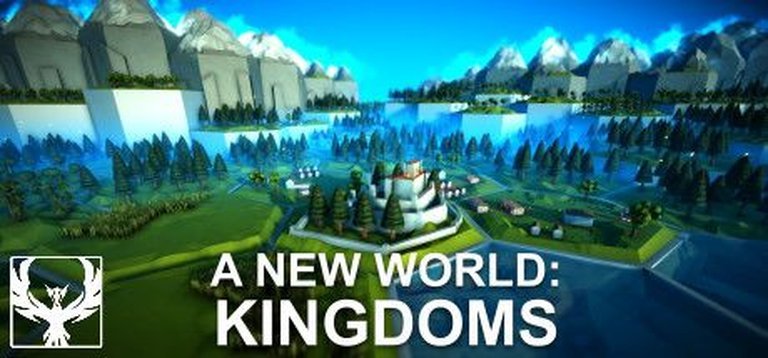
A New World: Kingdoms is a turn-based strategy game set in a fantasy world where players build and manage their own kingdom. The game features city-building, resource management, and tactical combat, allowing players to expand their empire, engage in diplomacy, and conquer rival factions. With a diagonal-down perspective and a free camera, players can explore a richly detailed world filled with ancient civilizations, magical resources, and strategic challenges.
Where to Buy A New World: Kingdoms
PC
A New World: Kingdoms Patches & Updates
A New World: Kingdoms Guides & Walkthroughs
A New World: Kingdoms Reviews & Reception
sockscap64.com (56/100): This Game has no review yet, please come back later…
A New World: Kingdoms Cheats & Codes
PC
Start a new game. Top left, rename your castle ‘cheat’. The name should automatically revert to the old one.
| Code | Effect |
|---|---|
| SHIFT + 0 | Spawns a huge stack of resources at your cursor. (2500 wood, stone, tools and armaments). Also gives up to 2500 gold if you have the Treasure Rooms. |
| 4 | Super speed. |
| F | Starts a fire. |
| G | Destroy selected building. |
| B | Kill nearest villager. |
| M | Spawn merchant ship. – Requires dock. |
| K | Spawn Viking Ship(s) – Requires at least 50 Villagers. |
| P | Spawns villagers inside vacant rooms. |
| [ | Grow trees at cursor. |
| ] | Remove trees at cursor. |
| – (Subtract/Underscore) | Spawns villagers while held. |
| CTRL + 1 | Clear weather. |
| CTRL + 2 | Rainy weather. |
| CTRL + 3 | Stormy weather. |
| CTRL + C | Toggle camera controls and UI. |
A New World: Kingdoms – A Forgotten Gem of Turn-Based Strategy
Introduction: The Uncharted Territory of a Niche 4X Game
In the vast ocean of strategy games, A New World: Kingdoms (2017) emerges as a quiet, unassuming title—one that slipped under the radar of mainstream acclaim yet carries the weight of a thoughtful, if flawed, 4X experience. Developed by the obscure Red Phoenix Studios, this turn-based strategy game attempts to carve its niche in a genre dominated by titans like Civilization and Endless Legend. But does it succeed? Or is it merely a footnote in the annals of indie strategy games?
This review will dissect A New World: Kingdoms with surgical precision, exploring its development history, narrative ambitions, gameplay mechanics, and artistic identity. We’ll examine why it failed to capture widespread attention, how it compares to its contemporaries, and whether it deserves a second look from strategy enthusiasts.
Development History & Context: The Birth of an Underdog
The Studio Behind the Curtain
Red Phoenix Studios is a name that barely registers in the gaming industry’s collective consciousness. With no prior major releases, A New World: Kingdoms was their debut—and, as of 2024, their only title. The studio’s obscurity raises questions: Was this a passion project? A labor of love by a small team? Or an ambitious but underfunded attempt to break into the strategy genre?
The game’s Steam release on October 5, 2017, came at a time when the 4X strategy market was already saturated. Civilization VI had launched the year before, and Endless Space 2 was still fresh in players’ minds. For an indie title with minimal marketing, standing out was always going to be an uphill battle.
Technological Constraints & Design Philosophy
A New World: Kingdoms is built on a diagonal-down perspective with a free camera, a choice that feels both retro and limiting. The visuals are low-poly, a stylistic decision that likely stemmed from budgetary constraints rather than artistic vision. While some indie games (e.g., Battle Brothers) have thrived with minimalist aesthetics, Kingdoms’ art direction lacks the polish or charm to make its simplicity compelling.
The turn-based pacing and 4X mechanics (eXplore, eXpand, eXploit, eXterminate) are standard for the genre, but the execution feels stiff and unrefined. The UI, in particular, is clunky, with menus that lack intuitiveness—a critical flaw in a genre where micromanagement is key.
The Gaming Landscape in 2017
2017 was a golden year for strategy games:
– XCOM 2: War of the Chosen expanded on the tactical masterpiece.
– Total War: Warhammer II dominated the real-time strategy scene.
– Northgard offered a fresh take on city-building and conquest.
In this environment, A New World: Kingdoms was doomed to obscurity. It lacked the narrative depth of Civilization, the tactical nuance of XCOM, or the visual spectacle of Total War. Without a unique hook or standout feature, it became just another drop in the ocean.
Narrative & Thematic Deep Dive: A Story of War, Exile, and Ambition
The Premise: A World Rebuilt from Ruin
The game’s official description (via Steam) sets the stage:
“After a devastating battle on the populated continent Holme, survivors of the Great War migrated across half the planet to the unclaimed continent Horga. They sought rich land to rebuild their population and become prosperous once again. Learning from past mistakes, most city leaders signed a peace agreement, allowing trade and scientific collaboration in exchange for a peaceful world. One leader, Vadik of Zamon, refused to sign. Exiled but not defeated, he vows to build his own empire—by any means necessary.”
This is a classic post-apocalyptic colonization narrative, reminiscent of Sid Meier’s Alpha Centauri or Beyond Earth. The themes of reconstruction, political intrigue, and the cost of ambition are compelling on paper, but the execution is severely lacking.
Characters & Dialogue: The Ghosts of a Forgotten Story
The game’s narrative delivery is minimalist to a fault. There are no voice-acted cutscenes, no dynamic events, and no meaningful character interactions. Instead, the story is conveyed through text-based quest logs and tooltips, a method that feels archic even by 2017 standards.
- Vadik of Zamon is the primary antagonist, a ruthless warlord who rejects peace in favor of conquest. His motivations are generic—power for power’s sake—with no deeper exploration of his ideology or backstory.
- The player’s faction is a blank slate, with no customization options for leaders, governments, or diplomatic stances.
- NPCs and rival leaders are one-dimensional, existing only as obstacles rather than dynamic entities with agendas.
Themes: The Cycle of War and the Illusion of Peace
The game’s central theme is the fragility of peace in a world scarred by war. The survivors of Holme seek to avoid repeating past mistakes, yet Vadik’s defiance ensures that conflict is inevitable. This mirrors real-world geopolitical struggles, where treaties and alliances are only as strong as the willingness of all parties to uphold them.
However, the game fails to explore these themes with depth. There are no moral dilemmas, no branching narrative paths, and no consequences for diplomatic choices. The story is linear and predictable, reducing what could have been a thought-provoking allegory into a shallow power fantasy.
Gameplay Mechanics & Systems: The Bones of a 4X Game
Core Gameplay Loop: Build, Expand, Conquer
A New World: Kingdoms follows the standard 4X formula:
1. Explore the continent of Horga, uncovering resources and rival settlements.
2. Expand by founding new cities and claiming territory.
3. Exploit resources through farming, mining, and trade.
4. Exterminate rivals through military conquest or economic domination.
The turn-based structure is functional but lacks depth. Movement and combat are grid-based, with no terrain bonuses, flank mechanics, or unit specializations—a glaring omission in a genre where tactical depth is paramount.
City Building & Resource Management
The city-building mechanics are simplistic:
– Buildings are limited to farms, mines, barracks, and markets.
– Happiness and population growth are tied to basic resource availability (food, gold, production).
– No district system (à la Civilization VI) or specialization options (e.g., military vs. scientific cities).
This lack of complexity makes city management tedious rather than engaging. There’s no incentive to optimize layouts or specialize cities, as the economic model is shallow.
Combat: A Missed Opportunity
Combat is turn-based and gridlocked, with no tactical nuance:
– Units (warriors, archers, siege engines) have basic attack/defense stats.
– No terrain effects (e.g., hills, forests, rivers).
– No morale system, flanking bonuses, or unit promotions.
This oversimplification makes battles a numbers game—whoever has the bigger army wins. There’s no strategy, only brute force.
Diplomacy & AI: The Ghost in the Machine
The diplomatic system is nonexistent:
– No alliances, trade agreements, or espionage.
– Rival leaders are passive until you attack them.
– No dynamic events (e.g., rebellions, natural disasters, random encounters).
The AI is predictable and unchallenging:
– Enemies will expand aggressively but lack tactical intelligence.
– No adaptive difficulty—once you outpace them economically, victory is inevitable.
Victory Conditions: A Hollow Triumph
The game offers three victory conditions:
1. Military Domination – Destroy Vadik’s city.
2. Economic Victory – Buy out Vadik’s city (a bizarre and immersion-breaking option).
3. Monument Victory – Construct a grand monument (a time-based win condition with no strategic depth).
None of these feel satisfying because the journey lacks challenge or variety.
World-Building, Art & Sound: A Land of Missed Potential
Setting & Atmosphere: A Generic Fantasy Continent
Horga is a fantasy continent with no distinct identity. The biomes (forests, mountains, plains) are visually bland, with no cultural or historical landmarks to make the world feel alive.
- No lore-rich ruins (like Civilization’s wonders).
- No dynamic weather or day/night cycles.
- No environmental storytelling (e.g., abandoned battlefields, ancient monuments).
The world feels empty and lifeless, a procedurally generated map with no soul.
Visual Design: Low-Poly Aesthetics Without Charm
The low-poly art style is functional but uninspired:
– Buildings are blocky and repetitive.
– Units lack animations or personality.
– The color palette is muted and unremarkable.
Games like The Banner Saga or Battle Brothers prove that minimalist art can be striking, but Kingdoms fails to leverage its style effectively.
Sound Design: The Silence of Obscurity
The audio experience is nonexistent:
– No voice acting.
– No memorable soundtrack.
– Ambient sounds (e.g., wind, wildlife) are generic and repetitive.
A strong audio identity can elevate even the simplest games (FTL: Faster Than Light being a prime example), but Kingdoms squanders this opportunity.
Reception & Legacy: The Game That Time Forgot
Critical & Commercial Reception: A Whisper in the Wind
A New World: Kingdoms launched to near-total silence:
– No Metacritic score (as of 2024).
– No major reviews from gaming outlets.
– Steam user reviews are sparse and mixed, with complaints about shallow gameplay, clunky UI, and lack of polish.
The game sold poorly, likely due to:
– No marketing push.
– No unique selling points.
– Competition from superior 4X titles.
Legacy: A Footnote in Strategy Gaming
The game faded into obscurity almost immediately. It did not influence later 4X titles, nor did it spawn a sequel or spiritual successor. Red Phoenix Studios has not released another game, suggesting that Kingdoms was either a commercial failure or a passion project abandoned.
In the pantheon of forgotten strategy games, A New World: Kingdoms is not even a cautionary tale—it’s a ghost, a game that barely existed in the first place.
Conclusion: A Game That Never Found Its Kingdom
A New World: Kingdoms is not a bad game—it’s an inconsequential one. It does nothing poorly enough to be memorable, but nothing well enough to be worth remembering.
The Good:
✅ Simple, accessible 4X mechanics (good for beginners).
✅ Low system requirements (runs on almost any PC).
✅ A noble attempt at storytelling (even if poorly executed).
The Bad:
❌ Shallow gameplay with no tactical depth.
❌ Bland visuals and sound design.
❌ No replayability or meaningful choices.
❌ Zero post-launch support or community engagement.
The Verdict: 5/10 – “Mediocre”
A New World: Kingdoms is not a disaster, but it’s not worth your time unless you’re a die-hard 4X completionist or a historian of obscure strategy games. It lacks the polish, depth, and ambition to compete with even mid-tier indie strategy titles, let alone AAA giants.
In the grand tapestry of gaming history, A New World: Kingdoms is a loose thread—one that never got woven into the fabric. It’s a game that exists, but barely lives.
Final Recommendation:
– Skip it unless you’re desperate for a new 4X fix.
– Play Civilization VI, Endless Legend, or Age of Wonders 4 instead.
– Only consider it if you find it in a bundle for $1 or less.
A New World: Kingdoms is not a lost classic—it’s a forgotten experiment, and the world of strategy gaming is no poorer for its absence.