
- Release Year: 2008
- Platforms: Windows
- Publisher: Artdink Corporation, Bluestone Interactive Ltd, Degica Co., Ltd., Mastertronic Games Ltd.
- Developer: Artdink Corporation, Degica Co., Ltd.
- Genre: Simulation, Strategy, Tactics
- Perspective: 1st-person, 3rd-person
- Game Mode: Single-player
- Gameplay: Business simulation, Managerial, Train
- Setting: Urban
Description
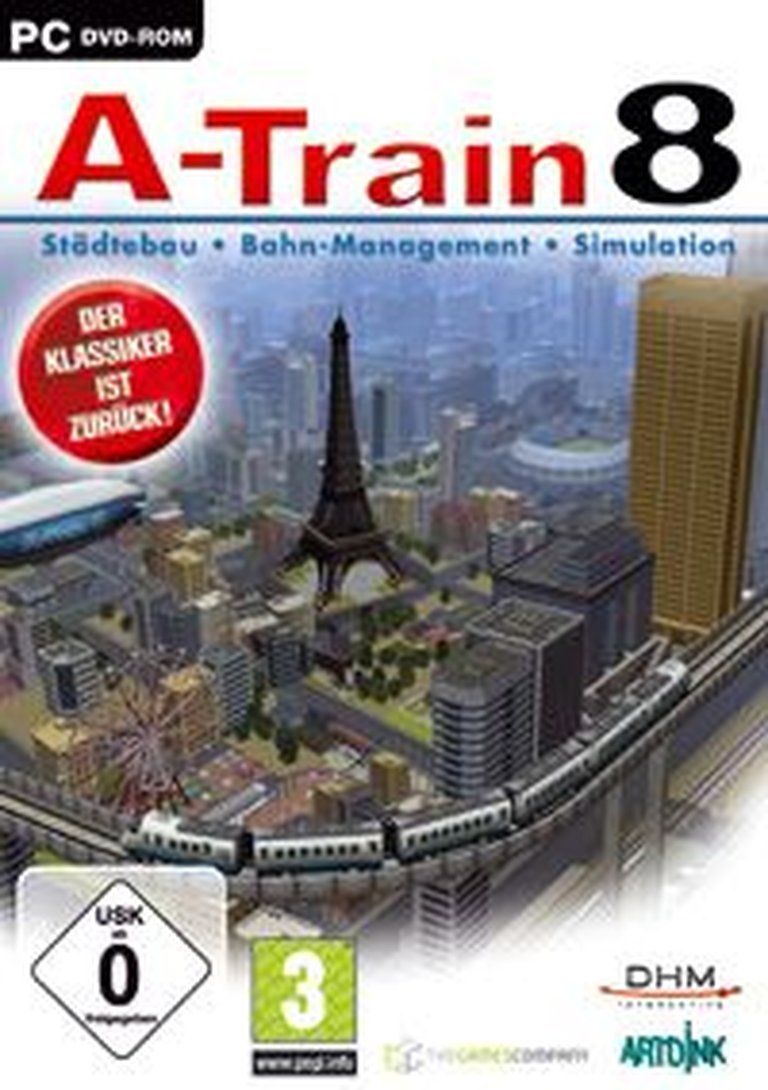
A-Train 8 is a simulation game where you serve as the CEO of a rail company, aiming to create effective mass-transit systems and stimulate urban development by managing train schedules, laying tracks, and investing in properties like hotels and famous landmarks such as Big Ben and the Eiffel Tower. Set in a fully 3D world with adjustable cameras and first-person views, the game combines railroad operations, urban planning, and financial strategy through activities like stock trading and loans across 30 scenarios and a sandbox mode, with the ultimate goal of amassing a trillion monetary units.
Gameplay Videos
Where to Buy A-Train 8
PC
A-Train 8 Patches & Updates
A-Train 8 Guides & Walkthroughs
A-Train 8: Review
Introduction
The A-Train series stands as a venerable pillar in the niche genre of urban development and rail management simulations, debuting in Japan during the 1980s and cultivating a devoted following for its intricate blend of logistics, economics, and city planning. By 2008, the franchise sought to modernize with A-Train 8, a direct evolution of its Xbox 360 predecessor A-TrainHX (2006), aiming to translate its complex systems to the PC platform with full 3D graphics, high-definition support, and expanded features like property speculation and stock market integration. Yet, this ambitious leap faltered dramatically. Despite its pedigree and potential, A-Train 8 emerges as a profoundly flawed entry, crippled by outdated design, poor execution, and a failure to adapt to evolving player expectations. This review argues that A-Train 8 represents a missed opportunity—a simulation that prioritizes bureaucratic minutiae over engaging gameplay, ultimately stalling the franchise’s momentum and alienating both newcomers and longtime enthusiasts.
Development History & Context
- A-Train 8* was developed by Artdink Corporation, a Japanese studio with decades of experience in the series, and co-developed by Degica Co., Ltd. for its Western release. The game was published by multiple entities—including Artdink itself, Mastertronic Games, Bluestone Interactive, and Degica—suggesting a fragmented international push with limited resources. Creators aimed to modernize the series by transitioning from its earlier pseudo-3D or isometric perspectives to a fully 3D environment with adjustable cameras and a first-person “driver’s eye” view, while also supporting resolutions up to 1920×1200. This vision was clearly influenced by the prior Xbox 360 iteration, A-TrainHX, but the leap to PC introduced significant challenges.
Technologically, the game was constrained by an engine that struggled to render convincing 3D environments, resulting in the “blocky graphics” (Klötzchengrafik) criticized by reviewers. In 2008, the simulation genre was crowded with titles like SimCity Societies, Cities XL, and various “tycoon” games, all pushing graphical fidelity and user-friendly interfaces. A-Train 8 felt antiquated even at launch, lacking the polish and accessibility of its competitors. The development team’s insistence on preserving complex, menu-driven mechanics—without adapting them for a broader audience—highlighted a disconnect between the series’ niche appeal and the mainstream expectations of the era. The inclusion of 30 scenarios and a built-in editor demonstrated effort, but without robust underlying systems, these tools felt underutilized.
Narrative & Thematic Deep Dive
- A-Train 8* eschews traditional narrative entirely, presenting itself as a pure sandbox simulator. Yet, its mechanics implicitly weave a tale of capitalist urban development and corporate hubris. The player assumes the role of a railroad CEO, tasked with constructing mass-transit networks to stimulate city growth. This framing positions the player as an invisible hand guiding urban expansion, with trains serving as the circulatory system of commerce—shuttling commuters to offices, workers to factories, and holidaymakers to amusement parks. Freight trains supply building materials for new developments, directly linking transit infrastructure to physical urban sprawl.
Thematically, the game explores the tension between public utility and private profit. The ability to dabble in property markets—building hotels, high-rises, and ski resorts—introduces elements of real estate speculation, where land values rise and fall based on rail access. This mirrors real-world transit-oriented development but lacks any ethical dimension; the player’s sole objective is amassing wealth, symbolized by the absurd goal of accumulating a trillion monetary units. This hyperbolic target satirizes the endless-growth paradigm of capitalism, reducing cities to numerical grids where human needs are secondary to profit margins.
Even the inclusion of famous landmarks like Big Ben and the Eiffel Tower feels detached, serving as aesthetic props rather than narrative anchors. They emphasize a globalized, placeless urbanism, where iconic structures are commodified within a sterile simulation. Without AI-driven citizens or dynamic events, the world feels static and lifeless, reinforcing a theme of top-down control devoid of organic community. The game thus becomes a commentary on—and critique of—urban planning as a dehumanized, spreadsheet-driven endeavor.
Gameplay Mechanics & Systems
The core gameplay loop of A-Train 8 is deceptively simple: lay tracks, establish stations, and schedule trains to transport passengers and freight across a growing city. Passengers demand routes to offices, factories, and leisure destinations, while freight must deliver construction materials to development sites. Seasons and zone types (residential, commercial, industrial) affect demand, requiring players to tweak schedules for optimal profit. This foundational loop is buried under layers of menus and abstractions, lacking the immediacy of more modern simulators.
Beyond railways, players engage in property development, constructing anything from budget hotels to luxury ski resorts. These properties generate revenue and influence surrounding land values, creating a feedback loop where transit access boosts property prices, which in turn fund further expansion. Financial systems add depth: players can take bank loans and invest in a stock market featuring 50 fictional companies, allowing for speculative strategies that can make or break the company’s solvency. The game offers 30 pre-made scenarios with specific objectives, and a built-in editor enables custom map creation, promising longevity through user-generated content.
However, these systems are marred by critical flaws. As noted by GameStar, the game “hat kein Ziel, keine KI, kein Tutorial” (has no goal, no AI, no tutorial). The absence of AI means trains and citizens do not operate autonomously; everything must be micromanaged manually, turning the experience into a tedious chore rather than a dynamic simulation. There are no signals or rail traffic management, leading to potential confusion and inefficiency. The user interface is described as “grausam” (cruel)—opaque and unforgiving, with no guidance for new players. Softpedia observed that the game “bit more than it could chew,” with mechanics that become either boringly repetitive or frustratingly opaque. The stock market and property systems, while ambitious, feel shallow and disconnected from the core rail operations, lacking the strategic depth seen in contemporaries like Railroad Tycoon.
On paper, innovations like the first-person camera mode and full 3D environments suggest progress, but in practice, they add little utility. The first-person view is a novelty that doesn’t enhance management, and the 3D graphics, while technically HD-compliant, are aesthetically underwhelming. The game’s complexity is not matched by accessibility, leaving players to decipher systems through trial and error—a daunting task without a tutorial.
World-Building, Art & Sound
- A-Train 8* presents its world in full 3D with fully adjustable camera angles and zoom levels, a step forward from the series’ earlier 2D or fixed-perspective entries. However, this technical upgrade is undermined by an art style that PC Games derisively labeled as “große ‘Klötzchengrafik'” (crude “block graphics”). Buildings, trains, and landscapes are rendered with simplistic geometries and poor texturing, creating a disjointed, toy-like aesthetic that fails to evoke a living city. Even with HD resolution support up to 1920×1200, the visual fidelity remains stuck in the early 2000s, making the simulation feel dated upon release.
The world’s atmosphere is consequently sterile. Without pedestrian or traffic AI, streets lie empty, and cities lack the bustle expected in urban simulations. Landmarks like Big Ben or the Eiffel Tower appear as isolated models, devoid of contextual integration. This emptiness extends to the sound design, which receives no mention in sources and likely consists of repetitive, generic loops that fail to enhance immersion. Trains emit basic noises, but there’s no ambient city soundscape—no chatter, traffic, or environmental cues that would make the world feel alive.
These elements combine to create a presentation that actively hinders engagement. The blocky visuals make it difficult to distinguish between zone types or assess city layouts at a glance, while the lack of audio feedback strips away sensory immersion. The game feels like a spreadsheet with 3D wallpaper, not a vibrant urban ecosystem. This disconnect between mechanical depth and artistic execution is central to A-Train 8‘s failures; its world-building is purely functional, offering no emotional or aesthetic payoff.
Reception & Legacy
- A-Train 8* was met with largely negative reception upon release. Critic scores hovered at a dismal 46% average: PC Games (Germany) awarded 63%, Softpedia 50%, and GameStar a scathing 26%. Player ratings mirrored this sentiment, averaging just 2.2 out of 5 on MobyGames, with no written reviews indicating profound player apathy. Reviews universally condemned the game’s regressive design. GameStar’s verdict—”Seit 1992 hat sich nichts getan” (Since 1992, nothing has changed)—encapsulates the feeling that the series had stagnated, failing to evolve beyond its 16-bit roots. Critics highlighted the absence of AI, signals, and a tutorial, coupled with “grausame” (cruel) controls and repetitive gameplay. Softpedia noted that while brief moments of entertainment existed, the game ultimately frustrated with its poor mechanics.
Commercially, the title’s performance is not explicitly documented, but the low review scores and multiple Western publishers suggest modest sales, likely limited to series devotees. Its legacy is one of caution. The A-Train series continued with The Train Giant (2010) and later A-Train Exp. (2017), indicating that A-Train 8 did not irrevocably damage the franchise but served as a low point from which to rebound. In the broader industry, its influence is negligible; simulation games had already moved toward more accessible, AI-driven experiences like Cities: Skylines (2015), which learned from such missteps by prioritizing player-friendly design and vibrant worlds. A-Train 8 is now remembered mostly as a footnote—a example of how even established franchises can falter when they neglect core gameplay and presentation.
Conclusion
- A-Train 8* is a simulation stranded on the rails of its own ambition. It attempts to modernize a classic formula with 3D graphics and expanded economic systems but collapses under the weight of its own design flaws. The absence of AI, a tutorial, and functional controls transforms what could be a deeply engaging urban management experience into a frustrating, repetitive chore. Its blocky visuals and sterile sound design fail to create an immersive world, while the narrative-free sandbox offers little thematic resonance beyond a shallow celebration of capitalist growth.
For historians, A-Train 8 serves as a instructive case study in the perils of stagnation: a series that rested on its laurels, only to find its mechanics outdated and its audience dwindling. It is not without merits—the property and stock market systems hint at deeper strategic layers, and the scenario editor empowers creative players—but these are overshadowed by systemic issues. Ultimately, A-Train 8 is recommended only for die-hard fans of the series willing to overlook its considerable faults. For everyone else, it stands as a phantom of what could have been—a train that never left the station.