
- Release Year: 2010
- Platforms: iPad, iPhone, Macintosh, Windows
- Publisher: Anuman Interactive SA, Big Fish Games, Inc, Mastertronic Games Ltd., S.A.D. Software Vertriebs- und Produktions GmbH
- Developer: Mzone Studio, Solilab
- Genre: Adventure
- Perspective: 1st-person
- Game Mode: Single-player
- Gameplay: Hidden object, Mini-games, Puzzle elements
- Setting: City – Paris, Country – France, Europe, Horror
- Average Score: 25/100
Description
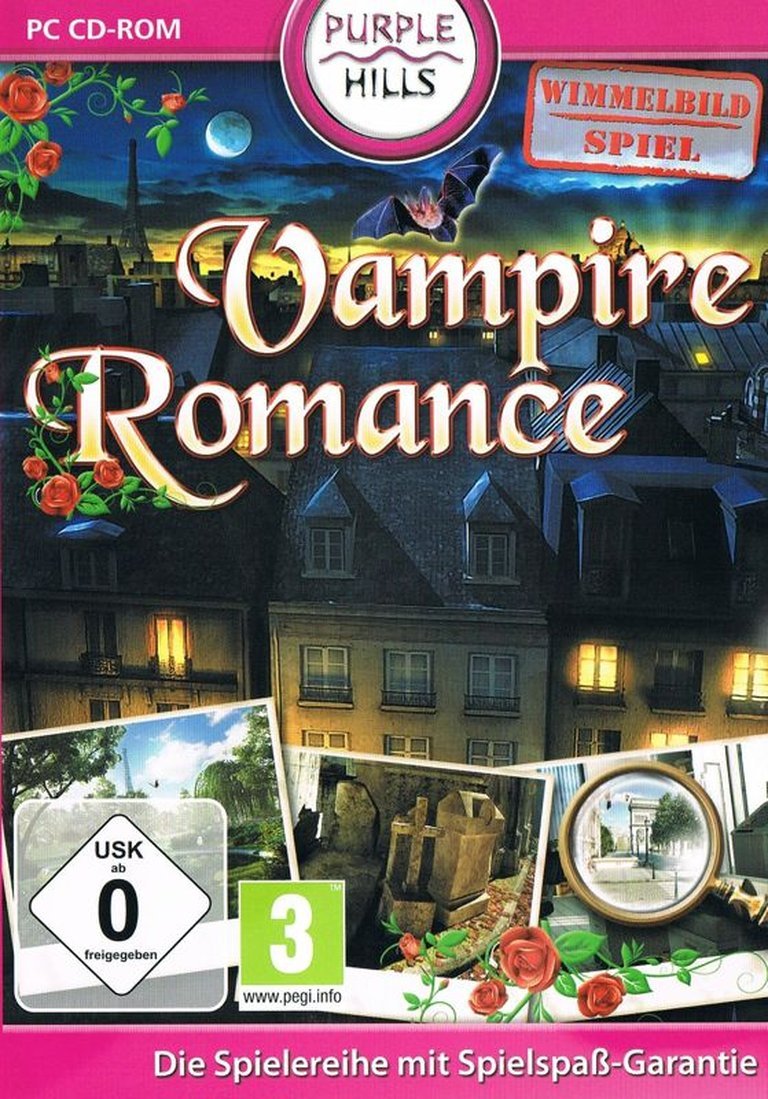
A Vampire’s Romance: Paris Stories is an adventure and hidden object game set in Paris, where players must uncover the mystery of Uriel, a vampire who has vanished in the city. The game features over 40 locations across Paris, blending hidden object puzzles and mini-games to progress the story. With a zoom function to aid in object discovery and two gameplay modes—Classic and Time Attack—players explore a gothic narrative filled with horror and romance, all while solving puzzles to unravel Uriel’s secrets.
Gameplay Videos
A Vampire’s Romance: Paris Stories Cracks & Fixes
A Vampire’s Romance: Paris Stories Patches & Updates
A Vampire’s Romance: Paris Stories Guides & Walkthroughs
A Vampire’s Romance: Paris Stories Reviews & Reception
mobygames.com (25/100): A mix of an adventure and a hidden object game.
shiningjewels.wordpress.com : A great game for vampire fans, but really tricky with repetitive mini-games.
A Vampire’s Romance: Paris Stories Cheats & Codes
PC (v1.3)
Use the following function keys during gameplay.
| Code | Effect |
|---|---|
| F1 | No Item Cooldown |
| F2 | Super Stealth Mode |
| F3 | Edit Combat Leadership |
| F4 | Maximum Crew Skill Level |
| F5 | Unlimited Career |
PC (v1.131)
Use the following function keys during gameplay.
| Code | Effect |
|---|---|
| F2 | Toggle Infinite Hints |
| F3 | Toggle Instant Hints |
| F4 | Toggle Infinite Time |
A Vampire’s Romance: Paris Stories: A Forgotten Relic of the Hidden Object Era
Introduction: The Twilight of a Subgenre
A Vampire’s Romance: Paris Stories (2010) is a relic of a bygone era in casual gaming—a time when hidden object games (HOGs) flooded digital storefronts, promising romantic intrigue, supernatural mysteries, and pixel-hunting adventures. Developed by Mzone Studio and published by Anuman Interactive, this title is a curious amalgamation of Twilight-inspired vampire romance, tourist-brochure Parisian aesthetics, and the mechanical tedium of early 2010s casual gaming. While it has faded into obscurity, its existence offers a fascinating case study in the commercialization of niche genres, the limitations of budget development, and the cultural fascination with vampires in the late 2000s.
This review will dissect A Vampire’s Romance: Paris Stories with surgical precision, examining its development context, narrative ambitions, gameplay mechanics, and the reasons behind its critical and commercial failure. By the end, we’ll determine whether it deserves its place in the dustbin of gaming history—or if there’s a forgotten spark beneath its flawed execution.
Development History & Context: The Casual Game Gold Rush
The Rise of Anuman Interactive and the Hidden Object Boom
Anuman Interactive, a French studio founded in 2000, cut its teeth on adventure games like Siberia and Post Mortem before pivoting to the lucrative casual market in the late 2000s. The studio recognized the financial potential of hidden object games (HOGs), a subgenre that exploded in popularity thanks to titles like Mystery Case Files (2005) and Hidden Expedition (2006). These games were cheap to produce, easy to market, and perfectly suited for the burgeoning digital distribution platforms like Big Fish Games and iOS App Store.
A Vampire’s Romance: Paris Stories was part of Anuman’s strategy to capitalize on two trends:
1. The Vampire Craze: Following the success of Twilight (2005–2008) and True Blood (2008–2014), vampires were everywhere in pop culture. Anuman saw an opportunity to blend Gothic romance with casual gameplay.
2. The “Travelogue” HOG: Games like Romance of Rome (2009) proved that players enjoyed virtual tourism. Paris, with its iconic landmarks, was a natural setting.
Technological Constraints and Design Philosophy
Released in June 2010, A Vampire’s Romance was built with the technical limitations of its time:
– Engine: A proprietary 2D engine with pre-rendered backgrounds and basic animations.
– Platforms: Initially launched on Windows, with subsequent ports to iOS (iPhone/iPad) and Macintosh in 2010–2011.
– Hardware Requirements: A modest Pentium 4 1 GHz, 512 MB RAM, and a GeForce 6800 GPU—reflecting the low-end specs of casual games.
The development team, led by Christophe Leclerc (game designer) and Julien Brard (level designer), prioritized:
– Accessibility: Two game modes (Classic and Time Attack) to cater to both relaxed and competitive players.
– Replayability: A scoring system and online leaderboards (though these features were poorly implemented).
– Atmosphere: Hand-drawn backgrounds and a zoom function to enhance immersion.
However, the game’s short development cycle (likely under a year) and budget constraints resulted in a product that felt rushed and unpolished.
The Gaming Landscape in 2010
2010 was a transitional year for gaming:
– Casual Games: HOGs were peaking, but the market was becoming oversaturated. Players were growing tired of formulaic designs.
– Indie Revolution: Games like Limbo and Super Meat Boy were redefining indie creativity, making A Vampire’s Romance feel antiquated by comparison.
– Mobile Gaming: The iPhone 4 (released June 2010) was pushing mobile games toward more sophisticated experiences. A Vampire’s Romance’s iOS port arrived just as players were expecting more than static hidden object scenes.
In this context, A Vampire’s Romance was doomed to be a forgotten footnote—a game that followed trends rather than setting them.
Narrative & Thematic Deep Dive: A Love Story Without Bite
Plot Summary: Twilight in Paris
The game follows Leila Saraostre, a young art student who moves to Paris to attend the Louvre’s Academy of Fine Arts. On her first day, she meets Uriel Ruthven, a brooding, mysterious young man who introduces her to the city’s hidden charms. Their whirlwind romance is cut short when Uriel vanishes, prompting Leila to uncover his dark secret: he’s a vampire.
The narrative unfolds across 40 Parisian locations, from the Seine Riverbanks to the Catacombs, as Leila pieces together Uriel’s past and confronts the supernatural underworld lurking beneath the City of Light.
Character Analysis: Flat Archetypes in a Gothic Postcard
- Leila Saraostre: A bland, passive protagonist whose personality extends little beyond “curious art student.” Her motivations are weak—she falls in love with Uriel after a single encounter, and her quest lacks urgency.
- Uriel Ruthven: A Twilight-era vampire—mysterious, handsome, and emotionally distant. His backstory (revealed in fragmented notes) is clichéd, involving ancient curses and tragic love.
- Supporting Cast: Mostly forgettable NPCs, including a grocery store clerk and art professors, who exist solely to deliver exposition or mini-game prompts.
Themes: Love, Isolation, and the Illusion of Depth
The game attempts to explore:
1. Forbidden Love: The central romance is tame by modern standards, lacking the tension or chemistry of better vampire narratives.
2. The Duality of Paris: The city is portrayed as both romantic (Eiffel Tower, Montmartre) and sinister (Catacombs, back alleys). However, this contrast is superficial—Paris serves as little more than a pretty backdrop.
3. Art and Obsession: Leila’s artistic aspirations are underdeveloped. The game’s art class mini-games (more on these later) are frustrating rather than insightful.
Dialogue and Writing: Lost in Translation
The script suffers from:
– Stilted Dialogue: Lines like “Uriel, where are you? I must find you!” feel lifted from a bad fanfiction.
– Poor Localization: The English translation is riddled with awkward phrasing, likely due to the game’s French origins.
– Lack of Agency: Leila rarely makes meaningful choices. The story progresses linearly, with no branching paths or moral dilemmas.
Verdict: A Missed Opportunity
A Vampire’s Romance had the potential to be a Gothic love letter to Paris, blending romance, horror, and adventure. Instead, it’s a shallow, mechanically driven experience where narrative takes a backseat to object-hunting. The vampire angle feels tacked on, serving as little more than a marketing hook.
Gameplay Mechanics & Systems: The Grind of Hidden Objects
Core Gameplay Loop: Find, Click, Repeat
The game is structured around three primary activities:
1. Hidden Object Scenes: Players search cluttered environments for items listed at the bottom of the screen.
2. Mini-Games: Puzzle interludes, including art class challenges, code-breaking, and metro navigation.
3. Exploration: Moving between Parisian locations via a metro map (a unique but underutilized mechanic).
Hidden Object Mechanics: The Good, the Bad, and the Ugly
Pros:
– Zoom Function: Allows players to inspect areas more closely, a rare feature in 2010 HOGs.
– Bonus Stars: Hidden in scenes, these grant extra hints or time—a clever risk-reward system.
Cons:
– Repetitive Design: Most scenes are static images with superimposed objects, leading to visual fatigue.
– Unintuitive Object Placement: Some items are practically invisible, requiring pixel-hunting.
– Limited Interactivity: Unlike later HOGs (e.g., Dark Parables), there’s no environmental interaction beyond clicking.
Mini-Games: From Tedious to Infuriating
The game includes a dozen mini-games, most of which are poorly designed:
– Art Class Challenges: Players must recreate paintings by clicking in the correct order. One mistake = restart, making these segments punishingly difficult.
– Metro Navigation: A unique idea—players use a real Paris metro map to travel—but it’s underutilized and feels like a chore.
– Code-Breaking Puzzles: Simple cipher puzzles that add little depth.
Progression and Difficulty: A Broken Curve
- Two Modes:
- Classic Mode: Untimed, but still frustrating due to unclear objectives.
- Time Attack: Adds pressure but doesn’t fix the core issues.
- Hints System: Initially generous (9 hints), but stars are scarce, leading to unnecessary backtracking.
- No Meaningful Rewards: Completing scenes yields no tangible progression—just more of the same.
UI and Controls: Clunky and Outdated
- Inventory System: Basic and unintuitive. Items are often used automatically, removing player agency.
- Metro Map: A cool idea, but poorly explained. Many players will get lost.
- Save System: Three save slots, but no autosave—a baffling omission.
Innovation? None to Speak Of
A Vampire’s Romance brings nothing new to the HOG genre. Even its Parisian setting feels wasted—the city could be any generic European locale. The vampire theme is similarly underdeveloped, with no mechanics tied to supernatural abilities or Gothic horror.
World-Building, Art & Sound: Paris as a Postcard
Setting: A Tourist’s Paris
The game’s greatest strength—and weakness—is its setting. Paris is rendered as a romanticized tourist destination, with locations like:
– Montmartre (bohemian charm)
– Père Lachaise Cemetery (Gothic atmosphere)
– The Catacombs (attempted horror)
– The Seine Riverbanks (clichéd romance)
However, these locations are devoid of life. There are no NPCs to interact with, no dynamic events, and no sense of a living city. Paris feels like a series of painted dioramas.
Visual Design: Hand-Drawn but Soulless
- Art Style: The game uses pre-rendered 2D backgrounds with hand-drawn aesthetics. While technically competent, the art lacks personality.
- Character Models: Leila and Uriel are stiffly animated, with minimal facial expressions.
- Lighting and Atmosphere: The Catacombs and cemetery scenes attempt a dark ambiance, but the bright, cartoonish colors undermine the tone.
Sound Design: A Missed Opportunity
- Music: Composed by Pierre Gerwig Langer, the soundtrack is forgettable. The main theme (“Benediction”) is a generic orchestral piece that fails to evoke romance or horror.
- Ambient Sounds: The ticking clock in one scene is annoying, and the lack of environmental audio (e.g., street noises, whispers) makes Paris feel empty.
- Voice Acting: Nonexistent. All dialogue is text-based, further distancing players from the story.
Verdict: A Pretty but Hollow Facade
The game’s visuals and setting are its most marketable features, but they fail to immerse the player. Paris should feel alive, mysterious, and seductive—instead, it’s a static museum exhibit.
Reception & Legacy: A Critical and Commercial Flop
Critical Reception: A 25% Metacritic Bomb
The game’s only professional review (from Galactic Pillow) awarded it a 25% score, calling it:
“Easily one of the worst experiences I have had the displeasure of enduring.”
Key criticisms included:
– Repetitive, uninspired gameplay
– A nonsensical, abrupt ending
– No replay value
– Not worth even $0.99
Player scores on MobyGames (1.4/5) and Metacritic (no user reviews) suggest a similar disdain.
Commercial Performance: Lost in the Crowd
- No sales figures are available, but given its lack of marketing and poor reception, it likely underperformed.
- The game was bundled with other Anuman titles (e.g., Hidden Mysteries: Vampire Secrets), suggesting it was not a standalone success.
Legacy: A Footnote in HOG History
A Vampire’s Romance had no lasting impact on the genre. It didn’t inspire imitators, nor did it evolve the HOG formula. Its only legacy is as a cautionary tale about:
– Chasing trends (vampires, Paris) without substance.
– Prioritizing mechanics over narrative.
– The dangers of oversaturating a market.
Influence on Later Games: None
Unlike Mystery Case Files or Dark Parables, A Vampire’s Romance left no discernible mark on later HOGs. Even Anuman Interactive moved on, focusing on licensed properties (e.g., Agatha Christie games) rather than original IPs.
Conclusion: A Game Best Left in the Shadows
A Vampire’s Romance: Paris Stories is a flawed relic of the early 2010s casual gaming boom. It had the ingredients for something special—a Gothic romance, a iconic setting, and a supernatural twist—but executed none of them well.
Final Verdict: 2/10 – A Forgettable Misstep
What It Does Well:
– Unique metro navigation system (though underutilized).
– Zoom function (a rare feature in 2010 HOGs).
– Parisian aesthetics (visually pleasant, if shallow).
Where It Fails:
– Repetitive, tedious gameplay.
– Shallow narrative and characters.
– Poorly designed mini-games.
– No innovation or lasting appeal.
Who Might Enjoy It?
- Die-hard HOG completionists looking for obscure titles.
- Twilight fans who want a low-stakes vampire fix.
- Paris enthusiasts who enjoy virtual tourism (despite the lack of depth).
Who Should Avoid It?
- Anyone expecting a meaningful story.
- Players who dislike pixel-hunting.
- Fans of modern adventure games (this feels archaic by today’s standards).
Final Thoughts: A Game That Didn’t Deserve to Be Forgotten—But Did
A Vampire’s Romance: Paris Stories is not a good game, but it’s a fascinating artifact of its time. It represents the worst excesses of the casual gaming boom—formulaic, shallow, and cynically designed to cash in on trends.
Yet, in its failure, it teaches us something important: Great settings and themes mean nothing without strong mechanics and storytelling. Paris deserves better. Vampires deserve better. And players deserve better.
Final Score: 2/10 – “A Beautiful Postcard with Nothing Written on the Back.”
Would you like a follow-up analysis comparing this to other vampire-themed HOGs like Dark Romance or Vampire Saga? Let me know!