
- Release Year: 2008
- Platforms: Windows
- Publisher: Crimson Cow GmbH
- Genre: Special edition
- Game Mode: Single-player
- Average Score: 76/100
Description
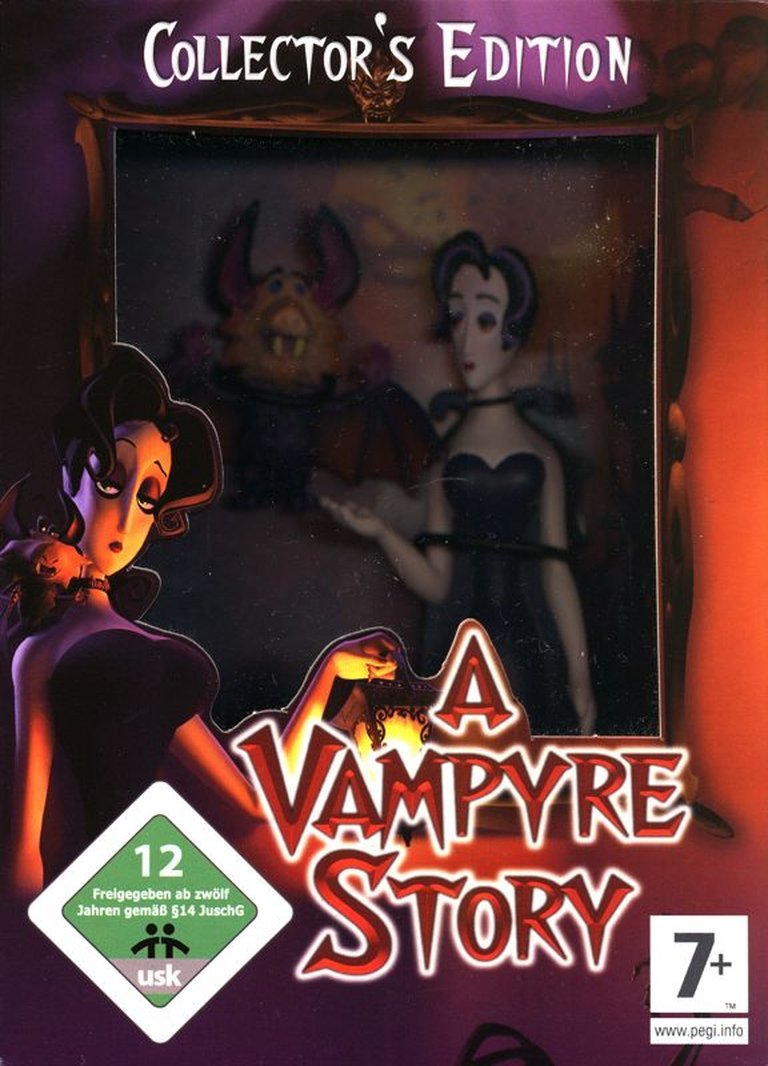
A Vampyre Story (Collector’s Edition) is a point-and-click adventure game set in 1890s Europe, following Mona De Lafitte, a young opera singer turned vampire, as she navigates her new undead life while trying to return to Paris to pursue her dreams of fame. With the help of her sarcastic bat companion, Froderick, Mona must use her supernatural abilities to solve puzzles and overcome challenges in Castle Warg and the town of Vlad’s Landing. The game features a distinctive art style and gameplay reminiscent of classic LucasArts adventures, blending humor, gothic themes, and a unique twist on vampire lore.
A Vampyre Story (Collector’s Edition) Cracks & Fixes
A Vampyre Story (Collector’s Edition) Patches & Updates
A Vampyre Story (Collector’s Edition) Guides & Walkthroughs
A Vampyre Story (Collector’s Edition) Reviews & Reception
metacritic.com (74/100): A Vampyre Story is reminiscent of the glory days of LucasArts and comes equipped with an awesome amount of humour.
steamcommunity.com (80/100): A Vampyre Story is a 2008 horror comedy graphic adventure set in Europe during the 1890s, and follows a young female opera singer, recently turned vampire named Mona with her trusty sidekick bat companion Froderick as they attempt to make the journey back home to Paris.
mobygames.com (77/100): This game manages to be its own adventure but also look something like a Broken Sword and Monkey Island game in one fun package.
ign.com (76/100): From a development staff made wholly of former LucasArts adventure gaming gurus comes this frightful and fantastical point-and-click adventure game.
A Vampyre Story (Collector’s Edition): A Gothic Comedy Masterpiece or a Flawed Gem?
Introduction
A Vampyre Story (Collector’s Edition) is a 2008 point-and-click adventure game that stands as both a love letter to the golden age of LucasArts and a bold attempt to revitalize the genre with a gothic twist. Developed by Autumn Moon Entertainment, a studio founded by former LucasArts artist Bill Tiller, the game follows Mona De Lafitte, a Parisian opera singer turned vampire, as she escapes her captor and embarks on a journey back to Paris. The Collector’s Edition, released alongside the base game, includes a soundtrack, figurines, and other physical extras, making it a coveted item for fans of the genre.
This review will delve into the game’s development history, narrative depth, gameplay mechanics, artistic and auditory design, critical reception, and lasting legacy. By examining these elements, we aim to determine whether A Vampyre Story is a masterpiece of gothic comedy or a flawed gem that never quite reached its full potential.
Development History & Context
The Birth of Autumn Moon Entertainment
A Vampyre Story was born from the creative vision of Bill Tiller, a veteran of LucasArts who had worked on iconic titles like The Curse of Monkey Island and The Dig. After leaving LucasArts, Tiller founded Autumn Moon Entertainment in 2002 with the goal of creating independent adventure games that captured the spirit of the classics while innovating within the genre. The studio’s first major project, A Vampyre Story, was announced in 2004 and quickly garnered attention as the winner of The Inventory magazine’s “Most-Awaited Adventure Game” award.
A Troubled Development Cycle
The game’s development was far from smooth. Initially slated for a Halloween 2006 release, A Vampyre Story faced significant delays due to publisher instability. The original publisher, Bad Brain Entertainment, abruptly ended their partnership with Autumn Moon in April 2005, leaving the project in limbo. Tiller and his small team persevered, working with minimal staff to keep costs low while searching for a new publisher. In July 2006, Crimson Cow, a Hamburg-based publisher, stepped in, and full production resumed with an expected 2007 release date. However, further delays pushed the game’s launch to late 2008.
Technological and Creative Challenges
The game’s development was marked by both technological and creative challenges. Autumn Moon opted to use the open-source Panda3D engine to render the game’s hand-drawn 2D backgrounds and 3D character animations. This choice allowed for efficient rendering of the game’s intricate environments and smooth character movements, but it also required significant prototyping to ensure seamless integration of Mona’s supernatural abilities, such as her bat transformation, into the gameplay.
The game’s distinctive spelling of “vampire” as “vampyre” was a deliberate nod to John Polidori’s 1819 novella The Vampyre, the first major Western vampire fiction. This choice underscored the game’s homage to gothic literature and its desire to carve out a unique identity within the adventure game genre.
The Gaming Landscape of 2008
A Vampyre Story was released in a gaming landscape dominated by high-profile titles like Spore and Grand Theft Auto IV. The adventure game genre, once a staple of the industry, had waned in popularity, making it a niche product. Despite this, the game’s release was met with anticipation from fans of the genre, who saw it as a potential revival of the classic point-and-click adventure.
Narrative & Thematic Deep Dive
Plot Summary
The game’s narrative follows Mona De Lafitte, a talented opera singer from Paris who is kidnapped and transformed into a vampire by the obsessive Baron Shrowdy von Kiefer. After being held captive in Castle Warg for a year, Mona seizes an opportunity to escape when the Baron is killed by vampire hunters. With the help of her sarcastic bat companion, Froderick, Mona embarks on a journey to return to Paris and resume her singing career. Along the way, she must navigate the eerie landscapes of Draxsylvania, encountering a cast of eccentric characters and overcoming supernatural challenges.
Themes and Motifs
A Vampyre Story explores several themes, including the struggle for identity, the acceptance of one’s true nature, and the power of friendship. Mona’s journey is not just a physical one but also an emotional and psychological one, as she grapples with her newfound vampiric abilities and the societal expectations placed upon her as a woman in the 19th century.
The game’s gothic setting and supernatural elements are used to explore these themes in a humorous and often absurd manner. The contrast between Mona’s refined Parisian sensibilities and the grotesque, supernatural world of Draxsylvania creates a rich tapestry of comedy and horror.
Character Analysis
Mona De Lafitte is a compelling protagonist, embodying both the elegance of a Parisian opera singer and the ferocity of a vampire. Her character is defined by her determination to return to Paris and her reluctance to fully embrace her vampiric nature. This internal conflict drives much of the game’s narrative and adds depth to her character.
Froderick, Mona’s bat companion, serves as both a source of comic relief and a loyal friend. His sarcastic wit and playful antics provide a counterbalance to Mona’s more serious demeanor, creating a dynamic and engaging duo.
The game’s supporting cast is equally memorable, with characters like the Baroness Vasilia von Kiefer, the eccentric inhabitants of Castle Warg, and the quirky villagers of Vlad’s Landing adding richness and variety to the narrative.
Dialogue and Writing
The game’s dialogue is a standout feature, blending humor, wit, and gothic charm. Mona and Froderick’s interactions are particularly noteworthy, with their playful banter and sarcastic remarks providing much of the game’s comedic relief. The writing is sharp and clever, with a keen eye for detail and a deep understanding of the adventure game genre’s conventions.
However, the game’s humor is not without its critics. Some players found the jokes to be hit-or-miss, with certain lines falling flat or feeling out of place. Despite this, the overall quality of the writing is high, with a strong emphasis on character development and narrative cohesion.
Gameplay Mechanics & Systems
Core Gameplay Loop
A Vampyre Story employs a classic point-and-click interface, with a context-sensitive radial cursor that allows players to interact with the game’s environment. The core gameplay loop revolves around exploring locations, solving puzzles, and engaging in dialogue with characters. The game’s puzzles are designed to be challenging but fair, with a strong emphasis on logical deduction and environmental interaction.
Vampire Abilities and Puzzle Design
One of the game’s most innovative features is its integration of Mona’s vampiric abilities into the puzzle design. As the game progresses, Mona learns to use her powers, such as turning into a bat, hypnotizing characters, and draining blood, to overcome obstacles and progress through the narrative. These abilities are not just gimmicks but are integral to the game’s puzzle-solving mechanics, adding a layer of depth and complexity to the gameplay.
The game’s puzzles are varied and creative, ranging from traditional item combination challenges to more complex, multi-step puzzles that require careful planning and execution. The inclusion of a hint system, accessible via the Tab key, helps to guide players through particularly tricky sections, ensuring that the game remains accessible to both novice and veteran adventure gamers.
Inventory and Interaction Systems
The game’s inventory system is unique, allowing players to “remember” items rather than carrying them around. This system is both realistic and practical, as it prevents the inventory from becoming cluttered with unnecessary items. The interaction system is similarly streamlined, with a radial menu that displays available actions and abilities when clicking on interactive objects.
Technical Issues and Limitations
Despite its strengths, A Vampyre Story is not without its technical issues. The game’s original release was plagued by bugs and compatibility problems, particularly on modern operating systems. These issues were later addressed in a 2023 re-release on Steam, which included compatibility fixes and additional localizations. However, the game’s lack of native widescreen support and controller compatibility remain notable limitations.
World-Building, Art & Sound
Setting and Atmosphere
A Vampyre Story is set in a fictionalized version of 19th-century Europe, with a particular focus on the gothic landscapes of Draxsylvania. The game’s setting is richly detailed, with a strong emphasis on atmospheric storytelling. The eerie, mist-shrouded landscapes of Castle Warg and the quaint, supernatural-infused village of Vlad’s Landing create a sense of immersion and wonder.
The game’s art direction is heavily influenced by the works of Edward Gorey, with a strong emphasis on intricate line work, shadowy palettes, and gothic aesthetics. The hand-drawn 2D backgrounds are beautifully rendered, with a multi-plane camera technique that adds depth and dimension to the environments. The character animations are similarly impressive, with smooth, fluid movements that bring the game’s cast to life.
Sound Design and Music
The game’s soundtrack, composed by Pedro Macedo Camacho, is a standout feature, blending orchestral gothic elements with operatic influences. The music is haunting and atmospheric, with a strong emphasis on emotional depth and narrative cohesion. The soundtrack includes soprano vocals by Carla Isabel Moniz and violin solos by Carlos Freitas, adding a layer of lyrical elegance to the game’s auditory experience.
The sound design is similarly impressive, with a strong emphasis on environmental audio and character voice acting. The game’s voice cast delivers strong performances, with Rebecca Schweitzer’s portrayal of Mona De Lafitte being particularly noteworthy. The dialogue is well-written and well-delivered, with a keen eye for comedic timing and emotional resonance.
Reception & Legacy
Critical Reception
A Vampyre Story received mixed to positive reviews upon its release, with critics praising its charming visuals, humorous tone, and innovative puzzle design. The game’s Metacritic score of 74 out of 100 reflects its status as a competent but unremarkable entry in the adventure game genre. Critics highlighted the game’s strengths in its visual presentation and lighthearted humor, often comparing it favorably to LucasArts classics for its whimsical vampire-themed world and high-quality voice acting.
However, the game was not without its detractors. Some critics found the puzzles to be too straightforward, the humor to be hit-or-miss, and the narrative to lack depth. The game’s technical issues, particularly its compatibility problems on modern systems, were also a point of contention.
Commercial Performance
Despite its critical reception, A Vampyre Story was a commercial disappointment, selling between 30,000 and 35,000 copies, well short of the expected 80,000 units. The game’s niche appeal and limited marketing efforts contributed to its underwhelming sales, making it a financial challenge for Autumn Moon Entertainment and its publisher, Crimson Cow.
Legacy and Influence
Despite its commercial struggles, A Vampyre Story has developed a cult following among adventure game enthusiasts. The game’s unique blend of gothic horror, comedic storytelling, and innovative puzzle design has earned it a place in the hearts of fans of the genre. The game’s legacy is further cemented by its influence on subsequent titles, such as Duke Grabowski: Mighty Swashbuckler!, which adopted similar comedic and artistic approaches.
The game’s planned sequel, A Vampyre Story 2: A Bat’s Tale, was announced in 2009 but faced significant delays due to budgetary and legal issues. In 2024, the sequel was revived through a partnership between Autumn Moon Entertainment and Tag of Joy, with a release expected in 2025 or later. The game’s prequel, A Vampyre Story: Year One, was also announced but ultimately canceled due to an unsuccessful Kickstarter campaign.
Conclusion
A Vampyre Story (Collector’s Edition) is a flawed but fascinating entry in the adventure game genre. Its blend of gothic horror, comedic storytelling, and innovative puzzle design makes it a standout title, despite its technical limitations and commercial struggles. The game’s legacy is a testament to the enduring appeal of the adventure game genre and the creative vision of its developers.
While A Vampyre Story may not have achieved the commercial success or critical acclaim of its LucasArts predecessors, it remains a beloved title among fans of the genre. Its unique blend of humor, horror, and heart makes it a game worth experiencing, particularly for those who appreciate the artistry and craftsmanship of classic adventure games.
In the end, A Vampyre Story is a testament to the power of creativity and the enduring appeal of the adventure game genre. It may not be a masterpiece, but it is a gem—a flawed, fascinating, and ultimately unforgettable gem.