
- Release Year: 2010
- Platforms: Windows
- Publisher: Big Fish Games, Inc
- Genre: Compilation
- Game Mode: Single-player
- Gameplay: Hidden object, Puzzle
- Average Score: 60/100
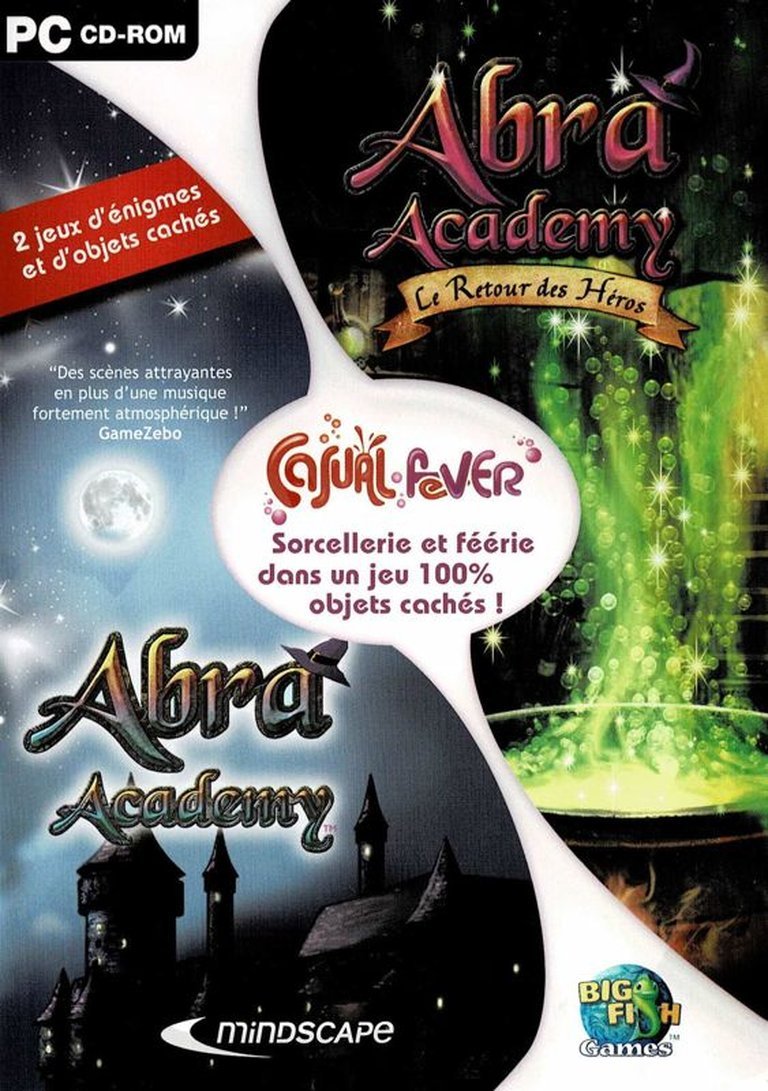
Description
This compilation contains two hidden object puzzle games set in a magical academy, where players assist students and staff by finding enchanted items, solving magical puzzles, and progressing through mystical challenges to restore harmony at the academy.
Gameplay Videos
Abra Academy / Abra Academy: Returning Cast Reviews & Reception
gamezebo.com (60/100): Abra Academy: Returning Cast is an average hidden object game that doesn’t do much to push the genre forward.
Abra Academy / Abra Academy: Returning Cast: Review
Introduction
In the golden age of casual PC gaming, few genres captivated audiences like the hidden-object puzzle game. Among its most charming yet underappreciated entries is the 2010 compilation Abra Academy / Abra Academy: Returning Cast, bundling the original 2007 title and its sequel into a magical school-themed adventure. Developed by BrutoMemo Entertainment and published by Big Fish Games, this duo invites players to step into the shoes of Wanda, a graduate witch investigating strange intrusions at her alma mater. While its whimsical premise and accessible gameplay initially promise delightful escapism, a closer examination reveals a product emblematic of its era—competent yet formulaic, charming yet constrained. This review deconstructs the legacy of these titles, arguing that they represent a microcosm of mid-2000s casual gaming: technically polished but creatively derivative, offering fleeting joy without lasting innovation.
Development History & Context
The Abra Academy series emerged from BrutoMemo Entertainment, a studio specializing in accessible puzzle games for burgeoning digital distribution platforms. Its 2007 debut and the sequel Returning Cast (released October 12, 2007) arrived during the hidden-object genre’s commercial zenith, fueled by Big Fish Games’ dominance in the downloadable space. The developers, led by producers Colin Kastner and Mario Russo (who also served as lead artist), envisioned a lighthearted alternative to darker mystery-themed titles like Mystery Case Files. Their goal was simple: create family-friendly, school-based adventures with a focus on visual clarity and gentle challenge.
Technologically, the games leveraged the Asphyre Sphinx engine, a then-modern middleware solution enabling detailed 2D environments with smooth animations. This choice reflected the era’s constraints: hidden-object games prioritized asset density over graphical fidelity, favoring crisp, scalable art for low-end PCs. The gaming landscape was saturated with similar releases, making innovation a luxury. Consequently, Abra Academy and its sequel adhered closely to established tropes, with BrutoMemo’s primary contribution being a consistent, cohesive aesthetic. Reflexive Entertainment’s involvement in the initial Returning Cast distribution further cemented its status as a niche, digitally native product—precisely the kind of title Big Fish Games excelled at marketing to its subscriber base.
Narrative & Thematic Deep Dive
The narrative of Abra Academy: Returning Cast is a study in playful simplicity. The plot hinges on a straightforward crisis: mysterious green creatures invade Abra Academy, disrupting classes and terrifying students. Wanda, now a fully trained witch, returns with her friends—presumably including familiar faces from the first game—to investigate. The story unfolds through rudimentary comic-book cutscenes and dialogue snippets, establishing urgency without depth. Antagonists remain unnamed and faceless, serving as mere obstacles rather than developed characters. The central mystery—why the creatures are attacking—is resolved perfunctorily, with no twists or emotional payoff.
Thematically, the game leans into nostalgia and safety. The academy functions as a metaphor for childhood innocence, threatened by chaotic external forces. Creatures represent disorder, while Wanda embodies order through her problem-solving skills. Dialogue reinforces this binary, with characters expressing fear (“The children are frightened!”) and reassurance (“Together, we’ll restore peace!”). Yet the narrative never explores tension; the threat is neutralized efficiently, reinforcing a sanitized worldview. The first Abra Academy similarly framed its story around Wanda’s student days, but the sequel’s lack of thematic evolution highlights its formulaic approach. It’s a tale of restoration, not revelation—perfect for a casual audience but intellectually thin.
Gameplay Mechanics & Systems
At its core, Abra Academy: Returning Cast is a hidden-object game, executed with genre-standard mechanics. Each of the 25 levels presents a cluttered scene (e.g., a Dragon’s Lair, Physics Lab) and a list of 10–15 items to locate within a time limit. Clicking an object highlights it, with sound effects confirming success. The progression is linear, with story scenes punctuating level transitions.
Key systems include:
– Hint Mechanic: A crystal ball icon grants location-based hints, but penalizes overuse with a gargoyle that reduces time. This punitive design encourages careful strategy but feels arbitrary.
– Matchstick Collection: Scattered matchsticks can be clicked to add time to the cauldron timer, adding a meta-layer of resource management.
– Mini-Games: Every few levels, “spot the differences” puzzles break the monotony, offering brief respite. These are competently designed but lack variety.
The gameplay loop is accessible but repetitive. Objects reappear across levels with jarring frequency—Gamezebo notes the ubiquity of hotdogs, pacifiers, and corn on the cob. Difficulty spikes inconsistently, relying on visual trickery (e.g., a green vegetable against green foliage) rather than genuine challenge. The absence of narrative integration or branching paths limits replayability. Compared to contemporaries like Mystery Case Files, Abra Academy feels static—a polished but rigid experience.
World-Building, Art & Sound
The series’ greatest strength lies in its cohesive world-building. Abra Academy is rendered as a whimsical institution, blending academic tradition with fantasy: libraries filled with spellbooks, chemistry labs bubbling with potions, and a North Tower overlooking enchanted forests. Locations are distinct yet thematically unified, creating a sense of place rare in the genre. The “Returning Cast” subtitle references returning to familiar areas, evoking nostalgia for the first game’s spaces.
Art direction is vibrant and cartoonish, prioritizing clarity over realism. Environments are densely populated but avoid clutter, using bold colors and exaggerated designs to aid object-finding. Character sprites are expressive but static, with Wanda and her friends lacking personality beyond their roles. Sound design enhances the atmosphere: lighthearted piano scores accompany exploration, while magical sound effects (chimes, sparkles) punctuate discoveries. Somatone Interactive’s soundtrack is effective but forgettable, matching the game’s tone without memorable melodies. The visual-verbal synergy—where art reinforces the narrative’s whimsy—ensures the experience remains charming, even if it never transcends its genre conventions.
Reception & Legacy
At launch, Abra Academy: Returning Cast received muted critical acclaim. Gamezebo awarded it a 60/100, praising its “delightful” graphics and music but criticizing its repetitive objects and weak story. Metacritic lists no professional reviews, reflecting its niche appeal. Player reviews on MobyGames average 3.0/5, with one user noting it was “good for a lazy afternoon” but “forgettable.” Commercially, the title benefited from Big Fish Games’ distribution model, finding success among casual gamers seeking accessible diversions.
Its legacy is modest. The Abra Academy series never spawned sequels or major spin-offs, unlike contemporaries such as Hidden Expedition. It remains a footnote in the hidden-object genre’s evolution—competent but not influential. The 2010 compilation re-release underscores its status as a relic, preserved for nostalgia rather than active play. Yet within its niche, it exemplifies the genre’s mid-2000s identity: polished, family-friendly, and risk-averse. Its influence lies in demonstrating that even formulaic games could thrive with strong art direction and straightforward mechanics.
Conclusion
Abra Academy / Abra Academy: Returning Cast is a time capsule of casual gaming’s golden era. It excels in accessibility and charm, offering a stress-free journey through a magical school rendered with vibrant art and gentle puzzles. However, its narrative thinness, repetitive design, and lack of innovation prevent it from rising above its genre trappings. For modern players, it serves as a reminder of a simpler time—when hidden-object games prioritized comfort over complexity. While not a landmark title, its enduring presence on platforms like GameFools (priced at $2.99) attests to its niche appeal. In the pantheon of casual gaming, Abra Academy is a solid B-student: diligent, agreeable, and destined for the mid-tier of history. For enthusiasts of the genre, it’s worth revisiting; for others, it’s a quaint relic from a bygone era of digital wizardry.