
- Release Year: 2013
- Platforms: Windows
- Publisher: Namco Bandai Games America Inc., Namco Bandai Games Europe SAS, Namco Bandai Games Inc.
- Developer: Project Aces
- Genre: Action, Compilation, Simulation
- Perspective: 1st-person
- Game Mode: Online PVP, Single-player
- Gameplay: Aviation, Flight, Helicopter, Rail shooter, Shooter, Vehicular combat, Vehicular
- Setting: Africa
- Average Score: 76/100
Description
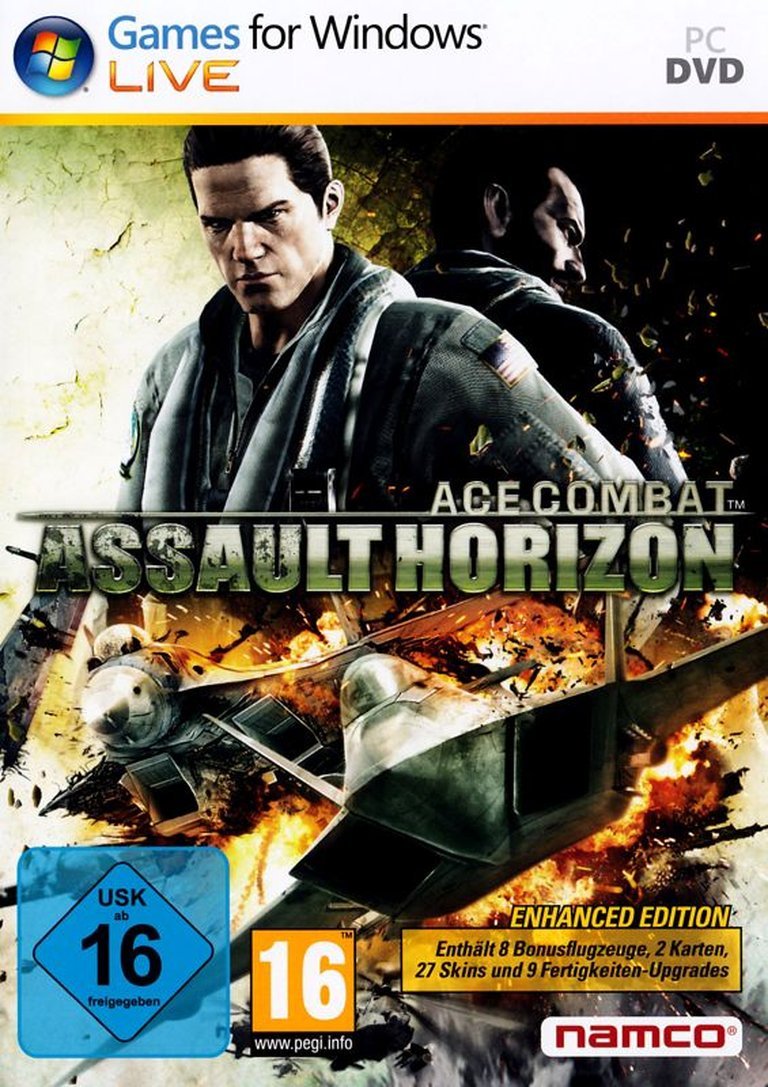
Ace Combat: Assault Horizon – Enhanced Edition is the PC release of the high-octane aerial combat game, set against the backdrop of modern warfare in Africa. This edition enhances the original experience with exclusive content, featuring nine additional planes like the F-4E Phantom II and CFA-44 Nosferatu, two new maps (Tokyo and Honolulu), skill upgrades, and 27 airplane skins. While consolidating console DLC packs into the base game, it delivers intense dogfights, helicopter missions, and explosive vehicular combat with improved performance for Windows. Though lacking some console DLC skins, it remains a definitive version for PC players seeking thrilling aviation action.
Gameplay Videos
Where to Buy Ace Combat: Assault Horizon – Enhanced Edition
PC
Ace Combat: Assault Horizon – Enhanced Edition Free Download
Ace Combat: Assault Horizon – Enhanced Edition Cracks & Fixes
Ace Combat: Assault Horizon – Enhanced Edition Guides & Walkthroughs
Ace Combat: Assault Horizon – Enhanced Edition Reviews & Reception
gamingbolt.com : All in all, Ace Combat: Assault Horizon isn’t a game that can be wholeheartedly recommended to PC owners- or anyone, really.
metacritic.com : This game is awesome! I have no idea why people complaining about realism but for me this was surprisingly pleasant experience!
gamefaqs.gamespot.com : The story will keep you hooked until the end, but it certainly takes a back seat to the gameplay:
Ace Combat: Assault Horizon – Enhanced Edition: A Divisive Epilogue in Aerial Arcade Legacy
When Innovation Clashed with Identity in Namco Bandai’s High-Octane Reimagining
Introduction: A Franchise at a Crossroads
The sky was never the limit—until it became a cage.
When Ace Combat: Assault Horizon first soared onto consoles in 2011, it marked a radical departure for Project Aces’ long-running franchise. By 2013, its Enhanced Edition PC port promised refined visuals, bundled DLC, and a belated embrace of the platform—yet it arrived as a polarizing artifact of identity crisis. This review argues that Assault Horizon – Enhanced Edition embodies an ambitious but fatally compromised experiment, sacrificing the series’ soul for blockbuster spectacle. It is a game torn between reverence for its arcade-sim roots and a desperate lunge toward Call of Duty’s lucrative shadow—a flawed yet fascinating study in what happens when a niche franchise gambles on mainstream appeal.
Development History & Context: Turbulence on the Horizon
Studio Pressures and the Ghost of Strangereal
The Visionaries and Their Gambit
Led by director Natsuki Isaki and producer Kazutoki Kono, Project Aces sought to revitalize the franchise after 2007’s Ace Combat 6: Fires of Liberation. The team faced mounting pressure to broaden the audience beyond the series’ cult following. Inspired by the success of cinematic military shooters, they abandoned Ace Combat’s fictional Strangereal universe—a setting beloved for its geopolitical nuance—for a globe-hopping, real-world narrative. This pivot aimed to heighten relatability, hiring New York Times bestselling author Jim DeFelice (American Sniper) to craft a screenplay steeped in post-9/11 counterterrorism tropes.
Technological Ambitions and Compromises
Built on a modified engine from Ace Combat 6, Assault Horizon introduced the controversial Close-Range Assault (CRA) system, including Dogfight Mode (DFM) and Air Strike Mode (ASM). These mechanics prioritized scripted, on-rails sequences over freeform dogfighting, leveraging QTE-like button prompts and automated camera angles to emulate Top Gun-style intensity. For consoles, this design addressed hardware limitations in rendering large-scale aerial combat—but PC players later critiqued the lack of advanced graphical settings and the awkward keyboard/mouse controls.
The 2013 Gaming Landscape
Releasing against competitors like Tom Clancy’s H.A.W.X. 2 and Heroes Over Europe, Assault Horizon entered a dwindling market for arcade flight action. The Enhanced Edition PC port arrived amidst the decline of Games for Windows Live (its multiplayer backbone), dooming its online community from inception. Despite these headwinds, Namco Bandai marketed it as a premium package, bundling eight console DLC packs (including Macross creator Shouji Kawamori’s ASF-X Shinden II fighter) into a standalone release.
Narrative & Thematic Deep Dive: The Weight of Cliches
A Tale of Two Pilots (and a Half-Baked Conspiracy)
Plot Synopsis: NATO vs. The New Russian Federation
Set in 2015–2016, the game follows Lieutenant Colonel William Bishop (voiced by Paul Mercier), leader of the USAF’s Warwolf Squadron, as he battles the Blatnoi—a Russian ultranationalist group led by the vengeful pilot Andrei Markov (David Agranov). Markov, traumatized by a U.S. airstrike that killed his wife during the Bosnian War, orchestrates a coup using thermobaric “Trinity” missiles. The narrative hopscotches between Miami, Dubai, and Moscow, framing the conflict through interchangeable military archetypes: the grizzled general (Graham McTavish), the loyal wingman (Philip Anthony-Rodriguez), and the duplicitous mole (Yuri Lowenthal).
Thematic Stumbles and Missed Opportunities
While DeFelice’s script strives for Zero Dark Thirty-style gravitas, it drowns in jingoistic bravado. Dialogue oscillates between cringe-worthy one-liners (“Make metal bleed!”) and lifeless technobabble, undercutting attempts at human drama like Bishop’s PTSD nightmares. Markov’s motivation—a scarred veteran weaponizing post-Soviet resentment—feels ripped from a 2000s-era thriller, lacking the moral ambiguity of earlier Ace Combat antagonists like The Unsung War’s Yellow Squadron.
The decision to abandon Strangereal strips the story of its trademark mythos. Without fictional nations like Osea or Belka, the conflict devolves into a generic U.S.-Russia proxy war—complete with cartoonish villains sneering about “American arrogance.” Even the Black Hawk Down-inspired helicopter missions, while novel, clash tonally with the aerial fantasy, reducing African insurgents to faceless cannon fodder.
Gameplay Mechanics & Systems: The Double-Edged Sword of DFM
When Automation Eclipses Agency
Core Loop: Spectacle Over Substance
Assault Horizon’s gameplay orbits around DFM and ASM—systems that automate maneuvers when players engage enemies at close range. While initially exhilarating (Eurogamer.de praised these as “cinematic adrenaline bursts”), their overuse collapses into tedium. Against “TGT_LEAD” enemies, DFM becomes mandatory, funneling dogfights into repetitive chase sequences:
- Lock onto an enemy.
- Enter DFM (LB+RB/L2+R2), triggering a scripted pursuit.
- Fill a reticle with machine-gun fire or missiles.
- Repeat—with no option to disengage or strategize.
Critics savaged this as “rollercoaster combat” (GameSpot) that robbed players of meaningful control. Even the Enhanced Edition’s expanded aircraft roster—F-4E Phantom II, YF-23A—feels hamstrung by combat’s on-rails shackles.
Mission Diversity: From Gunships to Grounded Potential
Non-DFM segments shine brighter. The AH-64 Apache missions offer tight, tactical strafing runs, while AC-130 Spectre gunner sequences channel Modern Warfare’s iconic “Death From Above” level. Yet these are undercut by forced linearity: In one mission, failing to destroy all targets in a timed bombing run triggers a checkpoint reset, exposing the game’s allergic reaction to player improvisation.
Technical Execution: A PC Port’s Identity Crisis
QLOC’s port bolstered resolution and frame rates (Spazio Games: “Smoother than console versions”), but skimped on PC-centric features. The absence of joystick deadzone adjustments and advanced graphical options (GameStar: “Mittelmaß für PC-Verhältnisse”) alienated sim-leaning players, while keyboard/mouse controls were lambasted as “unintuitive” (GamingXP). Multiplayer modes like Capital Conquest (8v8 base assaults) languished due to GFWL’s demise, rendering online lobbies ghost towns by mid-2014.
World-Building, Art & Sound: Aesthetic Highs Amid Conceptual Lows
When Style Outshines Substance
Visual Design: Gritty Realism vs. Arcade Flair
Divorcing from Strangereal’s fantastical architecture, Assault Horizon leverages satellite data to recreate cities like Dubai and Moscow, rendered in muted military grays and desert tans (Vandal Online: “Una compra muy recomendable”). Aircraft models gleam with obsessive detail—the F-22 Raptor’s cockpit instruments dazzle—but ground textures dissolve into ps2-era blur upon close inspection. The Enhanced Edition’s higher resolutions amplify these contrasts, with explosions and particle effects (Eurogamer.it: “Effetto spettacolare”) masking environmental austerity.
Sound Design: Symphony of Chaos
Keiki Kobayashi’s score marries orchestral swells with electronic pulses, evoking Hans Zimmer’s Modern Warfare work during DFM sequences. Jet engines roar with visceral weight, though repetitive radio barks (“Fox Two! Fox Two!”) grate over time. Voice acting wavers, with Markov’s accented growls veering into self-parody, while Bishop’s stoicism borders on narcoleptic.
Reception & Legacy: The Crash Landing
Critical Impact and Franchise Reckoning
Launch Reception: Divided Skies
Critics lauded the spectacle (IGN Italia: “Ottimo titolo arcade”) but skewered repetitive design (PC Invasion: “Disregard for realism”). The PC version garnered a 76% Metacritic average—higher than consoles (X360: 78%, PS3: 77%)—yet fan backlash was volcanic. Traditionalists decried DFM’s “casualization,” while newcomers found it shallow. Commercial performance was solid (1.07M sales globally) but failed to match Ace Combat 6’s heights.
Evolution of Legacy: Lessons from the Flames
Assault Horizon’s influence is paradoxical. Its bombast inspired Ace Combat 7’s VR missions and setpiece-driven campaign, yet its rejection of Strangereal was swiftly undone by fan demand. The 2025 delisting from Steam cemented its status as a curious footnote—a game that sacrificed depth for accessibility, only to alienate both camps.
Conclusion: A Wingman, Not a Leader
Assault Horizon – Enhanced Edition is a relic of ambition and identity crisis—a game that hungers for Hollywood’s glamor but forgets its own strengths. Its flashes of brilliance (helicopter sorties, Kobayashi’s score) drown beneath DFM’s tyranny, while the PC port’s technical shortcomings tarnish its enhancements. For historians, it remains essential as a cautionary tale of franchise reinvention; for players, it’s best approached as a B-tier arcade curio—one that soars highest when it dares to let go of the rails.
Final Score: 6.5/10
The Verdict: A turbulent ride for series faithfuls, but a fleeting rush for spectacle-seekers—proof that not every flight needs a Hollywood co-pilot.