
- Release Year: 2000
- Platforms: Windows
- Publisher: HiTech Creations, Inc.
- Developer: HiTech Creations, Inc.
- Genre: Action, Simulation
- Perspective: 1st-person
- Game Mode: Online PVP, Single-player
- Gameplay: Base building, Flight Simulation, Ground target capture, Large-scale Battles, Supply drops, Team-based combat
- Setting: World War I, World War II
- Average Score: 76/100
Description
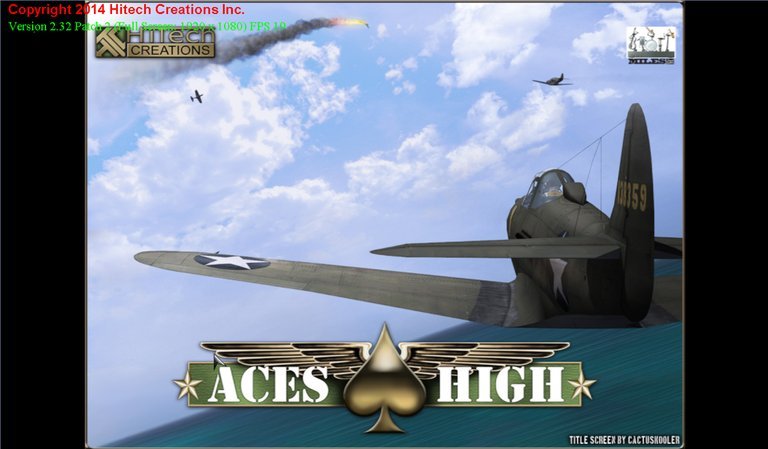
Aces High is a large-scale multiplayer combat flight simulator set in World War II, where three teams battle for map domination by capturing and defending ground targets. Players engage in aerial dogfights, ground assaults, and naval warfare using historically accurate vehicles, with matches lasting hours and requiring strategic coordination. The game blends simulation and action controls, offering both a subscription-based online mode and a free offline training mode. Continuously updated since its 2000 release, it features dynamic gameplay, customizable arenas, and evolving mechanics, including World War I vehicles and replay tools.
Gameplay Videos
Where to Buy Aces High
PC
Aces High Patches & Updates
Aces High Reviews & Reception
mobygames.com (76/100): A multiplayer game in which three teams fight over domination of the map.
Aces High Cheats & Codes
PC
Select ‘Offline Practice’. Go to the Hanger, then press / to display the radio text entry prompt. Enter one of the following codes to activate the cheat function.
| Code | Effect |
|---|---|
| .showrv | RV-8 in hangar |
Aces High: A Comprehensive Retrospective on the Definitive WWII Combat Flight Simulator
Introduction: The Lasting Legacy of a Multiplayer Masterpiece
Few games have captured the thrill, chaos, and camaraderie of large-scale aerial combat like Aces High. Released in 2000 by HiTech Creations, this massively multiplayer online (MMO) combat flight simulator carved out a niche that few have dared to challenge. Unlike the scripted campaigns of single-player flight sims, Aces High thrust players into a persistent, player-driven war where teamwork, strategy, and raw piloting skill determined victory. It was—and remains—a game where the sky is not just a battlefield but a living, breathing ecosystem of dogfights, bomber intercepts, and ground assaults.
At its core, Aces High is a game about scale. Matches could last hours, involving over 100 players across three factions, all vying for control of a dynamically shifting map. The game’s blend of simulation-depth physics and accessible controls made it a rare bridge between hardcore flight sim enthusiasts and action-oriented gamers. Yet, its true genius lay in its community-driven design, where player cooperation wasn’t just encouraged—it was essential. Whether coordinating a bomber escort, defending a besieged airfield, or executing a daring tank assault, Aces High demanded that players think like soldiers, not just pilots.
This review will dissect Aces High in exhaustive detail, exploring its development, gameplay systems, narrative (or lack thereof), and its enduring influence on the flight sim genre. We’ll examine why, despite its age and relatively modest graphics, it remains a benchmark for online aerial combat—and why its legacy continues to resonate over two decades later.
Development History & Context: The Birth of a Persistent War Machine
The Studio: HiTech Creations and the WarBirds Legacy
Aces High was not HiTech Creations’ first foray into online aerial combat. The studio’s roots trace back to WarBirds (1994) and WarBirds II (1997), early multiplayer flight sims that pioneered the concept of large-scale, persistent online dogfights. These games laid the groundwork for Aces High, refining the netcode, physics, and community features that would define its successor.
By the late 1990s, HiTech Creations had developed a reputation for prioritizing community over flashy presentation. Their games were less about cinematic single-player experiences and more about creating a virtual sandbox where players could forge their own stories. This philosophy was evident in Aces High’s development, which began in the late 1990s as an evolution of the WarBirds formula.
Technological Constraints and Innovations
Released in 2000, Aces High arrived at a pivotal moment in online gaming. Broadband internet was still in its infancy, and most multiplayer games relied on dial-up connections. HiTech Creations faced the daunting task of creating a game that could support hundreds of players in a single battle without descending into lag-riddled chaos.
The solution was a proprietary netcode that prioritized smooth, predictable gameplay over graphical fidelity. While contemporaries like Microsoft Combat Flight Simulator 2 (1999) boasted superior visuals, Aces High focused on functionality. The game’s physics engine struck a balance between realism and accessibility:
– Flight models were detailed enough to satisfy sim enthusiasts (e.g., stall behavior, energy retention) but forgiving enough for newcomers.
– Damage modeling was granular, with individual components (engines, control surfaces, fuel tanks) susceptible to damage.
– Ballistics accounted for bullet drop and velocity, rewarding leading shots and situational awareness.
The game’s initial release was modest in scope, featuring primarily WWII aircraft and a handful of ground/naval units. However, HiTech Creations adopted an iterative development model, continuously expanding the game post-launch. This included:
– World War I aircraft (added in 2010), introducing iconic planes like the Fokker Dr.I and Sopwith Camel.
– Enhanced ground combat, with tanks like the M4A3 Sherman and Tiger I receiving updates to improve their role in battles.
– Replay tools, allowing players to record and review their dogfights—a feature that predated modern esports analysis tools.
The Gaming Landscape in 2000
Aces High launched into a market dominated by single-player flight sims like IL-2 Sturmovik (2001) and arcade-style games like Crimson Skies (2000). Multiplayer flight sims were rare, and those that existed (e.g., Falcon 4.0) were often plagued by technical limitations.
What set Aces High apart was its persistence. Most online games of the era were session-based, with matches lasting minutes or hours. Aces High, by contrast, offered wars that could span days, with territories changing hands based on player actions. This created a sense of investment—players weren’t just fighting for a scoreboard; they were fighting for control of a living world.
The game’s subscription model (a then-controversial $14.95/month) reflected its MMO ambitions. While free alternatives like War Thunder (2012) would later challenge this model, Aces High’s dedicated player base justified the cost through its depth and community.
Narrative & Thematic Deep Dive: The Story You Write Yourself
The Absence of a Traditional Plot
Aces High is not a game with a scripted campaign or cinematic storytelling. There are no cutscenes, no NPC characters, and no overarching narrative. Instead, the game’s “story” emerges organically from player actions.
This design choice was deliberate. HiTech Creations understood that the true drama of war lies not in pre-written missions but in the unpredictable moments of multiplayer combat:
– A lone Spitfire pilot holding off a wave of Bf 109s to protect a bombing run.
– A C-47 transport barely limping home after a harrowing supply drop.
– A Tiger I ambush turning the tide of a ground assault.
The game’s arenas (maps) are divided into WWI and WWII settings, each with its own thematic flavor:
– WWI arenas are tight, chaotic dogfighting zones where biplanes duel at close range.
– WWII arenas are sprawling, with distinct “early,” “middle,” and “late” war settings that dictate the available aircraft (e.g., P-40 Warhawks in early war, Me 262s in late war).
Themes: Brotherhood, Sacrifice, and the Fog of War
While Aces High lacks a traditional narrative, it is rich in themes that resonate with military history:
1. Teamwork Over Individualism
– The game’s capture-the-flag-inspired mechanics force players to work together. A solo ace can rack up kills, but victory requires coordination—bombers need escorts, ground troops need air support, and bases need defenders.
– This fosters a sense of brotherhood, with players forming squads, assigning roles (e.g., fighter cover, ground attack), and communicating via voice chat long before Discord became standard.
-
The Cost of War
- Resources are finite. Losing a bomber isn’t just a respawn timer—it’s a strategic loss. Players must weigh the risk of sending a B-17 on a bombing run against the potential gain of crippling an enemy airfield.
- The game’s supply system (where transport planes drop ammunition and reinforcements) adds another layer of realism, forcing players to think like logisticians, not just pilots.
-
The Fog of War
- Unlike modern games with minimaps and radar, Aces High relies on line of sight and player communication. A lone scout plane can mean the difference between spotting an enemy bomber formation or being caught by surprise.
- This creates tension and emergent storytelling—players recall battles not for their kill counts but for the moments of triumph or despair.
Scenarios: Scripted Chaos
While the main game is open-ended, Aces High’s Scenarios offer structured, large-scale battles based on historical (or hypothetical) conflicts. These events, running 2-3 times per year, are the closest the game comes to “narrative” gameplay:
– Battle of Britain Scenario: Players reenact the Luftwaffe’s assault on England, with strict historical loadouts (e.g., Hurricanes vs. Bf 109s).
– Hypothetical Battles: What if the Me 262 entered service earlier? What if the U.S. and USSR clashed in 1945? These “what-if” scenarios let players explore alternate history.
– Command Structure: Each side has a dedicated staff assigning roles, issuing orders, and adapting strategies mid-battle—a rare level of organization in online gaming.
Scenarios are where Aces High’s community shines. Players don’t just play these battles; they live them, debating tactics, mourning losses, and celebrating victories long after the servers reset.
Gameplay Mechanics & Systems: The Art of Virtual War
Core Gameplay Loop: Capture, Defend, Repeat
Aces High’s gameplay revolves around a territorial control system reminiscent of Battlefield’s conquest mode, but with deeper strategic layers:
1. Ground Targets: The map is dotted with bases, airfields, and factories. Teams win by capturing a majority of these targets.
2. Capture Mechanics:
– Step 1: Softening Defenses – Bombers and fighters must weaken enemy anti-air guns and troops.
– Step 2: Troops Deployment – Transport planes (e.g., C-47) drop paratroopers to seize the target.
– Step 3: Rebuilding – Captured targets must be repaired (via supply drops) before they become fully operational.
3. Resource Management: Capturing certain targets grants bonuses (e.g., faster respawns, additional ammunition).
This system ensures that no single role dominates. Fighters, bombers, transports, and ground units all have critical roles, creating a rock-paper-scissors dynamic:
– Fighters counter bombers but struggle against well-defended ground targets.
– Bombers devastate bases but are vulnerable to interceptors.
– Transports enable captures but are sitting ducks without escorts.
Combat: The Dance of Death in the Skies
Aces High’s dogfighting is a masterclass in risk vs. reward:
– Energy Fighting: The game rewards players who master energy retention—using altitude and speed to dictate engagements.
– Gun Harmony: Unlike arcade shooters, guns have convergence points. A P-51 Mustang’s .50 cals might be deadly at 300 yards but useless in a close-range turn fight.
– Damage Modeling: Hitting an enemy’s coolant system can lead to an overheating engine, while a well-placed burst into the fuel tank can turn a plane into a fireball.
Ground and naval combat, while less emphasized, add variety:
– Tanks (e.g., Sherman, Tiger I) engage in slow, methodical battles where positioning and terrain matter.
– PT Boats and destroyers allow for naval skirmishes, though these are less common due to the game’s aerial focus.
Progression and Customization
Aces High lacks a traditional “leveling” system. Instead, progression is skill-based and community-driven:
– Aircraft Unlocks: Players gain access to more advanced planes by earning merit through gameplay (e.g., capturing targets, assisting teammates).
– Squadrons: Joining a player-run squadron grants access to private training sessions, custom paint schemes, and organized events.
– User-Created Content: The game’s Terrain Editor allows players to design custom maps, while skin creators can design unique liveries for aircraft.
UI and HUD: Functional Over Flashy
The game’s interface is utilitarian, reflecting its 2000-era origins:
– Minimalist HUD: Speed, altitude, and ammunition are displayed clearly, but there’s no hand-holding. Players must rely on situational awareness.
– Communication Tools: Voice chat (via third-party apps like Teamspeak) and text commands are essential for coordination.
– Replay System: A post-launch addition that lets players review their dogfights—a feature that was revolutionary at the time.
Flaws and Frustrations
No game is perfect, and Aces High has its share of criticisms:
– Steep Learning Curve: New players often struggle against veterans who’ve spent years mastering the flight models.
– Grind for Advanced Aircraft: Unlocking late-war planes (e.g., Me 262, P-51D) requires significant time investment.
– Aging Graphics: Even after the 2016 visual update, the game’s aesthetics lag behind modern sims like DCS World.
Yet, these flaws are often overshadowed by the game’s depth. As Computer Gaming World noted in 2000: “Aces High is a game that rewards patience and teamwork, and punishes lone wolves.”
World-Building, Art & Sound: Crafting an Immutable War
The Illusion of a Living World
Aces High’s world is not “open” in the modern sense—there are no civilians, no dynamic weather (until later updates), and no NPCs. Yet, the game feels alive thanks to:
– Player-Driven Events: The ebb and flow of battle is dictated by human decisions, not scripts.
– Persistent Damage: A bombed-out airfield remains scarred until repaired, reinforcing the consequences of combat.
– Day/Night Cycles: Later updates introduced dynamic lighting, adding tension to night bombing runs.
Visual Design: Function Over Form
The game’s art direction prioritizes clarity and performance:
– Aircraft Models: While not hyper-detailed, the planes are recognizable and functional. A Bf 109’s narrow landing gear is a visual cue to its tricky handling.
– Terrain: Maps are designed for gameplay, not realism. Airfields are clearly marked, and key landmarks (e.g., bridges, factories) are easy to spot from altitude.
– Effects: Tracer fire, explosions, and smoke trails are exaggerated for visibility—a necessity in large-scale battles.
Sound Design: The Symphony of War
Aces High’s audio is understated but effective:
– Engine Sounds: Each aircraft has a distinct audio profile. The Merlin engine of a Spitfire sounds different from the radial engine of a F4U Corsair.
– Gunfire and Explosions: The crack of a 20mm cannon vs. the thud of a bomb impact helps players assess threats.
– Radio Chatter: While not voice-acted, the game’s text-based communication system (e.g., “Enemy bombers inbound!”) adds to the immersion.
The lack of a musical score is notable. Unlike games like Ace Combat, which use orchestral swells to heighten drama, Aces High relies on ambient sounds—the hum of engines, the whistle of wind, the distant thump of flak—to create tension.
Reception & Legacy: The Game That Refused to Die
Critical Reception: A Niche Masterpiece
Aces High received positive but muted reviews at launch:
– GameSpy (83/100, 2002): Praised its “unparalleled multiplayer depth” and “addictive teamplay.”
– Computer Gaming World (70/100, 2000): Called it “a game that will only get better” due to HiTech’s commitment to updates.
However, the game’s subscription model and steep learning curve limited its mainstream appeal. It never achieved the commercial success of IL-2 Sturmovik or War Thunder, but it cultivated a devoted fanbase.
Evolution and Longevity
Aces High’s greatest strength is its adaptability. HiTech Creations supported the game for over two decades, adding:
– World War I content (2010).
– Graphical updates (2016).
– New arenas and scenarios (ongoing).
This longevity is rare in gaming. Most MMO flight sims from the 2000s (Air Warrior, Fighter Ace) have faded, but Aces High endures thanks to its community. Player-run squads, tournaments, and events keep the game alive, with veterans mentoring newcomers.
Influence on the Genre
Aces High’s impact can be seen in later games:
– War Thunder (2012): Borrowed the combined arms approach (air, ground, naval) and persistent battles.
– DCS World (2008): Adopted the community-driven content model (e.g., user-created missions).
– World of Tanks/Warships (2010s): The team-based objective design owes a debt to Aces High’s territorial control mechanics.
Yet, no game has fully replicated Aces High’s scale and persistence. Modern flight sims focus on realism (e.g., DCS) or accessibility (e.g., War Thunder), but few attempt the large-scale, player-driven warfare that defines Aces High.
Conclusion: The Unmatched King of Online Aerial Combat
Aces High is not a game for everyone. Its steep learning curve, subscription model, and dated visuals make it a hard sell in 2024. Yet, for those willing to invest the time, it offers an experience unmatched in the flight sim genre:
– A living, breathing war where every action has consequences.
– A community that values teamwork, strategy, and skill over flashy graphics.
– A legacy of over two decades of continuous development and player-driven storytelling.
In an era where games are increasingly ephemeral—designed for quick dopamine hits and discarded within months—Aces High stands as a testament to the power of persistence. It is a game where you are the story, where your decisions shape the battle, and where your skills determine victory.
Final Verdict: 9/10 – A Timeless Masterpiece of Multiplayer Combat
Aces High may not be the prettiest or most accessible flight sim, but it remains the deepest and most rewarding online aerial combat experience ever made. For those who crave strategy, camaraderie, and unscripted warfare, it is—quite simply—unmatched.
Post-Script: The Future of Aces High
With Aces High III released in 2017, HiTech Creations continues to evolve the formula. Yet, the original Aces High persists, a testament to the enduring appeal of its core design. In a gaming landscape dominated by battle royales and live-service shooters, Aces High remains a relic—and a revelation—of what online multiplayer can achieve when community and depth take precedence over monetization and trends.
For the true aerial combat enthusiast, Aces High isn’t just a game. It’s a way of virtual life.