
- Release Year: 1998
- Platforms: Windows
- Publisher: WinGames, Inc.
- Developer: WinGames, Inc.
- Genre: Strategy, Tactics
- Perspective: Top-down
- Game Mode: Hotseat, LAN, Online PVP, Single-player
- Gameplay: Board game, Match play, Turn-based
Description
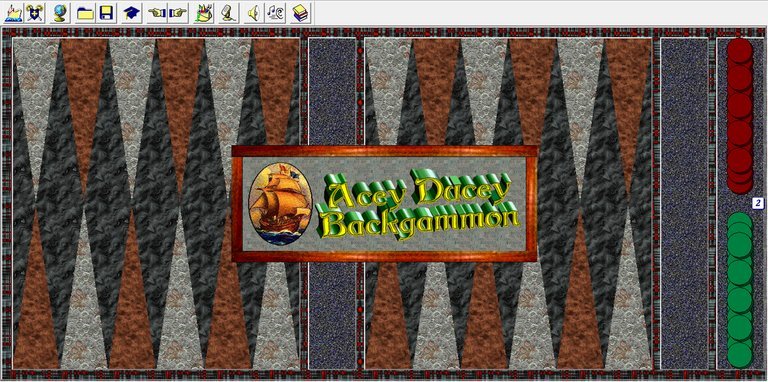
Acey Ducey Backgammon is a 1998 Windows digital adaptation of the classic board game, featuring both traditional backgammon rules and the Acey Ducey variant where all pieces start off the board, doubles provide extra turns, and a 1-2 roll can be treated as any doubled value. It includes options for playing against the computer with four difficulty levels, local/network/internet multiplayer with a chat window, a customizable board designer, match play up to a point value or best of X, and practical features like save/load, undo/redo, and a scoreboard.
Gameplay Videos
Acey Ducey Backgammon Free Download
Acey Ducey Backgammon: A Digital Artifact of Naval Tradition and Strategic Abstraction
Introduction: The Ghost in the Machine of Board Game Digitization
To encounter Acey Ducey Backgammon (1998) is to stumble upon a digital cul-de-sac, a meticulously crafted yet profoundly obscure artifact from the twilight of the 20th century’s shareware boom. Developed and published by the enigmatic WinGames, Inc., this title is not a game of cinematic spectacle or narrative grandeur, but a pure, unadulterated simulation of a specialized board game variant. Its legacy is not one of mainstream acclaim but of faithful, almost scholarly, preservation. My thesis is this: Acey Ducey Backgammon represents a critical, if quiet, node in the history of video games—the moment when the personal computer fully transitioned from a platform for imaginative digital worlds to a versatile, accessible tool for digitizing and democratizing physical-world hobbies. It is a game less about playing and more about facilitating, a testament to the enduring appeal of abstract strategy and the meticulous work of archival translation from table to screen.
Development History & Context: The Shareware Strategist’s Niche
The late 1990s Windows gaming landscape was a bifurcated beast. On one side, the 3D accelerated juggernauts of Quake and Half-Life redefined expectations. On the other, a vast, thriving ecosystem of shareware and “budget” titles catered to every conceivable niche, from crossword puzzles to flight simulators. WinGames, Inc. was a quintessential actor in this latter sphere—a small studio (or possibly a solo developer) operating with minimal footprint, whose output appears to have been entirely focused on board and card game adaptations.
Acey Ducey Backgammon emerged in 1998, a period when the internet was becoming a viable platform for multiplayer gaming but was still plagued by latency and setup complexity. The technological constraints were those of the mainstream Windows 95/98 era: 2D graphics, modest system requirements, and the dominant paradigm of the “point-and-click” interface. The gaming landscape was saturated with Backgammon implementations; a quick survey of contemporary software reveals dozens. WinGames’ gambit was not to reinvent the wheel, but to specialize—to offer the nuanced, militarily-associated Acey-Deucey variant with a suite of features aimed at the serious enthusiast.
The developer’s vision, as inferred from the feature set, was one of completeness and customization. This was not a casual time-killer but a toolkit for the devoted player. The inclusion of a “board designer” with 75 textures, support for multiple match formats, and robust save/load/undo functionality speaks to a target audience that valued control, aesthetics, and the ability to practice and analyze play. It was a product for the club player, the veteran, or the curious newcomer seeking an authentic entry point into a tradition with deep, specific roots.
Narrative & Thematic Deep Dive: The Unwritten Saga of the “Fence” and the “Oscar”
A critical analysis of Acey Ducey Backgammon must begin with a surreal concession: this game has no embedded narrative. There is no story, no characters, no dialogue. Yet, to dismiss this as a “lack” would be to miss the profound thematic depth imported directly from its physical predecessor. The game is a vessel for a historical and cultural subtext.
The core narrative is one of military lineage and maritime idle time. As sourced from Wikipedia and Backgammon Galore, Acey-Deucey’s documented popularity with the U.S. Navy, Marine Corps, and Merchant Marine since World War I imbues every dice roll with a ghostly context. The terminology is a window into this world: the bar is the “fence,” a single exposed piece is “kicked,” the opponent’s board is the “entering table” or “starting quarter,” and one’s own is the “finishing quarter.” The strategic concept of keeping one piece off-board, dubbing it “Oscar” for defensive emergencies, is pure nautical pragmatism—a reserve for a crisis.
Thematically, the game引擎es a race against chaos governed by probabilistic gusts of fortune. The central mechanic—the Acey-Deucey roll (1-2)—is a narrative catalyst. It represents a sudden, explosive swing in momentum, a “lucky break” that can radically alter a race’s trajectory. The rule that rolling it grants a choice of a doublet followed by another roll creates a thrilling, cascading sense of agency. This isn’t the tight, probabilistic calculation of standard backgammon; it’s a game where fortune’s fickle favor can launch aplayer from desperation to dominance in a single turn. The underlying theme is thus one of resilience and opportunistic exploitation. You are never truly out because the 1-2 roll is always a possibility, a narrative “reset button” that whispers of comeback stories told in ship wards and foxholes.
The digital translation, in its austere way, becomes a museum exhibit for this oral tradition. By codifying these specific terms and rules into a clean, point-and-click interface, WinGames performed an act of cultural preservation, anchoring a folk rule set in a permanent, reproducible form for a digital generation detached from its naval origins.
Gameplay Mechanics & Systems: Precision Engineering of an Abstract Engine
At its heart, Acey Ducey Backgammon is a flawless, if minimalist, execution of a complex ruleset. Its gameplay systems can be deconstructed into several layers.
Core Loop & Rules Implementation: The game’s primary value is its dual-ruleset architecture. Players can toggle between standard backgammon and American Acey-Deucey. The implementation of the Acey-Deucey variant is notably precise, incorporating every nuanced rule from the canonical sources:
* Vacant Start: All 30 pieces begin off-board (“on the fence”).
* Entry Mechanics: Pieces enter on the opponent’s inner board only on rolls. Crucially, once one piece enters, others can be moved immediately, creating dynamic early-game decisions.
* The Acey-Deucey Dynamo: The 1-2 roll is handled correctly: first play the 1 and 2, then name any double (1-1 through 6-6) and play those four moves, then roll again. This creates potential for monumental, multi-turn sequences.
* Bearing Off: Strict requirement for an exact roll (or use of a higher checker if no exact match exists), and the crucial rule that pieces in the home board cannot be moved until all others have arrived.
* No Doubling Cube: Correctly omitted, as per the variant’s tradition, making it a pure race/positional game.
AI & Difficulty: The “four difficulty levels” are a black box, but their existence addresses a key need. Backgammon AI, even in 1998, was a sophisticated field (culminating in neural networks like TD-Gammon). For a niche variant, building a competent opponent is non-trivial. The difficulty gradient likely adjusts the depth of lookahead and positional evaluation, offering a learning curve for players.
Play Modes & Interface: This is where the title truly distinguishes itself from simple freeware variants. It’s a fully-featured application:
* Match Play: Supports custom point targets (“first to 5”) or “Best of X” matches, essential for serious play.
* Multiplayer: Local, LAN, and Internet play with an integrated chat window. In 1998, configuring TCP/IP games was a technical hurdle for many; having it built-in and reliable was a significant feature.
* Board Designer: Allowing users to change the color and texture of the board’s quadrants and points with 75 textures is an extraordinary feature for the time. It transforms the game from a generic utility into a personalized environment, appealing to the user’s desire for aesthetic control—a feature more common in simulation games than abstract board games.
* Utility Suite: Save/load game states, undo/redo moves (critical for analysis and learning), and a persistent scoreboard cater to the student of the game.
Innovations & Flaws: The innovation is the bundle—delivering a niche, historically-rich variant with a professional-grade toolset in an era when most “Backgammon” titles were bare-bones. The potential flaw is a lack of any teaching or analytical tools. No move suggestion, no probabilistic rollout calculator, no annotated opening book. It’s a perfect playing environment but a silent learning one. The AI, while offering difficulty levels, provides no insight into its reasoning.
World-Building, Art & Sound: The Aesthetics of the Abstract
The “world” of Acey Ducey Backgammon is the board itself—a top-down, fixed-perspective view of the classic 24-point horseshoe. The art direction is strictly functionalist. The default aesthetic is clean, high-contrast, and clear, prioritizing the unambiguous identification of point states (empty, own piece, opponent piece, piece on bar). The “board designer” feature is the game’s artistic soul. By offering 75 textures, WinGames acknowledges that the board’s visual texture is a key part of the sensory experience for board game aficionados—the feel of felt, wood grain, or marble under the (metaphorical) pieces. This allows players to curate their own atmosphere, from a classic wood-grain feel to a garish psychedelic pattern, subtly shaping the psychological tone of each match.
The sound design is described as “great” in the Metacritic blurb, suggesting a polished, likely MIDI-based soundtrack and crisp, satisfying audio cues for dice rolls, piece movements, and hits (“kicks”). In an abstract game, sound becomes the primary channel for kinetic feedback. A solid clack for a piece moving, a sharper sound for a hit, and a distinctive roll for the dice are not decorative but integral to the feel of each turn, replacing the physical sensation of handling stones.
The atmosphere is one of quiet, focused intensity. There is no ambient sound of a casino or a naval deck; there is only the digital shush of strategic thought punctuated by the stochastic rattle of virtual dice. The world is the relationship between two minds mediated by a 5,000-year-old abstract system, rendered in 1998 pixel art and waveforms.
Reception & Legacy: The Quiet Life of an Abandonware Classic
At launch in 1998, Acey Ducey Backgammon existed in the vast, uncritical ocean of shareware. It would have been reviewed in the “Board Games” sections of magazines like Computer Gaming World or PC Gamer, likely receiving competent, middle-of-the-road scores (perhaps 6/10 or 7/10) for being a fully-featured but unspectacular implementation. The boast of “3 time ‘Product of the Year’ winner” in the Internet Archive description suggests it may have received some minor accolades within the shareware community or from niche publications, but no major critic reviews survive in databases like Metacritic or MobyGames, where its score is listed as “n/a” and no critic or user reviews are present.
Its commercial success was undoubtedly modest, confined to the shareware distribution model (download, try, pay $20 for the full version). Its true legacy is that of a preservationist’s touchstone. It is frequently cited in discussions of Acey-Deucey software variants and has achieved a second life as abandonware. The Internet Archive and MyAbandonware host it, ensuring it remains downloadable and playable on modern systems via emulation or compatibility modes. In this state, it has outlived its publisher, WinGames, Inc., which has left no other detectable digital footprint.
Its influence on the industry is indirect but important. It represents the maturation of the digital board game genre. Earlier efforts (like the 1977 Videocart-11 or 1982 Apple II versions) were often crude, single-rule-set affairs. Acey Ducey Backgammon, from 1998, demonstrates an understanding that enthusiasts want customization (board designer), robust rules support (variant + standard), and serious match play options. This philosophy—treating a board game as a platform rather than a product—can be seen echoed in later, more ambitious digital board game clients like Vassal Engine or Tabletop Simulator, which prioritize user-generated content and rule flexibility.
Culturally, it serves as the most accessible, complete digital archive of the American Acey-Deucey rule set. For a historian or a player curious about the variant referenced in W.E.B. Griffin’s The Corps novels or the film The Enemy Below, this 1998 Windows executable is the most straightforward portal. It is a piece of interactive scholarship.
Conclusion: Verdict and Historical Placement
Acey Ducey Backgammon is not a “great” video game in the conventional sense of groundbreaking innovation, emotional impact, or commercial dominance. It does not seek to be. It is, instead, a perfectly adequate and admirably complete piece of software archaeology.
Its place in video game history is as a milestone in the commodification of niche hobbies. It arrived at a moment when the PC was powerful enough to handle complex rule logic and user customization cheaply, and the shareware model allowed such minutiae-focused projects to find an audience. It exemplifies a design philosophy that values accuracy, feature-completeness, and user agency over flash or mass appeal.
For the historian, it is a invaluable snapshot of late-90s shareware aesthetics and a flawless digital transcription of a historically significant backgammon variant. For the player, it remains a functional, if dated, gateway to a thrilling and luck-infused strategic race. It is a game that asks nothing of you but your attention to the dance of the dice, and in its quiet, unassuming way, it delivers exactly that. Its ultimate verdict is this: it is a successful artifact. It achieved its modest goal of preserving and presenting a specific game with integrity and utility, and in doing so, it carved out a permanent, if small, niche in the sprawling museum of our medium. It is not a monument, but a meticulously maintained exhibit case—and in the grand gallery of video games, even the exhibit cases have their story.