
- Release Year: 2013
- Platforms: Windows
- Publisher: United Independent Entertainment GmbH
- Genre: Compilation
Description
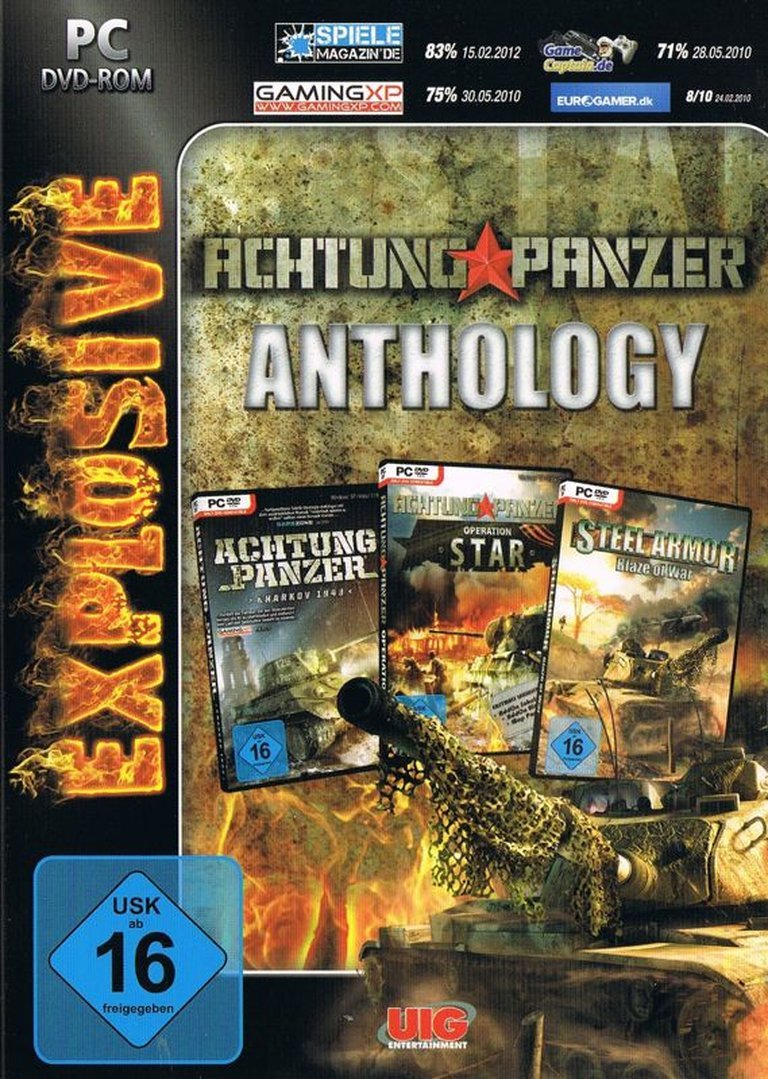
Achtung Panzer: Anthology is a 2013 Windows compilation that brings together several World War II tank simulation games, focusing on historically accurate tactical combat on the Eastern Front. It includes titles like Steel Armor: Blaze of War, Achtung Panzer: Kharkov 1943, and entries from the Graviteam Tactics series, offering a comprehensive collection of realistic tank warfare experiences.
Achtung Panzer: Anthology: Preserving the Crucible of the Eastern Front
Introduction: The Armored Anomaly
In the vast museum of video game history, certain titles exist not as blockbuster attractions but as meticulously preserved artifacts in a niche wing. Achtung Panzer: Anthology (2013) is precisely such an artifact—a curated time capsule of one of the most dedicated and uncompromising tactical simulation series ever created. Compiled by United Independent Entertainment GmbH, this collection brings together the core entries of the Achtung Panzer and Graviteam Tactics lineages, which for over a decade defined the hardcore end of World War II armored warfare simulation. While the mainstream gaming world chased photorealism in AAA shooters or streamlined complexity in arcade-style tank games like World of Tanks, this series stubbornly rooted itself in the mud, steel, and terrifying mathematics of historical tank combat. This anthology is more than a repackaging; it is a canonical preservation effort, a monument to a specific, demanding design philosophy that prioritized systemic authenticity over accessibility. Its thesis is twofold: to serve as an exhaustive historical document of Eastern Front tactical engagements and to stand as a defiant testament to the viability of ultra-niche, simulation-first design in an increasingly casual market.
Development History & Context: Forged in the Post-Soviet Sim Scene
The story of Achtung Panzer: Anthology is intrinsically linked to the obscure but fiercely talented development studios behind its constituent games, primarily Graviteam (formerly associated with Ukrainian/Russian developers like Alexander “Flex” Yudincev and later collaborations). The series began with Achtung Panzer: Kharkov 1943 (2009), a direct descendant of earlier titles like Achtung Spitfire (1997), which itself was a pioneering World War II flight sim. The core vision was born from a desire to model the brutal, close-quarters tank warfare of the Eastern Front with a fidelity that contemporary Western sims often overlooked.
The technological constraints of the late 2000s/early 2010s were a double-edged sword. On one hand, the rise of accessible 3D acceleration and multi-core CPUs allowed for more complex real-time calculations—ballistics, armor penetration based on angle and thickness, crew skill interactions—than ever before. On the other, these games were built on proprietary, often quirky engines (like the “Battles” engine used by Graviteam) that prioritized simulation density over graphical polish or user-friendly interfaces. The gaming landscape of their original release (2009-2011) was dominated by the juggernauts of the Call of Duty and Battlefield series, with the tank genre largely split between the arcadey World of Tanks and the prohibitively complex Steel Beasts. Into this gap stepped the Achtung Panzer series: accessible enough for the dedicated amateur but demanding enough to feel like a professional staff exercise. The 2013 compilation release itself was a product of a transitional period, where physical “anthology” DVDs were still a viable way to bundle and preserve digital-only titles that might otherwise vanish from online storefronts.
Narrative & Thematic Deep Dive: The Silence of the Shell Impacts
It is a profound mistake to approach these games seeking a traditional narrative. There is no campaign with cutscenes, no character arcs, no dialogue trees. The “story” is emergent, written not by writers but by the cold equations of physics and statistics. Each mission, whether based on the historic Battle of Kharkov, Operation Star, or the Volokonovka engagements, is a historical scenario presented with a brief orders of battle and map. The theme is therefore one of brutal agency and systemic determinism.
You are not a hero; you are a platoon commander, a logistical and tactical node. The narrative emerges from the procedures: the agonizing decision to commit your last precious anti-tank round, the hail of machine-gun fire as your crew bails out of a burning tank, the slow, tense crawl across an open field under observer fire. The games simulate the Eastern Front’s defining characteristic: the clash of two industrial war machines where matériel and numbers often outweighed individual bravery. The thematic weight is in the absence of glory. There are no power fantasy upgrades; your “progress” in a campaign is measured in surviving tanks, accrued crew experience points (improving shot reaction times, repair speed), and hard-won reputation—a currency of survival, not domination. The compilation’s inclusion of titles from 2009 to 2014 traces an evolution in this approach, from the more straightforward Kharkov scenarios to the deeper, dynamic campaign systems of later Graviteam Tactics entries, where the outcome of one battle reshapes the entire front line and available reinforcements.
Gameplay Mechanics & Systems: The Cathedral of Detail
This is where the series earns its revered, if fearsome, reputation. The gameplay is best described as real-time with active pause (often called “We-Go” or simultaneous turn-based), occupying a unique space between pure real-time tactics and traditional wargaming.
- Core Loop & Command Paradigm: The fundamental unit is the tank platoon (3-5 vehicles), often supported by infantry sections, AT guns, and artillery observers. Command is decentralized. You issue orders to individual vehicles/units (Move, Aim At Target, Load Specific Ammo, Pop Smoke, Dismount Infantry), which are then executed by their AI crews with varying degrees of competence based on their stats. The Active Pause system is critical: you can freeze time at any moment to survey the battlefield, issue complex orders, and assess damage—a necessity given the speed of modern CPU processing.
- Combat as Applied Physics: This is the series’ soul. Ballistics are modeled from the gun barrel. There is no abstract “to-hit” percentage. A shot’s success depends on gun caliber, muzzle velocity, range, target armor slope and thickness, and the random chance of a “golden BB.” Penetration is calculated using historical penetration tables; a shell may glance off at 30 degrees but punch through at 20. Ammunition types (AP, APCR, HE) have distinct physics and limited stocks. The infamous “5+ to hit at all ranges” rule cited in the Warlord Games tabletop Q&A (which is a separate product sharing a name) actually has an analog here: for high-velocity tank guns, there is no range penalty within historical engagement distances (500-1500m), simulating a flat trajectory. This creates intense, realistic close-quarters brawls where getting the first, accurate shot off is everything.
- Crew & Logistics: Each tank is crewed by individuals with stats for skill (Green to Ace), morale, and roles (Commander, Gunner, Driver, Loader). A veteran crew fires faster, repairs track damage quicker, and is less likely to panic. These systems are deeply interwoven. Ammunition is physically stored in the tank’s rack; you must choose which type to load, and the loader’s skill determines the speed of that process. Suppressive fire from machine guns can pin down infantry and force tank crews to button up, reducing their observation and reaction speed. Fuel and ammo supplies are front-line concerns in campaign modes.
- Innovations & Flaws: The series pioneered the “First-Person/Tactical View” hybrid. You can follow your tank commander’s vision from inside the cupola (with realistic limited visibility) or pull back to a classic RTS view. The innovation is the Dynamic Campaign System—especially in Graviteam Tactics: Operation Star and later titles. Here, a series of linked battles occur on a strategic map. Your platoon’s performance, losses, and crew advancements carry over. You might be awarded a new tank variant for success or forced to amalgamate crews after a disaster. The flaws are legendary and part of the package: an opaque, non-tutorialized UI that resembles a military simulation dashboard; steep learning curves where dying to unseen infantry or “luck” is common; and quirky AI that can be brilliant in flanking maneuvers or frustratingly obtuse in pathfinding around obstacles. The sheer number of tokens and datacards needed (as noted in the tabletop Q&A, the concept is shared) translates to a complex HUD with its own beauty and frustration.
World-Building, Art & Sound: The Unflinching Gaze
The aesthetic philosophy is one of brutalist functionality. The visual presentation, using the Battles engine and later iterations, is not about graphical fidelity but about tactical clarity and atmospheric immersion.
- Visuals & Environments: The Eastern Front is a character: mud-choked roads, snow-blanketed forests, bomb-shattered villages of Kharkov, the vast steppes. The terrain modeling is arguably the series’ greatest strength. Every field, forest hex, and building has a defined elevation, concealment value, and armor-piercing resistance. Tank models are historically accurate, often ugly in their utilitarian detail, with functioning turret rings, removable side skirts, and realistic camouflage patterns. The art style is grey, brown, and muted green—a palette of exhaustion.
- Sound Design: The soundscape is a masterclass in diegetic information. The distinctive guttural rumble of a V-2-engined Panther versus the higher-pitched whine of a T-34 tells you about your enemy before you see it. The clack-clack-clack of a loader ramming a shell, the metallic thwump of a hit, the terrifying scream of a penetrator round—all are rendered with visceral, unfiltered realism. Radio chatter, when present, is in-period Russian or German, adding to the immersive disorientation. The sound of rain on the commander’s hatch or the crunch of frost under tracks is not ambiance; it is tactical data. The silence between engagements is often more terrifying than the noise, filled only with the wind and the distant crack of an unknown rifle.
Reception & Legacy: The Cult of the Authentic
Upon release, the series existed in a critical void. Mainstream reviewers, trained on the logic of Company of Heroes or Men of War, often found these games impenetrable. As the Metacritic and MobyGames pages for the Anthology itself show, there are virtually no critic reviews. Its reception was entirely community-driven, built on forums like SimHQ, Tank-net, and the Soviet-Eastern Front wargaming circles. Here, it was hailed as a revelation—the first digital simulation to truly capture the chaotic, interdependent reality of platoon-level armored combat.
Its legacy is profound but subterranean. It directly influenced the design of later, more accessible tactical games by demonstrating that deep systems could be engaging. The dynamic campaign with persistent crews concept filtered into titles like War Thunder‘s crew certification system and Enlisted‘s squad persistence. More importantly, it kept the flame of hardcore, data-driven simulation alive during a period when the genre was considered commercially dead. The Achtung Panzer: Anthology compilation, therefore, serves a crucial archival purpose. When individual titles like Steel Armor: Blaze of War became difficult to install on modern OSes or vanished from digital retailers, the anthology (and the community patches that followed) ensured these specific historical artifacts of game design remained playable. It stands as a benchmark against which all subsequent “tactical” tank games are measured by the hardest-core fans, a reminder that complexity and authenticity can be virtues, not vices.
Conclusion: A Historical Document, Not a diversion
Achtung Panzer: Anthology is not a game for everyone. It will not provide a power fantasy, a cinematic story, or a quick adrenaline fix. Its demands are absolute: patience, a tolerance for opaque interfaces, and a desire to understand rather than simply play. Its value lies entirely in what it preserves: a specific, rigorous simulationist vision of World War II combat that has no equal in the digital realm. It captures the white-knuckled tension of scanning a treeline for an enemy you cannot see, the profound relief of a successful flanking maneuver, and the hollow frustration of a catastrophic “lucky” hit from a hidden adversary.
For the game historian, it is an essential primary source, demonstrating the peak of a certain design philosophy in the early 2010s. For the dedicated tactics enthusiast, it remains a unparalleled sandbox for exploring the what-ifs of Eastern Front engagements. For the casual player, it is an impenetrable relic. Its place in history is secure not in sales charts or awards, but in the quiet reverence of a community that understands that to simulate the chaos of battle, you must first model the integrity of its parts. The anthology is the definitive edition of that noble, difficult, and indispensable experiment. It is the Rosetta Stone for tank sim enthusiasts, and for that, it must be preserved and studied.