
- Release Year: 1995
- Platforms: DOS, Linux, Macintosh, Windows
- Publisher: Atari Interactive, Inc., iEntertainment Network, Inc., MicroProse Software, Inc., Night Dive Studios, LLC, Tommo Inc.
- Developer: MPS Labs
- Genre: Simulation, Strategy, Tactics
- Perspective: 1st-person, Top-down
- Game Mode: Single-player
- Gameplay: Direct control, Real-time strategy, Realism options, Tank simulation, Unit command
- Setting: Historical events, World War II
Description
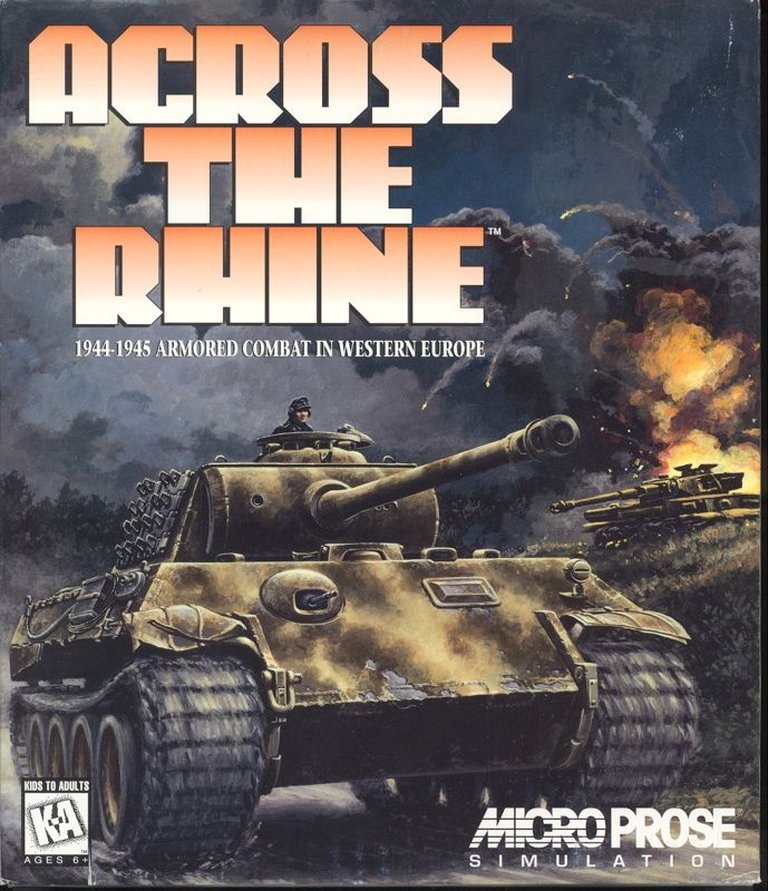
Across the Rhine: 1944-1945 Armored Combat in Western Europe is a real-time strategy and simulation game set during World War II, where players command tank battalions in battles ranging from the Allied invasion of Normandy to the Rhine crossings. Combining strategic overviews with direct, immersive tank control, the game features historically accurate and hypothetical scenarios, along with customizable realism settings for elements like ammo, fuel, and morale.
Gameplay Videos
Where to Buy Across the Rhine: 1944-1945 Armored Combat in Western Europe
PC
Across the Rhine: 1944-1945 Armored Combat in Western Europe Reviews & Reception
myabandonware.com : Dear Lord, what a letdown!
Across the Rhine: 1944-1945 Armored Combat in Western Europe: Review
Introduction: The Promise of Steel and the Reality of Fog
In the mid-1990s, the computer wargame landscape was a fertile ground for ambition. MicroProse, the studio synonymous with deep, systemic strategy and simulation thanks to Sid Meier and the Civilization and X-COM series, turned its gaze to the most iconic battlefield of the 20th century: the armored clashes of WWII’s Western Front. Across the Rhine (known in Europe as 1944: Across the Rhine) arrived in 1995 atop a wave of potent anticipation, marketed as the definitive World War II tank command experience—a spiritual successor to the acclaimed M1 Tank Platoon. It promised a seamless fusion of grand real-time strategy and visceral, first-person tank simulation, all underpinned by historical rigor and cutting-edge SVGA graphics. The reality, as contemporary reviews reveal, was a game of profound and fascinating contradictions. This review will argue that Across the Rhine stands as a monumental, deeply flawed experiment—a title whose audacious vision to merge two distinct genres was ultimately undermined by technical limitations, a misjudged core mechanic, and an identity crisis, yet which contains within its jagged frame some of the most thoughtful and historically grounded design ever attempted in the medium. It is not the classic its previews promised, but it is a critical case study in the perils and pleasures of overreaching design.
Development History & Context: MicroProse’s Costly Gamble
The Studio and the Vision: Across the Rhine was developed by MPS Labs, an internal MicroProse team responsible for several of the company’s simulation titles. The project was led by a design team including Christopher Clark, James M. Day, Tim Goodlett, and Chris Hewish—names associated with the technical and design pedigree of MicroProse’s simulation wing. The primary external consultant was Brigadier General A. F. Irzyk (Ret.), former commander of the 8th Tank Battalion in Patton’s 3rd Army. His involvement was a major marketing point, promising authentic tactical doctrine.
The 1994-95 Gaming Landscape: The game was conceived during the explosive rise of the real-time strategy (RTS) genre, catalyzed by Warcraft: Orcs & Humans (1994) and Command & Conquer (1995). Simultaneously, the military simulation market was thriving with titles like M1 Tank Platoon (1989) and Spectrum Holobyte’s Tank! (1994), which offered detailed, procedural vehicle interiors and ballistics. MicroProse’s ambition was to synthesize these trends: to create a real-time, large-scale tactical wargame where the player could seamlessly zoom from a strategic map down into the gunner’s sights of any single tank. This “one view to rule them all” concept was revolutionary on paper.
Technological Constraints and Hype: Developed for MS-DOS and targeting high-end systems with accelerated graphics cards, the game was a resource hog. Contemporary accounts (like those on My Abandonware and in PC Joker) frequently cite excessive loading times and performance issues as major obstacles. It was showcased at the 1994 Consumer Electronics Show (CES), generating significant buzz. The hype, as veteran wargamer M. Evan Brooks noted on My Abandonware, was immense: “This was the most anticipated wargame of 1993-1994.” This created an impossible expectations gap. Players anticipated a next-gen, M1 Tank Platoon-style deep tank sim. What they received was something else entirely—a hybrid that felt incomplete in both its strategy and simulation halves.
Narrative & Thematic Deep Dive: Briefings, Debriefings, and the Weight of History
Across the Rhine consciously eschews a traditional, character-driven narrative. There is no overwrought campaign story about a lone hero’s journey. Instead, its narrative is environmental, systemic, and documentary.
-
Structural Narrative: The game is organized into three campaigns (American, German, and a combined “What-If” Allied campaign) spanning from the Normandy breakout in mid-1944 to the crossing of the Rhine in early 1945. Each campaign is a series of discrete, historically-based battle scenarios, like the fight for Saint-Lô, the Battle of the Bulge, or Operation Market Garden. Some scenarios are pure history; others introduce hypothetical “what-if” situations, allowing the player to test alternate tactical decisions (e.g., what if German reinforcements had arrived earlier at a critical point?).
-
Thematic Core – The Tyranny of Tactics: The central theme is the devastating, claustrophobic, and relentless nature of armored warfare. The narrative is delivered not through cutscenes, but through the 40-minute companion documentary CD included with the original release. Produced by award-winning documentary filmmaker Lou Reda, this film uses archival footage, maps, and expert commentary to frame the historical context of each campaign. This audio-visual primer primes the player for the grim, methodical brutality of the battles. The game’s briefings and debriefings, delivered in a stark, military text format, reinforce this. They coldly report casualties, objectives achieved or failed, and promotions earned. There is no glory, only duty and consequence.
-
The Player as Promoted protagonist: The only persistent “character” is the player-created soldier. Starting as a Sergeant, successful performance in battles leads to promotion, eventually putting the player in command of a company or battalion. This RPG-lite element creates a personal stake and a career arc, transforming the player from a tactical executor to a strategic commander. It’s a brilliant attempt to provide continuity across disparate battles, grounding the grand strategy in a personal progression. The medals and ranks are historically accurate, adding to the authentic atmosphere.
-
Absence of Grand Strategy: Crucially, the narrative makes it clear that the player cannot change the outcome of the war. You are a cog in a vast machine, managing your sector of the front. This is a narrative of constrained agency, reflecting the historical reality that while tactical victories were possible, the strategic tide turned on factors far beyond a single battalion’s control. This design choice is thematically resonant but was a point of frustration for players expecting a grander sandbox.
Gameplay Mechanics & Systems: The Unworkable Synthesis
This is where Across the Rhine‘s revolutionary ambition collides violently with its execution, creating a gameplay experience that is at once mesmerizing and maddening.
-
The Dual-Perspective, Real-Time Interface: The game’s signature feature is its freely arrangeable multi-window interface. Players can split their screen into a strategic map (top-down, showing unit icons and terrain), a tactical zoomed-in map, and one or more first-person 3D views from any tank in their command (driver, gunner, commander perspectives). All commands are issued in real-time via point-and-click menus from any window. You can issue an advance order from the map, then instantly switch to the gunner’s view of your lead tank to personally engage the first enemy spotted. This seamless scale-shifting was technically impressive for 1995.
-
The Fatal Flaw: The Platoon-as-Unit Model: The core, deal-breaking design decision is that each “unit” on the map represents an entire tank platoon (typically 4-5 tanks), not an individual vehicle. As the Steam user review succinctly states: “When you see a tank in the 1st person view the tank represents a platoon.” This has catastrophic consequences for both gameplay pillars:
- For the Strategy Layer: You cannot maneuver individual vehicles. Ordering a platoon to “move” moves the whole formation as a single blob. Flanking, hull-down positioning, and precise tactical spacing are impossible at the unit level. The strategy devolves into managing formation blobs on a map, a blunt and unsatisfying affair.
- For the Simulation Layer: When you take a first-person view, you are not controlling a single tank; you are controlling the “viewpoint” of the platoon leader’s tank. The rest of your platoon follows AI scripts. Your gunner’s sight does not correspond to a discrete vehicle in the world, but to a representative unit. This utterly destroys the immersion and precision expected of a tank simulator. You cannot track a specific enemy tank or feel the vulnerability of a single machine. You are a ghost commanding ghosts.
-
AI and Command Issues: The AI for platoon movement and combat was widely panned. PC Joker called the command system “hakelig” (jumpy/awkward), and Power Play noted that in large battles, the real-time nature meant you “get so sweaty you can only monitor a fraction of your own units.” Orders were often ignored or poorly executed. The “platoon combat system” was, as one My Abandonware commenter noted, “the only downfall,” but it was a downfall that infected every aspect of the game.
-
Progression and Customization: The promotion system is well-conceived but hampered by the platoon model. Earning command of more units simply means managing larger, more unwieldy blobs. The realism settings (manual fuel, limited ammo, morale, air support, invulnerability) are a strong point, allowing players to tailor the experience from a brutal hardcore sim to a more forgiving strategy game. However, toggling these settings often couldn’t overcome the fundamental flaw of the unit abstraction.
-
The Learning Curve: As Computer Games Strategy Plus noted, the game has a “very steep learning curve.” The dense, 400-page manual (praised by many as historically excellent) is not for optional reading; it’s a necessity. The interface, while customizable, is information-dense and unintuitive. Players would invest hours only to discover the core tactical model was fundamentally unsatisfying.
World-Building, Art & Sound: A Gritty, Authentic Window
If the gameplay is fractured, the presentation is largely cohesive and atmospheric, successfully evoking the Western Front of 1944-45.
-
Visual Design & Atmosphere: The game uses SVGA graphics (supporting up to 1024×768) with texture-mapped 3D polygons for the tank interiors and external models. For its time, the tank models—M4 Shermans, M18 Hellcats, Pzkwfg IVs, Tigers—are detailed and authentic, with correct markings, camouflage patterns, and accurate shapes. The environments, depicting the bocage of Normandy, the forests of the Ardennes, and the towns of Germany, are rendered with a * utilitarian, map-like clarity. The color palette is muted—greys, browns, olive drabs—enhancing the grim, war-torn feel. The *user interface windows have a clean, functional, “wartime briefing” aesthetic with semi-transparent backgrounds, keeping the battlefield visible. Explosions, smoke, and tank damage are effectively portrayed, though sometimes simplistic.
-
Sound Design: Sound is a strong suit. Michael Bross’s soundtrack and effects create a palpable sense of tension. The deep rumble of a Panther’s engine, the clatter of treads, the sharp crack of a 75mm gun, and the distant thunder of artillery are all present and effective. Radio chatter, though limited, adds to the immersion. The sound design, combined with the visuals, does its job of placing the player in a noisy, dangerous battlefield.
-
The Documentary CD: This is the game’s secret weapon in world-building. The 40-minute Lou Reda documentary provides crucial historical context through real footage and expert analysis. It’s not just an extra; it’s an integral part of the educational package, framing the player’s tactical struggles within the larger, tragic arc of the campaign. This commitment to historical authenticity, separate from gameplay, is commendable and rare.
Reception & Legacy: A Scandalous Failure and a Cult Curiosity
-
Critical Reception at Launch: The reviews were polarized and largely negative, with a Metacritic-esque average of 70% masking deep divisions.
- The Positives: German magazines like PC Games (85%) and Play Time (85%) praised its complexity, historical detail, and the ambitious blend of views. They saw it as a serious tool for the dedicated wargamer.
- The Negatives: The English-language press was brutally harsh. Computer Gaming World (40%) delivered a scathing takedown, accusing MicroProse of “betraying the trust of gamers by creating false expectations” and marketing it as a simulation it clearly was not, comparing it unfavorably to M1 Tank Platoon. Power Play (52%) declared the core gameplay “missgeboren” (miscarried/botched), stating the simulation was unusable and the strategy layer unmanageable. PC Joker (63%) called the genre hybrid a failure that satisfied neither sim fans nor strategists.
- The Common Critique: Almost every review identifies the same core problem: the failed merger of simulation and strategy. The platoon-unit abstraction crippled both sides of the intended experience. Technical issues (long load times, demanding system requirements) compounded the frustration.
-
Commercial Performance & Legacy: The game was not a commercial blockbuster. Its high system requirements and niche appeal limited its reach. However, it has maintained a small, devoted cult following. Its re-releases on GOG.com ($1.19) and Steam (via Night Dive/Atari), bundled in collections like the “Classic War Pack,” attest to a persistent, if quiet, demand. Modern user reviews on Steam are “Mostly Positive” (73%), with a significant gap between nostalgic appreciation (“I played the hell out of this game back in the day”) and modern frustration (“not for me, even for a retro gamer”).
-
Influence on the Industry: Across the Rhine’s direct influence is minimal. Its specific design—the platoon-as-unit model in a real-time tactical space—was not adopted by later titles. It served more as a cautionary tale about the dangers of over-ambitious genre fusion without a rock-solid core mechanic. Its true legacy lies in its historical integration efforts. The use of a real general as consultant, the inclusion of a serious documentary, and the painstaking research in the manual foreshadowed the later, more successful trend of “educational entertainment” and serious historical simulation seen in series like Company of Heroes (with its in-game encyclopedia) or the deep dive into historical doctrine in the Combat Mission series. It proved there was an audience for this depth, even if the gameplay vessel was flawed.
Conclusion: A Flawed Monument to Ambition
Across the Rhine is not a good game by most conventional metrics. Its central mechanical conceit—the platoon-as-unit model—fatally undermines its stated goals, creating a persistent sense of abstraction and disconnection. The interface is cumbersome, the AI is unreliable, and theReal-time strategy layer is often a frantic, imprecise mess. It failed to satisfy the tank sim crowd or the RTS crowd, a catastrophic positioning for a niche title.
Yet, to dismiss it entirely is to miss its fascinating, historical significance. It is a monument to a specific, ambitious moment in game design history when studios like MicroProse were willing to risk everything on a grand synthesis. Its commitment to historical authenticity is breathtaking for its era, from the meticulously researched manual to the included documentary. Thematically, it captures the impersonal, industrial horror of armored warfare in a way few games attempt.
Its modern reappraisal is nuanced. As a historical curiosity, it is essential. As a playable game, it is a deeply frustrating, often bewildering experience that requires immense patience to extract any satisfaction from. It is a game that promises the visceral thrill of Saving Private Ryan‘s tank battle and delivers a clunky, board-game-like abstraction. But in that failed translation lies a valuable lesson: that genre boundaries exist for a reason, and that a brilliant design on paper must be stress-tested on the unforgiving grid of actual gameplay.
Final Verdict: Across the Rhine is a 6/10—a fascinating, deeply flawed artifact. It is not the classic it aspired to be, but it is an important, respect-worthy failure. For historians of game design, it is a must-study case. For the modern player, it is a curiosity best approached with lowered expectations, an appreciation for its historical scaffolding, and a willingness to forgive its broken promises. It occupies a unique place: the ambitious, troubled bridge between the solo tank sims of the late 80s/early 90s and the squad-based tactical shooters and RTS games that would later dominate the WWII genre. It did not succeed in its mission, but its failed charge across the Rhine of game design remains a compelling story nonetheless.