
- Release Year: 2014
- Platforms: Windows
- Publisher: Qumaron, rondomedia Marketing & Vertriebs GmbH
- Developer: Realore Studios
- Genre: Strategy, Tactics
- Perspective: Diagonal-down
- Game Mode: Single-player
- Average Score: 87/100
Description
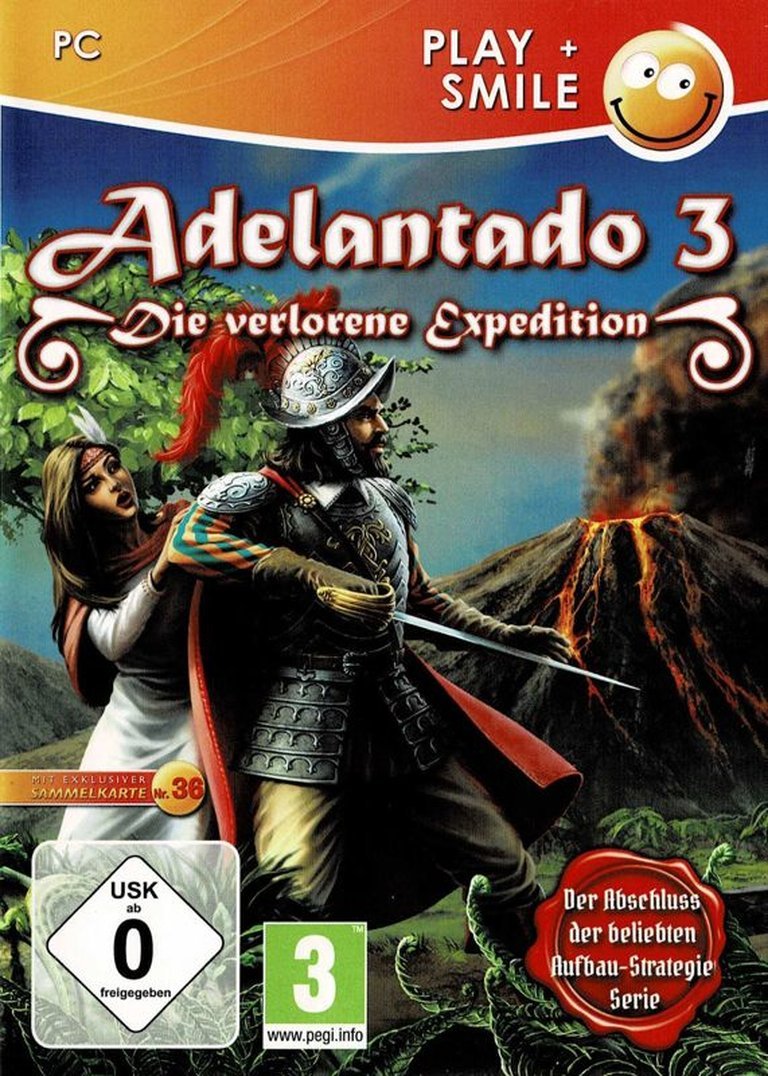
Adelantado Trilogy: Book Three is a strategy and tactics game set in the historical era of Spanish exploration, where players assume the role of an adelantado leading an expedition through the uncharted territories of the New World. The game challenges players with resource management, tactical decision-making, and point-and-click exploration in a diagonal-down isometric view, as they navigate diverse and hazardous environments like lost worlds, ancient caves, and volcanic islands, all while uncovering hidden secrets and confronting mysterious threats across episodic chapters.
Gameplay Videos
Where to Buy Adelantado Trilogy: Book Three
PC
Adelantado Trilogy: Book Three Free Download
Adelantado Trilogy: Book Three Guides & Walkthroughs
Adelantado Trilogy: Book Three Reviews & Reception
gametop.com (80/100): Adelantado Trilogy: Book Three is a satisfying conclusion to the series, offering the same engaging time management and exploration gameplay that fans have come to love.
Adelantado Trilogy: Book Three: A Historian’s Final Dispatch from the New World
Introduction: The Last Ship Sails
In the vast, often-overlooked archipelago of the casual time-management and strategy genre, few series maintained a steady course for as long as Realore’s Adelantado. Spanning a trilogy and a thematic successor, these games distilled the Age of Discovery into a compulsive loop of resource gathering, settlement building, andNative diplomacy. Adelantado Trilogy: Book Three, released in 2014 (with a later Steam re-release in 2017), serves as the narrative and mechanical capstone to this journey. It is not a game that reinvented its genre, nor one that sought critical acclaim from hardcore audiences. Instead, it represents a steadfast commitment to a proven, accessible formula—a final chapter that prioritizes satisfying closure over revolutionary design. This review will argue that Book Three‘s true significance lies in its role as a polished, competent, and ultimately faithful conclusion to a niche but enduring series, embodying the early-2010s golden age of downloadable casual strategy games. It is a game less about groundbreaking mechanics and more about delivering a predictable, comforting, and complete experience for its dedicated player base.
Development History & Context: From Realore to Qumaron, and the Casual Crusade
The Adelantado trilogy was the brainchild of Realore Studios, a Russian developer with a clear specialty: accessible, story-driven time-management games. Their earlier Roads of Rome series had established their core gameplay DNA—a hybrid of resource management (food, wood, gold), construction, and light questing within a historical setting. The first two Adelantado books (2012, 2013) refined this template, applying it to a fictionalized Spanish conquest of the Americas, starring the noble officer Don Diego de León.
Book Three presents a fascinating development footnote: while it concludes the story conceived by Realore, its actual release was handled by Qumaron. The Steam store page and modern distribution list Qumaron as both developer and publisher, suggesting a transition in the series’ stewardship, possibly after Realore’s original trilogy arc was complete. This handoff mirrors the broader industry trend of the early 2010s, where established casual game studios (like Realore, Alawar, or Melesta) would often see their properties picked up by other mid-sized European publishers (like rondomedia or, here, Qumaron) for continued support and re-releases on emerging digital platforms like Steam.
Technologically, the game was built on a proprietary engine typical of its ilk—a 2D, isometric (diagonal-down perspective) engine capable of handling sprites for workers, buildings, and environments. The system requirements (Pentium III 800MHz, 256MB RAM) were minimal, targeting the broadest possible audience, including those on older PCs and, later, mobile devices. The game’s release landscape was the heyday of the “casual renaissance” on PC, where portals like Big Fish Games and Steam’s own “Casual” category thrived on precisely this type of content. Adelantado Trilogy: Book Three arrived not as a pioneer, but as a seasoned veteran of this battlefield, relying on name recognition and a loyal fanbase rather than trying to capture new headlines.
Narrative & Thematic Deep Dive: The Final Expedition
The narrative of Book Three is a direct continuation, picking up with Don Diego de León stranded atop a high cliff, having discovered a stone that chronicles the land’s ancient history. His mission—to find the lost Spanish expedition—remains paramount, but the scope expands. The journey now leads toward a “gigantic volcano visible afar,” introducing a more mythic, almost Lovecraftian undertone to the setting (“beautiful but dangerous inhabitants,” “never-before-seen creatures”). The plot is structured across 10 chapters (levels, referred to in the community guide as Part 1 & 2, each with multiple chapters), each presenting a new biome and a discrete story beat: rescuing survivors, appeasing or combating native tribes, confronting Neanderthal-like threats, and uncovering the secrets of ancient ruins.
Characters remain archetypal. Don Diego is the unwavering, paternalistic leader—the “noble Adelantado.” His crew is a collective of loyal helpers with no individual depth. Antagonists are environmental (volcanoes, ravines), primal (hostile tribes, Neanderthals), or bureaucratic (the ever-present, scheming Commander Rodriguez, mentioned in the series synopsis for Book Two and implied to continue his rivalry). The dialogue is functional, delivered through text boxes during mission briefings and in-game events, serving to progress objectives rather than develop character.
Thematically, the game sits in a problematic but largely unexamined space. It lightly touches on colonization (building forts, “helping” locals, claiming gold for the Spanish Crown) but filters it through a harmless, “noble explorer” lens. The “natives” are presented as potential allies or obstacles, not as agents of their own destiny. The more compelling, albeit superficially explored, theme is archaeological mystery. The ancient stones, portals, and strange creatures suggest a lost, advanced civilization—a “mysterious land” trope that sidelines historical accuracy for fantastical adventure. This is not a game about the brutal realities of conquest but about the pulpy, romanticized fantasy of discovering a hidden world. The conclusion, implied by the trilogy’s end and the protagonist’s ultimate goal, is one of triumphant completion—the lost expedition is found, the land’s secrets are partially unveiled, and Don Diego’s epic travel is complete.
Gameplay Mechanics & Systems: The Refined Grind
Book Three operates on a tightly looped core gameplay cycle:
1. Receive Objectives: Rescue X survivors, build Y structure, collect Z resources.
2. Manage Workers: Assign the limited number of crew members (the “workers”) to tasks: chop wood, mine gold/stone, build, repair, fight, or interact with special objects/NPCs.
3. Resource Chain: Gather basic resources (food from bushes/fields, wood from trees, stone/gold from mines) to construct buildings that enable more advanced tasks (e.g., a tavern to increase worker capacity, a warehouse for storage, special altars that grant buffs like “double productivity”).
4. Explore & Discover: Navigate the map to find hidden secrets (see below), trigger story events, and unlock new areas via clearing obstacles (rocks, vines, broken bridges).
5. Complete & Repeat: Finish objectives to end the level, often with a grade (though not explicitly stated in sources), and unlock the next.
Combat & Conflict is simplistic. Workers can be clicked on hostile creatures (Neanderthals, wild animals) to fight them in a auto-attack exchange. There is no tactical positioning or complex systems; it’s a resource drain where you sacrifice worker time for safety. Progression is level-based. Each of the 10 chapters is a self-contained map with its own set of buildings and resources to build from scratch. There is no persistent tech tree or carry-over of resources between levels. New features mentioned include “gigantic volcano” environments, “never-before-seen creatures,” and likely new building types or altar effects (like the “speed altar” mentioned in the secrets guide). The “improved graphics” touted by Qumaron are relative to the earlier books, featuring more detailed sprites and colorful, lush environments.
The game’s most defining systemic feature is its secrets hunt. As meticulously documented in the Steam guide, each level contains a dozen or more hidden objects (pages, rocks, buried treasure, tablets) that are often placed in obscure corners, under bushes, or behind destructible cracks. Finding them requires exhaustive exploration and keen observation. This system does not impact the core objectives but provides completionist goals and a sense of rewarding discovery, effectively adding a metagame of “pixel-hunting.” This design philosophy—a primary loop with a secondary layer of completionism—is classic for the genre.
The UI is straightforward: a bottom panel for worker assignment, a resources display, and a minimap/radar. Its simplicity is a strength, avoiding complexity that would alienate the core casual audience. The main flaw inherent to the design is repetitiveness. The core loop of “click-gather-click-build” remains identical across all 10 levels, differentiated only by map layout, resource nodes, and specific objectives. For players who enjoy this meditative grind, it’s perfect; for others, it will feel exceedingly samey.
World-Building, Art & Sound: A Vibrant, Functional Tapestry
The game’s setting is a fictionalized, romanticized Spanish Main—a mosaic of dense jungles, ancient ruins, volcanic highlands, ravines, and native villages. It avoids specific historical geography, opting for a “Lost World” aesthetic where dinosaurs (or similar creatures) and Neanderthals can plausibly exist. This world-building prioritizes playful adventure over authenticity. The atmosphere is one of serene danger: beautiful landscapes punctuated by threats in the bushes.
The visual direction is characterized by bright, saturated colors. The jungle greens are lush, the gold glints enticingly, and the native structures have a stylized, almost cartoonish quality. Character and creature designs are simple but expressive. While primitive by 2020s standards, the art served its purpose in 2014: to be clear, cheerful, and instantly readable at a glance on small monitors or mobile screens. The “improved graphics” over the first two books are noticeable in the increased detail of environments and animations, but the engine limitations are still apparent.
Sound design follows the casual game template. The soundtrack is light, adventurous, and often melodic, using flute and string motifs to evoke exploration and discovery. It is non-intrusive, designed to fade into the background as the player focuses on tasks. Sound effects are crisp and functional: the chop of an axe, the chime of collected gold, the grunt of a worker, the snarl of an enemy. They provide necessary audio feedback for every action, reinforcing the game’s compulsive, task-oriented feedback loop. Together, the audiovisual package creates a cohesive, low-stress, and aesthetically pleasant experience that perfectly complements the mundane-actually-magical gameplay.
Reception & Legacy: A Niche Triumph and a Quiet Conclusion
At launch, Adelantado Trilogy: Book Three existed almost entirely outside the critical spotlight. As evidenced by Metacritic, there are no compiled critic reviews for the primary PC version. This is not an anomaly but the norm for the mid-to-late 2010s casual strategy genre, which operated on different review channels (portals like Big Fish, casual gaming blogs) and relied more on word-of-mouth and series loyalty.
Its commercial and community reception is best gauged through user platforms. On Steam, it holds a “Very Positive” rating (93% of ~30 reviews) with a Player Score of 94/100 on aggregators like Steambase. Reviews consistently praise its relaxing, engaging gameplay, charm, and value. The 2 negative reviews cited (from the ~31 total) typically mention minor bugs or the repetitive nature, not fundamental flaws. The presence of an active community guide dedicated to locating all 150+ secrets (spanning Part 1 & 2) is a testament to its dedicated player base willing to engage deeply with its completionist aspects.
Its legacy is twofold:
1. Series Finale: It successfully concludes the narrative arc of Don Diego de León and the core Adelantado trilogy. The 2018 release of Adelantado 4: Aztec Skulls, developed by Qumaron and shifting focus to a new protagonist (Master Miguel Sanchez) and a priest/demon plotline, confirmed that Book Three was the end of an era. It closed the book on Realore’s vision.
2. Genre Artifact: It stands as a polished example of the time-management/strategy hybrid genre at a time of its mainstream casual popularity. It did not innovate, but it executed its formula with competence and charm. Its influence is indirect—it is part of the continuum that includes Roads of Rome, Northern Tale, and Viking Brothers, establishing a template of “historical/fantasy theme + resource loop + map secrets” that many successors would follow. As of 2025, the series is noted as “dead” by observers, a casualty of the shifting casual market towards mobile hyper-casual and more complex PC indie titles.
Conclusion: A Worthy Last Voyage
Adelantado Trilogy: Book Three is not a hidden gem waiting to be rediscovered by the masses. It is, instead, a testament to the value of consistency and completion. For the player who journeyed through Books One and Two, Book Three delivers a familiar, comfortable, and satisfying conclusion. It expands the environmental palette, introduces new mysteries, and provides the expected 10 levels of compulsive, low-stakes strategy. Its mechanics are sound, its art is pleasant, and its secrets provide ample reason for thorough exploration.
Critically, its weaknesses are the genre’s weaknesses: repetition, shallow narrative, and a colonial fantasy lens that goes unexamined. Yet, to judge it by the standards of a narrative RPG or a grand strategy title is to miss its point. It aims to be a pleasant way to spend an afternoon, a game to play with one hand while listening to a podcast, and in that specific design goal, it succeeds admirably.
Final Verdict: Adelantado Trilogy: Book Three is a solid, if unspectacular, genre entry. It earns its keep through reliable execution, a complete package (including a robust secrets system), and steadfast loyalty to the series’ established identity. Its place in history is not as a landmark but as a reliable compass—one that pointed fans of Realore’s formula safely to the trilogy’s long-awaited shore. For historians of the casual strategy genre, it is a perfect case study in iterative, audience-focused design. For contemporary players, it remains a pleasant, if dated, time capsule of a quieter, more methodical kind of adventure.