
- Release Year: 1995
- Platforms: Windows
- Publisher: Christian Carrillo
- Developer: Christian Carrillo
- Genre: Action
- Perspective: 1st-person
- Game Mode: Single-player
- Gameplay: Shooter
- Setting: Futuristic, Sci-fi
- Average Score: 86/100
Description
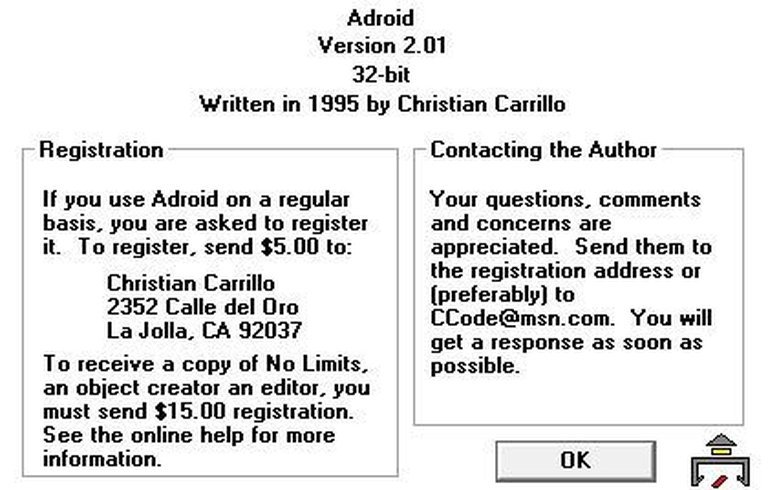
Adroid is a 1995 shareware first-person shooter set in a futuristic world dominated by five powerful corporations. As the only company without advanced technology, the player is tasked with piloting the newly developed Adroid ship to fend off attacks from the rival ‘Big Four’ corporations. The game features mouse-controlled movement and shooting, with the objective of destroying enemy ships and collecting flags to score points, though each laser shot deducts a point, adding a strategic twist to the combat.
Adroid Free Download
PC
Adroid Reviews & Reception
metacritic.com (86/100): Brilliant graphics and animation provide a strong cartoon feel, while the voice acting is powerful and cinematic.
Adroid: A Forgotten Relic of the Shareware Era
Introduction
In the vast, ever-expanding universe of video games, some titles fade into obscurity, becoming little more than footnotes in the annals of gaming history. Adroid, a 1995 shareware shooter developed by Christian Carrillo, is one such title. Released during a pivotal year in gaming—when the industry was transitioning from 16-bit consoles to 32-bit powerhouses like the PlayStation and Sega Saturn—Adroid emerged as a modest, niche experiment in first-person space combat. While it lacked the polish and ambition of its contemporaries, it offers a fascinating glimpse into the creative spirit of indie developers during the mid-1990s.
This review aims to resurrect Adroid from the digital archives, examining its development, gameplay, and legacy within the broader context of 1995’s gaming landscape. Though it may not have left a lasting mark on the industry, Adroid serves as a testament to the ingenuity of solo developers and the enduring appeal of shareware as a distribution model.
Development History & Context
The Birth of a Solo Project
Adroid was the brainchild of Christian Carrillo, a lone developer working in an era when indie game creation was far more arduous than today. Unlike modern indie developers who can leverage engines like Unity or Unreal, Carrillo built Adroid from the ground up, likely using basic programming tools available at the time. The game’s existence is a testament to the passion and determination of solo creators who sought to carve out a space in an industry dominated by corporate giants like Nintendo, Sega, and Sony.
The shareware model, which allowed players to try a portion of the game for free before purchasing the full version, was a popular distribution method in the 1990s. It provided indie developers like Carrillo with a way to reach audiences without the need for expensive retail distribution. Adroid’s release as shareware reflects the democratizing potential of this model, even if it ultimately failed to gain significant traction.
The Gaming Landscape of 1995
1995 was a watershed year for video games, marked by the rise of 3D graphics, the decline of 16-bit consoles, and the emergence of new genres. The year saw the release of iconic titles such as Chrono Trigger, Donkey Kong Country 2: Diddy’s Kong Quest, and Tekken 2, all of which pushed the boundaries of what was possible in gaming. Meanwhile, the PlayStation and Sega Saturn were locked in a fierce battle for dominance in the 32-bit era, while the Nintendo 64 loomed on the horizon.
Against this backdrop, Adroid was a humble offering. It lacked the graphical fidelity of console titles and the depth of storytelling found in RPGs like Chrono Trigger. Instead, it was a straightforward, arcade-style shooter designed for quick bursts of gameplay—a far cry from the immersive experiences that were beginning to define the medium.
Technological Constraints
The limitations of 1995’s hardware are evident in Adroid’s design. The game’s first-person perspective and mouse-controlled movement were innovative for a Windows-based shooter, but the lack of dedicated 3D acceleration meant that the visuals were rudimentary by modern standards. The game’s reliance on simple polygons and flat textures reflects the technological constraints of the era, where even high-end PCs struggled to render complex 3D environments.
Despite these limitations, Adroid’s controls were surprisingly intuitive for the time. The use of mouse movement for navigation and strafing was a precursor to the control schemes that would later become standard in first-person shooters. However, the absence of keyboard support for movement—a common feature in contemporary shooters like Doom—made the controls feel somewhat clunky and restrictive.
Narrative & Thematic Deep Dive
A Corporate Dystopia in Space
Adroid’s backstory is a product of its time, reflecting the cyberpunk and corporate dystopia themes that were popular in the 1990s. The game is set in a future where five megacorporations dominate the galaxy, wielding immense power and influence. The player’s company, the underdog of the group, has developed a revolutionary starship known as the Adroid to challenge the dominance of the “Big Four.”
The narrative is minimalistic, serving primarily as a backdrop for the gameplay rather than a driving force. The player’s mission is simple: survive waves of enemy ships sent by the rival corporations to destroy the Adroid. There are no complex characters, branching storylines, or moral dilemmas—just a straightforward struggle for survival in a hostile universe.
Themes of Isolation and Survival
At its core, Adroid is a game about isolation and survival. The player is alone in the vastness of space, facing overwhelming odds with nothing but their wits and the Adroid’s limited firepower. This theme of solitude is reinforced by the game’s lack of allies or NPCs, creating a sense of vulnerability that is central to the experience.
The game’s scoring system, which penalizes players for each shot fired, adds an additional layer of tension. Unlike most shooters, where players are encouraged to unleash a barrage of bullets, Adroid rewards precision and restraint. This mechanic subtly reinforces the theme of resource scarcity, forcing players to carefully consider each shot in a world where every action has consequences.
Dialogue and Character Development
Adroid’s narrative is conveyed through a brief text-based introduction, with no in-game dialogue or character interactions. The absence of voice acting or cutscenes is a reflection of the game’s modest scope and budget, but it also contributes to the sense of isolation that permeates the experience. The player is truly alone, with no companions or allies to rely on—just the cold, unfeeling void of space.
Gameplay Mechanics & Systems
Core Gameplay Loop
Adroid’s gameplay is deceptively simple. The player controls the Adroid starship, navigating through a 3D environment while engaging in combat with enemy vessels. The primary objective is to destroy enemy ships and collect flags, which serve as the game’s scoring mechanism. Each flag collected awards points, while each shot fired deducts a point—a unique twist that encourages strategic play over mindless shooting.
The game’s controls are entirely mouse-based, with the player moving the cursor to navigate and clicking to fire the ship’s laser. Strafing is achieved by holding down the mouse button while moving the cursor, a mechanic that feels intuitive once mastered but can be awkward for players accustomed to keyboard controls.
Combat and Progression
Combat in Adroid is straightforward but challenging. Enemy ships appear in waves, each with distinct movement patterns and attack behaviors. The player must dodge incoming fire while positioning themselves to land precise shots, all while managing the game’s unusual scoring system.
Unlike many shooters of the era, Adroid lacks a traditional progression system. There are no power-ups, weapon upgrades, or new abilities to unlock. Instead, the game’s difficulty scales with the player’s skill, as enemy waves become increasingly aggressive and numerous. This lack of progression may feel limiting to modern players, but it also creates a pure, unadulterated test of reflexes and strategy.
User Interface and Feedback
The game’s UI is minimalistic, with a simple HUD displaying the player’s score and remaining lives. There are no maps, radar systems, or detailed enemy tracking—just the player, their ship, and the endless expanse of space. This stripped-down approach reinforces the game’s focus on raw gameplay, but it also makes navigation and enemy detection more challenging than in more polished titles.
One of the most notable aspects of Adroid’s design is its lack of audio feedback. There are no sound effects for firing weapons, enemy explosions, or even background music. This absence of audio cues, while likely a result of technical limitations, further enhances the game’s sense of isolation. The silence of space is palpable, creating an eerie atmosphere that is both immersive and unsettling.
World-Building, Art & Sound
A Barren Cosmic Playground
Adroid’s setting is a stark, featureless void, with no planets, stars, or celestial bodies to provide context or visual interest. The game’s environments are little more than empty 3D spaces, populated only by the player’s ship and the enemy vessels. This minimalist approach to world-building is a far cry from the rich, detailed universes of contemporary space shooters like Wing Commander or X-Wing, but it also serves to highlight the game’s focus on pure gameplay.
The lack of environmental detail is likely a result of the technological constraints of the era, but it also contributes to the game’s sense of isolation. The player is adrift in an endless, featureless expanse, with no landmarks or points of reference to guide them. This barren cosmic playground is both a limitation and a strength, forcing the player to rely solely on their instincts and reflexes.
Visual Design: Simplicity Over Spectacle
Adroid’s visual design is functional rather than flashy. The game’s ships are rendered as simple polygons, with flat textures and basic color schemes. There are no elaborate animations, particle effects, or dynamic lighting—just clean, uncluttered visuals that prioritize clarity over spectacle.
The enemy ships are distinguishable primarily by their movement patterns and colors, with no unique designs or visual flourishes. This lack of variety may make the game feel repetitive over time, but it also ensures that the player can quickly identify and react to threats.
The Silence of Space
As mentioned earlier, Adroid is devoid of sound effects and music, a decision that is likely a result of technical limitations but also contributes to the game’s atmosphere. The absence of audio creates a sense of solitude and vulnerability, reinforcing the theme of isolation that permeates the experience.
While modern players may find the lack of sound jarring, it also serves as a reminder of the constraints under which indie developers operated in the 1990s. Without the resources to create complex audio systems, Carrillo focused on delivering a tight, responsive gameplay experience—a decision that ultimately defines Adroid’s identity.
Reception & Legacy
Critical and Commercial Reception
Adroid’s reception was muted, with the game failing to make a significant impact on the gaming community. As a shareware title released in an era dominated by high-profile console and PC games, it struggled to attract attention. There are no known contemporary reviews or sales figures, and the game has largely been forgotten in the decades since its release.
The lack of critical or commercial success is not surprising given the game’s modest scope and technical limitations. However, it is also a reflection of the challenges faced by indie developers in the 1990s, who often lacked the marketing resources and distribution channels needed to compete with larger studios.
Influence and Legacy
While Adroid may not have left a lasting mark on the gaming industry, it serves as a fascinating artifact of its time. The game’s use of mouse-based controls and first-person perspective was innovative for a Windows-based shooter, and its unique scoring system—penalizing players for each shot fired—was a bold departure from the norms of the genre.
In many ways, Adroid embodies the spirit of indie game development in the 1990s: a solo creator working with limited resources to bring a unique vision to life. While it may not have achieved commercial success, it stands as a testament to the creativity and determination of developers who sought to push the boundaries of what was possible in gaming.
The Shareware Model and Indie Development
Adroid’s release as shareware is a reminder of the importance of this distribution model in the history of indie gaming. Shareware allowed developers to bypass traditional retail channels, reaching audiences directly and building communities around their games. While the model has largely been replaced by digital storefronts like Steam and itch.io, its legacy lives on in the indie games that continue to thrive outside the mainstream.
Conclusion
Adroid is not a game that will be remembered alongside the classics of 1995, but it is a title that deserves recognition for its ambition and innovation. As a solo-developed shareware shooter, it represents the creative spirit of indie developers who sought to carve out a niche in an industry dominated by corporate giants. Its minimalist design, unique scoring system, and mouse-based controls make it a fascinating artifact of its time, offering a glimpse into the challenges and triumphs of game development in the mid-1990s.
While Adroid may not have achieved commercial success or critical acclaim, it stands as a testament to the enduring appeal of indie gaming. In an era where blockbuster titles and AAA studios dominate the landscape, games like Adroid serve as a reminder of the power of individual creativity and the importance of preserving gaming’s diverse history.
Final Verdict: Adroid is a forgotten relic of the shareware era, but its innovative mechanics and minimalist design make it a worthy subject of study for fans of gaming history. While it may not offer the depth or polish of modern shooters, it remains a fascinating glimpse into the creative spirit of indie developers in the 1990s.
Score: 5/10 – A flawed but intriguing experiment in first-person space combat.