
- Release Year: 1999
- Platforms: Windows
- Publisher: ROM POINT
- Developer: Motelsoft
- Genre: Compilation
- Game Mode: Single-player
Description
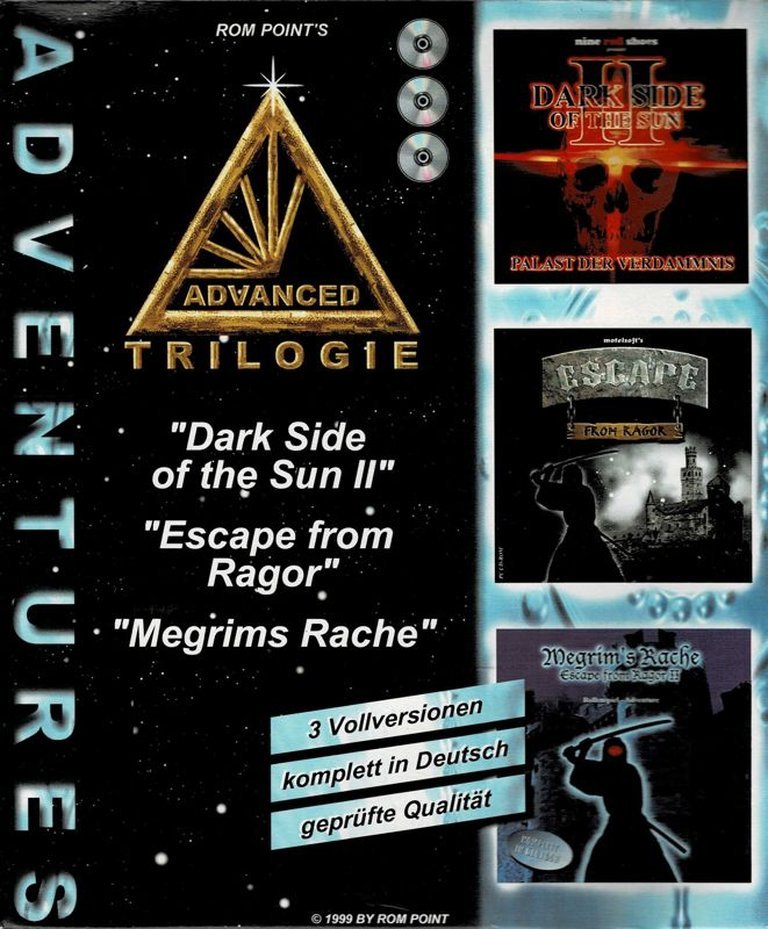
Advanced Trilogie: Adventures is a 1999 compilation of three German adventure games developed by Motelsoft, released exclusively for Windows. The collection includes Darkside of the Sun II: Palast der Verdammnis, Escape from Ragor, and Megrim’s Rache, each offering distinct narratives and gameplay experiences within the adventure genre. Published by ROM POINT, this commercial CD-ROM release bundles three standalone titles into a single package, catering to fans of classic point-and-click adventures and narrative-driven gameplay.
Advanced Trilogie: Adventures Reviews & Reception
retro-replay.com : Advanced Trilogie: Kartenspiele offers a trio of classic card experiences—Poker King, Royal Flush and Stammtisch Skat—each faithfully recreated for solo and multiplayer sessions.
Advanced Trilogie: Adventures: A Forgotten Gem of Late ’90s Adventure Gaming
Introduction
In the twilight years of the 20th century, as the adventure game genre stood at a crossroads between its golden age and the impending rise of 3D action titles, Advanced Trilogie: Adventures emerged as a quiet testament to the enduring appeal of classic point-and-click storytelling. Released in 1999 by the obscure German developer Motelsoft and published by ROM POINT, this compilation of three distinct adventure games—Darkside of the Sun II: Palast der Verdammnis, Escape from Ragor, and Megrim’s Rache—offers a fascinating snapshot of a genre in transition. While it may not have achieved the commercial success or critical acclaim of contemporaries like Grim Fandango or The Longest Journey, Advanced Trilogie: Adventures deserves recognition for its ambitious scope, atmospheric world-building, and unapologetic embrace of the adventure game traditions that defined the 1990s.
This review aims to dissect Advanced Trilogie: Adventures with the rigor it deserves, exploring its development context, narrative depth, gameplay mechanics, and lasting legacy. By examining each of its three constituent games in detail, we can uncover why this compilation remains a compelling artifact of its era—one that reflects both the strengths and limitations of late-’90s adventure gaming.
Development History & Context
The Studio Behind the Trilogy: Motelsoft’s Obscure Legacy
Motelsoft, the German studio responsible for Advanced Trilogie: Adventures, remains one of the more enigmatic developers of the late 1990s. Unlike industry giants such as Sierra On-Line or LucasArts, Motelsoft operated largely under the radar, producing a small but diverse catalog of games that spanned genres from adventure to strategy. Their output was primarily targeted at the German market, which may explain why their work has been overlooked in broader discussions of adventure game history.
The studio’s most notable trait was its willingness to experiment with unconventional themes and settings. While many adventure games of the era leaned into fantasy or sci-fi tropes, Motelsoft’s titles often explored darker, more psychological narratives. This is evident in Advanced Trilogie: Adventures, where each game delves into themes of isolation, revenge, and existential dread—topics that were not commonly tackled in mainstream adventure titles of the time.
Technological Constraints and the Late ’90s Adventure Scene
By 1999, the adventure game genre was undergoing a seismic shift. The rise of 3D graphics and real-time gameplay mechanics, exemplified by titles like Half-Life and Resident Evil, was beginning to overshadow the traditional point-and-click formula. Developers faced a choice: adapt to the new technological landscape or double down on the genre’s core strengths.
Motelsoft chose the latter. Advanced Trilogie: Adventures is a defiantly 2D experience, relying on pre-rendered backgrounds, pixel art, and a classic point-and-click interface. This decision was likely influenced by both budgetary constraints and a desire to cater to a niche audience that still cherished the genre’s roots. The result is a compilation that feels like a love letter to the adventure games of the early-to-mid ’90s, even as the industry was moving away from them.
The Compilation Format: A Marketing Strategy
The decision to release Advanced Trilogie: Adventures as a compilation was a savvy marketing move. Compilations were a common strategy in the late ’90s, allowing publishers to bundle multiple games into a single, cost-effective package. For Motelsoft, this approach provided an opportunity to showcase three distinct narratives under one umbrella, offering players a diverse range of experiences.
However, the compilation format also presented challenges. Each game within Advanced Trilogie: Adventures had its own unique tone, setting, and gameplay mechanics, which could lead to a disjointed experience for players expecting a cohesive trilogy. This lack of thematic unity may have contributed to the compilation’s limited commercial success, as it struggled to carve out a distinct identity in a crowded market.
Narrative & Thematic Deep Dive
Darkside of the Sun II: Palast der Verdammnis
Plot Overview:
Darkside of the Sun II is a direct sequel to an earlier Motelsoft title, though it stands well enough on its own. The game follows the protagonist, a hardened detective named Marcus Kane, as he investigates a series of gruesome murders in a dystopian city known as “The Palast der Verdammnis” (Palace of the Damned). The narrative unfolds like a noir thriller, with Kane uncovering a web of corruption, betrayal, and supernatural horrors lurking beneath the city’s surface.
Themes and Tone:
The game’s tone is unrelentingly bleak, drawing inspiration from cyberpunk and horror fiction. The city of Palast der Verdammnis is a character in its own right—a sprawling, decaying metropolis where the line between reality and nightmare blurs. Themes of moral ambiguity, existential despair, and the futility of justice permeate the story, making it one of the darker entries in the adventure game canon.
Characters and Dialogue:
Marcus Kane is a classic antihero, a detective whose cynicism and brutality are matched only by his determination to uncover the truth. The supporting cast is equally compelling, featuring a mix of corrupt officials, desperate civilians, and enigmatic figures who may or may not be supernatural entities. The dialogue is sharp and often laced with dark humor, though the English translation (if available) may have diluted some of its nuance.
Narrative Strengths and Weaknesses:
Darkside of the Sun II excels in creating a sense of dread and mystery. The story’s pacing is deliberate, allowing players to piece together the city’s secrets at their own pace. However, the game’s reliance on supernatural elements can feel jarring at times, particularly in a genre that often grounds its narratives in more tangible conflicts. Additionally, the lack of a strong emotional core—Kane’s motivations are largely professional rather than personal—can make it difficult for players to fully invest in his journey.
Escape from Ragor
Plot Overview:
Escape from Ragor shifts gears dramatically, offering a sci-fi survival horror experience. The player takes on the role of Dr. Elena Voss, a scientist stranded on a derelict space station orbiting the planet Ragor. As Voss explores the station, she uncovers evidence of a catastrophic experiment gone wrong, leading to the creation of grotesque, mutated creatures that now stalk the corridors.
Themes and Tone:
The game’s tone is one of claustrophobic terror, evoking comparisons to Alien and System Shock. Themes of scientific hubris, the ethics of experimentation, and the fragility of human life are central to the narrative. Unlike Darkside of the Sun II, which leans into noir, Escape from Ragor is a pure horror experience, with a focus on tension and survival.
Characters and Dialogue:
Dr. Voss is a more sympathetic protagonist than Marcus Kane, her vulnerability and intelligence making her a relatable figure. The supporting cast is minimal, consisting mostly of audio logs and holographic recordings that provide context for the station’s downfall. The dialogue is sparse but effective, with Voss’s internal monologues serving as the primary means of storytelling.
Narrative Strengths and Weaknesses:
Escape from Ragor’s greatest strength is its atmosphere. The space station is a masterclass in environmental storytelling, with each room offering clues to the disaster that unfolded. The game’s horror elements are well-executed, though they may feel dated by modern standards. The primary weakness lies in the lack of character interaction—Voss is largely alone for the duration of the game, which can make the experience feel isolating in a less engaging way.
Megrim’s Rache
Plot Overview:
Megrim’s Rache (Megrim’s Revenge) is the most unconventional of the three games, blending psychological horror with surrealist storytelling. The player assumes the role of an amnesiac protagonist who awakens in a nightmarish asylum, only to discover that the facility is under the control of a malevolent entity known as Megrim. As the protagonist explores the asylum, they uncover fragments of their past and the dark rituals that have taken place within its walls.
Themes and Tone:
The game’s tone is deeply unsettling, drawing inspiration from psychological horror and surrealist art. Themes of memory, identity, and the nature of reality are explored through a fragmented narrative that challenges players to piece together the truth. The asylum itself is a labyrinthine nightmare, filled with grotesque imagery and disturbing soundscapes.
Characters and Dialogue:
The protagonist is a blank slate, allowing players to project their own interpretations onto the character. The supporting cast consists of fellow inmates and asylum staff, each of whom is deeply disturbed in their own way. The dialogue is cryptic and often nonsensical, reflecting the game’s surrealist influences.
Narrative Strengths and Weaknesses:
Megrim’s Rache is the most ambitious of the three games, both narratively and thematically. Its surrealist approach to storytelling is bold and memorable, though it may alienate players who prefer more straightforward narratives. The game’s greatest weakness is its lack of clarity—some players may find the story too obscure to fully appreciate, particularly without additional context or multiple playthroughs.
Gameplay Mechanics & Systems
Core Gameplay Loops
Each game in Advanced Trilogie: Adventures adheres to the classic point-and-click adventure formula, with players interacting with the environment by examining objects, collecting items, and solving puzzles. However, the compilation introduces subtle variations on this formula to keep the experience fresh.
- Inventory Management: The inventory system is straightforward, with players able to combine items and use them in context-sensitive ways. However, the lack of a “use” cursor (a staple of LucasArts games) can lead to frustration, as players must manually try every item on every interactive object.
- Puzzle Design: The puzzles range from logical to esoteric, with Megrim’s Rache featuring some of the most abstract challenges. While this variety is commendable, it can also lead to inconsistency in difficulty, with some puzzles feeling arbitrary or unfair.
- Dialogue Trees: Dialogue is handled through branching conversations, though the lack of voice acting (a common limitation of the era) can make interactions feel stiff. The writing is strong, but the delivery suffers from the absence of vocal performances.
Combat and Character Progression
Unlike many adventure games of the era, Advanced Trilogie: Adventures incorporates light combat mechanics, particularly in Escape from Ragor and Megrim’s Rache. These sequences are rudimentary by modern standards, relying on simple point-and-click interactions rather than real-time action. While they add variety to the gameplay, they can feel clunky and out of place in a genre that typically eschews combat in favor of puzzle-solving.
Character progression is minimal, with no traditional RPG elements such as leveling or skill trees. Instead, progression is tied to narrative advancement and the acquisition of key items. This approach keeps the focus on storytelling but may leave players craving more tangible rewards for their efforts.
UI and Quality-of-Life Features
The user interface is functional but unremarkable, with a standard verb-based system (e.g., “look,” “take,” “use”) that will be familiar to fans of the genre. However, the lack of modern conveniences such as a hint system or an in-game map can make navigation and puzzle-solving more tedious than necessary. The absence of voice acting also detracts from the immersion, particularly in a compilation that relies so heavily on atmosphere.
World-Building, Art & Sound
Visual Design and Atmosphere
Advanced Trilogie: Adventures excels in creating distinct visual identities for each of its three games. The pre-rendered backgrounds are detailed and atmospheric, with Darkside of the Sun II’s noir-inspired cityscapes, Escape from Ragor’s claustrophobic space station, and Megrim’s Rache’s surreal asylum each offering a unique aesthetic. The pixel art, while dated, is expressive and effective in conveying the games’ tones.
The character designs are similarly varied, with Darkside of the Sun II featuring hard-boiled detectives and shadowy figures, Escape from Ragor showcasing grotesque mutations, and Megrim’s Rache presenting distorted, nightmarish visages. The art direction is consistently strong, though the technical limitations of the era are evident in the stiff animations and occasional pixelation.
Sound Design and Music
The sound design is a mixed bag. While the ambient soundscapes are effective in building tension—particularly in Escape from Ragor and Megrim’s Rache—the lack of voice acting is a noticeable omission. The music, composed of synth-heavy tracks, is atmospheric but repetitive, with some themes overstaying their welcome during extended play sessions.
Reception & Legacy
Critical and Commercial Reception
Advanced Trilogie: Adventures was released to little fanfare in 1999, a year that saw the adventure genre overshadowed by the rise of 3D action games. The compilation received minimal critical attention, with most reviews focusing on its individual components rather than the package as a whole. While it developed a small but dedicated following in Germany, it failed to make a significant impact on the global stage.
Influence and Lasting Impact
Despite its obscurity, Advanced Trilogie: Adventures is a fascinating artifact of its era. Its willingness to explore dark, mature themes and its defiant adherence to 2D adventure mechanics make it a standout example of a genre in transition. While it may not have influenced subsequent games directly, it serves as a reminder of the creativity and ambition that defined the late ’90s adventure scene.
Conclusion: A Flawed but Fascinating Relic
Advanced Trilogie: Adventures is not a perfect compilation. Its disjointed narrative structure, inconsistent puzzle design, and dated presentation may deter modern players accustomed to the polish of contemporary titles. However, for those willing to engage with it on its own terms, it offers a rich and rewarding experience—one that captures the essence of late ’90s adventure gaming in all its flawed glory.
Final Verdict: 7.5/10 – A compelling but niche compilation that rewards patience and a love for classic adventure mechanics.
For fans of the genre, Advanced Trilogie: Adventures is a hidden gem worth uncovering. For everyone else, it serves as a reminder of a time when adventure games dared to be dark, surreal, and unapologetically ambitious.