
- Release Year: 2009
- Platforms: Windows
- Publisher: Freeware / Free-to-play / Public Domain
- Developer: halcun, slash000
- Genre: Action
- Perspective: Diagonal-down
- Game Mode: Single-player
- Gameplay: Key collection, Maze navigation, Randomized item locations
- Setting: Fantasy
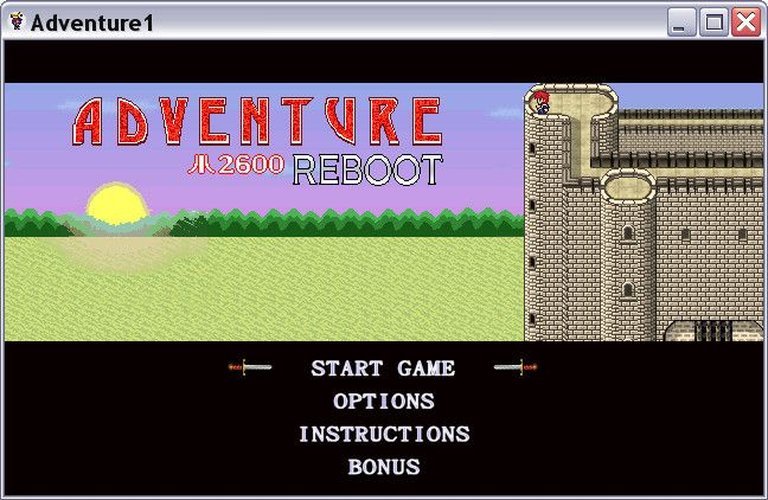
Description
Adventure 2600 Reboot is a modernized remake of the classic Atari 2600 game Adventure, featuring updated graphics and sound while retaining the original’s core gameplay. Players navigate a fantasy maze, collecting keys to unlock castles, retrieving a golden chalice, and delivering it to the gold castle. The game offers three progressively challenging quests, with the first introducing basic mechanics, the second adding a bat and a dark maze, and the third randomizing item locations. Completing the harder quests unlocks bonus levels, blending nostalgia with fresh challenges.
Adventure 2600 Reboot Free Download
Adventure 2600 Reboot Reviews & Reception
destructoid.com : Adventure 2600 Reboot : awesome and available for download
wastedseconds.com : Adventure Atari 2600 Reboot aims to be a graphical overhaul of that old game. And so far it’s looking pretty good.
Adventure 2600 Reboot: A Modern Homage to a Pioneering Classic
Introduction
In the pantheon of video game history, few titles loom as large as Adventure (1979), Warren Robinett’s groundbreaking Atari 2600 masterpiece. A game that not only defined the action-adventure genre but also introduced the world to the concept of Easter eggs, Adventure was a technical marvel of its time, pushing the limits of the Atari 2600’s hardware to create a sprawling, interconnected world filled with dragons, castles, and a mischievous bat. Fast forward to 2009, and a passionate team of developers—spearheaded by members of the Penny Arcade forums—set out to pay tribute to this classic with Adventure 2600 Reboot, a fan-made remake that modernizes the original while preserving its core essence.
Adventure 2600 Reboot is more than just a graphical facelift; it is a love letter to the original, a meticulous recreation that enhances the visuals, sound, and gameplay mechanics while staying true to the spirit of Robinett’s vision. This review will delve deep into the game’s development, narrative, mechanics, and legacy, exploring how it stands as both a faithful homage and a fresh experience for modern audiences.
Development History & Context
The Legacy of the Original Adventure
Before diving into Adventure 2600 Reboot, it’s essential to understand the significance of its predecessor. Released in 1979, Adventure was a revolutionary title for the Atari 2600. At a time when most games were confined to single-screen experiences or simple arcade-style gameplay, Adventure offered players a vast, interconnected world to explore. It introduced elements that would become staples of the action-adventure genre: a clear objective (retrieving the Enchanted Chalice), multiple items to collect and use, enemies with distinct behaviors, and a persistent world where actions had consequences.
Warren Robinett, the game’s sole developer, spent an entire year crafting Adventure, overcoming the Atari 2600’s severe technical limitations. The console’s 4KB of memory and lack of processing power made it a Herculean task to create a game where enemies could move off-screen, items could be carried and dropped, and the world could be explored non-linearly. Yet, Robinett succeeded, and in doing so, he laid the groundwork for future classics like The Legend of Zelda and Metroid.
One of Adventure’s most enduring legacies is its Easter egg—a hidden room containing the text “Created by Warren Robinett.” This was a direct response to Atari’s policy of not crediting developers, and it marked the first known Easter egg in video game history. The Easter egg became a cultural phenomenon, inspiring countless hidden secrets in games to come.
The Birth of Adventure 2600 Reboot
Adventure 2600 Reboot emerged from the passion of a small team of developers, primarily active on the Penny Arcade forums. Led by William Stiernberg (known as “slash000” in the credits), the team sought to modernize Adventure while retaining its core gameplay. The project took approximately seven months to complete, with Stiernberg handling programming, design, artwork, and sound effects, alongside contributions from others like “halkun” (sprites and collision masks) and “khavall” (music).
The team’s goal was clear: to create a version of Adventure that would appeal to modern audiences without losing the charm of the original. This meant updating the graphics to a 16-bit style, adding a full musical score (a far cry from the original’s simple bleep-bloop sounds), and refining the user interface. The result is a game that feels familiar to those who played the original while offering a fresh experience for newcomers.
Technological and Design Challenges
Creating Adventure 2600 Reboot was not without its challenges. The original Adventure was a product of its time, with mechanics and design choices dictated by the Atari 2600’s hardware limitations. The reboot had to navigate these constraints while introducing modern improvements.
One of the most significant changes was the behavior of the Black Bat, a notorious element of the original game. In Adventure, the bat would randomly steal and drop items, including dragons, making the game unpredictable and often frustrating. The reboot tweaked this behavior to make it more manageable, ensuring that the bat’s antics remained challenging but not overly punishing.
The team also had to decide how to handle the game’s difficulty levels. The original Adventure featured three skill levels, each introducing new mechanics and challenges. The reboot retained this structure but added bonus quests for players who completed the higher difficulty levels, providing additional replayability.
Narrative & Thematic Deep Dive
The Story: A Simple Yet Effective Premise
Adventure 2600 Reboot retains the original game’s straightforward but effective narrative. The player takes on the role of a hero tasked with retrieving the Enchanted Chalice from the clutches of an evil magician. The chalice has been hidden somewhere in a vast kingdom, guarded by three dragons—Yorgle the Yellow, Grundle the Green, and Rhindle the Red—and a mischievous Black Bat. The hero must navigate a series of mazes, collect keys to unlock castles, and ultimately return the chalice to the Golden Castle to restore peace to the land.
While the story is minimal by modern standards, it serves its purpose well. The lack of complex dialogue or cutscenes allows the gameplay to take center stage, emphasizing exploration, problem-solving, and strategic item management. The narrative’s simplicity also makes it accessible to players of all ages, much like the original.
Themes: Exploration, Perseverance, and Discovery
At its core, Adventure 2600 Reboot is a game about exploration and discovery. The kingdom is a labyrinthine world filled with hidden rooms, secret passages, and unpredictable enemies. The player must carefully navigate this environment, learning the behaviors of the dragons and the bat, and figuring out how to use items like the sword, magnet, and bridge to their advantage.
The game also touches on themes of perseverance and adaptability. The dragons are relentless in their pursuit of the hero, and the bat’s erratic behavior can disrupt even the best-laid plans. Players must adapt to these challenges, learning to use the environment and items to outmaneuver their foes. The randomized item placement in the higher difficulty levels further emphasizes this theme, forcing players to think on their feet and adjust their strategies.
Characters and Their Roles
The characters in Adventure 2600 Reboot are simple but effective, each serving a distinct role in the gameplay:
-
The Hero: The player’s avatar, a square-shaped protagonist whose goal is to retrieve the Enchanted Chalice. The hero can carry one item at a time and must navigate the kingdom’s dangers to succeed.
-
The Dragons: Yorgle, Grundle, and Rhindle each have unique behaviors and guard specific items. Yorgle is the least aggressive but can still be a nuisance, Grundle is more cautious and wise, and Rhindle is the most dangerous, pursuing the hero relentlessly. Defeating them requires strategy, as they can be killed with the sword but will respawn if the hero is eaten.
-
The Black Bat: The bat is the game’s wildcard, randomly stealing and dropping items, including the hero and the dragons. Its behavior is unpredictable, adding an element of chaos to the gameplay.
-
The Enchanted Chalice: The ultimate objective, the chalice must be found and returned to the Golden Castle to complete the game. Its flashing appearance makes it stand out, but the bat can steal it, complicating the hero’s quest.
Gameplay Mechanics & Systems
Core Gameplay Loop
Adventure 2600 Reboot retains the original game’s core gameplay loop: explore the kingdom, collect keys, unlock castles, and retrieve the Enchanted Chalice. The game is divided into three quests, each increasing in difficulty:
-
Quest 1: The simplest version, featuring one maze and two dragons. The Black Bat and Rhindle the Red Dragon are absent, making it an ideal starting point for newcomers.
-
Quest 2: Introduces the Black Bat and a second, darker maze. All three dragons are present, and the bat’s erratic behavior adds complexity. Item locations are fixed, allowing players to learn the layout.
-
Quest 3: The most challenging version, with randomized item and enemy placements. This mode tests the player’s adaptability and knowledge of the game’s mechanics.
Combat and Enemy Behavior
Combat in Adventure 2600 Reboot is straightforward but strategic. The hero’s primary weapon is the sword, which can be used to slay the dragons. However, the sword must be carried, and the hero can only hold one item at a time, forcing players to prioritize their inventory.
The dragons each have distinct behaviors:
– Yorgle the Yellow Dragon: The least aggressive, Yorgle will flee if the hero carries the Gold Key. He is often found guarding the Magnet or the Enchanted Chalice.
– Grundle the Green Dragon: More cautious than Yorgle, Grundle guards the Magnet, Bridge, and Black Key. He will avoid the hero if they carry the sword.
– Rhindle the Red Dragon: The most dangerous, Rhindle is faster and more aggressive. He guards the White Key and will pursue the hero relentlessly.
The Black Bat is the game’s most unpredictable element. It can steal items from the hero, including the sword or the chalice, and even carry dragons. Its behavior is randomized, making it a constant threat.
Item Management and Puzzles
Item management is a crucial aspect of Adventure 2600 Reboot. The hero can carry only one item at a time, forcing players to plan their movements carefully. Key items include:
- Keys: Used to unlock the corresponding castles (Gold, White, and Black).
- Sword: Essential for defeating dragons.
- Magnet: Attracts inanimate objects, useful for retrieving items stuck in walls.
- Bridge: Allows the hero to cross walls in dungeons and catacombs.
- Enchanted Chalice: The ultimate objective.
The game’s puzzles revolve around using these items effectively. For example, the magnet can pull the bridge toward the hero, while the sword is necessary to defeat dragons guarding keys or the chalice.
User Interface and Controls
Adventure 2600 Reboot modernizes the original’s controls, using the keyboard for movement and item interaction. The interface is streamlined, with clear indicators for the hero’s inventory and the current quest objectives. The game also includes a map feature, though it is minimal, encouraging players to explore and memorize the kingdom’s layout.
World-Building, Art & Sound
Visual Design: A 16-Bit Facelift
One of the most striking aspects of Adventure 2600 Reboot is its visual design. The original Adventure was constrained by the Atari 2600’s limited graphics, resulting in blocky, abstract representations of characters and environments. The reboot updates these visuals to a 16-bit style, giving the game a fresh, vibrant look while retaining the charm of the original.
The dragons are now more detailed, with distinct colors and animations. The castles and mazes are rendered with greater clarity, making navigation easier without sacrificing the game’s exploratory nature. The Enchanted Chalice, once a simple flashing dot, is now a beautifully designed artifact, emphasizing its importance.
Sound and Music: From Bleep-Bloops to a Full Score
The original Adventure featured minimal sound effects—simple bleeps and bloops to indicate actions like picking up an item or defeating a dragon. Adventure 2600 Reboot expands on this with a full musical score, composed by “khavall,” and ambient sound effects by “delphinus.” The music enhances the game’s atmosphere, adding a sense of adventure and urgency to the hero’s quest.
Sound effects are also more varied, with distinct noises for actions like opening a castle gate, using the magnet, or being eaten by a dragon. These audio cues provide valuable feedback, helping players understand the game’s mechanics and their progress.
Atmosphere and Immersion
The combination of updated visuals and sound creates a more immersive experience than the original. The kingdom feels like a living, breathing world, with the dragons and bat moving dynamically and the hero’s actions having tangible consequences. The game’s fantasy setting is reinforced by the medieval castles, labyrinthine dungeons, and the mystical Enchanted Chalice, all of which contribute to a sense of wonder and discovery.
Reception & Legacy
Critical and Commercial Reception
Adventure 2600 Reboot was released as freeware in 2009, making it accessible to a wide audience. While it did not receive the same level of commercial attention as the original Adventure, it was warmly received by fans and critics alike. The game was praised for its faithful recreation of the original’s mechanics, its modernized visuals and sound, and its respectful homage to Robinett’s work.
The reboot’s reception highlights the enduring appeal of Adventure and the importance of preserving classic games. By updating the original while retaining its core gameplay, Adventure 2600 Reboot introduced a new generation of players to a seminal title in video game history.
Influence and Legacy
Adventure 2600 Reboot stands as a testament to the power of fan-made remakes and the enduring legacy of classic games. It demonstrates how modern technology can breathe new life into older titles, making them accessible and enjoyable for contemporary audiences. The game’s success also underscores the importance of preserving video game history, ensuring that groundbreaking titles like Adventure are not forgotten.
While Adventure 2600 Reboot may not have the same cultural impact as the original, it serves as a bridge between generations of gamers. It allows those who grew up with the Atari 2600 to relive their childhood memories while introducing younger players to the roots of the action-adventure genre.
Conclusion
Adventure 2600 Reboot is a remarkable achievement—a labor of love that successfully modernizes a classic while preserving its essence. The game’s updated visuals, sound, and refined mechanics make it accessible to modern audiences, while its faithful recreation of the original’s gameplay ensures that it remains true to Warren Robinett’s vision.
For fans of the original Adventure, Adventure 2600 Reboot is a nostalgic trip down memory lane, offering a fresh coat of paint on a beloved classic. For newcomers, it is an opportunity to experience one of the most influential games in history, presented in a way that feels contemporary and engaging.
In the grand tapestry of video game history, Adventure 2600 Reboot may not be as revolutionary as its predecessor, but it is a vital reminder of the importance of preserving and celebrating the classics. It stands as a testament to the passion of its developers and the enduring legacy of Adventure, a game that helped shape the medium as we know it today.
Final Verdict: 8.5/10 – A masterful homage that modernizes a classic while preserving its soul.