
- Release Year: 2008
- Platforms: Windows
- Publisher: DreamCatcher Interactive Inc.
- Genre: Compilation
- Game Mode: Single-player
- Average Score: 55/100
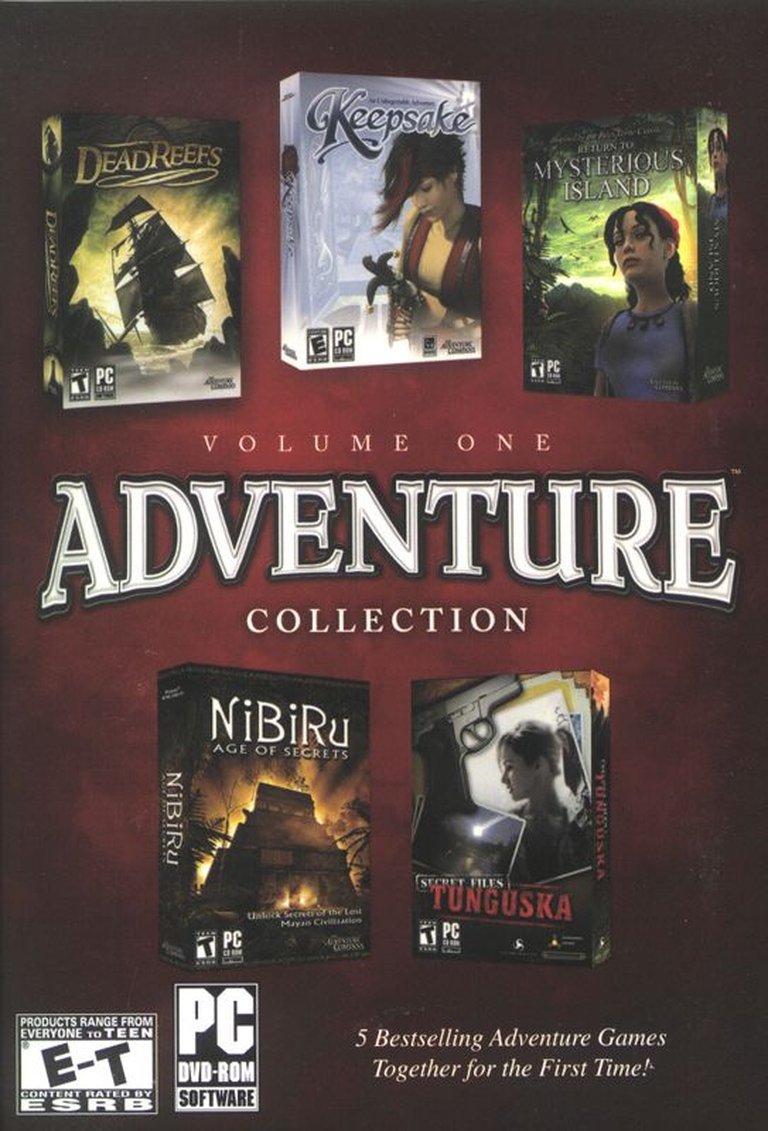
Description
Adventure Collection: Volume One is a 2008 Windows compilation released by DreamCatcher Interactive, bundling five diverse point-and-click adventure games from various developers, each featuring intricate puzzles, engaging narratives, and atmospheric settings ranging from haunted Caribbean islands in Dead Reefs to a mysterious orphanage in Keepsake, ancient Mayan ruins in NiBiRu: Age of Secrets, a deserted tropical isle in Return to Mysterious Island, and the enigmatic Tunguska explosion in Secret Files: Tunguska.
Where to Get Adventure Collection: Volume One
Guides & Walkthroughs
Reviews & Reception
adventureclassicgaming.com : A landmark in Kheops Studio’s canon, offering lush graphics and distinctive action adventure elements despite minimal character interaction.
Adventure Collection: Volume One: A Timeless Trove of Mid-2000s Point-and-Click Adventures
Introduction
In an era when video games were evolving from pixelated epics to sprawling open-world behemoths, the point-and-click adventure genre quietly carved out a niche for narrative-driven escapism, blending intricate puzzles with atmospheric storytelling. Released in 2008 by DreamCatcher Interactive (under its The Adventure Company imprint), Adventure Collection: Volume One compiles five standout titles from the mid-2000s, offering a curated snapshot of this golden revival period for adventure games. These aren’t blockbuster franchises but labors of love from small- to mid-sized studios, each weaving tales of mystery, survival, and the supernatural. From shipwrecks on cursed islands to conspiracies rooted in historical enigmas, this DVD-ROM bundle—rated Teen for mild violence and thematic elements—serves as a time capsule for fans craving intellectual challenges over explosive action. My thesis: While the collection’s obscurity belies its value, Adventure Collection: Volume One stands as a testament to the genre’s resilience, delivering diverse, puzzle-centric experiences that influenced later indie adventures and remain essential for historians seeking the soul of 2000s interactive fiction.
Development History & Context
The mid-2000s marked a renaissance for point-and-click adventures, a genre that had waned after the LucasArts/Sierra heyday of the 1990s due to shifting tastes toward real-time action and multiplayer dynamics. Studios like Kheops Studio (France), Fusionsphere Systems (Canada), and others in Europe were breathing new life into it, leveraging improving PC hardware for pre-rendered environments and voice acting without the budgetary excesses of AAA titles. Adventure Collection: Volume One aggregates games from 2004–2007, developed by these boutique teams amid a gaming landscape dominated by consoles like the Xbox 360 and PlayStation 3, yet thriving on PC for narrative depth.
Kheops Studio’s Return to Mysterious Island (2004), the earliest entry, exemplifies this vision: Founded in 2003, Kheops specialized in literary adaptations, drawing from Jules Verne’s The Mysterious Island to create an ecological survival tale. French developers like those behind Secret Files: Tunguska (2006, Fusionsphere Systems, a Canadian studio with European ties) and NiBiRu: Age of Secrets (2005, also Fusionsphere) focused on real-world mysteries, blending historical events like the 1908 Tunguska explosion with speculative fiction. Canadian efforts shone in Dead Reefs (2007, unknown studio but tied to DreamCatcher) and Keepsake (2005, Wicked Studios, Canada), emphasizing gothic horror and psychological intrigue.
Technological constraints shaped these games: Pre-rendered 360-degree panoramas maximized visual fidelity on modest hardware (e.g., 800 MHz Pentium III processors), while avoiding full 3D modeling kept costs low. The era’s piracy issues and digital distribution infancy made physical compilations like this one—a single DVD-ROM—a savvy way to bundle titles from The Adventure Company, a publisher founded in 2002 to revive the genre post-Sierra’s decline. Amid hits like Half-Life 2 (2004) and The Elder Scrolls IV: Oblivion (2006), these adventures targeted niche audiences via magazines and word-of-mouth, reflecting a broader indie ethos that prioritized story over spectacle. The collection’s 2008 release, post-console shift, positioned it as a budget-friendly archive, but its commercial model (retail at around $20–30) underscored the genre’s struggle for mainstream visibility.
Trivia from the era highlights the compilation’s cohesion: Three games (Keepsake, NiBiRu, Secret Files) involve threats to loved ones, fostering emotional stakes; three feature female leads, subverting male-dominated tropes; and most originated in non-English markets, showcasing global talent amid localization challenges.
Narrative & Thematic Deep Dive
Adventure Collection: Volume One excels in its thematic diversity, uniting five self-contained stories under the umbrella of mystery and human resilience, yet each probes deeper existential questions. At its core, the compilation explores isolation, discovery, and the blurred line between science and the supernatural—a hallmark of 2000s adventures reacting to post-9/11 anxieties and scientific optimism.
Return to Mysterious Island (Kheops Studio) adapts Verne’s novel with modern flair: Protagonist Mina Svoboda, a solo yachtswoman, shipwrecks on a volcanic isle teeming with Nemo’s relics. Her monologue-driven narrative—punctuated by ghostly whispers and a single pivotal robot dialogue—unfolds as a survival odyssey. Themes of ingenuity versus nature dominate; Mina’s resourcefulness echoes Verne’s optimism, but subtle ecology undertones critique environmental hubris (e.g., Nemo’s Nautilus as a relic of unchecked ambition). Supporting cast is sparse yet evocative: The monkey sidekick Jep adds whimsy, while Mina’s non-interactive phone calls to her mother inject personal vulnerability, humanizing her aloof navigator persona.
Dead Reefs, a pirate-infused horror tale, likely centers on cursed Caribbean waters, blending nautical folklore with ghostly apparitions. Its narrative probes colonial legacies and greed, with protagonists navigating spectral threats to unearth buried secrets— a thematic kin to Monkey Island but darker, emphasizing loss and redemption.
Keepsake delves into psychological horror at a shadowy academy, following young protagonist Lydia who uncovers family curses and institutional sins. Dialogue-heavy interactions reveal layered backstories, with themes of inherited trauma and forbidden knowledge. The female lead’s journey mirrors coming-of-age arcs, complicated by supernatural guardians and moral dilemmas involving endangered kin, creating tense, introspective monologues.
NiBiRu: Age of Secrets tackles ancient astronaut theories, with heroine Samantha Hudson investigating her mentor’s disappearance amid Sumerian myths. The plot weaves conspiracy thriller elements—secret societies, alien artifacts—with personal stakes, as Sam’s quest endangers her loved ones. Themes of forbidden history and cultural erasure resonate, using non-linear reveals and branching dialogues to question reality’s fragility.
Finally, Secret Files: Tunguska revisits the 1908 Siberian meteor event through journalist Nina Kalenberg and agent Max, unraveling a global conspiracy tied to Nina’s grandfather. Its episodic structure builds a tapestry of espionage, occultism, and familial peril, with witty banter and historical accuracy grounding fantastical elements. Recurring motifs across the collection—female agency in male-coded perils, threats to relatives fostering urgency, and built-in hints (Keepsake, Secret Files) for accessibility—underscore a thematic unity: Knowledge as both salvation and curse, inviting players to empathize with protagonists’ intellectual and emotional trials.
Gameplay Mechanics & Systems
As a point-and-click anthology, Adventure Collection: Volume One prioritizes cerebral loops: Exploration yields inventory items for combinatorial puzzles, interspersed with riddles and light action. Core mechanics emphasize trial-and-error creativity, moderated by era-appropriate aids, though flaws like pixel-hunting persist.
Inventory systems shine brightest in Return to Mysterious Island, Kheops’ blueprint: Players assemble/disassemble items (e.g., molding clay, mixing chemicals) via a crowded radial menu, allowing multi-item combos for survival tasks like fire-starting or battery-recharging. Redundant objects enable alternative solutions, reducing frustration; Jep the monkey extends reach, fetching items or greasing mechanisms in fanciful ways. Health bars track Mina and Jep’s vitality, tying puzzles to narrative needs (e.g., foraging to restore strength). UI is intuitive—contextual icons for examine/use—but panoramic nodes demand precise clicking, occasionally leading to hunts.
Dead Reefs likely mirrors pirate adventures with navigation puzzles and curse-breaking rituals, using environmental interactions for progression. Keepsake‘s gothic puzzles involve logic gates and hidden object elements, with a hint system nudging stuck players; character progression unfolds via unlocked areas post-puzzle, building tension through escalating revelations.
NiBiRu introduces code-breaking and relic manipulation, with a progression tree gating mythos unlocks; its systems reward historical trivia, blending deduction with light stealth. Secret Files: Tunguska refines this with file-gathering mechanics, allowing evidence cross-referencing in a journal UI—innovative for contemporaneous titles, fostering detective immersion. Built-in hints here prevent dead-ends, but timed sequences (rare, per Return) test reflexes minimally.
Flaws include short lengths (4–8 hours per game) and occasional obtuseness, like Return‘s chemistry riddles requiring real-world knowledge. No combat dominates, save Return‘s shooting mini-games (trivial, with auto-restores). Overall, the collection innovates in educational integration (encyclopedias, docs) and replayability via scoring/galleries, but UI datedness (no modern saves) highlights 2000s constraints. Character progression is narrative-tied, with scores unlocking art rewards, encouraging multiple paths without altering endings.
World-Building, Art & Sound
The compilation’s worlds are vivid dioramas of immersion, using pre-rendered art to conjure isolated, lore-rich settings that amplify thematic isolation. Visual direction prioritizes atmospheric realism over dynamism, with 360-degree pans evoking static wonder akin to Myst successors.
Return to Mysterious Island‘s South Pacific isle bursts with exotic detail: Bubbling geysers, cliffside nests, and Nemo’s subterranean lab blend Verne’s steampunk with lush tropics. Art style—photorealistic nodes—creates a tangible, unspoiled paradise turned peril, though animations are sparse (static cutscenes, no drifting clouds). Dead Reefs evokes foggy atolls and derelict ships, its art layering dread via shadowy palettes.
Keepsake‘s academy is a gothic labyrinth of dusty tomes and ethereal glows, with intricate interiors fostering claustrophobia. NiBiRu spans urban digs to ancient ruins, its art fusing modern grit with Mesopotamian grandeur for a globe-trotting epic. Secret Files: Tunguska contrasts Siberian wilds with urban intrigue, using sepia tones for historical flashbacks that deepen conspiracy layers.
Sound design enhances these realms: Natural ambiences—waves crashing, monkey chatter in Return—ground players, while scores mix tropical percussion, eerie whistles, and organ swells for tonal shifts. Voice acting is earnest, with Mina’s purposeful narration driving isolation; Tunguska‘s banter adds levity. Minimalism (unchanging tracks) suits puzzle focus, but immersive SFX (geysers hissing) elevate everyday interactions, contributing to a contemplative experience that rewards patient exploration.
Reception & Legacy
Upon 2008 release, Adventure Collection: Volume One flew under the radar, with no aggregated MobyScore or critic reviews—indicative of the genre’s niche status amid Grand Theft Auto IV‘s dominance. Individual titles fared modestly: Return to Mysterious Island earned 3/5 from Adventure Classic Gaming for its puzzles but critiqued brevity; Secret Files: Tunguska praised for narrative in outlets like IGN (7/10), while Keepsake and NiBiRu garnered cult followings via forums. Commercially, it targeted bargain bins, collected by few (4 MobyGames owners), reflecting physical media’s twilight.
Over time, reputation has warmed in retro circles: Backloggd and VG Times note zero ratings but spark nostalgia discussions. Its legacy lies in influencing indie revivals—Kheops’ inventory systems echoed in The Vanishing of Ethan Carter (2014); Tunguska’s conspiracy tropes in Life is Strange (2015). By bundling European/Canadian gems, it preserved non-English origins (four non-native titles), aiding genre globalization. In industry terms, it bridged LucasArts’ decline to modern walks like Unavowed (2018), underscoring compilations’ role in accessibility. Obscurity hasn’t diminished its impact; it’s a historian’s delight for tracing adventure’s evolution from literary roots to digital puzzles.
Conclusion
Adventure Collection: Volume One distills the mid-2000s adventure renaissance into a compelling, if understated, package—five games rich in narrative ingenuity, puzzle innovation, and atmospheric depth, united by themes of discovery amid peril. Strengths like alternative solutions and educational elements outweigh dated UI and brevity, offering 20–30 hours of brain-teasing joy for genre aficionados. Flaws, such as minimal interaction and obscurity, reflect its era, but that’s part of its charm. In video game history, it occupies a vital, if footnote, role: A bridge preserving boutique creativity against mainstream tides, essential for understanding how point-and-clicks endured. Verdict: Essential for retro collectors (8/10 overall), a solid entry point for newcomers, and a love letter to adventures that prioritize mind over muscle. If you’re weary of open worlds, this collection beckons you back to the island of intellect.