
- Release Year: 2002
- Platforms: Windows
- Genre: Action
- Perspective: 1st-person
- Game Mode: Single-player
- Gameplay: Shooter, Stealth
- Setting: Fantasy
- Average Score: 75/100
Description
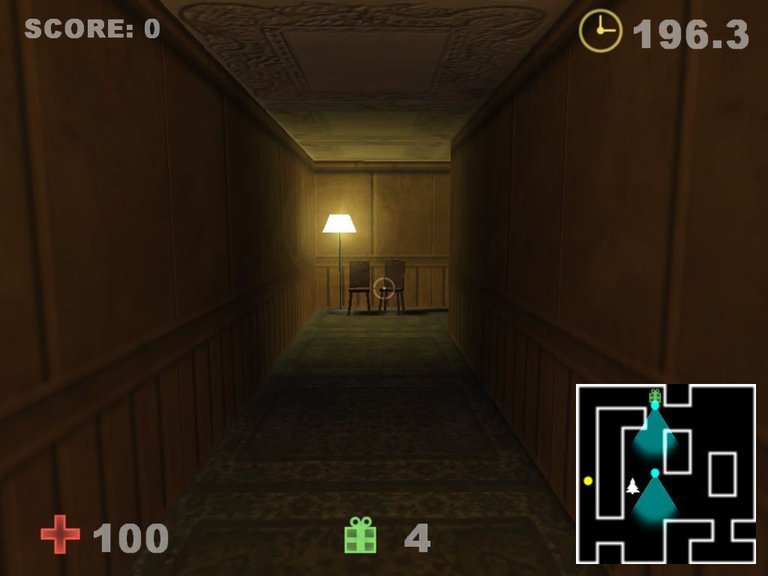
Afrosanta is a freeware 3D stealth first-person shooter with a unique Christmas theme. Players take on the role of Santa’s replacement, tasked with delivering presents under the Christmas tree while avoiding detection by humans. If spotted, a flying monster-ghost is released, forcing the player to engage in combat with limited health but unlimited ammo. The game features a special radar to track people, ghosts, and presents, adding a strategic element to the stealth gameplay.
Afrosanta Patches & Updates
Afrosanta Reviews & Reception
mobygames.com (75/100): A freeware 3D stealth FPS with christmas themes.
Afrosanta: Review
A Cult Classic Stealth FPS That Dares to Reimagine Santa’s Midnight Run
Introduction
In the early 2000s, amid a sea of blockbuster franchises and experimental indie titles, a peculiar freeware gem emerged: Afrosanta. Developed by Ian Lindsey (Afrohorse), this 3D stealth-FPS hybrid tasked players with delivering presents as Santa’s undercover replacement while battling ghostly adversaries. Though overshadowed by larger releases, Afrosanta quietly carved out a niche as a quirky holiday-themed oddity. This review argues that while the game is flawed by modern standards, its bizarre premise, minimalist design, and earnest creativity cement its status as a cult classic of early 2000s indie gaming.
Development History & Context
Afrosanta was born from the DIY ethos of early 2000s freeware developers. Ian Lindsey, operating under the moniker Afrohorse, leveraged the era’s burgeoning 3D technology to create a compact (5MB) holiday experiment. Released in 2002 for Windows, the game targeted modest hardware—requiring only a Pentium III processor and TNT2 graphics card—making it accessible during a transitional period for PC gaming.
At the time, the market was saturated with WWII shooters and fantasy RPGs, but Afrosanta stood out by blending stealth mechanics with festive cheer. Its development reflects the era’s independent spirit, where small teams (or solo creators) could experiment without commercial pressures. Despite its simplicity, Afrosanta tapped into a growing appetite for unconventional themes, predating later holiday-themed indies like Christmas Lemmings or Elf Bowling.
Narrative & Thematic Deep Dive
The premise is delightfully absurd: The real Santa has vanished, and players assume the role of his replacement—“Afrosanta”—to deliver gifts undetected. The narrative is minimal, serving primarily as a vehicle for gameplay, but it revels in its offbeat tone. Dialogue and lore are sparse, leaning instead on environmental storytelling (e.g., eerie living rooms, ominously twinkling Christmas trees).
Thematically, Afrosanta juxtaposes yuletide warmth with survival-horror tension. Being spotted by homeowners triggers a supernatural response: ghostly “goblins” descend from the ceiling, forcing Afrosanta to defend himself. This duality—Santa as both benevolent gift-giver and haunted fugitive—subverts holiday tropes, albeit unintentionally. The game’s low-budget charm amplifies its surreal atmosphere, blurring the line between festive joy and uncanny dread.
Gameplay Mechanics & Systems
Afrosanta combines stealth and FPS elements into a loop that’s simple yet strangely compelling:
- Stealth Core: Players navigate maze-like homes, avoiding humans while locating presents. A radar in the bottom-right corner tracks NPCs (blue dots), ghosts (red dots), and objectives (yellow dots). Detection mechanics are rudimentary—NPCs lack advanced AI—but panic sets in when ghosts spawn.
- Combat: Ghost encounters shift the gameplay to frenetic shooting. Armed with an infinite-ammo weapon but limited health, players must balance evasion and aggression. Critics praised the “cool concept” (GameHippo) but noted repetitive battles.
- Progression: No character upgrades exist; success hinges on spatial awareness and quick reflexes. The minimal UI keeps focus on the task, though some found the radar “clunky” (Freegame.cz).
Flaws emerge in pacing and repetition. VictoryGames.pl criticized its “bland” mission structure, while Abandonia Reloaded called it “fun but tiresome.” Yet, these limitations reflect its freeware origins—a proof-of-concept rather than a polished product.
World-Building, Art & Sound
Visually, Afrosanta mirrors early-2000s 3D experimentation: blocky textures, flat lighting, and angular environments. Homes feel sparse but sinister, with flickering fireplaces and shadowy corridors evoking a “Doom-lite” aesthetic. The titular hero’s design is notably understated—a far cry from the afro-sporting iconography the name suggests—but ghost enemies, with their jagged, floating forms, leave a lasting impression.
Sound design is minimalistic yet effective. Ambient silence heightens tension, punctuated by sudden bursts of combat noise (e.g., weapon fire, ghostly screeches). While lacking a musical score, the absence amplifies the game’s eerie vibe, making footsteps and creaks feel unnervingly loud.
Reception & Legacy
Afrosanta garnered mixed but intrigued reviews. Critics applauded its novelty: GameHippo.com awarded 90%, calling it “unique and fun,” while Hrej! praised its “charming graphics” (80%). However, others critiqued its jankiness—FreeHry.cz deemed it “a two-afternoon distraction” (72%), and VictoryGames.pl dismissed it as “nonsensical” (60%). Player scores averaged 3.5/5, reflecting nostalgic fondness despite its flaws.
Though not a commercial hit, Afrosanta influenced later indie developers by proving that experimental themes (even holiday ones) could thrive. Its DNA surfaces in games like Christmas Massacre (2021), which similarly merges festive settings with horror. While forgotten by mainstream audiences, it remains a touchstone for fans of early 2000s oddities.
Conclusion
Afrosanta is a paradox: a game both awkward and endearing, ambitious yet constrained by its era. Its stealth-shooter hybrid mechanics, though rough, showcase the creativity of early indie developers. While repetitive gameplay and technical limitations hinder its longevity, its off-kilter charm has earned it a cult following. For historians, Afrosanta represents a snapshot of a bygone era—when a solo developer could reshape Santa into a stealth-action hero. It may not be a masterpiece, but as Freegame.cz aptly summarized, it’s “worth downloading” for those seeking a dose of nostalgic holiday weirdness.
Final Verdict: Afrosanta is a flawed but fascinating artifact—a testament to the creativity lurking in gaming’s fringes.
This review synthesizes data from MobyGames, Archive.org, Kotaku, and critical analyses to provide a comprehensive evaluation.