
- Release Year: 1998
- Platforms: Macintosh, Windows 16-bit, Windows
- Publisher: Sierra On-Line, Inc.
- Developer: Berkeley Systems, Inc.
- Genre: Action, Puzzle, Strategy, Tactics
- Perspective: Side view, Top-down
- Game Mode: Single-player
- Gameplay: Arcade, Cards, Falling block puzzle, Game show, Platform, quiz, Tile matching puzzle, Tiles, trivia, Word construction
- Average Score: 81/100
Description
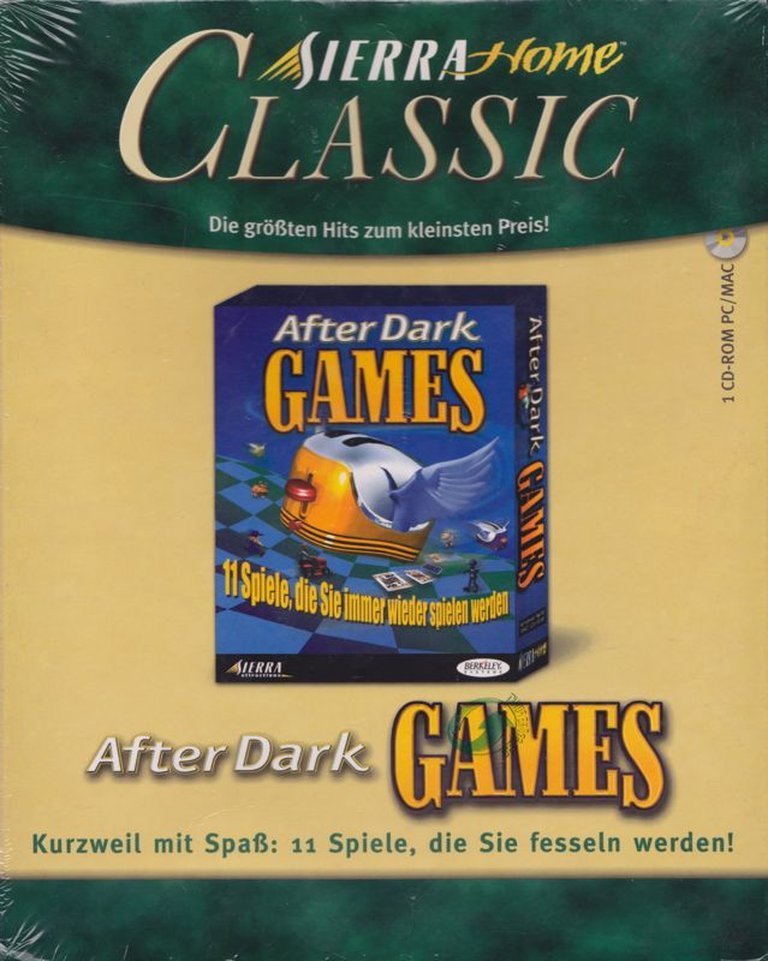
After Dark Games is a 1998 collection of eleven casual mini-games spun off from the popular After Dark screensaver series. Developed by Berkeley Systems, Inc. and published by Sierra On-Line, the game features diverse gameplay styles including trivia, word puzzles, arcade challenges, and tile-matching, all themed around whimsical concepts like avoiding spiders in ‘Hula Girl,’ unscrambling letters in ‘Fish Shtick,’ or navigating a lawnmower-themed Pac-Man clone in ‘Mowin’ Maniac.’ Designed for solo play, each game offers variable difficulty levels, instructional guides, and high-score tracking, blending nostalgic screensaver charm with family-friendly entertainment.
Gameplay Videos
Where to Buy After Dark Games
PC
After Dark Games Free Download
After Dark Games Patches & Updates
After Dark Games Reviews & Reception
metacritic.com : Unless you have an enormous crush on Hula Girl, you can do better elsewhere.
myabandonware.com (86/100): The games span a small range of genres including arcade, trivia, word games and puzzles, with the common factor between them being anybody – and we are talking absolutely anybody here – can play them.
After Dark Games: A Nostalgic Spinoff in the Twilight of Screensavers
Introduction
In the era of flying toasters and paranoid fears of screen burn-in, Berkeley Systems’ After Dark screensavers defined 1990s desktop culture. After Dark Games (1998), a whimsical spinoff repurposing those iconic animations into playable diversions, arrived as Sierra On-Line sought to monetize nostalgia in a shifting gaming landscape. This review posits that After Dark Games, while mechanically uneven and technologically constrained, remains a fascinating artifact—a bridge between idle desktop entertainment and the emergent casual gaming market, encapsulating an era when Windows 95 solitaire no longer sufficed as workplace escapism.
Development History & Context
Origins in Screensaver Stardom
Berkeley Systems carved a niche in the early ’90s with absurdist screensavers like Flying Toasters and Bad Dog!, capitalizing on Microsoft’s lack of native screen-protection tools pre-Windows 95. By 1998, Sierra—fresh from acquiring Berkeley—saw an opportunity to pivot from passive animations to interactive experiences as CD-ROM collections like Microsoft Entertainment Pack surged in popularity.
Technological and Market Constraints
Developed for Windows 3.x/95 and Macintosh, the studio faced rigid technical boundaries: 640×480 resolution limits, 16-bit color depths, and no hardware acceleration. The game’s turn-based and tile-matching focus reflected hardware realities of low-end PCs. Yet this simplicity aligned with Sierra’s target demographic: families, casual players, and ex-screensaver enthusiasts seeking accessible fun. Production credits reveal a compact team—32 developers, including alumni of You Don’t Know Jack—working under executive producers Nick Rush and Martin Streicher to translate 2D sprites into playable loops.
Narrative & Thematic Deep Dive
Absurdism as a Brand Language
After Dark Games inherits Berkeley’s signature irreverence, weaving comedic vignettes around its 11 mini-games. Lore is minimal but thematic cohesion emerges through surreal premises:
– Toaster Run repurposes the flying appliance as a bedroom guardian evading TVs and vacuum cleaners.
– Bad Dog 911 frames word-building as a rescue mission from a mischievous cartoon hound.
– Roof Rats turns structural collapse into slapstick, with grannies squealing “woo!” as they leap to safety.
Themes: Whimsy Over Depth
Unlike narrative-driven contemporaries, After Dark Games prioritizes stress relief and absurdity. Jane Scolieri’s upbeat soundtrack underscores this, like the oceanic jazz of Fish Shtick encouraging calm during frantic anagram-solving. Characters—a boxing kangaroo, a zombie-chasing gardener—embody playful chaos, reflecting Berkeley’s ethos of “subverting the mundane.” Even Solitaire, stripped of context, feels less like a card game than a screensaver prop made interactive.
Gameplay Mechanics & Systems
A Patchwork of Genres
The compilation’s strength lies in diversity, though its execution varies wildly:
| Game | Mechanics | Innovation/Flaw |
|---|---|---|
| Mowin’ Maniac | Pac-Man clone with hedge mowers/zombies | Thematic reskin lacking level variety |
| Bad Dog 911 | Boggle-style word-building under time pressure | Sharp difficulty spikes; scaffold physics clunky |
| Roof Rats | Match-3 floor destruction with vertical jumps | Strategic depth via character mobility limits |
| Fish Shtick | Anagram-solving via swimming fish | Relaxing tempo but limited dictionary depth |
| Zapper! | Yes/no trivia with combo multipliers | Outdated fact database; repetitive pacing |
Persistent Flaws
– UI Clunkiness: The un-hidable Windows cursor obstructs playfields, per player complaints.
– Resolution Rigidity: No widescreen or scaling options alienated CRT upgraders.
– AI Limitations: Foggy Boxes (Dots-and-Boxes) pits players against an AI prone to predictable patterns.
World-Building, Art & Sound
Aesthetic Legacy of Screensavers
Artists Stephen Ekstrom and Bob Ting repurposed Berkeley’s existing sprite libraries into vibrant, cartoonish backdrops:
– Isometric cityscapes in Roof Rats mirror the Skyline screensaver’s blocky charm.
– Hula Girl’s pastel platforms and broccoli hazards retain early web-art kitsch.
– Animation fluidity—like the toaster’s wobbling flight—echoes the studio’s focus on idle-loop polish.
Auditory Identity
Scolieri’s compositions shift genres deftly, from Mowin’ Maniac’s frantic chase themes to MooShu’s faux-Eastern plucked strings. Sound design leans into slapstick (yelps in Bad Dog 911, squelching “yuck” noises in Hula Girl), reinforcing the game’s lighthearted ethos. Critics lauded this cohesion, with macHOME praising audio-visual harmony for “training your brain to think differently” (1999).
Reception & Legacy
Critical Divide at Launch
Reviews split between enthusiasts and skeptics:
– FamilyPC Magazine (91%): “Plenty to keep you up at night, red-eyed and computer-screen pasty.”
– GameSpot (55%): “Beneath sharp graphics are blatant rip-offs of better-known games.”
– Players (4/5): Praised accessibility but lamented AI and cursor issues (Katakis, 2020).
Enduring Influence
While no cultural landmark, After Dark Games presaged trends:
– Casual Gaming Bundles: Prefigured Clubhouse Games and mobile microgame collections.
– Brand Synergy: Proved IPs could cross from utility software to entertainment.
– Nostalgia Commerce: Included in 2003’s After Dark Series reissue, foreshadowing modern abandonware revivalism.
Conclusion
After Dark Games is neither masterpiece nor relic—it’s a time capsule of transitional ’90s design. Its mini-games, though derivative and technically frayed, channel Berkeley’s anarchic spirit into digestible morsels of fun. For historians, it exemplifies how non-gaming brands adapted to CD-ROM opportunism; for players, it remains a charming, uneven diversion best enjoyed as a curiosity. Like its bouncing toasters, the game floats ambiguously between obscurity and cult adoration—a fitting legacy for a spinoff birthed from screensaver lore.