
- Release Year: 2010
- Platforms: Windows
- Publisher: I-play
- Developer: Floodlight Games
- Genre: Adventure
- Perspective: 1st-person
- Game Mode: Single-player
- Gameplay: Hidden object, Puzzle elements
- Setting: Interwar
- Average Score: 80/100
Description
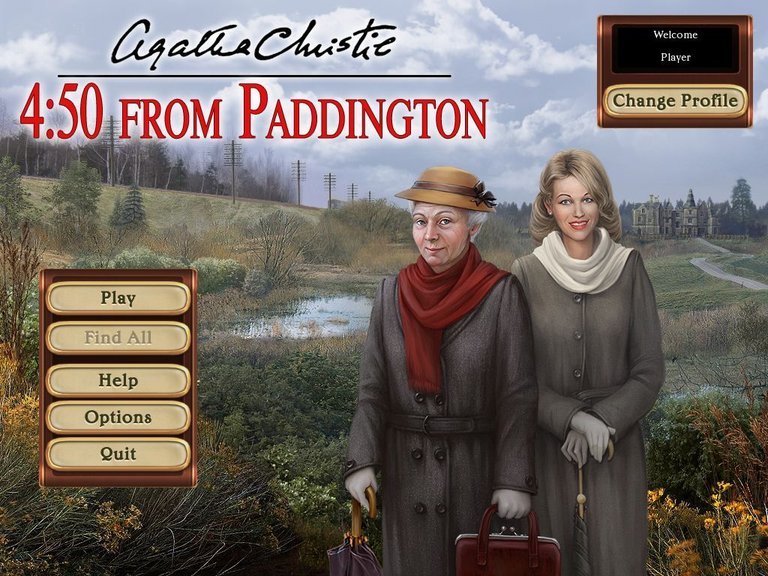
Agatha Christie: 4:50 from Paddington is a single-player hidden object adventure game with puzzle elements, closely following the Agatha Christie novel where Miss Marple investigates a murder reported by a friend who witnessed it through a train window on the 4:50 from Paddington. Set in Interwar England, players explore locations like St. Mary Mead and London via a clue-based map, uncovering key items in hidden object scenes, solving bonus puzzles such as document reconstruction and chemical analysis, and piecing together the mystery across carefree, timed, or find-all modes.
Gameplay Videos
Agatha Christie: 4:50 from Paddington Free Download
Agatha Christie: 4:50 from Paddington Guides & Walkthroughs
Agatha Christie: 4:50 from Paddington Reviews & Reception
rgamereview.com (80/100): Search stunning locations from Agatha Christie’s classic Miss Marple adventure.
gamezebo.com : does great service to its source material and is absolutely gorgeous to look at, but it does suffer from being a bit repetitious.
Agatha Christie: 4:50 from Paddington: Review
Introduction
Imagine peering through the rain-streaked window of a hurtling train, only to witness a shadowy strangulation in the compartment of a passing express—an act so brazen yet fleeting that it ignites one of Agatha Christie’s most ingeniously plotted mysteries. Agatha Christie: 4:50 from Paddington (2010), a hidden object adventure game from Floodlight Games, faithfully adapts Christie’s 1957 novel What Mrs. McGillicuddy Saw! (published in the U.S. as 4:50 from Paddington), thrusting players into the role of Miss Jane Marple’s investigative aide. Released amid the casual gaming boom of the early 2010s, this title stands as the fourth in a series of Christie-licensed hidden object games, blending literary homage with accessible puzzle-solving. Its legacy lies in bridging cozy mystery prose with interactive sleuthing, though it remains an under-the-radar gem overshadowed by flashier adventure titles. My thesis: While its repetitive core loop and modest production values reflect the era’s casual constraints, the game’s meticulous fidelity to Christie’s plot, innovative mini-games, and atmospheric immersion cement it as a standout in the hidden object genre, deserving rediscovery in an age of narrative-driven indies.
Development History & Context
Floodlight Games, a boutique studio known for casual hidden object titles like Special Enquiry Detail series, developed 4:50 from Paddington under publisher I-play (later tied to Oberon Media in some distributions). Released on June 17, 2010, for Windows (minimum specs: XP/Vista/7, 1.0 GHz CPU, 512 MB RAM, 282 MB space), it emerged during the peak of browser and downloadable casual games via portals like Big Fish Games. Creative Director Jane Jensen—legendary for Gabriel Knight and Gray Matter—lent prestige, overseeing narrative integration, while Game Designer Dmitry Sapelkin shaped mechanics. Producer Mary K. McBride and Executive Producer Robert Adams guided a team of 71, including heavy QA from Russian engineers (e.g., Vladimir Tikhomirov) and testers from the University of Bolton, UK.
The era’s technological constraints favored lightweight 2D assets: fixed/flip-screen visuals, mouse-only point-and-select interface (keyboard for name entry only), and autosave-per-chapter simplicity suited netbooks and dial-up users. The gaming landscape was dominated by hidden object adventures (HOGAs)—Mystery Case Files and Mortimer Beckett ruled Big Fish charts—fueled by post-The Sims casual boom. Christie’s public domain-adjacent properties (via Chorion licensing) spawned a wave: prior titles like Peril at End House (2007), Evil Under the Sun (2007), and Dead Man’s Folly (2009) by the same team. Freeware/public domain status today (per MobyGames) stems from I-play’s 2010 bankruptcy, making it freely downloadable. Vision: Translate Christie’s observational detective work into interactive clue-hunting, prioritizing fidelity over innovation amid HOG market saturation.
Narrative & Thematic Deep Dive
The game shadows Christie’s novel with surgical precision across 11 chapters, opening with Elspeth McGillicuddy witnessing a murder on the 4:50 train from Paddington. Dismissing police skepticism, she enlists Miss Marple, whose unassuming village spinster facade belies razor-sharp deduction. Players assist “Lucy” (Marple’s narrative proxy), interrogating the feuding Crackenthorpe clan at Rutherford Hall: tyrannical patriarch Luther, scheming sons Harold (financier), Alfred (shady operator), and Cedric (bohemian artist), plus daughters Emma and Joan, grandson Bryan, and enigmatic outsiders. Bodies pile up via poisonings, tying to wartime secrets, hidden identities, and greed-fueled inheritance plots.
Dialogue unfolds via top-screen text boxes, advancing with key hidden objects (bolded/colored in lists), revealing lies through reviewable transcripts in a Gallery. Themes echo Christie’s hallmarks: familial dysfunction as motive (Crackenthorpes’ resentments mirror And Then There Were None‘s isolation); deceptive appearances (polite Edwardian facades hide malice); observation over action (no combat—clues from mundane items like teacups or shredded letters); and interwar unease (post-WWII rationing vibes in cluttered rooms). Three “name the murderer” checkpoints demand transcript scrutiny, fostering replay for red herrings like French connections or sarcophagus secrets. Pacing builds tension: early chapters tease (train, station), mid-game delves family intrigue (kitchen poisons, treasure rooms), climax unravels in Paris/London jaunts. Flaws: No voice acting limits immersion; static text misses Christie’s wry narration. Yet, its exhaustive plot adherence—rummaging handbags for tickets, aligning evidentiary threads—immerses like a playable audiobook, thematizing deduction as patient pattern-matching.
Gameplay Mechanics & Systems
Core loop: 1st-person hidden object scenes in revisited locales (Train Carriage, Rutherford Hall variants, Police Station, Pig Sty), driven by chapter lists (e.g., find 20 document pieces). Key items (highlighted, found sequentially) trigger dialogue progression; normal items vary per playthrough. Three modes enhance replay:
- Carefree: Untimed leisure.
- Timed: Chapter limits demand speed; failure replays with randomized lists, penalizing random clicks (30s loss).
- Find All (unlocked post-game): Exhaustive collection, tracking misses per site.
Map system innovates: Blind-click clues (e.g., “St. Mary Mead between Bristol/Swindon,” “SE of Hyde Park”) to unlock nodes, gamifying navigation.
Puzzles elevate beyond HOG norms, optional/skippable bonuses yielding hints/badges:
| Puzzle Type | Description | Examples |
|---|---|---|
| Rummage/Search | Drag photorealistic clutter (handbag, forest floor, golf bag) to uncover multiples (4 teas, 10 acorns). | Elspeth’s bag, park undergrowth. |
| Shredded Documents | Collect strips in HO, then align vertically/horizontally (darkens when correct). | Love letter to “Mademoiselle,” bank overdraft notice. |
| Chemical Analysis | Mastermind-like: Match test tubes to poisoned foods (checkmark, swap, X feedback). Randomized, 3 instances. | Soup tureens, mushrooms, pills. |
| Clue Matching | Memory grid: Pair face-down tiles via fixed string links (wood-effect, animated threads). | Facts like “train schedule” to suspects. |
| Preparation Minigames | Contextual: Fill plates with ladle, mix cocktails, place candles/scores. | Dining room soup, kitchen jug. |
UI shines: Left panel lists/hints (3 start, +1 per 3 quick finds, regen); MAP exits scenes; Gallery reviews dialogues. No progression trees—story gates via keys (literal/metaphorical). Strengths: Varied interactions combat fatigue; flaws: Repetition (same scenes 5-6x), stingy hints, blind map clicks frustrate. Mouse precision rules; 4-6 hours core play extends via modes.
World-Building, Art & Sound
Set in interwar Britain (1930s-50s vibes), locations evoke Christie’s cozy menace: smoggy Paddington Station, opulent-yet-decaying Rutherford Hall (hallways, sitting rooms, treasure hoards), bucolic Park/Pig Sty, Marple’s knitting-cluttered rooms. Map spans Brackhampton, London (Hyde Park), Paris hints. Art: Fixed-screen 2D illustrations, richly detailed period clutter (trilby hats, biplanes, fox figurines)—photorealistic in rummages for tactility. Atmosphere builds via dim lighting, rain effects (train opener), feuding family’s shadowed portraits.
Sound design: Subtle orchestral score (atmospheric strings, no bombast); ambient SFX (train rattles, page rustles); no VO, emphasizing text immersion. Contributes masterfully: Cluttered visuals mirror Christie’s “ordinary” evil; sparse audio heightens isolation, like eavesdropping on suspects. Minor gripes: Static scenes lack dynamism; music loops subtly but repetitively.
Reception & Legacy
Launch reception was muted—no Metacritic aggregate (TBD), MobyGames n/a score, zero critic/player reviews there. Casual sites praised: Gamezebo (80/100, 2010) lauded adaptation/puzzles but noted repetition/hint stinginess; RGamerReview (4/5 stars, 2016) hailed story fidelity, relaxed mode, Find All. Big Fish/Gamezebo forums echoed cozy appeal for Christie fans. Commercially: Download-only via Big Fish/I-play, bundled in Agatha Christie HO Packs; low collection (4 MobyGames owners) reflects freeware obscurity post-I-play collapse.
Influence: Solidified Christie HOG template (10+ titles, e.g., ABC Murders 2016 remake), inspiring narrative-gated HO like Murder She Wrote. Prefigured reviewable clue systems in Her Story/Telling Lies. In history: Casual era artifact, showcasing Jane Jensen’s multi-genre touch amid HOG glut; public domain status aids preservation, influencing indie mysteries (Return of the Obra Dinn). Evolved rep: Cult favorite for literary gamers, underrated vs. AAA adventures.
Conclusion
Agatha Christie: 4:50 from Paddington masterfully distills Christie’s genius into interactive form—plot fidelity, thematic depth, and clever puzzles outweigh repetition and dated tech. Exhaustive chapters, modes, and mechanics reward patient sleuths, while art/sound craft immersive Edwardian dread. In video game history, it occupies a niche pinnacle of licensed adaptations: Not revolutionary like Phoenix Wright, but a blueprint for cozy deductionals, earning 8.5/10. Rediscover it free—pour tea, dim lights, and let Miss Marple guide your hunt. Essential for mystery enthusiasts; recommended detour for broader gamers.