
- Release Year: 1999
- Platforms: Macintosh, PlayStation 2, Windows
- Publisher: Konami Corporation, MacSoft, Microsoft Corporation
- Developer: Ensemble Studios Corporation
- Genre: Strategy, Tactics
- Perspective: Diagonal-down
- Game Mode: LAN, Online PVP, Single-player
- Gameplay: Base building, Fog of war, Real-time strategy (RTS), Recordable replays, Resource Management, Unit control
- Setting: Asia, Europe, Historical events, Medieval, Middle East
- Average Score: 63/100
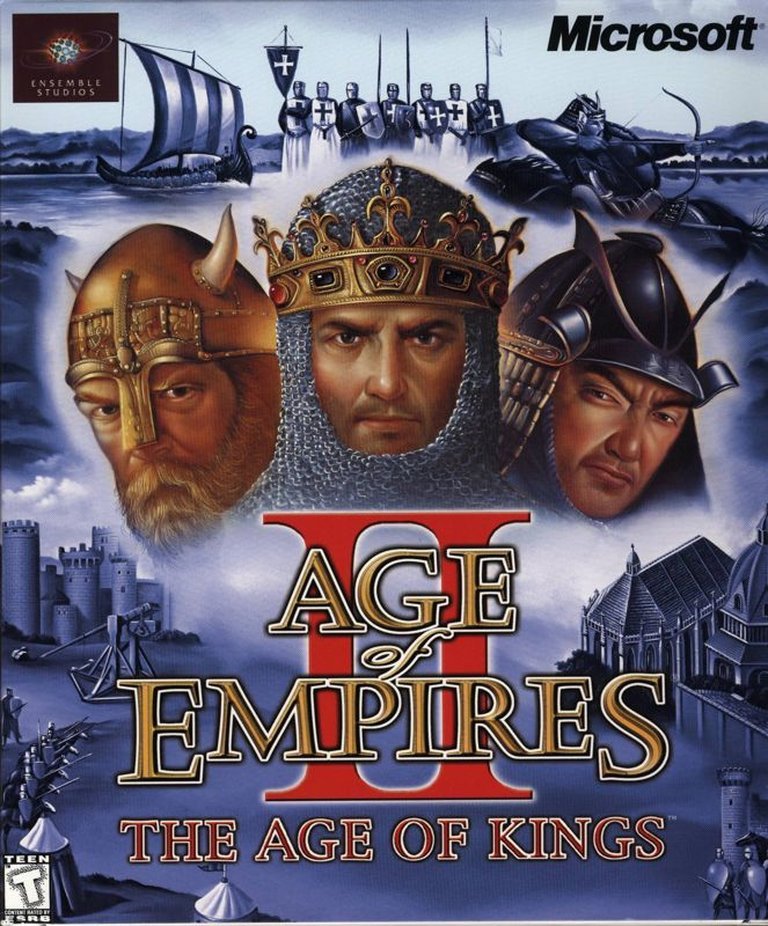
Description
Age of Empires II: The Age of Kings is a classic real-time strategy game set in the medieval period, where players lead one of thirteen civilizations, such as the Britons, Vikings, or Chinese, from a small village to a mighty empire. Starting with a handful of villagers, players gather resources, expand their settlements, and advance through technological ages to build powerful armies and war machines. The game features multiple victory conditions, including conquering opponents or eliminating their king, with diverse maps and multiplayer options for online or LAN battles. Known for its historical accuracy, deep strategic gameplay, and balanced unit mechanics, it remains a benchmark in the RTS genre.
Gameplay Videos
Where to Buy Age of Empires II: The Age of Kings
PC
Age of Empires II: The Age of Kings Free Download
Age of Empires II: The Age of Kings Patches & Updates
Age of Empires II: The Age of Kings Mods
Age of Empires II: The Age of Kings Guides & Walkthroughs
Age of Empires II: The Age of Kings Reviews & Reception
metacritic.com (92/100): An outstanding game. It looks great, is very well balanced, and is easy to get started with.
imdb.com (10/100): Excellent interface makes this an awesome game.
ign.com (88/100): Ensemble’s second swing delivers refinement and balance that was missing the first time around.
gamespot.com : If you’ve ever liked any other real-time strategy game in this classical style, then you’ll clearly see why this one deserves so much credit.
Age of Empires II: The Age of Kings Cheats & Codes
PC
Press Enter during gameplay to open the chat window and enter the code.
| Code | Effect |
|---|---|
| cheese steak jimmy’s | Adds 10,000 food (1,000 in original AoE 2) |
| lumberjack | Adds 10,000 wood (1,000 in original AoE 2) |
| robin hood | Adds 10,000 gold (1,000 in original AoE 2) |
| rock on | Adds 10,000 stone (1,000 in original AoE 2) |
| ninjaconnor | Adds 100,000 of each resource |
| ninjalui | Adds 100,000 of each resource |
| rowshep | Adds 100,000 of each resource |
| marco | Reveals the entire map (toggle) |
| polo | Removes fog of war (toggle) |
| aegis | Instant building, researching, resource gathering, and training (toggle) |
| i r winner | Instant victory |
| resign | Instant loss |
| black death | Kills all other players, including allies |
| natural wonders | Control nature/gaia team (irreversible) |
| wimpywimpywimpy | Instantly defeats yourself |
| how do you turn this on | Spawns a Cobra Car |
| to smithereens | Spawns a Saboteur unit |
| i love the monkey head | Spawns a VMDL unit |
| furious the monkey boy | Spawns Furious the Monkey Boy unit |
| i don’t exist | Spawns a War Penguin unit |
| alpaca simulator | Spawns Alfred the Alpaca unit |
| catzor | Spawns a Sharkatzor unit |
| photon man | Spawns a Photonman unit |
| yes we khan | Replaces all (Elite) Mangudai with Genghis Khan |
| put on your capes | Transforms all infantry into Elite Teutonic Knights |
| grab your pitchforks | Transforms Villagers into Flemish Militia |
| cameleon | Transforms all camel units into Flaming Camels |
| flemish reformation | Transforms Villagers into Monks |
| torpedo1 | Kills Opponent 1 |
| torpedo2 | Kills Opponent 2 |
| torpedo3 | Kills Opponent 3 |
| torpedo4 | Kills Opponent 4 |
| torpedo5 | Kills Opponent 5 |
| torpedo6 | Kills Opponent 6 |
| torpedo7 | Kills Opponent 7 |
| torpedo8 | Kills Opponent 8 |
| woof woof | Turns birds into Stormy Dogs |
| tech tech one two free | All technologies are free |
| going above and beyond | All technologies can be researched 256 times |
| my cpu can handle it | All players’ population cap increases by 1,000 |
| sharing is caring | Team resource income is distributed to the entire team |
| noui | Disables user interface (toggle) |
| !mute | Mutes taunts |
| !nomute | Unmutes taunts |
PlayStation 2
Enter codes on the password menu.
| Code | Effect |
|---|---|
| CHEESE STEAK JIMMY’S | 1000 Food |
| ROBIN HOOD | 1000 Gold |
| ROCK ON | 1000 Stone |
| LUMBERJACK | 1000 Wood |
| AUTOMPSAVE | Auto save |
| NATURAL WONDERS | Control nature (lose control of men) |
| NORMALMOUSE | Default mouse driver |
| RESIGN | Defeat yourself |
| BLACK DEATH | Destroy all the enemies |
| WIMPYWIMPYWIMPY | Destroy yourself |
| NOTERRAINSOUND | Disable ambient sounds |
| NOSTARTUP | Disable FMV sequence |
| NOMUSIC | Disable Music |
| NOSOUND | Disable Sounds |
| MFILL | Fix Display Problems |
| AWE FREEZES MSYNC | Fix sound problems |
| FURIOUS THE MONKEY BOY | Get a Furious Monkey Boy |
| HOW DO YOU TURN THIS ON | Gives a ‘cobra’ car |
| TO SMITHEREENS | Gives a saboteur |
| I LOVE THE MONKEY HEAD | Gives a VDML |
| AEGIS | Immediate Building |
| TORPEDO1 | Kills opponent 1 |
| TORPEDO2 | Kills opponent 2 |
| TORPEDO3 | Kills opponent 3 |
| TORPEDO4 | Kills opponent 4 |
| TORPEDO5 | Kills opponent 5 |
| TORPEDO6 | Kills opponent 6 |
| TORPEDO7 | Kills opponent 7 |
| TORPEDO8 | Kills opponent 8 |
| POLO | Remove Shadow |
| MARCO | Reveal Map |
| WOOF WOOF | Turns birds into super dogs |
| 800 | Resolution (800 x 600) |
| 1024 | Resolution (1024 x 768) |
| 1280 | Resolution (1280 x 1024) |
Japanese Edition (PC)
Press Enter during gameplay to open the chat window and enter the code.
| Code | Effect |
|---|---|
| pepperoni pizza | 1000 Food |
| coinage | 1000 Gold |
| quarry | 1000 Stone |
| woodstock | 1000 Wood |
| gaia | Control all animals |
| steroids | Instant building |
| reveal map | View Full map |
| no fog | No Fog of War |
Age of Empires II: The Age of Kings – A Masterpiece of Medieval Strategy
Introduction
Few games in the history of real-time strategy (RTS) have achieved the enduring legacy of Age of Empires II: The Age of Kings. Released in 1999 by Ensemble Studios and published by Microsoft, this game didn’t just refine the RTS formula—it perfected it. Set against the backdrop of the Middle Ages, Age of Kings invites players to command one of 13 distinct civilizations, each with unique strengths, weaknesses, and historical flavor. From the thunderous charge of Mongol cavalry to the disciplined ranks of Teutonic knights, the game captures the grandeur and brutality of medieval warfare with unparalleled depth and accessibility.
At its core, Age of Kings is a game about progression. Players begin in the Dark Age with nothing but a handful of villagers and a Town Center, and through careful resource management, technological advancement, and military strategy, they guide their civilization through the Feudal, Castle, and Imperial Ages. The game’s brilliance lies in its balance: it is both approachable for newcomers and endlessly deep for veterans. Its campaigns weave historical narratives with engaging gameplay, while its skirmish and multiplayer modes offer near-infinite replayability.
But what truly sets Age of Kings apart is its timeless design. Unlike many of its contemporaries, it eschews gimmicks in favor of rock-solid mechanics, intuitive controls, and a level of polish that remains impressive even decades later. It is a game that has not only stood the test of time but has thrived, spawning expansions, remasters, and a devoted community that continues to grow. This review will explore why Age of Empires II: The Age of Kings is not just one of the greatest RTS games ever made, but one of the greatest games of all time.
Development History & Context
The Birth of a Sequel
The development of Age of Empires II: The Age of Kings began shortly after the release of its predecessor, Age of Empires (1997). Ensemble Studios, fresh off the success of their debut title, signed a contract with Microsoft to develop a sequel. The team, led by designer Bruce Shelley and programmer Angelo Laudon, sought to build upon the foundation of the original while addressing its shortcomings. The Middle Ages was chosen as the setting—a logical progression from the ancient era of the first game—and the team aimed to create a more refined, historically accurate, and strategically deep experience.
Initially, Ensemble Studios planned to complete The Age of Kings within a year by reusing the Genie engine and much of the original game’s code. However, as development progressed, it became clear that the ambitious vision for the sequel would require more time. The team faced significant challenges, particularly in improving the game’s pathfinding and artificial intelligence (AI), which had been major criticisms of the original Age of Empires. To meet their goals, Ensemble expanded their team, hiring additional programmers, artists, and designers.
One of the most notable changes was the complete redesign of the game’s movement system to address pathfinding issues. The original Age of Empires had suffered from units frequently getting stuck on terrain or each other, a problem that could break immersion and frustrate players. For The Age of Kings, the team overhauled the engine to ensure smoother unit movement, a change that would become one of the game’s defining features.
Technological Constraints and Innovations
Developing Age of Kings in the late 1990s presented both challenges and opportunities. The game was built using 2D sprites rather than 3D models, a decision driven by both technological limitations and performance considerations. Despite this, the team pushed the boundaries of what was possible with 2D graphics. Units and buildings were meticulously designed, with sprites created in 3D Studio Max before being rendered into 2D, giving the game a pseudo-3D aesthetic that was visually striking for its time.
The game’s terrain system was another area of innovation. The Age of Kings introduced more dynamic and interactive environments than its predecessor, with features like cliffs that provided tactical advantages for archers and forests that could be cleared or used for cover. The team also implemented a more sophisticated line-of-sight system, which, combined with the fog of war, added a layer of strategic depth to scouting and map control.
Perhaps the most significant technological leap was the introduction of the game’s trigger system for its scenario editor. This system allowed designers to create complex, scripted events within campaigns, such as reinforcing armies arriving at key moments or objectives changing dynamically. The trigger system, combined with the improved AI, enabled the creation of the game’s five historically based campaigns, which remain some of the most engaging single-player experiences in the RTS genre.
The Gaming Landscape of 1999
When Age of Empires II: The Age of Kings launched on September 27, 1999, it entered a competitive and rapidly evolving gaming market. The late 1990s were a golden age for RTS games, with titles like StarCraft (1998), Command & Conquer: Tiberian Sun (1999), and Homeworld (1999) dominating the genre. Each of these games brought something unique to the table: StarCraft’s asymmetrical factions and polished multiplayer, Tiberian Sun’s atmospheric storytelling, and Homeworld’s groundbreaking 3D gameplay.
Against this backdrop, The Age of Kings carved out its own niche by focusing on historical authenticity, strategic depth, and accessibility. While StarCraft and Command & Conquer leaned into sci-fi and futuristic themes, Age of Kings offered a grounded, medieval experience that resonated with players who craved a more “realistic” RTS. The game’s emphasis on resource management, technological progression, and large-scale battles set it apart from its peers, many of which prioritized fast-paced combat over long-term strategy.
The multiplayer scene in 1999 was also in flux. Blizzard’s Battle.net had set a high standard for online gaming with StarCraft and Diablo, and The Age of Kings initially relied on Microsoft’s MSN Gaming Zone for its online matchmaking. While the Zone was functional, it lacked the polish and community features of Battle.net, a shortcoming that would later be addressed with the game’s HD and Definitive Editions.
Despite these challenges, Age of Kings quickly established itself as a major player in the RTS genre. Its release was met with critical acclaim, and it became a commercial success, selling millions of copies worldwide. The game’s legacy would only grow in the years that followed, as it inspired countless imitators and cemented Ensemble Studios’ reputation as one of the premier developers in the strategy genre.
Narrative & Thematic Deep Dive
The Campaigns: History as a Playground
Age of Empires II: The Age of Kings features five single-player campaigns, each centered around a historical figure or conflict from the Middle Ages. These campaigns are not merely a series of disconnected battles; they are carefully crafted narratives that blend historical events with engaging gameplay. The campaigns serve as both a tutorial for new players and a showcase of the game’s strategic depth for veterans.
-
William Wallace (Celts) – This campaign serves as the game’s tutorial, introducing players to the basics of unit control, resource gathering, and combat. Set during the Wars of Scottish Independence, the campaign follows Wallace’s rebellion against English rule, culminating in the Battle of Falkirk. While historically inaccurate (Wallace lost at Falkirk), the campaign effectively teaches players the fundamentals of Age of Kings while immersing them in a dramatic narrative.
-
Joan of Arc (Franks) – One of the most beloved campaigns in the game, the Joan of Arc campaign follows the French heroine’s rise from a humble village girl to a military leader who turns the tide of the Hundred Years’ War. The campaign is notable for its emotional storytelling, with Joan’s eventual capture and execution serving as a poignant conclusion. Gameplay-wise, the campaign introduces players to the importance of cavalry and siege weapons, as well as the strategic use of relics and monks.
-
Saladin (Saracens) – This campaign focuses on the legendary Muslim leader Saladin and his efforts to repel the Crusaders from the Holy Land. The campaign is notable for its emphasis on defensive play, with missions requiring players to hold key positions against overwhelming odds. The narrative also highlights Saladin’s chivalry and strategic brilliance, making him one of the most compelling figures in the game.
-
Genghis Khan (Mongols) – The Genghis Khan campaign documents the rise of the Mongol Empire, from its humble beginnings to its conquest of Eurasia. This campaign is a masterclass in mobility and aggression, with the Mongols’ fast cavalry and hit-and-run tactics encouraging players to adopt a more dynamic playstyle. The campaign’s narrative is epic in scope, reflecting the vastness of the Mongol Empire and the ruthlessness of its leader.
-
Barbarossa (Teutons) – The final campaign follows Frederick Barbarossa, the Holy Roman Emperor, as he seeks to expand his empire and lead the Third Crusade. This campaign is the most challenging in the game, requiring players to manage multiple fronts and adapt to different strategic situations. The narrative is less personal than the others, focusing instead on the grand scale of Barbarossa’s ambitions.
Each campaign is structured as a series of missions with specific objectives, ranging from straightforward military conquests to more complex scenarios involving diplomacy, espionage, and economic management. The missions are designed to teach players different aspects of the game, from basic unit control to advanced tactics like flanking, siege warfare, and resource denial.
Themes: War, Faith, and the Rise of Civilizations
At its heart, Age of Empires II: The Age of Kings is a game about the rise and fall of civilizations. The Middle Ages were a time of immense change, marked by the clash of empires, the spread of religion, and the evolution of technology. The game captures these themes through its campaigns, which often explore the tension between faith and conquest, the cost of war, and the resilience of human ambition.
-
War and Conquest – The most obvious theme in Age of Kings is warfare. The game’s campaigns are built around historical conflicts, from the Crusades to the Mongol invasions, and the gameplay revolves around military strategy. However, the game does not glorify war; instead, it presents it as a brutal and necessary means of survival. The campaigns often highlight the human cost of conflict, such as the suffering of civilians in the Joan of Arc campaign or the devastation wrought by the Mongols.
-
Faith and Religion – Religion plays a central role in Age of Kings, both mechanically and thematically. Monks are a unique unit in the game, capable of healing allies, converting enemy units, and collecting relics, which generate gold over time. The inclusion of relics as a victory condition reflects the importance of religion in medieval society, where holy artifacts were often the focus of military campaigns (e.g., the Crusades). The Saladin campaign, in particular, explores the role of faith in warfare, with Saladin’s devotion to Islam serving as a counterpoint to the Crusaders’ zealotry.
-
Technological Progress – The game’s progression system, where players advance through the Dark, Feudal, Castle, and Imperial Ages, mirrors the technological and societal advancements of the Middle Ages. Each age unlocks new units, buildings, and technologies, reflecting the real-world innovations that shaped medieval warfare. For example, the introduction of gunpowder in the Imperial Age (represented by units like the Hand Cannoneer and Bombard Cannon) marks a turning point in military history, signaling the decline of traditional medieval warfare.
-
Leadership and Legacy – The campaigns in Age of Kings are not just about battles; they are about the leaders who shaped history. Each campaign focuses on a historical figure—Wallace, Joan, Saladin, Genghis Khan, and Barbarossa—and explores their motivations, strengths, and flaws. The game presents these figures as complex individuals, neither purely heroic nor villainous, but products of their time. This nuanced approach to storytelling elevates the campaigns beyond simple military simulations, giving them a human dimension that resonates with players.
Historical Accuracy and Creative Liberties
Age of Empires II: The Age of Kings is often praised for its historical accuracy, but it is important to note that the game takes creative liberties for the sake of gameplay and narrative coherence. The developers at Ensemble Studios conducted extensive research to ensure that the game’s units, buildings, and technologies were historically plausible, but they also made concessions to make the game more fun and accessible.
For example, the game’s civilizations are grouped into four architectural styles—Western European, Central European, Middle Eastern, and East Asian—but the distinctions between them are often simplified. The Britons, Franks, and Celts all share the same architectural style, despite their real-world cultural differences. Similarly, the game’s unit roster includes a mix of historically accurate and anachronistic elements. The presence of gunpowder units in the Imperial Age is historically plausible, but their widespread use in medieval warfare is exaggerated for gameplay purposes.
The campaigns also take liberties with history. The William Wallace campaign, for instance, concludes with a victory at the Battle of Falkirk, which Wallace historically lost. Similarly, the Joan of Arc campaign simplifies the complex political and military dynamics of the Hundred Years’ War, focusing instead on Joan’s personal journey. These creative choices are understandable, as the game’s primary goal is to entertain, not to serve as a history textbook. However, they also reflect the game’s broader approach to history: it is a source of inspiration, not a rigid framework.
The Role of the Scenario Editor
One of the most powerful tools in Age of Kings is its scenario editor, which allows players to create their own custom campaigns and scenarios. The editor is remarkably flexible, offering a wide range of options for terrain design, unit placement, and scripting. Players can create everything from simple skirmish maps to complex, story-driven campaigns with custom objectives and triggers.
The scenario editor has played a crucial role in the game’s longevity. It has enabled the creation of countless user-generated campaigns, many of which are shared online and enjoyed by the community. Some of these campaigns are so well-designed that they rival the official content, offering new challenges and narratives that keep the game fresh. The editor has also been used for educational purposes, with teachers and historians creating scenarios that explore specific historical events or themes.
Gameplay Mechanics & Systems
Core Gameplay Loop: From Villagers to Empires
At its core, Age of Empires II: The Age of Kings is a game about progression. Players start in the Dark Age with a Town Center, a few villagers, and a scout unit. From these humble beginnings, they must gather resources, expand their settlement, and advance through the ages to build a powerful empire. The game’s core gameplay loop can be broken down into several key phases:
-
Resource Gathering – The foundation of any successful civilization in Age of Kings is its economy. Players must gather four primary resources: food, wood, gold, and stone. Food is obtained through hunting, farming, fishing, and foraging; wood is gathered by chopping trees; gold is mined or obtained through trade; and stone is quarried. Villagers are the backbone of the economy, and managing them efficiently is crucial to success.
-
Expansion and Infrastructure – As the player’s economy grows, they must expand their settlement by building additional Town Centers, houses, and resource-gathering buildings (e.g., mills, lumber camps, mining camps). The placement of these buildings is strategic, as players must balance proximity to resources with defensibility. Walls and towers can be constructed to protect key areas, but they require stone, a finite resource.
-
Technological Advancement – Advancing to a new age (Feudal, Castle, Imperial) unlocks new units, buildings, and technologies. Each advancement requires a significant investment of resources and time, so players must carefully plan when to advance. Technologies can be researched at various buildings, such as the Blacksmith (for unit upgrades) or the University (for economic and military improvements).
-
Military Production and Strategy – Once the economy is stable, players can begin producing military units. Age of Kings features a rock-paper-scissors combat system, where each unit type has strengths and weaknesses against others. For example, infantry are strong against buildings but weak against cavalry, while archers excel against infantry but struggle against skirmishers. Players must diversify their armies and adapt their strategies based on their opponent’s composition.
-
Victory Conditions – The game offers multiple paths to victory. In standard games, players can win by military conquest (destroying all enemy buildings), constructing a Wonder and defending it for a set time, or collecting all relics on the map. The Regicide mode, unique to Age of Kings, introduces a king unit that must be protected at all costs; killing the enemy king wins the game.
This core loop is deceptively simple but endlessly deep. The game’s strategic depth comes from the interplay between these phases, as players must constantly balance economic growth, military production, and technological advancement while adapting to their opponent’s actions.
Unit Diversity and the Rock-Paper-Scissors System
One of the defining features of Age of Kings is its unit diversity. The game features over 100 unique units, each with distinct roles and counters. The combat system follows a rock-paper-scissors model, where each unit type has specific strengths and weaknesses:
- Infantry – Strong against buildings and cavalry but weak against archers. Includes units like the Militia (basic), Man-at-Arms (upgraded), and the Long Swordsman (elite).
- Archers – Effective against infantry but vulnerable to skirmishers and cavalry. Includes the Archer, Crossbowman, and Arbalester.
- Cavalry – Fast and powerful against archers but weak against spearmen and camels. Includes the Scout Cavalry, Knight, and Paladin.
- Siege Weapons – Devastating against buildings and groups of units but slow and vulnerable to melee attacks. Includes the Mangonel, Scorpion, and Trebuchet.
- Monks – Unique units that can heal allies, convert enemy units, and collect relics. They are weak in direct combat but invaluable for support.
- Naval Units – Used for water-based combat and transport. Includes the Galley, Fire Ship, and Cannon Galleon.
Each civilization in Age of Kings has access to a unique unit that reflects its historical strengths. For example:
– Britons – Longbowmen (archers with extended range)
– Mongols – Mangudai (cavalry archers with bonus damage)
– Teutons – Teutonic Knight (heavily armored infantry)
– Saracens – Mamluk (camel riders that counter cavalry)
This diversity ensures that no two civilizations play exactly alike, encouraging players to experiment with different strategies and adapt to their opponent’s strengths.
Economic Management: The Backbone of Empire
The economy in Age of Kings is one of the most sophisticated in the RTS genre. Players must manage four resources—food, wood, gold, and stone—each of which is gathered in different ways and used for specific purposes.
-
Food – The most versatile resource, used for training villagers, military units, and researching technologies. Food is gathered through:
- Hunting – Villagers kill animals (deer, boars) for meat. Hunting is efficient early in the game but depletes quickly.
- Farming – Villagers plant and harvest crops from farms. Farms are renewable but require wood and space.
- Fishing – Villagers fish from shore or using fishing ships. Fishing is reliable but limited by the number of fish in the water.
- Foraging – Villagers gather berries from bushes. Berries are a quick early-game food source but deplete over time.
-
Wood – Used for building structures, ships, and siege weapons. Wood is gathered by chopping trees, which are finite but can be replenished by planting new ones (a feature introduced in later expansions).
-
Gold – The most valuable resource, used for advanced units, technologies, and trade. Gold is obtained through:
- Mining – Villagers mine gold from deposits, which deplete over time.
- Trade – Players can trade resources (wood, food, stone) for gold at the market, with prices fluctuating based on supply and demand.
- Relics – Monks can collect relics, which generate gold over time. Controlling relics is a key strategic objective.
-
Stone – Used for defensive structures (walls, towers, castles) and some advanced buildings. Stone is mined from deposits and is the most finite resource in the game.
Managing these resources efficiently is crucial to success. Players must prioritize which resources to gather based on their strategy. For example, a player focusing on a military rush will prioritize food and gold for unit production, while a defensive player will invest in stone for walls and castles.
The game also introduces economic technologies that improve gathering rates, such as:
– Wheelbarrow/Hand Cart – Increases villager carrying capacity.
– Horse Collar/Heavy Plow – Increases farm efficiency.
– Gold Mining/Stone Mining – Increases mining rates.
These upgrades, combined with the unique economic bonuses of each civilization (e.g., the Mayans’ cheaper archers, the Persians’ faster-working Town Centers), add layers of depth to the economic system.
Military Strategy: The Art of War
Age of Kings is a game that rewards strategic thinking and adaptability. The military system is designed to encourage players to think critically about unit composition, positioning, and timing.
-
Unit Composition – The rock-paper-scissors system means that a balanced army is often the key to victory. Players must anticipate their opponent’s strategy and counter it effectively. For example, if an opponent is massing cavalry, a player should respond with spearmen or camels. If the opponent relies on archers, skirmishers or fast cavalry can neutralize them.
-
Formations and Micro-Management – The game allows players to group units into formations, which can be customized for different situations. For example:
- Line Formation – Useful for defending against cavalry charges.
- Flank Formation – Allows units to surround and encircle enemies.
- Staggered Formation – Protects ranged units by placing melee units in front.
Micro-management (or “micro”) is the art of controlling individual units to maximize their effectiveness. Skilled players can use micro to dodge enemy attacks, focus fire on key targets, or retreat wounded units to safety.
-
Siege Warfare – Siege weapons are some of the most powerful units in the game, capable of devastating buildings and groups of units. However, they are slow, expensive, and vulnerable to melee attacks. Players must protect their siege weapons with escort units and use them strategically to break enemy defenses.
-
Naval Combat – While often overlooked, naval combat is a crucial aspect of Age of Kings, especially on water-heavy maps. Ships like the Galley, Fire Ship, and Cannon Galleon can control the seas, transport troops, and bombard coastal defenses. Naval battles require different tactics than land battles, with an emphasis on positioning and ranged attacks.
-
Scouting and Map Control – Knowledge is power in Age of Kings. Scouting the map early with units like the Scout Cavalry or Eagle Warrior (in later expansions) is essential for locating resources, enemy bases, and potential choke points. Controlling key areas of the map, such as gold mines or relics, can give players a significant advantage.
Multiplayer: The Ultimate Test of Skill
While the single-player campaigns are a highlight of Age of Kings, the game’s multiplayer mode is where its true depth shines. Multiplayer matches can be played over LAN, the internet (originally via MSN Gaming Zone, later through platforms like Steam), or against AI opponents. The game supports up to eight players, with a variety of game modes, including:
- Random Map – Players start on a randomly generated map with limited resources and must expand and conquer.
- Deathmatch – Players begin with abundant resources, leading to fast-paced, high-stakes battles.
- Regicide – Each player has a king unit that must be protected; killing the enemy king wins the game.
- King of the Hill – Players compete to control a central hill or landmark.
- Capture the Relic – A team-based mode where players must collect and hold relics to generate gold.
Multiplayer Age of Kings is a test of both macro-management (economy, technology) and micro-management (unit control, tactics). The best players can execute complex strategies, such as:
– Rushing – A fast, early-game attack designed to cripple the opponent’s economy before they can defend.
– Booming – A slow, economic-focused strategy that aims to outproduce the opponent in the late game.
– Turtling – A defensive strategy that relies on walls, towers, and castles to wear down the opponent.
The multiplayer community has developed its own meta over the years, with certain civilizations and strategies rising and falling in popularity. For example, the Franks (with their powerful cavalry) and the Huns (with their fast, no-house economy) are perennial favorites in competitive play.
The AI: A Flawed but Formidable Opponent
The AI in Age of Kings has been a subject of both praise and criticism. On one hand, the AI is aggressive and capable of executing basic strategies, such as rushing or booming. It can adapt to the player’s actions, such as building defensive structures if the player is aggressive or launching raids if the player is turtling.
However, the AI also has significant weaknesses. It struggles with complex decision-making, such as managing multiple fronts or adapting to unexpected situations. It can also be exploited by experienced players, who can predict its patterns and counter them effectively.
Despite these flaws, the AI in Age of Kings is more than adequate for casual play and serves as a good training ground for multiplayer. The game also includes a “cheat” AI option, which gives the computer additional resources or advantages, making it a greater challenge for experienced players.
The User Interface: A Model of Clarity
One of the most underrated aspects of Age of Kings is its user interface (UI). The game’s UI is clean, intuitive, and highly functional, with features that were ahead of their time in 1999.
- Idle Villager Button – A small but crucial feature that highlights villagers who are not currently gathering resources, allowing players to quickly reassign them.
- Town Bell – A button that sends all villagers to the nearest Town Center for safety, protecting them from raids.
- Unit Grouping – Players can group units into control groups (e.g., Ctrl+1 for archers, Ctrl+2 for cavalry) for quick access during battles.
- Mini-Map – The mini-map provides a clear overview of the battlefield, with color-coded units and terrain.
The UI’s simplicity belies its depth. It allows players to manage complex economies and armies without feeling overwhelmed, a testament to Ensemble Studios’ commitment to accessibility.
The Expansion: The Conquerors
In 2000, Ensemble Studios released The Conquerors, an expansion pack for Age of Kings that added five new civilizations (Aztecs, Huns, Koreans, Mayans, Spanish), new campaigns, and several gameplay improvements. The expansion addressed some of the base game’s shortcomings, such as the lack of unique technologies for each civilization and the limited late-game options.
The Conquerors also introduced new units, such as the Hussar (a faster cavalry unit) and the Petard (a suicide bomber for destroying buildings), as well as new game modes and balance tweaks. The expansion was widely praised for adding depth to the game without disrupting its core mechanics.
World-Building, Art & Sound
A Living, Breathing Medieval World
Age of Empires II: The Age of Kings excels in creating a vivid and immersive medieval world. The game’s art direction is a masterclass in 2D design, with detailed sprites, lush environments, and a strong sense of scale. Unlike many RTS games of its time, which relied on exaggerated or cartoonish visuals, Age of Kings strives for a more grounded, realistic aesthetic.
-
Architectural Styles – The game features four distinct architectural styles, each reflecting the real-world cultures they represent:
- Western European (Britons, Franks, Celts) – Characterized by timber-framed buildings and thatched roofs.
- Central European (Goths, Teutons, Vikings) – Features sturdy stone and wood constructions, with a more rugged appearance.
- Middle Eastern (Byzantines, Saracens, Persians, Turks) – Includes domed structures, minarets, and intricate tile work.
- East Asian (Chinese, Japanese, Mongols) – Features pagoda-style roofs, curved eaves, and ornate decorations.
These architectural styles are not just cosmetic; they reinforce the game’s historical setting and give each civilization a unique identity.
-
Unit Design – The units in Age of Kings are meticulously designed, with attention to historical accuracy and visual clarity. Each unit type has a distinct silhouette, making it easy to identify them on the battlefield. For example:
- Infantry – Wear chainmail or plate armor, with shields and swords.
- Archers – Dressed in lighter armor, with bows and quivers.
- Cavalry – Mounted on horses, with lances or swords.
- Siege Weapons – Large, imposing machines like trebuchets and battering rams.
The game also includes unique units for each civilization, such as the Samurai (Japanese) or the War Elephant (Persians), which further enhance the game’s visual diversity.
-
Environmental Detail – The game’s maps are richly detailed, with varied terrain that affects gameplay. Forests can be cleared for wood or used as cover, cliffs provide defensive bonuses for archers, and rivers can be crossed with bridges or forded by cavalry. The game’s day-night cycle and weather effects (e.g., rain, snow) add to the immersion, though they do not affect gameplay.
Sound Design: The Symphony of War
The audio design in Age of Kings is as meticulous as its visuals. The game’s soundtrack, composed by Stephen Rippy, is a blend of medieval-inspired music and original compositions that evoke the grandeur and drama of the era. The music is dynamic, shifting between peaceful melodies during economic phases and intense, percussive tracks during battles.
-
Unit Voices – One of the most charming aspects of Age of Kings is the voice acting for its units. Each civilization’s units speak in their native language, adding a layer of authenticity to the game. For example:
- Franks – Speak in French (“Oui, mon seigneur”).
- Britons – Speak in English (“Yes, my lord”).
- Saracens – Speak in Arabic (“Na’am, sayyidi”).
- Mongols – Speak in a mix of Mongolian and Turkish.
These voice lines are not just for flavor; they also provide feedback to the player, such as confirming orders or alerting to attacks.
-
Ambient Sounds – The game’s ambient sounds are subtle but effective. Players can hear the rustling of trees, the clanging of blacksmiths, the distant calls of wildlife, and the murmur of villagers at work. These sounds create a sense of a living, breathing world, even when no battles are taking place.
-
Combat Sounds – The sounds of battle in Age of Kings are visceral and impactful. Swords clash, arrows whistle through the air, and siege weapons thunder as they unleash their payloads. The game’s sound design ensures that each unit type has a distinct audio profile, making it easier to identify what is happening on the battlefield even when the screen is crowded.
Thematic Cohesion: A Game Steeped in History
Age of Kings is more than just a collection of mechanics and visuals; it is a game that is deeply thematically cohesive. Every aspect of the game, from its campaigns to its unit design, reinforces its medieval setting and historical inspiration.
-
Historical Campaigns – The game’s campaigns are not just a series of battles; they are narratives that explore the motivations, struggles, and triumphs of historical figures. Whether it’s Joan of Arc’s divine mission, Saladin’s defense of the Holy Land, or Genghis Khan’s relentless conquests, each campaign is a story that draws players into the world of the Middle Ages.
-
Civilization Design – The game’s civilizations are not just reskins of each other; they are distinct entities with unique strengths, weaknesses, and historical contexts. The Britons’ focus on archery reflects the importance of the longbow in English military history, while the Mongols’ emphasis on cavalry mirrors their real-world dominance as horseback warriors.
-
Technological Progression – The game’s age system is more than just a gameplay mechanic; it is a reflection of the technological and societal advancements of the Middle Ages. Advancing from the Dark Age to the Imperial Age mirrors the real-world transition from feudalism to the Renaissance, with each age introducing new units and technologies that reflect the era’s innovations.
-
Religion and Culture – The game’s inclusion of monks, relics, and religious buildings highlights the central role of faith in medieval society. The ability to convert enemy units with monks, or to generate gold by controlling relics, adds a layer of strategic depth that is rooted in historical reality.
Reception & Legacy
Critical Acclaim and Commercial Success
Upon its release in 1999, Age of Empires II: The Age of Kings was met with widespread critical acclaim. Reviewers praised the game’s depth, polish, and historical authenticity, with many hailing it as a masterpiece of the RTS genre. The game received an aggregate score of 92% on Metacritic, based on 21 reviews, and was awarded numerous “Game of the Year” honors.
-
GameSpot (9.1/10) – Greg Kasavin praised the game’s “rock-scissors-paper balance of the military units” and its “remarkable” attention to detail. He noted that while the game’s graphics were not groundbreaking, its gameplay was “immediately recognizable” to fans of the genre while offering enough innovation to stand out.
-
IGN (8.8/10) – The review highlighted the game’s “amazing amount of detail” and its “very solid audio,” though it criticized the voice acting in the campaigns. The reviewer also praised the game’s unit diversity and the strategic depth of its rock-paper-scissors combat system.
-
PC Gamer (94/100) – The magazine called Age of Kings “a work of art” and “one of the best RTS games ever,” praising its “elaborate chess system of strengths and weaknesses” and its “near-flawless presentation.”
-
Eurogamer (9/10) – Geoff Richards commended the game’s “authentic medieval atmosphere” and its “stern strategic challenge,” noting that it “captures a sense of scale that was missing in the original.”
The game was also a commercial success, selling over two million copies within three months of its release. It topped sales charts in seven countries, including the United States, Japan, and the United Kingdom, and remained a bestseller for years after its launch. The game’s success was bolstered by its inclusion in Microsoft’s Age of Empires II: Gold Edition, which bundled the base game with The Conquerors expansion.
Awards and Accolades
Age of Empires II: The Age of Kings received numerous awards and accolades, cementing its status as a classic of the RTS genre. Some of the most notable include:
- GameSpot’s “Strategy Game of the Year” (1999)
- PC Gamer’s “Best Real-Time Strategy Game” (1999)
- Computer Gaming World’s “Best Weapon of the Year” (for the Trebuchet) and “Best Interface Design of the Year” (1999)
- Academy of Interactive Arts & Sciences’ “Computer Strategy Game of the Year” (2000)
- IGN’s “53rd Best Game of All Time” (2005) and “10th Best PC Game of All Time” (2007)
The game’s critical and commercial success was a testament to Ensemble Studios’ vision and execution. It demonstrated that a historically grounded RTS could compete with the sci-fi and fantasy titles that dominated the genre at the time.
Influence on the RTS Genre
Age of Empires II: The Age of Kings had a profound influence on the RTS genre, inspiring countless games that followed. Its rock-paper-scissors combat system, resource management mechanics, and historical setting became benchmarks for future strategy games.
-
Gameplay Mechanics – Many RTS games that followed Age of Kings adopted its core mechanics, such as the idle villager button, the town bell, and the emphasis on economic management. Games like Empire Earth (2001) and Rise of Nations (2003) drew heavily from Age of Kings’ design, particularly its focus on technological progression and civilization-specific bonuses.
-
Historical Setting – Age of Kings proved that a historical RTS could be just as compelling as a sci-fi or fantasy title. This paved the way for games like Medieval: Total War (2002), Cossacks: European Wars (2001), and Stronghold (2001), all of which explored medieval warfare in different ways.
-
Multiplayer and Community – The game’s multiplayer mode, while initially limited by the MSN Gaming Zone, set the stage for the competitive RTS scene. The rise of platforms like Steam and Voobly in later years allowed Age of Kings to thrive as an esport, with tournaments and ladder systems that keep the game alive to this day.
-
Modding and Custom Content – The game’s scenario editor and modding community have been instrumental in its longevity. Players have created thousands of custom campaigns, maps, and modifications, many of which are still played and shared today. This culture of user-generated content has influenced other games, such as StarCraft II and Civilization V, which also emphasize modding and customization.
The Remasters: HD Edition and Definitive Edition
The legacy of Age of Empires II: The Age of Kings has been further cemented by its remastered editions, which have introduced the game to new generations of players while preserving its classic gameplay.
-
Age of Empires II: HD Edition (2013) – Developed by Hidden Path Entertainment and released on Steam, the HD Edition updated the game’s graphics for modern displays, added Steam Workshop support for mods, and included The Conquerors expansion. While the remaster received mixed reviews for its lack of significant gameplay changes, it was praised for making the game accessible to a new audience.
-
Age of Empires II: Definitive Edition (2019) – Released by Forgotten Empires, Tantalus Media, and Wicked Witch Software, the Definitive Edition is the most comprehensive version of the game to date. It features 4K graphics, a remastered soundtrack, all previous expansions, and new civilizations and campaigns. The Definitive Edition has been a critical and commercial success, with players and critics alike praising its faithfulness to the original while modernizing its presentation.
The remasters have ensured that Age of Kings remains relevant in the modern gaming landscape. They have introduced the game to players who may not have experienced it in its original form, while also providing veterans with new content and improved visuals.
The Competitive Scene and Esports
Despite its age, Age of Empires II: The Age of Kings has maintained a thriving competitive scene. The game’s depth, balance, and strategic variety make it a favorite among esports enthusiasts, and tournaments are held regularly around the world.
-
The Age of Empires World Championship – Organized by Microsoft and ESL, the World Championship is the premier Age of Kings esports event, featuring top players from around the globe competing for substantial prize pools.
-
Community Tournaments – In addition to official events, the Age of Kings community hosts numerous tournaments, ladder systems, and show matches. Platforms like Voobly and the Definitive Edition’s built-in multiplayer have made it easier than ever for players to compete.
-
Streaming and Content Creation – The game’s popularity has been further boosted by streamers and content creators on platforms like Twitch and YouTube. Players like TheViper, Hera, and T90Official have built large followings by showcasing high-level gameplay, tutorials, and entertaining matches.
The competitive scene has kept Age of Kings alive long after its initial release, proving that the game’s design is timeless and its appeal enduring.
Cultural Impact and Legacy
Beyond its influence on the RTS genre, Age of Empires II: The Age of Kings has had a broader cultural impact. The game has been used as an educational tool, with teachers and historians using its campaigns and scenarios to teach students about medieval history. Its emphasis on historical accuracy, combined with its engaging gameplay, makes it a unique and effective learning resource.
The game has also inspired a dedicated fanbase that continues to create new content, from custom campaigns to total conversion mods. Websites like AoK Heaven and the Steam Workshop are hubs for this creativity, ensuring that the game remains fresh and exciting for both new and veteran players.
Perhaps the most enduring aspect of Age of Kings’ legacy is its status as a “perfect” game. Unlike many classics that feel dated by modern standards, Age of Kings remains as playable and enjoyable today as it was in 1999. Its mechanics are timeless, its design is elegant, and its appeal is universal. It is a game that has transcended its genre to become a cultural touchstone, beloved by millions of players around the world.
Conclusion: A Timeless Masterpiece
Age of Empires II: The Age of Kings is more than just a game; it is a masterpiece of design, a testament to the power of strategy, and a celebration of history. From its humble beginnings as a sequel to Age of Empires, it has grown into one of the most influential and beloved games of all time. Its campaigns are engaging, its gameplay is deep, and its presentation is immersive. It is a game that rewards both casual players and competitive strategists, offering something for everyone.
The game’s legacy is unparalleled. It has inspired countless imitators, spawned multiple remasters, and maintained a thriving competitive scene for over two decades. Its influence can be seen in everything from modern RTS games to educational tools, and its fanbase remains as passionate as ever.
But what truly sets Age of Kings apart is its timelessness. In an industry where games often feel outdated within a few years, Age of Kings remains as fresh and enjoyable as it was in 1999. Its mechanics are elegant, its design is polished, and its appeal is universal. It is a game that has stood the test of time, not just as a relic of the past, but as a living, breathing experience that continues to captivate players.
For these reasons, Age of Empires II: The Age of Kings is not just one of the greatest RTS games ever made—it is one of the greatest games of all time. It is a testament to the power of strategy, the beauty of history, and the enduring appeal of a well-crafted experience. Whether you are a veteran player or a newcomer, Age of Kings offers a journey through the Middle Ages that is as rewarding as it is unforgettable.
Final Verdict: 10/10 – A Perfect Strategy Game