
- Release Year: 2005
- Platforms: Windows
- Publisher: 1C Company, Akella, Playlogic International N.V.
- Developer: Sea Dog
- Genre: Role-playing (RPG), Simulation
- Perspective: Behind view
- Game Mode: LAN, Online PVP, Single-player
- Gameplay: Crew management, Missions, Naval combat, Pirate simulation, RPG upgrades, Sailing, Sword fighting, Trading, Treasure hunting
- Setting: Caribbean, Sea pirates
- Average Score: 56/100
Description
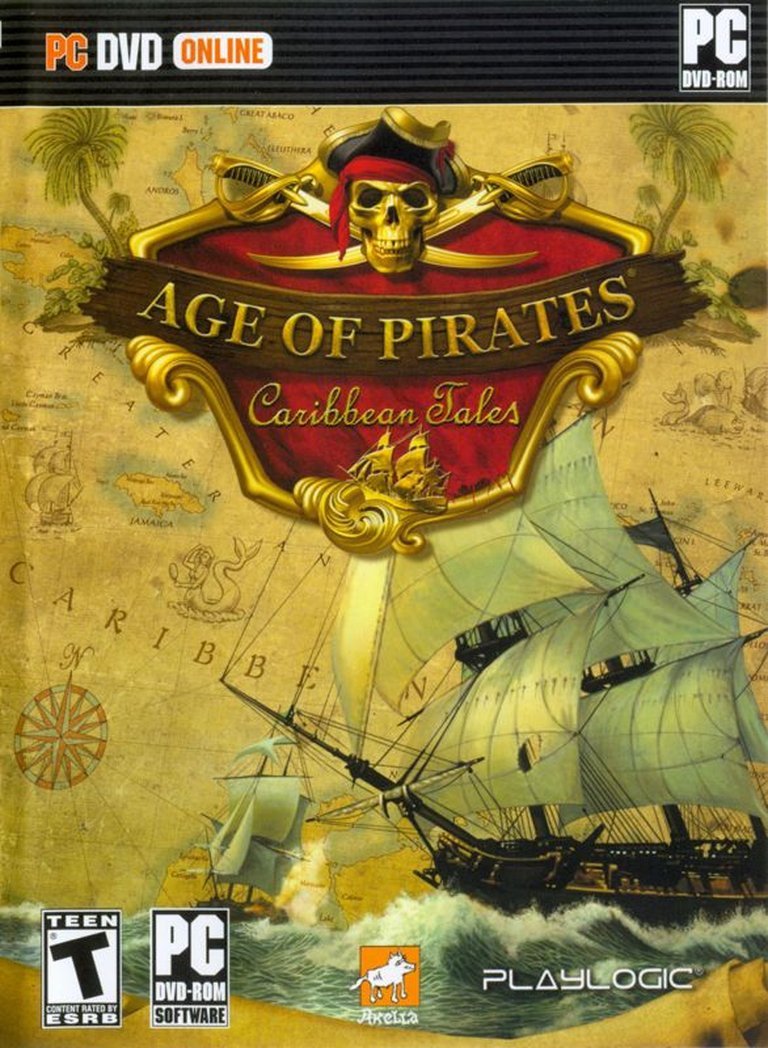
Age of Pirates: Caribbean Tales is a pirate simulation RPG set in the Caribbean Sea, where players assume the role of either Blaze or Beatrice in a non-linear adventure. The game combines naval combat, sword fights, treasure hunting, and strategic management of 16 different ships, with RPG elements allowing upgrades to captains, crews, and skills. Players undertake missions from NPCs, freely choosing to aid nations or engage in plunder across an open-world environment.
Gameplay Videos
Age of Pirates: Caribbean Tales Free Download
Age of Pirates: Caribbean Tales Patches & Updates
Age of Pirates: Caribbean Tales Guides & Walkthroughs
Age of Pirates: Caribbean Tales Reviews & Reception
metacritic.com (56/100): The graphics and environment are beautiful, and the open-ended gameplay with RPG-like elements work great, but they cannot recover from the other shortcomings.
ign.com : And, without giving spoilers, the story is pretty lame after that opening.
gamesradar.com : You can almost see a good RPG/pirate sim trying to get out, but it never makes it through the byzantine combat interface or bug infestation.
Age of Pirates: Caribbean Tales Cheats & Codes
PC
Enter cheat codes as the ship name in the ship selection menu.
| Code | Effect |
|---|---|
| GodMode | God Mode |
| ExpBooster | 10,000 Exp Points |
| MoneyBooster | 10,000 Gold |
| BestGun | Get Best Pistol |
| BestSaber | Get Best Sword |
| BestGlass | Receive the best spy glass |
Age of Pirates: Caribbean Tales: Review
A Swashbuckling Sandbox Strangled by Its Own Rigging
In the mid-2000s, the video game industry found itself caught in a “pirate gold rush,” a thematic wave cresting on the cinematic success of Pirates of the Caribbean. Into this crowded Caribbean sailed Age of Pirates: Caribbean Tales, a title with a heritage as tangled as a ship’s rigging. Born from Russia’s respected Sea Dogs franchise (itself a cult favorite for its ambitious sandbox design), this 2005/2006 release from Akella and Playlogic represented a significant production, promising a deep, open-ended pirate simulator. Yet, as the aggregated critical consensus and hundreds of player hours reveal, it is a game of extraordinary ambition constantly at war with execution so flawed it often founders on the rocks of its own potential. This review will dissect Age of Pirates: Caribbean Tales not as a mere curiosity, but as a profound case study in how a studio’s visionary scope can be catastrophically undermined by clunky design, technical debt, and a failure to refine a promising core.
1. Development History & Context: The Sea Dogs Legacy Sets Sail Again
Age of Pirates: Caribbean Tales did not emerge from a vacuum. Its direct lineage traces to the 2000 Russian phenomenon Sea Dogs, developed by the now-legendary studio Akella. That game, and its Westernized 2003 sequel Pirates of the Caribbean (a curious rebranding of Sea Dogs II), built a fervent niche following for their unprecedented freedom: a living, simulated Caribbean where players could be traders, privateers, or outright pirates. The Sea Dogs series was praised for its depth but often criticized for a steep learning curve and rough edges, issues that seemed almost baked into its DNA.
For Caribbean Tales, Akella was not inventing a new wheel but polishing an old, complex one. The source material confirms it was originally developed as Sea Dogs III, intended as a major technological leap forward using the new STORM engine. This engine delivered the game’s single most acclaimed feature: arguably the most beautiful and dynamic open-sea sailing visuals of its era, with realistic wave physics, weather effects like terrifying tropical storms, and detailed ship models. However, this focus on the nautical spectacle appears to have come at a severe cost. The user review succinctly diagnoses the problem: “The ‘sailing around the ocean’ graphics are quite pretty… Unfortunately, everything else feels as if it was tacked on at the last minute.”
The development context is one of constrained resources and rushed ambition. The original Russian version launched as a buggy 0.99, requiring a critical 1.00 patch to fix “critical bugs.” This fact, noted in the MobyGames trivia, is not an anomaly but a symptom. The project seems to have suffered from feature-creep without corresponding polish. The inclusion of a last-minute narrative (as suggested by the IGN review) and the problematic implementation of a female protagonist—Beatrice, who is reportedly “treated like a man by many NPCs”—point to significant late-stage changes that were not fully integrated. In the 2006 landscape, it was sandwiched between the universally acclaimed Sid Meier’s Pirates! (2004), a masterclass in focused, polished design, and the movie-tied Pirates of the Caribbean: Armada of the Damned (canceled) and Dead Man’s Chest games. Age of Pirates tried to be a harder-core, more complex RPG-simulator hybrid in a market increasingly favoring accessible, action-oriented experiences.
2. Narrative & Thematic Deep Dive: A Story Afterthought
If the engine was built for the sea, the narrative was an ill-fitting passenger. The IGN review cuts to the chase: the story “was pretty much tacked on late in the development cycle.” The premise—playing as Blaze or Beatrice Shark, children of a pirate who dreamed of unifying the Caribbean, receiving a map piece from a stranger—holds potential. Yet, the implementation is spectacularly hollow. The game provides zero direction after the cryptic opening. As the user review notes, it offers no guidance to find the other map half, nor any narrative momentum. The “story” is reduced to a series of disconnected cutscenes and mission snippets from governors and tavern patrons, failing to coalesce into a compelling arc.
Thematically, the game aspires to the Pirates of the Caribbean blend of supernatural mystery and political intrigue but achieves none of it. The 17th-century Caribbean setting is merely a backdrop for repetitive errands. Depth is attempted through the RPG framework—your character has a reputation, affiliations with nations (England, France, Holland, Spain, or the Pirates), and a personal history—but these systems exist in a narrative vacuum. There is no overarching plot to give your conquests meaning beyond the abstract goal of “capturing all colonies.” The game’s “non-linear” promise, as described on its store page, feels less like empowering freedom and more like a complete absence of authorial intent. You are not a hero on a journey; you are a spreadsheet given a sailboat, tasked with filling cells until the final tally.
3. Gameplay Mechanics & Systems: A Cauldron of Contradictions
Here lies the game’s fundamental schizophrenia. It is an RPG, a trading sim, a naval tactics game, and an action-adventure, and it executes each with varying degrees of failure, all glued together by one of the most punishing interfaces in the genre.
-
Core Loop & RPG Progression: The loop is quintessential Sea Dogs: sail, fight/trade/mission, earns XP and gold, upgrade ship/crew/skills, repeat. The RPG layer is deep on paper. You gain XP for nearly everything—capturing ships, completing missions, even surviving storms (which also damage your ship, creating a perverse incentive). Leveling up grants attribute points and traits (e.g., “Watcher” for evading encounters). Officers can be hired, who take a 10% XP cut but contribute their own stats. This system is robust and offers meaningful customization, a point highlighted by the user who enjoyed the “management aspects for your crew and officers.”
-
Sea Combat: Frustration and Tactics: This is the game’s most praised and most criticized pillar. Visually, it is stunning, with ships weaving, turning, and exploding in a fiery ballet. Mechanically, it is a lesson in delayed gratification and opacity. The user review’s summary is brutal and accurate: “Point your guns at enemy ship. Give the ‘Fire!’ command. Pray.” There is a significant, un-Telegraphed delay between command and execution. Gunnery accuracy is tied to your Gunnery Officer’s skill and your own attribute, meaning early-game shots are laughably ineffective. Cannons have a random chance to explode, damaging your own ship and crew—a historically plausible feature that makes for terrible gameplay. Boarding is initiated by getting alongside, but the transition to the chaotic, Dynasty Warriors-style melee on deck is jarring. The user correctly notes you’ll often stab your own men in the back. The pinnacle of this flawed design is the Captain’s Duel: a one-on-one swordfight in the cabin that uses the same cumbersome system. The IGN review found the optimal strategy to be a “simple and boring” cycle of attacking and running to recover stamina, devoid of the reflex-based thrill of Sid Meier’s Pirates!.
-
Interface & Usability Crisis: This is the game’s Achille’s heel, the source of 90% of its negative reviews. The interface is a masterclass in anti-user design. The user review provides a devastating litany:
- Town navigation is a “maze” with only four functional buildings, lacking clear signage.
- Mission text is displayed in a tiny window; the mouse wheel scrolls for dialogue choices but not for mission text, forcing reliance on the spacebar, which also confirms mission acceptance, leading to accidental declines.
- NPCs offer missions once then vanish (“fade from existence”), often before you can even read their offer properly.
- No quick-save key, only manual saves accessible through clunky menus.
- The “Travel” command to instantly go to buildings exists, but you’ll still be lost wandering for mission-givers.
This isn’t just “old-school” or “daunting”; it’s actively hostile. It turns every mundane town visit into a chore, every mission acceptance into a gamble.
-
Trading & Economy: Broken and Derivative: Trading is present but shallow. Colonies have fixed import/export lists, and the user discovered a clear bug: selling to random ships in port yields far more (and accepts infinite cargo) than selling to the shopkeeper. The economy lacks a dynamic supply/demand model, making it a simple, repetitive buy-low/sell-high exercise. The IGN review concurs: “economic changes seem arbitrary at best.” Smuggling and capturing ships for cargo provide more reward than trading itself, undermining the simulation’s core.
-
Colony Conquest & Endgame: The user review from Metacritic provides the only in-depth look at the broken late-game. Capturing colonies is possible but disastrously unbalanced. Captured colonies are “hard time defending themselves” unless meticulously upgraded to castles and staffed with governors possessing high Leadership. The game provides no tools or clear systems for this, leading to a grinding, frustrating endgame where you must personally defend every outpost from simultaneous attacks by all nations. This directly contradicts the empowering sandbox promise and turns the ultimate goal into a tedious, often impossible chore.
4. World-Building, Art & Sound: A Tale of Two Caribbeans
The game’s world is a breathtaking ocean set within a disappointingly small and static archipelago. The sea and sky are the undeniable stars. The STORM engine renders water with impressive fluidity, sail physics are convincing, and weather transitions—especially sailing through a lightning-streaked tropical storm—are exhilarating, as noted by multiple reviews. This is the “seaworthy ambience” praised by GamePro and the living ocean the user loved.
Contrast this with the towns and islands. They are visually drab, repetitive, and functionally barren. As the user and 4Players note, they are “maze-like” with generic buildings and cloned NPCs. There is no sense of unique culture or life. The “baroque colonies” mentioned in a German review are merely cosmetic. The overworld map is a tiny handful of islands, laughably small compared to the expansive Caribbean of Pirates! or Port Royale 2. The sound design is functional: sea shanties and orchestral music during combat are serviceable, but the “ambient” clash of swords that vanishes instantly post-battle is jarring. Voice acting is minimal or absent, replaced by text boxes, contributing to the minimalist, cold presentation. The world feels like a beautiful stage set with nothing happening behind the curtains.
5. Reception & Legacy: A Ship That Never Quite Righted Itself
Upon release, Age of Pirates: Caribbean Tales met with mixed-to-negative reviews. The Metacritic metascore of 56 (based on 23 critics) and Moby average of 62% reflect a deep divide. A handful of reviewers (GamePro, IGN at 79%, Hooked Gamers) saw a flawed but compelling sandbox with “swashbuckling good time” potential. The majority, however, were scathing: GameSpot (47%), PC Gamer UK (24%), GamesRadar+ (calling it a “Jack Sparrow of all trades” that fails at everything), and the German GameStar dismissing it as “just the old Sea Dogs… hübscher verpackt” (prettier packaged).
The critical consensus coalesced around three pillars of failure: 1) an unforgivably clunky interface that made basic tasks a struggle, 2) repetitive, poorly designed missions and combat that lacked satisfaction, and 3) a lack of cohesion between its ambitious systems. The user review on Moby, which gained significant traction (“7 of 8 Moby users rated this review helpful”), became a definitive summation: “The manual describes, accurately, every single feature I’ve ever wanted in a pirate-themed game. But the implementation of these features is just horrendous.”
Its legacy is that of a cult curio and a cautionary tale. For a dedicated few, it is a beloved, modifiable sandbox. The mention of the “Supermod” on Metacritic, which fixes many bugs and adds content (banks, brothels, etc.), is telling. It suggests a passionate community saw the dormant potential beneath the rubble. However, in the broader industry context, it is remembered as the game that proved the Sea Dogs formula, despite its ambition, was not viable in a market demanding polish. Akella would release Age of Pirates II: City of Abandoned Ships in 2007, but the series’ reputation never recovered. It stands as the last major gasp of the complex, hardcore Russian sim style in the pirate genre, a style soon eclipsed by more accessible or action-focused titles. Its influence is negative: it demonstrated the perils of prioritizing systemic breadth over user experience and narrative integration.
6. Conclusion: A Sunken Treasure of Potential
Age of Pirates: Caribbean Tales is a game of magnificent, haunting contradictions. It boasts the most gorgeous and dynamic seascape of its time, paired with some of the most frustratingly inert towns. It offers a deep, multi-system RPG progression wrapped in an interface that actively fights the player. It promises an open-ended pirate life but delivers a meaningless sandbox where your actions have no narrative consequence and its ultimate goal is broken by design.
Its place in history is not as a classic, but as a poignant monument to wasted potential. It is the game that proves ideas and scope are not enough. It is a testament to Akella’s technical prowess in simulating the sea but a damning indictment of their ability to design a coherent game on it. For historians, it is a vital case study in the pitfalls of “feature bloat” and the non-negotiable importance of UI/UX design. For players, it remains a deeply flawed experience, one that the user review’s final verdict nails perfectly: “Don’t. Just don’t. Try ‘Sid Meyer’s Pirates’ instead. Or, if you want something more in-depth, there’s ‘Port Royale 2’.”
To play Age of Pirates: Caribbean Tales today is to witness a ship with a magnificent hull and powerful engines, but with a broken rudder, a confused crew, and a captain who has no destination. You can admire its ambition from the shore, but choosing to sail its waters will likely leave you stranded, frustrated, and longing for the polished, focused adventures that defined the genre’s true golden age. It is not a sunken treasure; it is the treasure chest itself, forever locked, its glorious contents glimpsed only through cracked glass.