
- Release Year: 2008
- Platforms: PlayStation 2, Wii, Windows
- Publisher: MediaHouse Ltd., NDS Denmark ApS
- Developer: Attractive Games Ltd.
- Genre: Action
- Perspective: Behind view
- Game Mode: Single-player
- Gameplay: Bubble gun, Combat, Platforming, Puzzle
- Setting: Fantasy
Description
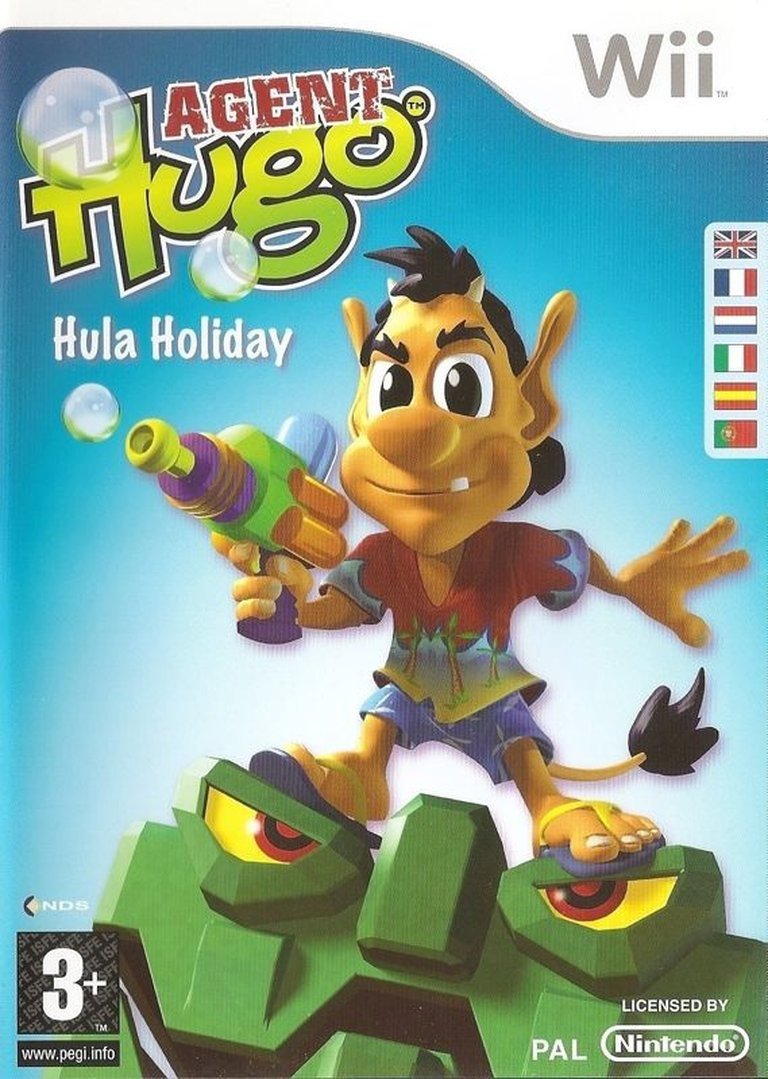
Agent Hugo: Hula Holiday is a 3D platform game starring Hugo the TV troll, played from a behind-view perspective. While vacationing on a fantastical tropical island, Hugo uncovers a plot by a giant fly to convert the paradise into a landfill using robotic trash cans, aiming to feed its growing fly army. Players navigate colorful, imaginative environments, utilizing Hugo’s tail sweep for close combat and bubble gun for distant foes, all within a licensed fantasy setting.
Gameplay Videos
Agent Hugo: Hula Holiday Free Download
Agent Hugo: Hula Holiday Patches & Updates
Agent Hugo: Hula Holiday Mods
Agent Hugo: Hula Holiday Cheats & Codes
Nintendo Wii
| Code | Effect |
|---|---|
| 081BF4DC 00000064 20100008 00000000 |
100% all level’s [memorris] |
| 081BF4D8 01000000 20100008 00000000 |
All Level’s open [memorris] |
| C201D2F0 00000002 3CC00002 3806869F 90050924 00000000 |
If diamond Increase, MAX [ZiT] |
| 040342B0 D07F3040 | Infinite Health [ZiT] |
| 201C2FC8 00000800 040B8364 D18600EC E0000000 80008000 201C2FC8 00000000 040B8364 D00600EC E0000000 80008000 |
Moon JUMP [ZiT] |
Playstation 2
| Code | Effect |
|---|---|
| 9032BB6C 0C0CEEB2 | Enable Code(Must Be On) |
| 2026BAE4 34020001 | Don’t Need Keys To Open Gates |
| 200C0200 3C030042 200C0204 8C63ABEC 200C0208 10600009 200C0210 8C630000 200C0214 10600006 200C021C 3C044040 200C0220 AC6432D0 200C0224 AC6432D4 200C0228 AC6432D8 200C0230 03E00008 2032BA40 08030080 |
Infinite Health |
| 2024C8B8 00000000 | Jump in Midair |
| 2026AE90 3C0205F5 2026AE98 3442E0FF |
Pickup Diamonds For Max Diamonds |
Agent Hugo: Hula Holiday: Review
Introduction: A Troll’s Last Stand in a Changing seas
In the vast, often-overlooked catalog of licensed European children’s games, few franchises boast the longevity and sheer volume of output as Hugo. Originating from a Danish interactive TV game show in 1990, the series evolved through countless minigame compilations, educational titles, and genre experiments. By the late 2000s, the brand was a familiar, if fading, fixture on Windows PCs and consoles across Continental Europe. Agent Hugo: Hula Holiday (2008) represents a poignant, final chapter: the last traditional 3D platformer in the core Agent Hugo sub-series and one of the final gasps of the classic Hugo formula before the franchise’s inevitable pivot to mobile and slot games. This review will dissect a game that exists almost entirely in the shadow of its own legacy and the titans of its genre, arguing that while Hula Holiday is a technically competent and charmingly simple piece of work, it is also a definitive artifact of a bygone era—a moment where a beloved regional character attempted to compete in a globalized market dominated by icons like Mario, ultimately revealing the creative and commercial constraints of its licensed, low-budget origins.
Development History & Context: The End of an Agent’s Era
The Agent Hugo series, beginning in 2005, was a deliberate reinvention. Moving away from the TV-show minigame anthologies, it positioned the titular troll as a James Bond-esque secret agent on globetrotting adventures. This shift required fuller 3D environments and more complex gameplay, a significant leap for a franchise built on simple, responsive 2D scenarios. The first three entries—Agent Hugo (2005), RoboRumble (2006), and Lemoon Twist (2007)—were developed by the series’ original creator, ITE Media (formerly Interactive Television Entertainment).
Hula Holiday marks a crucial transition. Development duties shifted to Attractive Games Ltd., a studio with a portfolio that includes other licensed children’s titles (notably Wonder World: Amusement Park and Bratz games). This change in hands is significant. While ITE Media understood the Hugo DNA intrinsically, Attractive Games was likely brought in for its 3D platformer expertise but operated within a tight budgetary and licensing framework. The technological context of 2008 is vital: the PlayStation 2 and Wii were in their twilight but still massively popular, especially in the family demographic. The Wii, with its motion controls, was utterly dominant. Yet, based on the platform-specific credits and specifications listed on MobyGames, Hula Holiday appears to be a fairly straightforward multi-platform release with no specific Wii motion implementation noted in its core specs. This suggests a “lowest common denominator” approach—a single design tailored for the keyboard/gamepad paradigm of PC and PS2, with a straightforward port to the Wii. The game’s PEGI 3 rating and “child-friendly universe” descriptor (per Metacritic) cement its place in the “safe” but creatively limited space of early-childhood software, a stark contrast to the moreComedically irreverent tone the Agent Hugo series had flirted with.
Narrative & Thematic Deep Dive: Environmentalism on Easy Mode
The plot, as summarized on MobyGames, is pure, unadulterated Saturday morning cartoon simplicity: “While on vacation Agent Hugo notices that a big fly with his robotic trash cans is transforming a nearby island into a dump, in order to feed his fly army.” The antagonist is Sly (likely a variant or minion of the series’ arch-nemesis, the witch Scylla, though the source material here is ambiguous), a megalomaniacal fly commanding an army of trash-compacting robots. His motive is literal gluttony—turning a paradise into a garbage dump to feed his larvae.
This narrative framework allows for two primary themes, both delivered with the subtlety of a sledgehammer:
1. Environmental Stewardship: The core conflict is pollution. The villain’s modus operandi is the destruction of a pristine island ecosystem. The player’s goal is to restore order, implicitly teaching that cleanliness and natural beauty are good, while trash and pollution are evil. This is not a nuanced critique of consumerism but a binary, child-appropriate lesson.
2. Vacation Inversion: The “Hula Holiday” title is ironic. Hugo’s vacation is immediately hijacked by duty. The tropical paradisiacal setting (inferred from “Hula” and “island”) is under siege, turning a relaxation scenario into a mission. This taps into a common children’s fantasy: the abrupt transition from play to responsible heroism.
The characters are archetypes. Hugo is the dependable, tail-wielding hero. Sly is a one-note villain whose design (a “big fly”) is visually repulsive in a cartoonish way, perfect for young children to identify as “the bad guy.” The absence of deeper dialogue or character arcs (per the lack of any quoted script in sources) confirms this is a game where narrative exists solely to motivate the platforming. The story is a McGuffin, a thin veneer justifying the traversal from Point A to Point B across 17 “colourful levels.”
Gameplay Mechanics & Systems: Tail Sweeps, Bubbles, and Autonomy
Agent Hugo: Hula Holiday is a 3D platformer in the “collect-a-thon” tradition, but with a notably stripped-down control scheme. The MobyGames description provides the complete mechanical toolkit:
1. Tail Sweep: The primary melee attack. It is performed in a full 360-degree spin, serving a dual purpose: eliminating nearby robotic trash cans and activating “screw switches” to open doors or trigger mechanisms. This is the game’s central, recurring verb. It requires no targeting reticle, encouraging button-mashing proximity combat.
2. Bubble Gun: A secondary, ranged tool. Used to shoot “distant enemies,” encapsulating them in “floating soap-bubbles.” These bubbles render the enemy helpless, presumably floating in the air until Hugo can close in and finish them with a tail sweep. This introduces a basic two-step combat流程: immobilize from a distance, then engage up close. It also likely has environmental puzzle applications (e.g., hitting switches from afar).
3. Platforming: The foundation. The “behind view perspective” (a fixed third-person camera, likely more restricted than contemporaries like Super Mario 64 or Ratchet & Clank) navigates “17 colourful levels.” Given the PEGI 3 rating, we can infer a generous helping of wide, forgiving platforms, minimal instant death pits, and a focus on horizontal traversal over precision jumping.
Analysis of Systems:
* Innovation? The system is not innovative but consolidative. Combining a melee spin attack with a ranged immobilizer and level navigation was standard fare by 2008 (Jak and Daxter, Sly Cooper). Its simplicity is its defining feature. There is no mention of health bars, complex combos, character upgrades, or a complex inventory. This is a game designed for preschoolers or very young children, where failure states are minimal and inputs are few.
* Flaws & Constraints: The “behind view” perspective in 3D platformers is notoriously tricky for camera control. Without evidence of a sophisticated camera system in the credits, we can anticipate a static or semi-static camera that may cause frustration in more complex level geometry. The lack of a jump button in the public description is conspicuous. It’s possible jumping is automatic (context-sensitive) or that the tail sweep provides a slight vertical boost, but this omission points to a game that drastically simplifies the platforming verb list. The combat loop (bubble then sweep) could become repetitive quickly for older players. The game likely lacks a meaningful “progression” system beyond level completion and gem/collectible gathering (alluded to by a MyAbandonware user reminiscing about “collecting gems”).
* Gameplay Loop: The loop is immediately graspable: enter level, traverse via platform jumps, use bubble gun on distant threats, use tail sweep on close threats and to activate switches, confront a minor boss or mini-challenge at the end (the “big fly”?), collect items, move to next level. It is a snack-size game, designed for short, satisfying play sessions.
World-Building, Art & Sound: A Generic Paradise
The setting is a “fantasy” tropical island, as per the MobyGames genre tags. “Hula Holiday” strongly evokes a Hawaiian/Pacific aesthetic—think palm trees, sandy beaches, volcanic peaks (recalled by a MyAbandonware user), and perhaps some cartoonish tiki decorations. This is a safe, universally recognizable “vacation” aesthetic, devoid of cultural specificity or depth. The “robotic trash cans” are the primary enemies and set dressing, a bizarre but child-appropriate design: familiar objects made monstrous and metallic.
Art Direction: The art direction, led by Guus Oosterbaan, would have aimed for bright, saturated colors, simple geometric shapes, and clear visual differentiation between hazards (red-trashcans?), interactables (yellow switches?), and platforms. Given the “licensed” nature and target age (PEGI 3), the style is almost certainly cartoonish and soft-edged, avoiding any sharp angles or dark palettes. The “colourful levels” descriptor suggests a primary-color-heavy palette. It is the antithesis of the moody, detailed worlds of the era’s flagship platformers; it is functional, cheerful, and instantly legible.
Sound Design: The credits list no specific sound designer or composer, which is typical for lower-budget titles where audio might be outsourced or handled by a small team. We can expect:
* A peppy, repetitive ukulele or steel-drum-based loop to sell the “Hula” theme.
* Simple,atisfying pop sounds for bubbles, a thwack for the tail sweep, and cheerful jingles for collecting items.
* Hugo’s vocalizations: likely a series of grunts, yelps, and a catchphrase, in keeping with the character’s TV show origins where he was famously silent save for expressive sounds.
The sound design’s goal is not immersion but clear auditory feedback for a child player, reinforcing every action with a positive, non-threatening sound.
Reception & Legacy: A Whisper in the Database
The reception data for Agent Hugo: Hula Holiday is almost non-existent, which is itself a significant part of its story.
* Critical Reception: There are zero critic reviews aggregated on Metacritic for any platform. MobyGames shows “n/a” for the Moby Score and lists 0 critic reviews. This is not an anomaly for niche, regionally-focused children’s games, but it is a stark statement. The game was not on the radar of the international press. It was not reviewed by major outlets like IGN, GameSpot, or Eurogamer. Its existence was confined to the shelves of European toy stores and the catalogues of local publishers.
* Player Reception: MobyGames records a user average of 2.0 out of 5, based on only 4 ratings and 0 written reviews. The single user comment on MyAbandonware from someone who owned it in Ukraine is telling: “I mainly remember spinning the tail to kill blue and green trashcans, and collecting gems. I also remember a large volcano, and flying across islands like a helicopter somewhere later.” This memory is fragmentary, affectionate, but devoid of critical analysis—it is a childhood sensory imprint. The low 2.0 score likely comes from retrospective votes by users who find the game simplistic or boring, not from its intended audience (young children, who do not typically post online reviews).
* Commercial & Franchise Legacy: Commercially, it was a quiet, standard release in the Hugo franchise’s long tail. Its true legacy is as a transition point and an endpoint.
* End of the Agent Era: It was the fourth and final Agent Hugo title. The sub-series, which tried to modernize Hugo into an action hero, did not achieve the breakout success needed to sustain it against global competitors.
* Shift in Development & Focus: Post-2008, the Hugo license holder (eventually Hugo Games) moved decisively away from traditional console/PC platformers. The Wikipedia list shows a rapid pivot to:
* Mobile endless runners (Hugo Troll Race).
* Freemium village builders (Hugo World).
* Online real-time strategy/tower defense (Hugo Troll Wars).
* Online slot games (a major revenue stream with Hugo, Hugo 2, Hugo Goal, etc., developed by 5th Planet Games and Play’n GO).
This mirrors the late-2000s/early-2010s industry shift towards mobile and online monetization.
* The Reboot: In 2009, the year after Hula Holiday, Attractive Games itself would develop Hugo: Magic in the Troll Woods, but this was a complete franchise reboot with a new “apprentice sorcerer” Hugo in a different fantasy world, published by Krea Medie. This signals that even the developers recognized the Agent Hugo formula was exhausted. The classic continuity was being shelved.
Conclusion: A Historical Curiosity, Not a Lost Classic
Agent Hugo: Hula Holiday is not a game that can be judged by the standards of Super Mario Galaxy (released the same year) or even Ratchet & Clank Future. It exists in a separate ecosystem: the world of budget-constrained, heavily-licensed children’s software for the European mass market. Its defense rests on its successful execution of a very narrow design brief: create a safe, colorful, easy-to-control 3D platformer for children aged 3-7 starring a nationally beloved character. In that narrow lane, with its simple tail-sweep/bubble-gun mechanics and non-threatening tropical aesthetics, it likely succeeded quietly for its target audience.
However, as a piece of video game history, its value is almost entirely documentary. It is the final, faded postcard from the Agent Hugo initiative—a last attempt to give a TV troll the full 3D platformer treatment before the realities of the market and the limitations of the IP became undeniable. Its obscurity outside its home region, the complete absence of critical discourse, and the franchise’s subsequent metamorphosis into a mobile/slot-game phenomenon highlight its true stature: it is the last breath of an old model, a competent but creatively barren endpoint where a charming, long-running character was finally unable to escape the confines of his humble, region-specific origins. To play Hula Holiday today is not to discover a hidden gem, but to witness a quiet epilogue in the story of how European interactive television struggled to translate into the global language of premium 3D gaming. It is, in the final analysis, a perfectly adequate game for a 5-year-old in 2008, and a fascinating case study in franchise lifecycle management for anyone else.