
- Release Year: 2017
- Platforms: Browser, Linux, Macintosh, Nintendo Switch, PlayStation 4, Windows, Xbox One, Xbox Series
- Publisher: Fancy Fish Games, Whitethorn Digital
- Developer: Fancy Fish Games, SnöBox Studio
- Genre: Action, Role-playing (RPG), Strategy, Tactics
- Perspective: Side view
- Game Mode: Co-op, Single-player
- Gameplay: City building, construction simulation, Crafting, Mining
- Setting: Fantasy
- Average Score: 81/100
Description
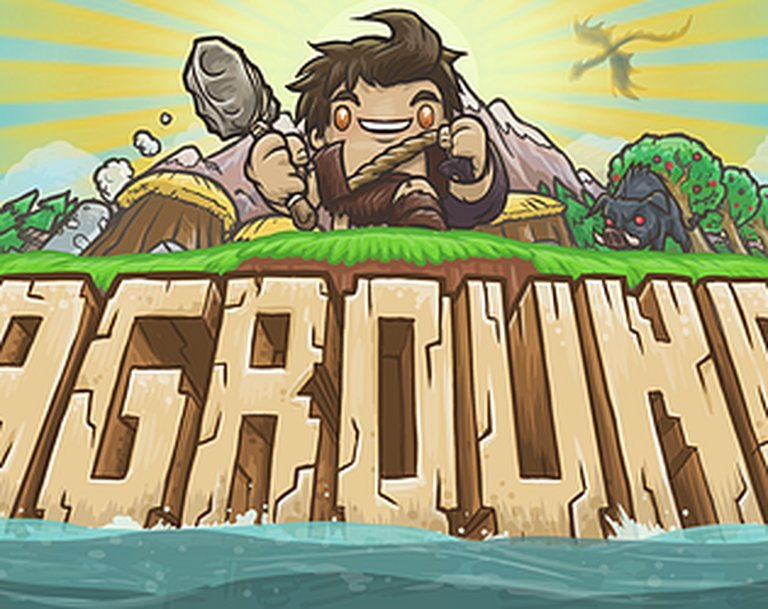
Aground is a resource-gathering and crafting game with a focus on progression, where players start as a lone survivor shipwrecked on a seemingly uninhabited island with almost nothing, gradually mining resources, crafting tools and items, building a thriving settlement, farming, trading, sailing to other islands, encountering NPCs and creatures like dragons, and advancing through technology to eventually reach space and travel between planets.
Gameplay Videos
Where to Buy Aground
Aground Free Download
Aground Mods
Aground Guides & Walkthroughs
Aground Reviews & Reception
metacritic.com (75/100): Aground surprised me with how much I kept wanting to get back to it the more I played.
opencritic.com (75/100): If you like your crafting but want a guiding hand for your experience, Aground is a good place to start.
steambase.io (94/100): Very Positive
gameshedge.com : hours upon hours of exploration fun.
collectingasylum.com : It has quite a satisfying feel to it.
Aground Cheats & Codes
PC
Press CTRL + Shift + D on Windows or CMD + Shift + D on Mac to open the developer console. Commands only work on PC. For item IDs and area names, refer to https://aground.fandom.com/wiki/IDs. Replace spaces in names with underscores.
| Code | Effect |
|---|---|
| player.loseHealth = function(){return 0;} | God mode (invincibility) |
| player.vehicle.setHidden(“true”) | Makes your vehicle invisible to enemies |
| player.fullRestore() | Restores your health and stamina |
| player.restoreHealth() | Restores your health (Health can be replaced with Stamina, Oxygen, or Power) |
| player.info.stamina = 300 | Sets the player’s stamina stat to 300 |
| player.addExp(500) | Gives you 500 XP |
| player.equipment.get(“pickaxe”).value.info.stamina = 0 | Mining will no longer cost stamina |
| player.equipment.get(“sword”).value.info.stamina = 0 | Attacking with a sword will no longer cost stamina |
| for (k in player.getInfo().getSkills()) player.skills.set(k,99) | Maxes all player skills |
| for (k in player.getInfo().getSkills()) player.skills.set(k,0) | Resets all player skills |
| Turns the Werewolf player into a human player | |
| Turns the human player into a werewolf | |
| player.addItem(“magic_box”) | Gives the player a Magic Box |
| player.addItem(“magic_box”,5) | Gives the player five Magic Boxes |
| player.inventory.weight = 0 | Sets your inventory weight to 0 |
| player.inventory.weight = -99999 | Allows unlimited carry weight |
| player.setVar(‘cp’, 1500) | Sets Colosseum Points (Spirit Points) to 1500 |
| for (e in player.equipment.slots) e.value.value = 0 | Repairs/Heals/Feeds any familiar or item currently equipped |
| player.equipment.forceEquip(“weapon”, player, getItem(“magic_sword”).asItem()) | Equips the player with a magic sword |
| Teleports the player to coordinates on the starting island | |
| Radar detects ores in the ground | |
| Hides/stops the radar | |
| player.addExp(999999999) | Gives massive amount of XP |
| player.equipment.get(“head”).value = null | Removes item equipped in head slot (e.g., cyborg eye) |
| rep = function(i){a = i.inventory.getItems();while(a.hasNext()){b=a.next().getItemValues();b.valueMap.h=[b.item.count];}} | Defines repair function for inventory items (run once after loading) |
| rep(player) | Repairs all items in player inventory |
| player.increaseValue = function(amt){} | Makes tools indestructible and flamethrower endless |
| player.loseStamina = function(){} | Stops losing stamina altogether |
| player.getStorage(“power”).loseValue = function(){return false;} | Makes batteries unending (don’t discharge) |
| oneHand = function(i){a = i.inventory.getItems();while(a.hasNext()){a.next().item.slots=[];}return “cheers”;} | Defines function to make items take only one slot (run once) |
| oneHand(player) | Makes all items in player inventory take only one slot |
| setPVP(true) | Enables PVP (use false to disable) |
| player.getOverlappingStructure() | Returns the type of structure the player is overlapping |
| player.renderer.stage.set_alpha(0.3) | Sets the transparency of the game |
| player.renderer.stage.application.windows[0].close() | Closes the game window without saving |
| player.renderer.stage.set_rotation(10) | Sets the rotation of the game |
| resetAll() | Resets everything, including saves and achievements |
| Creates new colony on Sunset Haven | |
| player.gui.coins.changeCurrency(“spirit”, “spirit”) | Changes coin display to spirit points |
| Moves dragon bomber to player position | |
| Creates a plant boss at x=45 y=0 | |
| Removes Magic Island Alchemist NPCs from current area | |
| Changes music to starting island night music |
Aground: Review
Introduction
Imagine washing ashore on a desolate island with nothing but your bare hands, only to claw your way from primitive survivalist to interstellar pioneer, taming dragons and unraveling cosmic mysteries along the way. This is the intoxicating promise of Aground, a 2D survival-crafting RPG that defies the genre’s often aimless grind by infusing every pickaxe swing with narrative purpose. Released initially as a free browser game in 2017 by indie studio Fancy Fish Games, Aground has since amassed over three million plays, spawned a vibrant community, and expanded to consoles via Whitethorn Digital. Its legacy lies in redefining progression not as endless sandbox sprawl—like Minecraft or Starbound—but as a tightly curated ascent from stone-age scraps to starfaring empire, complete with branching stories and magical-scientific dichotomies. My thesis: Aground stands as a landmark in indie survival design, proving that constraint breeds innovation, purpose trumps freedom, and humble pixels can house epic odysseys, cementing its place as a must-play for genre enthusiasts.
Development History & Context
Fancy Fish Games, a small Connecticut-based indie outfit founded by David Maletz, birthed Aground in May 2017 from an ambitious spark: a 2D procedural galaxy simulator “done right.” Maletz, handling design and programming solo initially, pivoted dramatically after realizing the power of starting players “with nearly nothing,” echoing text adventures like A Dark Room more than voxel behemoths. This shift emphasized linear-yet-branching progression over open-world chaos, a bold counterpoint to the 2010s survival boom dominated by Minecraft‘s infinite liberty and Terraria‘s metroidvania sprawl.
Technological constraints shaped its HTML5 browser debut on October 24, 2017, via portals like Kongregate, Newgrounds, and Armor Games—platforms thriving amid Flash’s death throes. Built with OpenFL for cross-platform parity (later PC, Mac, Linux, consoles), Aground leveraged simple 2D scrolling and pixel art by Aaron Norell of SnöBox Studio, sound/music by Chase Bethea, and story editing by Natalie Maletz. No sprawling engine like Unity burdened it; instead, lightweight code enabled rapid iteration.
The gaming landscape was ripe: survival-crafters ruled itch.io and Steam Early Access, but browser games offered free discovery amid mobile and Twitch dominance. Aground‘s viral explosion—top-five on Newgrounds, Kongregate’s monthly winner, PAX West showcase—fueled a February 2018 Kickstarter success and ongoing Patreon. Feature creep threatened during Early Access (2018-2020), ballooning from three islands to planetary odysseys, multiplayer, and mods via mod.io. Maletz’s “incremental mining” dev philosophy mirrored the game: fix, expand, community-refine. Full release hit Steam/GOG/itch.io April 17, 2020 ($14.99), with console ports (PS4, Xbox One/Series, Switch) in 2021. Constraints birthed genius—browser limits forced focused progression, birthing a genre antidote to bloat.
Narrative & Thematic Deep Dive
Aground‘s narrative is a masterclass in emergent storytelling, unfolding via quests, cutscenes, and survivor dialogues rather than heavy exposition. You awaken as a shipwrecked survivor on a lush, alien-world island post-cataclysmic crash—humanity’s colony ship ravaged by extraterrestrial “Old Ones.” Themes of progression, magic vs. science, and human resilience propel a plot branching into Science Path (tech uplift via cyborg Mirrows, jets, spaceships) and Magic Path (dragon-taming, elemental spirits, portals), with hybrids possible.
Plot Structure: Linear gates unlock islands/planets, but choices matter. Eastern Island’s “Old One” boss guards Alter Gems; Sunset Haven’s Mirrows (paranoid cyborg scientists) demand fealty or combat. Deeper lore reveals World War III over exotic matter/FTL, alien invasion, and cryo-pod survivors. Endgame spans Spirit Worlds, Mars portals, and Colony Ship horrors—body horror wombs, chained experiments—culminating in alien confrontations. Branching yields multiple endings: Science builds mecha-dragons; Magic summons spirit armies.
Characters & Dialogue: Colorful NPCs drive humanity. The Miner eats dirt pre-rescue; Builder enables storage; Alchemist hatches wyrms (larval dragons) into familiars; Hunter wields shotguns. Mirrows—goggle-eyed, red-lensed extremists—embody well-intentioned villainy, experimenting on humans to counter aliens (justified by crash-saving feats). Dialogue shines: terse, flavorful, lore-droppers around nightly campfires. “Why am I mining? What’s it all for?”—Maletz’s vision manifests in purposeful chit-chat, evolving from survival banter to philosophical riffs on tech-magic fusion (e.g., battery-powered spell staves).
Themes Explored:
– Progression as Catharsis: Every tool/space unlocks “what’s next?” surprises, mirroring human ascent.
– Duality: Science (chainsaws, guns) vs. Magic (fire-breathing dragons as ships); hybrids like Ice-enchanted torpedoes Mundane-Make-Awesome.
– Moral Grayness: Defeat Means Respect (befriend Mirrows post-boss); Skippable Bosses risk NPC deaths.
– Discovery: Foreshadowing (wyrm Dragonblood drops) rewards curiosity, blending Body Horror (Mirrow labs) with whimsy (fire-breathing chickens).
Unmarked spoilers abound in play, preserving TV Tropes-noted “element of discovery.” Narrative elevates crafting from tedium to epic necessity.
Gameplay Mechanics & Systems
Aground‘s core loop—gather, craft, build, explore—escalates masterfully from fist-punching trees to spaceship dogfights, gated by tools/NPCs.
Core Loops:
– Resource Gathering: Punch/chop/mine (XP from tile toughness); auto-pickup fails at encumbrance. Fishing, farming (crops/animals), trading expand sustainably.
– Building/City Sim: Structures (warehouse, farm, smelter) unlock via quests; NPCs automate (Miner stocks ore). Minecarts streamline logistics; power plants guzzle fuel.
– Crafting/Smelting/Cooking: Integral—iron bars, burgers heal; Alter Gems morph wyrms into living weapons/armor.
Combat: Side-view action; weapons (axes, shotguns, magic staves) vs. boars, golems, Steel Wyrms, bosses. Elemental Rock-Paper-Scissors (Fire weak to Water/Earth) adds depth; Critical Encumbrance slows fat-laden fighters. Stealth (invisibility cloaks) averts fights; familiars (dragons) assist.
Progression: Point-buy skills (Health, Stamina, Oxygen); level-ups fill HP/Stamina. Non-combat XP (mining/crafting) emphasizes builder playstyles. Vehicles (boats, jets, dragon-ships) enable interplanetary travel.
UI/Systems: Clean pixel HUD; intuitive menus (up enters buildings). Multiplayer (IP connect, co-op) shines for shared progression. Flaws: Repetitive grinding (mitigated by automation); oxygen drowns unwary swimmers. Innovations: Living Weapons (degrade on HP zero); Hybrid Magitek (Mecha Dragon batteries > steak-feeding); moddable via mod.io.
Pacing flawlessly layers complexity—early medieval, late Schizo Tech (guns amid farms).
World-Building, Art & Sound
Aground‘s planet—Earth-like yet alien—pulses with Patchwork Maps: conifer forests abut deserts; whirlpools portal to ice realms; Depths’ ocean floors hint lost continents. Exploration rewards: underground golem lairs, Eastern Wyrm Hives (ribcage-like), Colony Ship abominations. Planets (Colony’s terraformer oasis, Spirit Worlds) expand to single-biome wonders.
Visuals: Retraux pixel art—super-deformed sprites (wide-as-tall chars)—evokes 8-bit charm. Vibrant palettes (lush greens, fiery caves) contrast horrors; dynamic animations (dragon flights, spirit glows) immerse.
Sound Design: Chase Bethea’s retro chiptune score—tranquil digging loops to boss jams—pairs ambient wildlife (boar grunts, wyrm hisses). SFX satisfy: crunchy mining, fiery breaths. Campfire cutscenes cozy amid peril.
Elements synergize: Pixels amplify progression wonder; sound underscores isolation-to-empire.
Reception & Legacy
Browser launch exploded (3M+ plays, stellar ratings); Early Access refined via feedback. Steam: 94% Very Positive (1,908 reviews), praising progression. Critics: 75-80% (NintendoWorldReport, LadiesGamers)—”tranquil digging,” “super fun,” though grind/visuals noted. Consoles (2021): Similar acclaim (GamesHedge 9/10, Collecting Asylum 8/10); Metacritic user 7.8.
Commercial: $15 steady seller; bundles itch.io. Legacy evolves: Modding community (mod.io), Discord/Reddit lore dives (e.g., Aground Zero prequel inferences—Earth cryo-survivors, wyrms). Influences Core Keeper, Nova Lands hybrids; inspires sequels (Aground Zero 2024). Crowdfunded success models indie sustainability; elevates browser-to-console paths.
Conclusion
Aground synthesizes survival’s grind into purposeful ascent, weaving crafting, combat, and choice into a narrative triumph that spans islands to infinity. Maletz’s vision—purposeful progression amid magic-science fusion—delivers addictive depth beneath pixel simplicity, flaws like repetition paling against innovations. Exhaustive yet accessible (20-85+ hours), it earns 9.5/10—a video game history cornerstone, proving indies can outshine giants by asking: “What’s next?” Essential for survival fans; its legacy endures in every mined block and launched rocket. Play it: progress awaits.