
- Release Year: 2003
- Platforms: PlayStation 2, PlayStation 3, Windows
- Publisher: Activision Value Publishing, Inc., Akella, Cenega Poland Sp. z o.o., Midas Interactive Entertainment BV, Nobilis France, rondomedia Marketing & Vertriebs GmbH
- Developer: InterActive Vision White Eagle Sp. z o.o.
- Genre: Simulation
- Perspective: 1st-person
- Game Mode: Single-player
- Gameplay: Arcade mode, Combat, Helicopter simulation, Mission-based, Physics-based controls
- Setting: Military, Modern
- Average Score: 70/100
Description
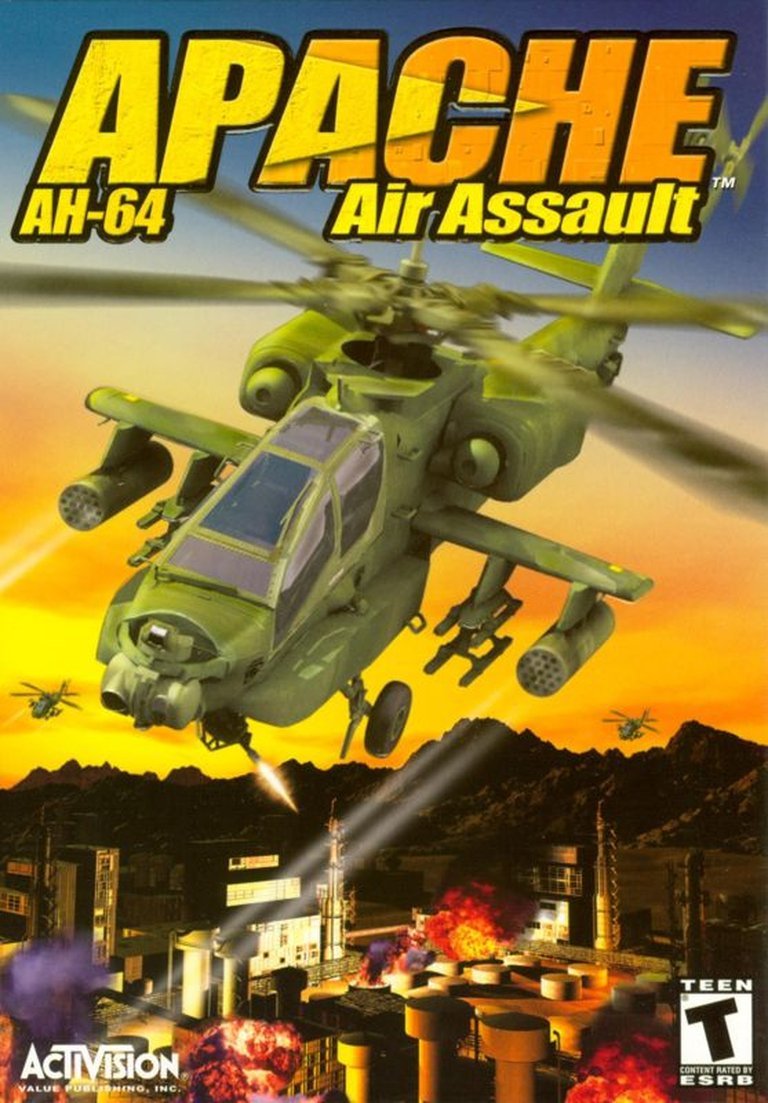
Set in the fictional conflict with the terrorist organization ‘The Solar Martyrs’ in Banhar, ‘AH-64 Apache Air Assault’ is a helicopter simulation where players take command of the AH-64 Apache, the primary attack helicopter in the U.S. arsenal. Featuring both arcade and realistic physics modes, the game offers 5 different camera views including an immersive 1st-person cockpit perspective. Players will utilize the Apache’s formidable arsenal including Hellfire Missiles, a 30mm automatic cannon, and various rockets across 30 unique missions, typically requiring the destruction of enemy targets in challenging environments.
Gameplay Videos
AH-64 Apache Air Assault Free Download
AH-64 Apache Air Assault Cracks & Fixes
AH-64 Apache Air Assault Patches & Updates
AH-64 Apache Air Assault Mods
AH-64 Apache Air Assault Reviews & Reception
metacritic.com (70/100): It could have been better, but as a simulator it’s quite good.
tallyhocorner.com : Despite colliding with a lot of the same mission design powerlines that HAWX 2 collided with, Apache Air Assault ends up far more entertaining thanks to its plausible handling, punchier violence, and naturally slower pace.
AH-64 Apache Air Assault Cheats & Codes
Apache AH-64 Air Assault (PC)
Type the following codes while playing the game.
| Code | Effect |
|---|---|
| JKGODM | God Mode |
| JKAMMO | Unlimited Ammo |
| JKMSUC | Mission Successful |
Apache Air Assault (PC)
Type the following codes at any time during a mission.
| Code | Effect |
|---|---|
| JKGODM | Indestructible Helicopter |
| JKAMMO | Unlimited Ammo |
| JKMSUC | Mission Successful |
AH-64 Apache Air Assault: Review
Introduction
In the pantheon of combat flight simulators, few vehicles evoke the same dread and awe as the Boeing AH-64 Apache. The “primary attack helicopter in the U.S. Arsenal,” as described in its 2003 debut, promised players the chance to unleash hellfire missiles and 30mm cannons from the skies. Yet, Apache Air Assault arrived not as a triple-A blockbuster but as a budget title priced at a mere $20. Developed by Polish studio InterActive Vision and published by Activision Value, it faced an uphill battle against contemporaries like Comanche 4 and Jane’s Longbow. This review argues that despite its modest ambitions, Apache Air Assault delivers a surprisingly authentic and engaging helicopter combat experience, constrained by budgetary limitations yet elevated by its faithful simulation of the Apache’s capabilities. It stands as a fascinating artifact of early 2000s simulation gaming—a niche title that punches above its weight, even if it never reaches the heights of its more ambitious peers.
Development History & Context
InterActive Vision White Eagle Sp. z o.o. was a Polish developer with a portfolio dominated by budget-friendly simulations, including titles like Search and Rescue 4 and Vietnam Med Evac. For Apache Air Assault, their vision was clear: create an accessible, mission-based helicopter combat game that captured the essence of flying the iconic AH-64 without the overwhelming complexity of hardcore sims like Jane’s Longbow 2. The project was helmed by Marcin Kaliciński, who served as both Project Manager and Lead Programmer, overseeing a small team of 47 developers. Technologically, the game leveraged the RenderWare engine—a popular choice for mid-2000s titles due to its versatility and cost-effectiveness. However, this came with trade-offs: RenderWare facilitated solid 3D environments but constrained graphical fidelity and advanced features.
Released in February 2003 for Windows, Apache Air Assault entered a gaming landscape dominated by the post-Grand Theft Auto III open-world boom and the rise of online multiplayer. Simulations, meanwhile, were experiencing a niche renaissance, with IL-2 Sturmovik: Forgotten Battles (2003) setting new benchmarks for realism. As a budget title priced at $20, it positioned itself as an entry point for players curious about helicopter combat but intimidated by hardcore sims. Its multi-platform releases—including a 2005 PlayStation 2 port and a 2012 PlayStation 3 re-release under the title Operation Air Assault—reflected a deliberate strategy to maximize reach despite minimal marketing. Ultimately, the game’s development was a testament to shoestring ingenuity: a small team working within strict technological and financial parameters to deliver a polished, if imperfect, product.
Narrative & Thematic Deep Dive
The narrative of Apache Air Assault is a product of its time—a post-9/11 thriller steeped in contemporary geopolitical anxieties. Set in July 2001, the plot unfolds as U.S. intelligence discovers that the terrorist organization “The Solar Martyrs” has hidden nuclear weapons in the fictional Middle Eastern nation of Banhar. Avoiding a full-scale invasion to prevent catastrophic escalation, the government dispatches a covert Special Forces unit, codenamed “Operation Desert Thunder.” The player assumes the role of an Apache pilot tasked with neutralizing the threat through surgical strikes. The story is conveyed sparingly, with minimal dialogue and no named characters beyond mission briefings. Each mission opens with a text-based briefing outlining objectives, such as destroying enemy convoys, dismantling nuclear facilities, or escorting ground troops.
Thematic elements revolve around the duality of technological superiority and moral ambiguity. The Apache is framed as the “only machine fit for such a task,” embodying the West’s faith in military hardware to resolve complex geopolitical crises. Yet, the game’s repetitive missions—focused almost exclusively on destruction—implicitly critique the dehumanizing nature of remote warfare. Enemy forces are faceless “hostiles,” their only characterization being the exaggerated, protracted death screams heard when bases are breached. This choice, noted in reviews, creates a jarring disconnect between the game’s realistic simulation and its cartoonish violence. Ultimately, the narrative serves as a functional framework for action rather than a deep exploration of its themes, reflecting the budget title’s pragmatic approach to storytelling.
Gameplay Mechanics & Systems
At its core, Apache Air Assault revolves around mastering the AH-64’s formidable arsenal and navigating complex mission objectives. The game offers two distinct control philosophies: Arcade Mode and Physics Mode. In Arcade Mode, the helicopter maintains altitude automatically while moving forward, simplifying flight for keyboard users. Physics Mode, by contrast, implements realistic aerodynamics, requiring constant adjustments to collective pitch and cyclic control to maintain stability—a feature praised by reviewers for its authenticity, especially with joystick support. The cockpit itself is a marvel of simulated detail, featuring animated gauges for RPM, torque, fuel, and damage, alongside functional displays for radar, altitude, and airspeed. Five camera angles—including a first-person cockpit view and third-person chase camera—allow players to experience the action from multiple perspectives.
Combat is governed by a robust weapon system:
– Hellfire Missiles: Lockable long-range projectiles ideal for armored targets.
– M230 Chain Gun: A 30mm cannon manually aimed with the mouse, devastating against infantry and light vehicles.
– Hydra Rockets: Unguided rockets for saturation bombing of ground positions.
– Zuni Rockets: A later-game addition, offering more power than Hydras but less precision.
Each weapon requires tactical consideration; Hellfires excel at distance but reload slowly, while the chain gun demands precision aiming under fire. Mission structure is straightforward but repetitive: 30 missions divided into objectives like destroying SAM sites, rescuing hostages, or eradicating enemy bases. However, the lack of mid-mission checkpoints—forcing players to restart entire objectives upon failure—and the absence of multiplayer or dynamic campaigns are significant drawbacks. Despite these flaws, the core loop of identifying targets, selecting appropriate weapons, and executing maneuvers remains satisfying, particularly when leveraging the Apache’s signature agility to weave through valleys or hover under bridges.
World-Building, Art & Sound
Apache Air Assault’s world is a blend of fictionalized conflict zones and loosely rendered geography. The campaign unfolds across three regions inspired by real-world hotspots: a coastal desert (evoking the Middle East), mountainous terrain (reminiscent of Afghanistan), and a jungle archipelago (suggesting Southeast Asia). These environments, while varied, are largely static, with limited interaction beyond destructible buildings and vehicles. The visual direction prioritizes functional realism over artistry. Textures are clean but dated, and while terrain features like jagged mountains and lush jungles provide scenic backdrop, they lack the dynamism of contemporary open-world games. Character models are notably primitive—infantry soldiers appear as stiff, low-poly sprites with awkward animations—a flaw acknowledged by critics as a distraction from the otherwise solid scenery.
Sound design emphasizes authenticity over flair. The Apache’s rotor wash, turbine whine, and weapon effects are faithfully reproduced, creating an immersive auditory experience. However, the enemy’s monotonous “death screams”—described by one German review as “a detail the developers should have spared”—undermine the atmosphere by reducing human opponents to caricatures. The soundtrack is minimal, consisting of ambient background music during menus and briefings, with no dynamic score during combat. This austerity reinforces the game’s pragmatic design: every element serves gameplay, even at the cost of emotional depth. The result is a world that feels like a military training ground—sterile, dangerous, and meticulously engineered for destruction.
Reception & Legacy
Upon release, Apache Air Assault received a mixed reception, with critics divided on its merits as a budget title. Aggregators reflect this ambiguity: MobyGames reports an average critic score of 56%, while Metacritic lists no consolidated score for the original 2003 release. Positive reviews highlighted its accessibility and authenticity. PC Gamer awarded it 72%, praising it as “a slap to the face of budget-game naysayers” that delivers “entertaining chopper action.” GameSpy concurred at 70%, noting it sat “closer to the upper register” of budget titles. Conversely, German magazine PC Action dismissed it with 51%, criticizing its “strange controls” and recommending players stick with Comanche 4. French outlet Jeuxvideo.com was harshest at 45%, deeming it “too lacunaire to hold a candle” to its competitors.
Commercial performance remains undocumented, but its budget pricing and multi-platform releases suggest moderate success. Legacy-wise, Apache Air Assault is remembered as a competent but flawed entry in the helicopter genre. It did not spawn sequels or influence major design trends, yet it retains a cult following among simulation enthusiasts for its faithful flight model. The unrelated 2010 title Apache: Air Assault by Gaijin Entertainment often causes confusion, but the original’s legacy endures as a footnote in budget gaming history—a title that proved a niche concept could thrive even with limited resources.
Conclusion
Apache Air Assault is a paradox: a game constrained by its budget yet elevated by its passion for simulation. As a product of early 2000s Poland, it captures the thrill of piloting one of the world’s most lethal aircraft with surprising authenticity, even as its repetitive missions and dated visuals hold it back. Its arcade/physics dual appeal makes it accessible to newcomers yet satisfying for veterans, while the RenderWare-powered environments and detailed cockpit demonstrate what a small team could achieve within constraints. While it never rivals the depth of Longbow or the spectacle of Comanche 4, it stands as a testament to the era’s experimental spirit—where budget titles dared to explore complex mechanics without AAA polish.
Ultimately, Apache Air Assault is not a classic, but it is a curio worth rediscovering. For historians of simulation gaming, it illustrates the genre’s diversity and the ingenuity of mid-budget developers. For players, it offers a raw, unvarnished taste of helicopter combat—flawed, yes, but undeniably effective at making you feel like the “greatest war machine ever to enter battle.” In a genre defined by its intensity and technical demands, Apache Air Assault carves out its own niche: a budget-born bird of prey that, despite its clipped wings, flies true.