
- Release Year: 2004
- Platforms: Windows
- Publisher: Dégriff’Soft, IncaGold GmbH, Russobit-M
- Developer: ASYLUM Games
- Genre: Action
- Perspective: First-person
- Game Mode: Single-player
- Gameplay: Shooter
- Setting: Historical events, World War II
- Average Score: 36/100
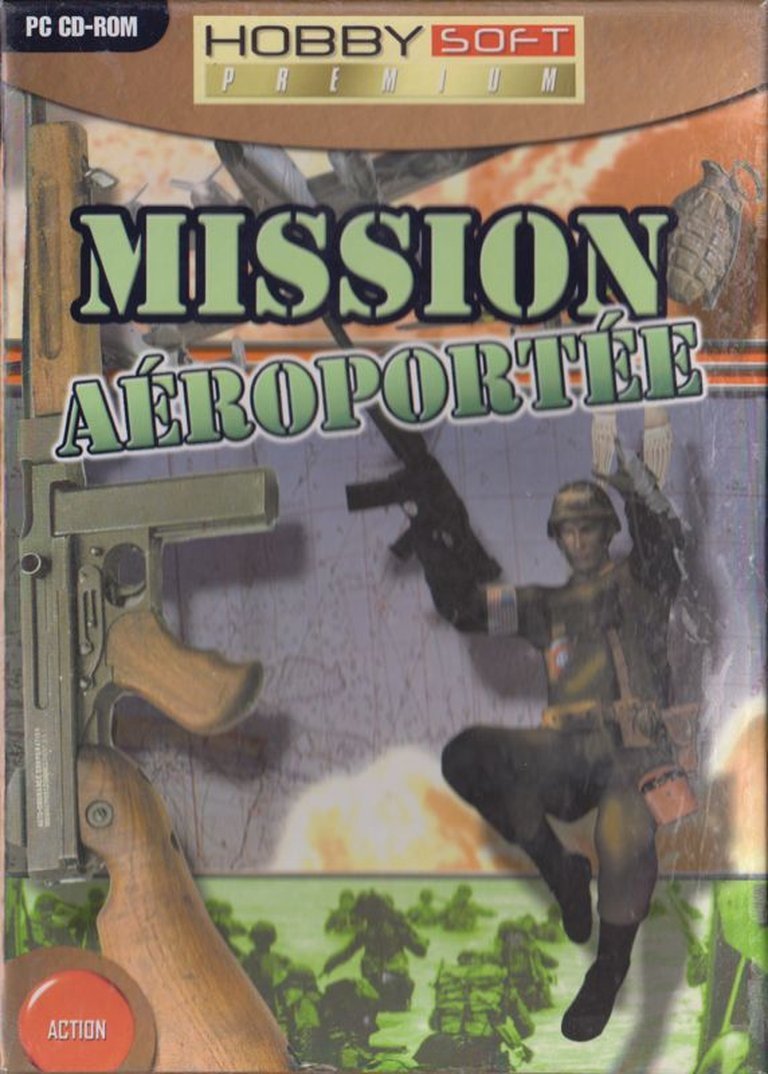
Description
Airborne Hero D-Day Frontline 1944 is a World War II first-person shooter set during the D-Day invasions. Players take on the role of American soldier Peter Smith, who survives a plane crash after German forces shoot down his aircraft. Across seven missions, he must complete objectives such as destroying enemy infrastructure, gathering intelligence, and engaging in combat using five weapons and hand grenades in varied indoor and outdoor environments.
Gameplay Videos
Airborne Hero D-Day Frontline 1944 Patches & Updates
Airborne Hero D-Day Frontline 1944 Mods
Airborne Hero D-Day Frontline 1944 Reviews & Reception
mobygames.com (36/100): Excoriatingly Painful to Play
myabandonware.com : This is one of the Best FPS, also at this Time,
Airborne Hero D-Day Frontline 1944: A Shovelware Case Study in Broken Ambition
Introduction: The Legacy of a “Failed Mission”
In the vast, often overlooked archives of PC gaming lies a title that has become a Byronic hero not for its virtues, but for its spectacular failures. Airborne Hero D-Day Frontline 1944 is not remembered for its contributions to the World War II shooter genre, but as a cautionary tale—a digital ghost haunting the mid-2000s budget software aisle. Released in 2004 by the German studio ASYLUM Games and published across Europe by various low-cost distributors like Russobit-M and IncaGold, this game has earned a reputation that precedes it: one of the most mechanically broken, conceptually frustrating, and existentially disappointing first-person shooters ever committed to CD-ROM. This review will argue that Airborne Hero is not merely a “bad game” but a critical artifact of poor design, asset reuse, and a complete failure to understand the core tenets of interactive entertainment. Its legacy is not one of influence, but of infamy—a benchmark against which other failures are measured, and a stark lesson in the perils of prioritizing historical veneer over fundamental playability.
Development History & Context: Born from the Shovelware Boom
The mid-2000s PC market, particularly in Europe, was a fertile ground for budget “shovelware.” Studios like ASYLUM Games operated on razor-thin margins, often reusing engines, assets, and code across multiple titles to maximize profit. Airborne Hero D-Day Frontline 1944 is a direct descendant of this practice. Developed using the 3D GameStudio engine—a tool accessible to small teams but with significant limitations—the game’s DNA is visibly tied to ASYLUM’s other projects, most notably Ardennes Offensive. Credits reveal a tiny, core team: Carsten Korte (Design), Thomas Bittrolff (Code, SFX, GFX), Carsten Wieland (GFX, Cover, Intro), and Axel Melzener (Intro Music), often working under external art service aliases like Geo-Metricks and Grafix Design Interactive. This seven-person team was responsible for a game that would sell for a fraction of a major title’s price, distributed in discount bins and bundled in “value packs” like Conflicts 20 : 21.
The technological constraints were self-imposed. The game required a Pentium II 800MHz, 64MB RAM, and a 16MB SVGA card—specs already outdated at release—indicating a devotion to minimal system requirements over graphical ambition. This context is crucial: Airborne Hero was not competing with Call of Duty or Medal of Honor: Pacific Assault on fidelity, but on price and a superficial historical premise. Its vision, as gleaned from the sparse credits and reused menu systems from Ardennes Offensive, was one of efficiency over innovation, resulting in a product that feels less like a crafted experience and more like a cynical assembly of recycled parts given a WWII skin.
Narrative & Thematic Deep Dive: The Hero That Wasn’t
The narrative framework of Airborne Hero is paper-thin, serving merely as a parchment-thin justification for its level layouts. The player assumes the role of Lieutenant Peter Smith, a member of the U.S. 82nd or 101st Airborne Division on the morning of June 6, 1944. The inciting incident is a classic trope: his troop transport is shot down by German anti-aircraft fire, and he is the sole survivor, “barely” making it to the ground. From there, he embarks on a lone wolf campaign through the Norman bocage against the Wehrmacht.
The plot, as critiqued on sources like Qualitipedia, is “lame and generic,” evoking “something from a typical history lesson.” There is no character arc, no meaningful dialogue, and no exploration of the psychological or moral weight of being a one-man army behind enemy lines. The “themes” are purely cosmetic. The intro and outro sequences, noted by Gamepressure for their historical references, are likely static slideshows or pre-rendered cutscenes with somber, generic orchestral music (by Axel Melzener) that feels borrowed from a documentary, not a narrative game. The objectives—destroy equipment, gather intelligence, kill Germans—are presented with the nuance of a checklist. Smith is a silent protagonist in the most literal sense; he is a pair of virtual eyes and a gun, devoid of motivation beyond the tape-recorded mission briefing. The game’s title promises a “Hero,” but the narrative provides none of the hero’s journey, only the hero’s monotonous grind. The historical setting of Operation Overlord is not explored; it is merely dressed in, a backdrop for shooting galleries that fails to capture the chaos, camaraderie, or terror of the actual airborne operations.
Gameplay Mechanics & Systems: A Symphony of Broken Systems
If the narrative is a skeleton, the gameplay is a corpse, animated by a series of catastrophic design failures. The core loop is deceptively simple: traverse seven (or ten, per some descriptions) linear missions, complete objectives, and eliminate German soldiers. However, every single system supporting this loop is fundamentally flawed.
Combat & AI: The Unfair Equation
Combat is a masterclass in frustration. The enemy AI is both impossibly accurate and psychologically passive. As the devastating user review by Skippy_Chipskunk details, enemies “never miss” and deal catastrophic damage, regardless of difficulty. This creates a scenario where the player is perpetually on the defensive, reacting to instant-death volleys. The counter—aiming—is rendered absurd by a “rubber plane” crosshair and the requirement to hit enemies three or four times to kill them, with headshots being irrelevant. The AI’s pathfinding is a separate disaster: enemies routinely get stuck in walls or walk into obstacles, yet retain their supernatural aim. Snipers in the infamous third level are the pinnacle of bad design: they have perfect accuracy and spotting, their spotlight mechanic (chasing the player) is relentless, and the player is inexplicably stripped of their machine gun for this section, forcing a grenade-throwing exercise where “100% accuracy” is required—any bounce or short throw results in instant, self-inflicted death. Explosives (grenades, panzerfaust) are a gamble, often harming the player even at a distance.
Progression & Resources: A Starvation Economy
There is no character progression. The arsenal of five weapons plus hand grenades is fixed, touted by Gamepressure as “authentic Airborne Rangers equipment” (likely including the M1 Garand, Thompson, etc.), but this authenticity is meaningless without functional mechanics. Ammunition is “almost never” dropped by enemies, creating a constant resource crisis. Health pickups are “rare,” forcing the player to hoard them like gold in a desert. The objective-based design, where you “must finish off every opponent” before moving on due to enemies that can “shoot through walls,” turns levels into protracted, ammo-conserving purgatories.
User Interface & Control: A UX Nightmare
The UI is a relic of a pre-standardization era, but bad even by 2004 standards. The pause menu requires keyboard navigation with no mouse support, and because the “E” key (likely for “Exit” or “End game”) is adjacent to “R” (likely for “Resume”), accidental quits are common. There is no option to rebind keys, and the help screen omits the existence of the lean function (Q and E keys), a crucial mechanic for survival that the player must discover accidentally or through external sources. This isn’t just poor design; it’s a fundamental lack of consideration for the player’s experience, treating the user as an afterthought.
The Third Level: The Apex of Failure
The critique that level 3 is “the absolute worst level in the entire game” and “makes you want to smash your keyboard” is not hyperbole; it is a precise clinical diagnosis. It perfectly encapsulates the game’s toxic design philosophy: it is not challenging because it tests skill, but because it employs cheap deaths, physics that defy logic, and information withholding. It demands perfection with tools that are inherently unreliable, a true “survival-of-no-chance” gauntlet.
World-Building, Art & Sound: The Facade of Authenticity
The game attempts to leverage its historical setting for atmospheric credibility, but every artistic element collapses under scrutiny. The visual presentation is catastrophic. Models are “cut from cardboards,” with stiff, wooden animations that make death animations laughable. Trees look like “poorly upscaled Google Images,” and the general aesthetic is compared to a “1996 PlayStation title,” a devastating criticism for a 2004 PC game. The physics are nonsensical: a tank driving into a tree does not faze it, as the tree might as well be made of metal. Peter Smith’s weapon handling is “facepalm-inducing,” with guns held at absurd angles, betraying a complete lack of animation work or reference to actual soldier stances.
The sound design is equally offensive. Weapon fire sounds like “hitting a metallic trash can with a brick.” Reloading is “hitting a stone with a knife.” Enemy death grunts are described as the work of an “edgy guy” who didn’t want to voice the game. Explosions are generic stock effects. The main menu music is “lame” and documentary-like, failing to instill any patriotic tension or WWII grit. The “decor and props” and “weather effects” are the sole positives noted, but they are isolated decorations in an otherwise ugly, broken world. The atmosphere is not immersive; it is jarring and cheap-looking, severing any potential connection to the solemn historical subject matter.
Reception & Legacy: From Shelves to Shame
Upon its staggered release (Russia in late 2004, Europe in 2006), Airborne Hero was met with near-universal derision. Its Metacritic and MobyGames pages are barren of professional reviews, a sign of its obscurity, but the sole critic score from Gamepressure is a dismal 3.6/10 (36%). This review acknowledged the authentic arsenal and historical references in stages but was clearly pained to do so, likely a reflection of the era’s more forgiving budget game reviews.
The player reception is brutally consistent. The MobyGames user review average is 0.8 out of 5, dominated by Skippy_Chipskunk’s “Excoriatingly Painful to Play” screed, which has become the definitive takedown of the title. On MyAbandonware, a site for old free games, the user ratings are bizarrely split—one 2025 review calls it “one of the Best FPS,” but this is an outlier, likely from a user with rose-tinted glasses or a different tolerance for broken software, set against more critical comments. The Qualitipedia entry bluntly categorizes it under “Shovelware games,” “Ugly games,” and “Bad games,” summarizing its failures with brutal concision.
Its legacy is one of caution. It is frequently grouped with other notorious Eastern European WWII shooters like City Interactive’s output or Wolfschanze 1944, but is often cited as being worse. It serves as a benchmark for “how not to design an FPS.” Its influence is negative: it exemplifies the pitfalls of asset reuse (Ardennes Offensive‘s menu), the danger of ignoring playtesting, and the ultimate futility of historical authenticity when divorced from playable systems. In an era now rich with critically analyzed “so bad it’s good” games and retro revivalism, Airborne Hero has not been reclaimed. It remains in the “media with no good qualities” category, a game whose primary historical value is as a case study in failure for game design students and a warning label for consumers.
Conclusion: Never Play This, Never Share It, Never Speak of It
Airborne Hero D-Day Frontline 1944 is a profound failure on every conceivable level. As a narrative experience, it is vacant. As a technical achievement, it is an embarrassment. As a playable game, it is an active insult to the player’s time, intelligence, and patience. It takes the noble, complex history of the D-Day airborne operations and reduces it to a series of mathematically unfair firefights against enemies with god-like aim, set in a world of cardboard models and ear-splitting sound effects.
Its place in video game history is secure, but it is a place of shame. It represents the nadir of the budget shovelware cycle—a product where cost-cutting was not a constraint but the primary design directive, where the soldier’s dilemma of 1944 is cynically mirrored by the player’s dilemma of 2004: “How do I survive this?” The answer, in both cases, is often “You don’t, and it’s not fair.” The final, definitive verdict must echo the most articulate and visceral criticism it has ever received: This is a scar-inducing aberration. It offers no heroics, only frustration. Its only lesson is that some games should be left in the clearance bin, forgotten, and never, ever spoken of again. For the sake of your sanity, heed that warning.