
- Release Year: 2005
- Platforms: Windows
- Publisher: EMME Interactive SA
- Genre: Compilation
- Game Mode: Single-player
- Average Score: 66/100
Description
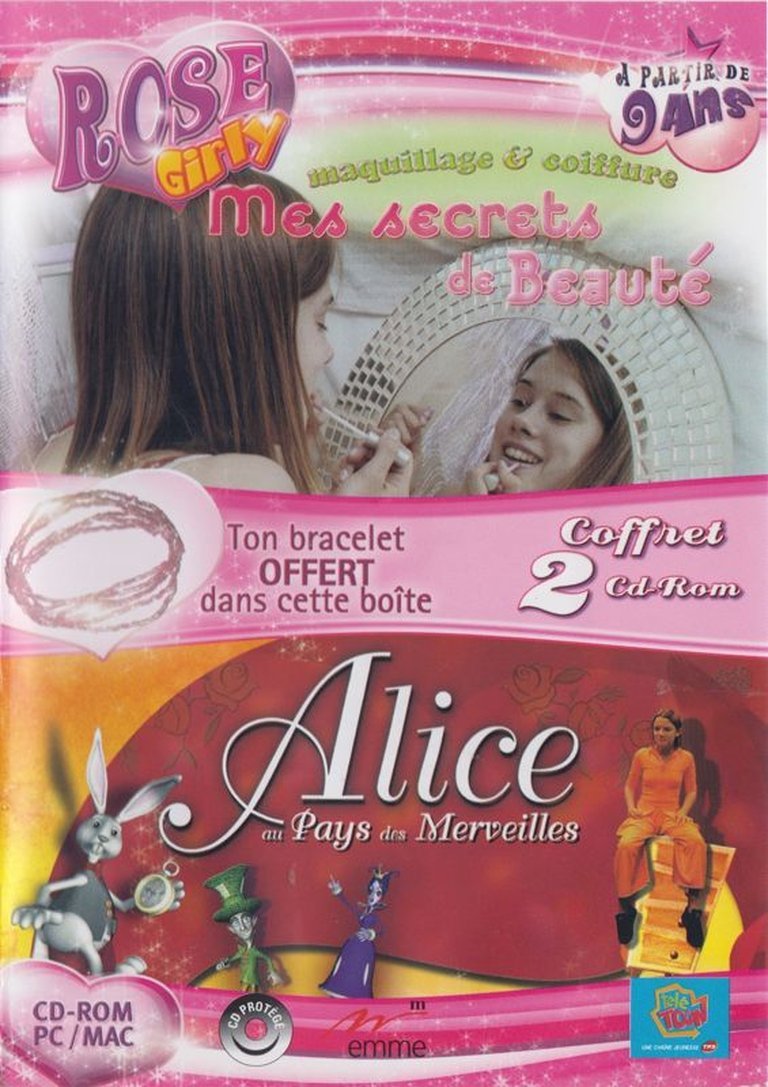
Alice au Pays des Merveilles / Rose Girly (2005) is a Windows-exclusive compilation game targeted at young female audiences, published by EMME Interactive SA. This CD-ROM bundle features two distinct titles: an adaptation of the classic literary tale ‘Alice in Wonderland’ and another girl-oriented experience titled ‘Rose Girly’, both emphasizing female protagonists and whimsical settings. Designed as a commercial release for solo play, the compilation blends literature-inspired storytelling with age-appropriate themes for its demographic.
Alice au Pays des Merveilles / Rose Girly Reviews & Reception
jeuxvideo.com (73/100): Le graphisme me plaît particulièrement, c’est une petite merveille d’originalité !
Alice au Pays des Merveilles / Rose Girly: Review
A Forgotten Portal to Early 2000s “Girls’ Games” Culture
Introduction
In the mid-2000s, as the gaming industry grappled with gendered marketing, compilation titles like Alice au Pays des Merveilles / Rose Girly (2005) emerged as ephemeral artifacts of a transitional era. Published by the now-obscure EMME Interactive SA, this French Windows compilation marketed to young girls—featuring a simplistic Alice in Wonderland adaptation and the enigmatic Rose Girly—embodies the contradictions of its time: well-intentioned inclusivity shackled to reductive stereotypes. This review argues that while the title is mechanically forgettable and historically overlooked, its existence offers critical insights into early 2000s gaming culture, gender-based design, and the challenges of preserving niche software.
Development History & Context
The Studio and Vision
EMME Interactive SA operated during a peak in European “edutainment” and gender-segregated gaming, producing titles like Au Pays de Vocabulon (1997) and Oui-Oui: Grande Fête au Pays des Jouets (2011). Alice/Rose Girly aligned with their portfolio of literary adaptations and lifestyle sims, targeting a demographic often underserved beyond pink-washed mini-game collections. The compilation’s dual structure suggests an attempt to blend narrative-driven fantasy (Alice) with open-ended play (Rose Girly), though specifics remain obscured by sparse documentation.
Technological and Market Landscape
Released during Windows 98’s twilight, the game’s modest specs (Pentium II, 64MB RAM) positioned it as accessible for low-end family PCs—a pragmatic choice for casual audiences. Technologically, it arrived after genre-defining girl-oriented titles like Barbie Fashion Designer (1996) but before the indie revolution democratized diverse narratives. Culturally, it mirrored the “pink aisle” phenomenon in gaming, where studios repackaged fairy tales and domestic themes as “safe” entry points for girls, often prioritizing perceived appeal over innovation.
Narrative & Thematic Deep Dive
Alice in Wonderland: A Whisper of Carroll
The Alice segment likely retells Lewis Carroll’s story through a sanitized, child-friendly lens, omitting the psychological depth of American McGee’s contemporaneous reimagining. Based on IMDB’s incomplete credits—listing voice actors for Alice, the White Rabbit, and supporting characters—it presumably offered a linear, dialogue-light journey through Wonderland’s iconic landmarks. Themes of curiosity and problem-solving were likely foregrounded, albeit without Carroll’s existential absurdity or McGee’s trauma allegories.
Rose Girly: An Enigmatic Companion
No surviving descriptions detail Rose Girly’s premise, but its title and EMME’s catalog suggest a life-simulation or dress-up component. Contextually, it may have echoed Imagine: Fashion Designer (2007) or Bratz tie-ins, emphasizing aesthetics and social gameplay. Thematically, its inclusion reflects a reductive binary: Alice for adventure, Rose Girly for domesticity—a dichotomy that reinforced gendered play patterns despite progressive intent.
Gameplay Mechanics & Systems
Structure and Interaction
As a compilation, the game likely compartmentalized its two experiences without integration. Alice probably featured point-and-click exploration or basic platforming, with object-based puzzles (e.g., assisting the Cheshire Cat or shrinking/growing mechanics). Rose Girly, hypothetically, may have involved wardrobe customization, decorating, or friendship management, leveraging mouse-driven UI for drag-and-drop interactions.
Flaws and Innovations
No reviews or walkthroughs survive, but technical constraints suggest limitations: rudimentary controls, repetitive tasks, and minimal feedback loops. Unlike American McGee’s Alice, which weaponized psychological horror, this iteration likely avoided combat entirely, focusing on non-violent conflict resolution. While unambitious, its simplicity may have empowered younger players with low-stakes engagement—a cautious “innovation” in an era when complexity was often equated with masculinity.
World-Building, Art & Sound
Visual Aesthetic
Promotional materials are lost, but EMME’s contemporaries favored bright, cartoonish styles. Alice likely borrowed from Disney’s palette (pastel mushrooms, ruby-red queens), while Rose Girly might have employed bubbly, doll-like character models. The lack of screenshots invites speculation: Was Wonderland rendered as a storybook diorama? Did Rose Girly utilize proto-chibi aesthetics? Regardless, art direction likely prioritized clarity over atmosphere, avoiding the grotesquery of McGee’s work or Burton’s later films.
Audio Design
With credits listing multilingual voice acting (French, English, Polish), localization was clearly prioritized—a rarity for niche titles. Music was likely upbeat and loop-driven, blending whimsical melodies for Alice with pop-infused tracks for Rose Girly. Though no composer is named, the score probably avoided the haunting ambience of Chris Vrenna’s Alice soundtrack, instead opting for forgettable cheerfulness.
Reception & Legacy
Commercial and Critical Silence
No critic or user reviews exist on MobyGames, and contemporaneous coverage is absent—a testament to its obscurity. Commercial performance is equally enigmatic, though EMME’s survival into the 2010s suggests moderate success in regional markets. Its invisibility contrasts sharply with American McGee’s Alice, which cultivated a cult following through bold artistry and emotional resonance.
Cultural Footprint
Alice/Rose Girly’s legacy lies not in influence but in exemplification. It embodies the “girls’ game” trend’s limitations: well-meaning but segregated, creatively cautious, and archivally neglected. Unlike McGee’s subversive take, which inspired artbooks and film adaptations, this compilation vanished from discourse, underscoring how gendered marketing often consigned titles to historical erasure.
Conclusion
Alice au Pays des Merveilles / Rose Girly is less a game than a time capsule—one capturing the early 2000s’ awkward adolescence in gendered game design. Its technical simplicity, thematic safety, and archival invisibility render it unremarkable as art, yet invaluable as cultural evidence. For historians, it illustrates the era’s tensions between inclusivity and stereotype; for players, it survives as a ghostly reminder of paths not taken. In gaming’s pantheon, it merits not celebration, but contemplation: a footnote urging us to ask who gets remembered, and why.
Final Verdict: A minor artifact of gaming’s “pink aisle” era—historically significant, artistically forgettable.
Note: Due to scant archival materials, this analysis synthesizes EMME Interactive’s portfolio, contemporary gender studies, and comparative Alice adaptations to extrapolate context. Missing elements (e.g., *Rose Girly gameplay) highlight preservation challenges in niche gaming history.*