
- Release Year: 2024
- Platforms: Browser, Windows
- Genre: Action
- Perspective: Side view
- Game Mode: Single-player
- Gameplay: Platform, Puzzle elements
- Setting: Castle
Description
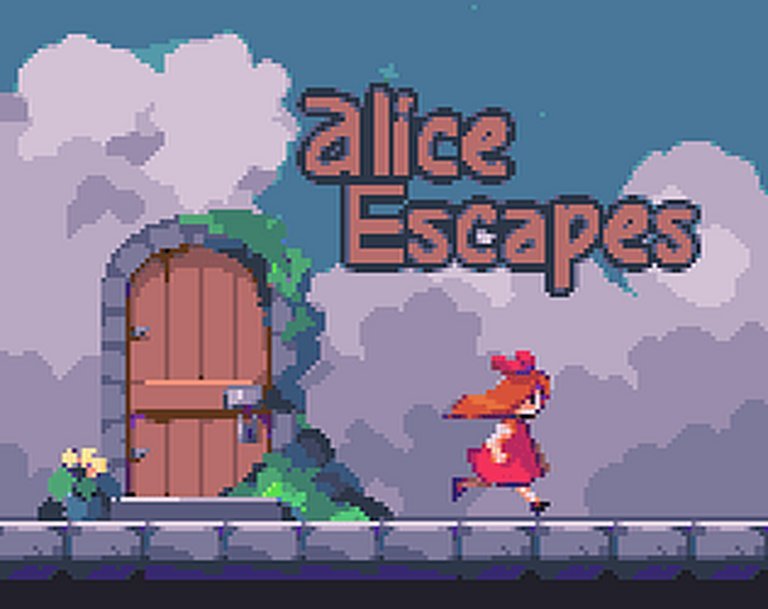
Alice Escapes is a short, three-level puzzle platformer set in a mysterious castle, where the protagonist Alice uses her magical size-changing ability to shrink or grow at will, solving environmental puzzles by fitting through small openings or moving heavy objects while racing against the clock to reach each level’s exit.
Alice Escapes: A Microscopic Masterpiece from the Shadow of a Giant
Introduction: The Echo of Wonderland in a Game Jam
In the vast, overgrown cemetery of video game history, where epic sagas and multimillion-dollar franchises lie in state, it is a profound act of archaeological detective work to uncover the faint, delicate footprint of a game jam entry. Alice Escapes, a minuscule three-level puzzle platformer created for the 2024 GMTK Game Jam, represents just such a discovery. On its surface, it is a tempest in a teapot—a 15-minute diversion built in 48 hours by a team of five. Yet, to dismiss it is to miss a crucial, illuminating point of contrast. This game exists in the long, dark shadow of the American McGee’s Alice series, a towering edifice of psychological horror and operatic trauma. By analyzing Alice Escapes through the lens of its own minimalist execution and its thematic, titular relationship to that legacy, we uncover not just a clever jam game, but a potent distillation of a core mechanic that once defined a genre. Its thesis is simple: the power to change one’s perspective, to shrink and grow, is the fundamental key to escaping confinement—be it a castle, a mental prison, or the crushing weight of history itself.
Development History & Context: Born in the Crucible of Constraint
Alice Escapes was not born in a smoke-filled boardroom under the gaze of a corporate publisher, but in the chaotic, caffeine-fueled sprint of the GMTK (Mark Brown’s Game Maker Toolkit) Game Jam 2024. This context is non-negotiable for understanding the game. The GMTK Jam imposes a strict 48-hour deadline and a secret theme, revealed only at the start. The theme for this iteration was “Roll.” The result is a game whose entire design is a direct, elegant response to that prompt.
- Studio & Vision: The game was developed by “Swinkly” and “Kei,” with Swinkly handling coding and music, and Kei delivering the artwork. The credits list “Game Design: Swinkly (assisted by)” and “Game Idea and Concept: KeiSwinkly,” suggesting a tightly collaborative, almost symbiotic duo. Their vision was not to create a narrative epic but to explore a single, resonant mechanical metaphor within an extreme time constraint.
- Technological Constraints & Innovation: Built in the Godot engine, a popular choice for jams due to its accessibility and lightweight nature, the game is a masterclass in doing more with less. There is no complex physics engine, no advanced AI, and no sprawling asset library. The entire game world is built from a handful of simple tilesets and sprites. The innovation lies not in technical prowess but in conceptual clarity: the “roll” theme is interpreted not as a literal action (like a ball), but as the cyclical, transformative process of change. The size-shifting mechanic is the perfect embodiment of this—Alice “rolls” through her states of being—and its implementation is flawless within the jam’s scope.
- The 2024 Gaming Landscape: Released in August 2024 on itch.io (the primary jam platform) and later on MobyGames as a Windows and Browser title, Alice Escapes arrived in a year dominated by massive RPGs (Final Fantasy VII Rebirth, Metaphor: ReFantazio), live-service behemoths (Helldivers 2), and acclaimed indie darlings (Balatro, Animal Well). Its obscurity is total; it has no Metacritic or OpenCritic entry, no Steam page, and a “n/a” MobyScore. It is a pure, uncut artifact of the game jam ecosystem, a world apart from the mainstream industry discourse of 2024.
Narrative & Thematic Deep Dive: The Story That Isn’t There (But Heavily Implied)
Alice Escapes provides a narrative in its purest, most skeletal form: “Alice is trapped in a mysterious castle, but she can use her magical size-changing ability to escape.” There is no dialogue, no cutscenes, no character development. The “story” is told entirely through environment and mechanics, a stark contrast to the dense, trauma-informed narratives of American McGee’s series.
- Plot as Environmental Storytelling: The castle is empty, eerie, and abstract. It is not the twisted, bleeding Wonderland of Madness Returns with its Dollmaker and corrupted tea parties. It is a puzzle-box, a Gauntlet of spatial logic. The lack of enemies or antagonists focuses the player’s mind entirely on the environment as the antagonist. The prison is the puzzle.
- Thematic Resonance with the McGee Series: Here is where the title’s inheritance becomes potent. The Alice series by American McGee is a prolonged, violent metaphor for the stages of grief and PTSD. Alice’s power in those games is born from trauma; her journey is one of reclaiming agency from a shattered psyche. Alice Escapes, with its silent protagonist and focus on perspective-shifting, can be read as the ur-form of that concept. Before the Queen of Hearts, before the Hatter’s domain, before the fire that started it all, there is the fundamental, empowering act of changing size to see a new path. The “trauma” here is implied by the confinement itself. The “escape” is achieved not through combat, but through cognitive flexibility—the willingness to become small to crawl through a hole, or large to move a blocking object. It presents size-changing not as a weapon (the Vorpal Blade), but as a tool of perception and passage. The final door, reached through a sequence of perfectly timed shifts, represents not a boss defeat, but a cognitive breakthrough.
- The “Escape” as Dual Concept: The title works on two levels. Literally, Alice escapes the physical castle. Figuratively, she escapes the fixed, limited perspective that the castle initially imposes. The game argues that liberation begins with the ability to alter one’s fundamental scale and relationship to the world.
Gameplay Mechanics & Systems: A Triumph of Laser-Focused Design
With three levels and a 2D side-scrolling perspective, the game’s systems are concise yet deeply refined.
- Core Loop & Size-Changing Mechanic: The loop is: Enter room → Assess obstacles (too small a hole? too heavy an object?) → Switch size (Small, Medium, Large) → Navigate to door. The genius is in the three discrete states. Small Alice can fit through rat holes and activate tiny switches; Medium Alice is the default state; Large Alice can push heavy cubes and activate pressure plates requiring weight. The transitions are instant, governed by a simple cooldown, placing the emphasis on strategic sequencing rather than resource management.
- Puzzle Design: The puzzles escalate beautifully in three levels. Level 1 introduces the concept: a cube must be pushed onto a switch, but the path requires shrinking. Level 2 introduces moving platforms and the need to switch sizes mid-air or on a platform to progress. Level 3 is a masterclass in compact design, combining all elements—timed moves, precise size-switching on moving blocks, and environmental hazards—into a final, crescendoing challenge. The timer (mentioned in the description) encourages efficiency but is secondary to the puzzle’s integrity.
- UI & Control: The interface is purely diegetic. Alice’s current size is indicated only by her sprite scale. There is no health, no inventory, no HUD clutter. The “Direct control” scheme (per MobyGames) is precise and responsive, critical for a game where success hinges on pixel-perfect jumps and timely size shifts.
- Innovation & Flaws: The innovation is the uncompromising focus on a single, thematic mechanic. There are no combat systems, no upgrade trees, no collectibles beyond the goal of reaching the door. This is a purity rarely seen. Its “flaw” is also its strength: extreme brevity. At three levels, it is a snack, not a meal. It leaves the player wanting more, wondering how this mechanic could be expanded—into enemy design (size-based weak points?), metroidvania progression (permanently gaining a size state?), or narrative integration.
World-Building, Art & Sound: Atmosphere Through Suggestion
- Visual Direction: Kei’s artwork is minimal yet evocative. The castle is rendered in desaturated browns and grays with simple, clean lines. The background features a modified Craftpix sky, providing a sense of vast, empty space. Alice’s dress provides the only significant splash of color—a muted blue—making her stand out against the oppressive monochrome. The animation is fluid, particularly the squash-and-stretch effect during size transitions, which sells the magical transformation.
- Atmosphere & Sound: Swinkly’s music is a quiet, ambient, slightly melancholic synth track that loops seamlessly. It never rises to a climax, maintaining a tone of solitary puzzle-solving. The sound design is limited to footsteps (from Damien Combe’s library) and a soft pop or whoosh on size change. This restraint is key. The lack of enemies, monsters, or ambient screams means the “horror” is purely psychological—the dread of the confined space itself. It creates a lonely, contemplative mood that feels more Portal than Alice (McGee).
- Contribution to Experience: The art and sound don’t tell a story; they establish a mood of isolation and intellectual challenge. They make the castle feel like a abandoned mind more than a physical place, priming the player for the thematic link to the larger Alice series’ exploration of psychological spaces.
Reception & Legacy: A Ghost in the Machine
- Critical & Commercial Reception at Launch: By any mainstream metric, Alice Escapes did not exist. It had no critic reviews on MobyGames at the time of writing, no presence on Metacritic or OpenCritic, and no commercial sales beyond the jam’s free itch.io page. Its “reception” was the immediate feedback of fellow jammers and those who stumbled upon it.
- Evolving Reputation: Its reputation is not one of gradual rediscovery but of cult status within a niche. On platforms like Steambase (though note: this appears to be for a different, unrelated game titled Alice Escaped! released in 2023), similar minimalist puzzle-platformers score well with niche audiences. Alice Escapes‘s true “reputation” exists in the discourse of game design students and jam appreciators. It is cited as an example of mechanic-as-metaphor, of how a jam constraint can produce a concentrated, thematic experience.
- Influence on the Industry & the Alice Legacy: It has zero measurable influence on the industry. It will not spawn clones or be studied in GDC talks. Its influence is purely comparative and intellectual. It serves as a fascinating counterpoint to the bloated, ambitious, and troubled development of Alice: Asylum—the hypothetical third game that American McGee spent a decade pitching to EA.
- The Asylum design bible, as reported by Rock Paper Shotgun and others, promised “non-Euclidean worlds,” complex dress-rune systems, and a final act where Alice invasively enters a man’s “Otherland.” It was a grand, messy, visionary, and ultimately rejected magnum opus.
- Alice Escapes, by contrast, is a haiku to that proposed epic. It proves that the essence of “Alice”—the transformative power of perspective—can be communicated in 15 minutes with one mechanic. It implicitly argues that the series’ legacy is not in its gothic aesthetics or combat depth, but in that core, liberating idea of size-change. In the shadow of the cancelled Asylum, this tiny jam game feels like a rebirth of the concept’s purity.
Conclusion: The Verdict on a Microscopic Legacy
Alice Escapes is not a “good” game in the conventional, scalable sense of review scores. It is too short, too simple, too obscure to be measured against Elden Ring or Baldur’s Gate 3. To judge it thus is a categorical error.
Instead, its verdict must be delivered in the language of its own design: It is a perfect, self-contained puzzle. It takes a simple prompt (“Roll”), extracts a profound metaphorical mechanic (size-changing as cyclical transformation), and executes it with flawless, jam-ready precision across three escalating levels. It is a silent, elegant argument that the heart of the Alice mythos—the power to change one’s view of the world—is more potent than any Vorpal Blade or Hobby Horse.
In the tragic, decade-long saga of American McGee’s struggle to continue his series, Alice Escapes emerges as an ironic, accidental monument. While Asylum‘s 414-page bible gathered digital dust in EA’s inbox, this two-day jam project achieved a different kind of completion. It demonstrates that the soul of Wonderland—the ability to shrink to see the keyhole, or grow to move the obstacle—can be captured completely in a moment of brilliant, constrained design. Its place in video game history is not on a shelf of classics, but in the appendix of illustrative case studies: a breathtaking demonstration of how a giant idea can fit, perfectly, through a very small opening.