
- Release Year: 1999
- Platforms: Windows
- Publisher: Electronic Arts, Inc., Fox Interactive, Inc., Interplay Entertainment Corp.
- Developer: Rebellion Developments Ltd.
- Genre: Action
- Perspective: 1st-person
- Game Mode: Online PVP, Single-player
- Gameplay: Cloaking, Shooter, Stealth, Vision modes, Wall climbing
- Setting: Futuristic, Sci-fi, Space station, Spaceship
- Average Score: 60/100
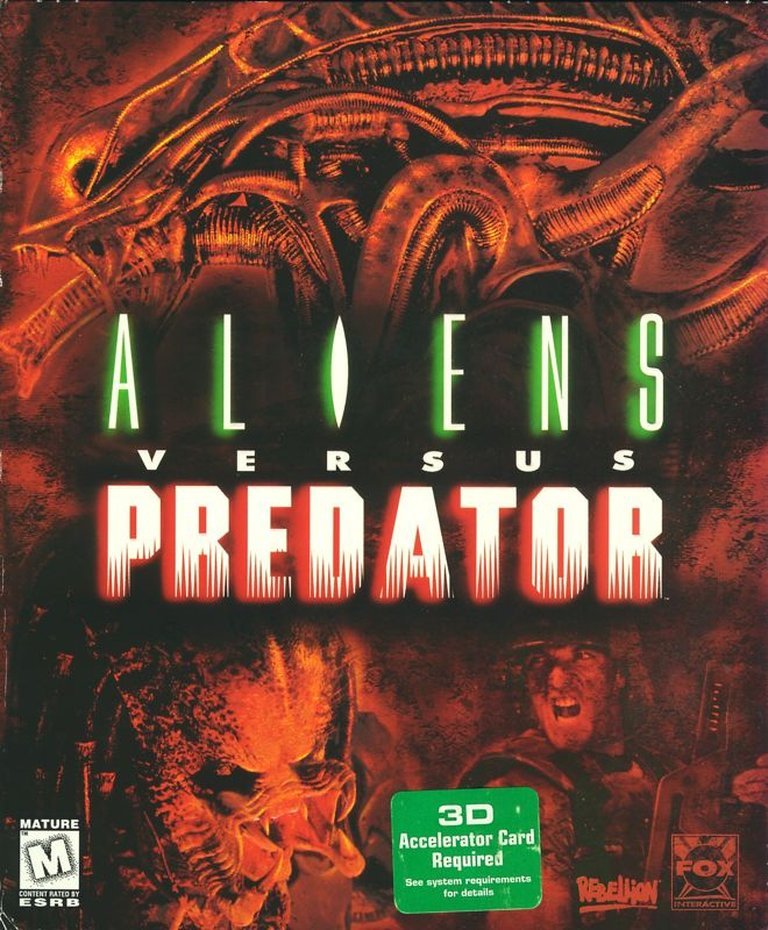
Description
Aliens Versus Predator is a sci-fi first-person shooter set in the universes of the Aliens and Predator franchises, offering three distinct single-player campaigns—each from the perspective of a Marine, Alien, or Predator. Players experience unique gameplay mechanics tailored to each species: Marines rely on heavy firepower in survival-horror scenarios, Aliens use agility, stealth, and brutal melee attacks, while Predators leverage advanced vision modes, cloaking, and precision weaponry. The game also features multiplayer modes, including cooperative battles against AI-controlled enemies and competitive deathmatches across species.
Gameplay Videos
Where to Buy Aliens Versus Predator
Aliens Versus Predator Free Download
Aliens Versus Predator Patches & Updates
Aliens Versus Predator Mods
Aliens Versus Predator Guides & Walkthroughs
Aliens Versus Predator Reviews & Reception
metacritic.com (80/100): A truly classic Horror-FPS with an unforgettable atmosphere.
imdb.com (70/100): A veritable cornucopia of references, though not as well-crafted as the second game.
reddit.com (30/100): After twenty-one years, this once great action shooter fails to entertain.
Aliens Versus Predator Cheats & Codes
PC
Start the game with the -debug command line parameter. Press ~ during gameplay to display the console and enter the following codes.
| Code | Effect |
|---|---|
| GOD | Makes the player immortal; player will still take damage but will not die when health reaches zero. |
| GIVEALLWEAPONS | Gives the player all weapons and ammo available in the game. |
| GIMME_CHARGE | Restores the Predator’s field charge to maximum. |
| SHOWFPS | Displays the current frame-rate per second on-screen. |
| MOTIONTRACKERSPEED | Allows the player to speed up/slow down the pulse rate of the Marine’s motion tracker (range from 0-16, default is 1). |
| LIGHT | Creates a light source near the player. Repeated use makes a brighter and brighter light. |
| ALIENBOT | Creates an Alien in front of the player. |
| MARINEBOT # | Creates a Colonial Marine (or civilian) of type # in front of player. # ranges from 1-15 for different weapons and types. |
| PREDOBOT # | Creates a Predator of type # in front of player. # ranges from 0-2 for different weapons. |
| PREDALIENBOT | Creates a Predator-Alien in front of player. |
| PRAETORIANBOT | Creates a Praetorian Alien in front of player. |
| XENOBORG | Creates a Xenoborg in front of player. |
| FREAKOFTHEUNIVERS | God mode for Marine. |
| SKULLCOLLECTOR | God mode for Predator. |
| THEONEDEADLYCREAUTUREEVERCREATED | God mode for Alien. |
| OBSERVER | Player becomes invisible to all opponents. |
| SHOWCOORDS | Displays level coordinates. |
| SHOWPOLYCOUNT | Displays the number of rendered polygons per frame on-screen. |
| LISTCMD | Lists all available cheat commands. |
| LISTVAR | Lists in-game help and variables. |
| MOTIONTRACKERVOLUME | Changes the volume of the Marine’s motion tracker (range from 0.00-1.00). |
| TIMESCALE | Changes the speed of the game (range from 0.0-1.0). |
| WIREFRAMEMODE | Toggles wire frame mode (0 or 1). |
| DOPPLERSHIFT | Toggles Doppler shift on Alien sounds (0 or 1). |
| SKY_RED | Adjusts the amount of red in the sky (0-255). |
| SKY_GREEN | Adjusts the amount of green in the sky (0-255). |
| SKY_BLUE | Adjusts the amount of blue in the sky (0-255). |
| LEANSCALE | Adjusts the amount of tilt when sidestepping (0-10). |
| CROUCHMODE | Toggles crouch and crawl for Alien (0 or 1). |
| QUICKSAVE | Saves the game to the first save slot. |
| QUICKLOAD | Loads the game from the first save slot. |
| SAVE # | Saves the game to slot # (1-8). |
| LOAD # | Loads the game from slot # (1-8). |
| SAVESLEFT | Displays how many saves the player has remaining in the current level. |
| WINNEROFTHEONEGREATBATTLEOFTHEUNIVERSE | Become Final Xenomorph (Alien). |
| DETAIL_LEVEL_MIN | Decreases detail level. |
| DETAIL_LEVEL_MAX | Increases detail level. |
| LISTBIND | Lists all key bindings. |
| LISTEXP | Lists all text expansions. |
| SCREENSHOT | Takes a screenshot. |
| CDPLAYLOOP | Selects CD track to be looped. |
| CDPLAY | Selects CD track to play. |
| CDVOLUME | Sets sound level (0-127). |
| CDSTOP | Stops playing CD track. |
| SHOW_SCORE | Shows frag score. |
| ID_PLAYER | Gets name of player nearest center of screen. |
| UNBIND-ALL | Clears all key bindings. |
| SAY | Broadcasts a message. |
| SAY_SPECIES | Broadcasts a message to your species. |
| EXPV | Verbose reports of text expansions. |
| EXTRAPOLATE_MOVEMENT | Toggles network opponent movement. |
Aliens Versus Predator: A Masterclass in Atmospheric Horror and Asymmetrical Gameplay
Introduction
Few games have left as indelible a mark on the first-person shooter genre as Aliens Versus Predator (1999). Developed by Rebellion Developments and published by Fox Interactive, AVP is a rare gem—a licensed game that not only respects its source material but transcends it, crafting an experience that is as terrifying as it is innovative. Set in the grim, claustrophobic corridors of the Alien universe and the jungle-infused techno-horror of Predator, AVP offers three distinct campaigns, each delivering a unique perspective on survival, power, and primal fear. This review will dissect the game’s development, narrative depth, gameplay mechanics, and lasting legacy, arguing that AVP remains one of the most atmospheric and mechanically bold shooters of its era.
Development History & Context
The Studio and Vision
Rebellion Developments, a UK-based studio founded in 1992, was no stranger to ambitious projects. Having previously developed Alien vs. Predator for the Atari Jaguar in 1994, the team was already familiar with the challenges of adapting these iconic franchises into interactive experiences. The 1999 PC iteration, however, was a quantum leap forward. Spearheaded by director Chris Miller and producer Vivian Barad, the game was conceived as a love letter to the films, aiming to capture their essence rather than merely retell their stories.
The development cycle was tumultuous. Initially announced in 1995 for a 1997 release on PlayStation, Sega Saturn, and PC, the console versions were ultimately scrapped, leaving the PC as the sole platform. This shift allowed Rebellion to focus on leveraging the burgeoning power of late-’90s hardware, particularly in terms of lighting, sound, and AI. The game’s engine, built in-house, was optimized for dark, claustrophobic environments—a necessity given the Alien franchise’s reliance on shadow and tension.
Technological Constraints and Innovations
The late 1990s were a period of rapid evolution for FPS games. Quake (1996) had set a new standard for 3D rendering, while Half-Life (1998) demonstrated the potential of narrative-driven gameplay. AVP, however, carved its own niche by prioritizing atmosphere and asymmetrical gameplay. The game’s three playable species—Marine, Predator, and Alien—each required distinct mechanics, which posed significant technical challenges.
For the Alien, Rebellion implemented a revolutionary movement system that allowed players to crawl on walls and ceilings, a feature that was as disorienting as it was immersive. The Predator’s multiple vision modes (thermal, electromagnetic, and Pred-Tech) demanded a flexible rendering pipeline capable of dynamically switching visual filters. Meanwhile, the Marine’s campaign leaned heavily on dynamic lighting and sound design to amplify tension, with flickering lights and the ever-present blip of the motion tracker creating an oppressive sense of dread.
The Gaming Landscape of 1999
AVP arrived in a crowded market. Half-Life had redefined storytelling in FPS games, Unreal showcased the potential of advanced graphics, and Quake III Arena was on the horizon, promising to revolutionize multiplayer shooters. Amidst these titans, AVP stood out by embracing its licensed roots rather than shying away from them. While many licensed games of the era were rushed, shallow cash-ins, AVP was a labor of love, meticulously crafted to honor its source material while innovating within the genre.
Narrative & Thematic Deep Dive
Plot Overview
AVP eschews a single, overarching narrative in favor of three interconnected but distinct campaigns, each offering a unique perspective on the eternal conflict between humans, Aliens, and Predators.
- Marine Campaign: Players assume the role of a Colonial Marine stationed on LV-426, tasked with investigating a research facility overrun by Aliens. The campaign is a masterclass in survival horror, with the player constantly outnumbered and outgunned. The narrative culminates in a desperate battle aboard the Tyrargo, where the player must confront an Alien Queen.
- Predator Campaign: As a Predator, players embark on a hunt to recover a captured comrade and exact vengeance on the humans who dared to experiment on their kind. The campaign is a power fantasy, with the Predator’s advanced technology and physical prowess making them a near-unstoppable force. The story takes the player across multiple planets, including the prison world of Fiorina “Fury” 161.
- Alien Campaign: Playing as an Alien, the goal is simple: survive and propagate the hive. The campaign is a relentless, visceral experience, with the player using stealth and brute force to eliminate human and Predator threats. The narrative concludes with the Alien stowing away on a ship bound for Earth, hinting at the potential for a larger invasion.
Themes
AVP explores several recurring themes from its source material, while also introducing new layers of depth:
- Survival and Fear: The Marine campaign is a relentless exercise in survival horror. The player is constantly under threat, with Aliens lurking in every shadow. The game’s sound design amplifies this fear, with the motion tracker’s incessant blipping serving as a constant reminder of impending doom. The Alien campaign, conversely, flips this dynamic, casting the player as the predator, instilling fear in others.
- Power and Honor: The Predator campaign delves into the Predator’s code of honor, portraying them as noble hunters rather than mindless killers. The Predator’s advanced technology and physical superiority reinforce their status as apex predators, but the campaign also highlights their vulnerability when faced with overwhelming odds.
- The Unknown and the Unseen: AVP thrives on the fear of the unknown. The Alien’s ability to crawl on walls and ceilings, combined with the Predator’s cloaking technology, creates a sense of paranoia. Players are never entirely sure where the next threat will come from, making every encounter a heart-pounding experience.
Characters and Dialogue
While AVP lacks the deep character development of modern narrative-driven games, it compensates with atmospheric storytelling. The Marine campaign, in particular, excels in creating a sense of isolation and desperation. The player’s character is a faceless grunt, one of many, which only serves to heighten the horror. The Predator and Alien campaigns, meanwhile, rely on environmental storytelling, with the player piecing together the narrative through level design and enemy encounters.
The game’s dialogue is sparse but effective. The Marine’s mission briefings, delivered via grainy video feeds, are intentionally cheesy, evoking the B-movie aesthetic of the Alien franchise. The Predator’s guttural growls and the Alien’s hisses and screeches are faithfully recreated, adding to the immersion.
Gameplay Mechanics & Systems
Core Gameplay Loops
AVP’s gameplay is defined by its asymmetrical design. Each species plays fundamentally differently, offering a unique experience that encourages multiple playthroughs.
- Marine: The Marine campaign is the most traditional FPS experience, but it is far from conventional. The player is armed with an arsenal of weapons, including the iconic pulse rifle, flamethrower, and smartgun. However, the Marine’s fragility and the overwhelming number of enemies make every encounter a fight for survival. The motion tracker is a crucial tool, but it is often more of a liability than an asset, as it constantly reminds the player of the ever-present threat.
- Predator: The Predator campaign is a stealth-action hybrid. The Predator’s cloaking device and multiple vision modes allow for a more tactical approach, but the campaign also encourages aggressive play, with the Predator’s wrist blades and shoulder cannon making short work of most enemies. The Predator’s energy system, which powers their cloaking and healing abilities, adds a layer of resource management.
- Alien: The Alien campaign is a masterclass in movement and melee combat. The Alien’s ability to crawl on walls and ceilings is both exhilarating and disorienting, offering a level of verticality rarely seen in FPS games. The Alien’s lack of ranged weapons means that players must rely on stealth and ambush tactics, making every encounter a tense, up-close affair.
Combat and Character Progression
Combat in AVP is brutal and unforgiving. The Marine’s weapons are powerful but often feel inadequate against the relentless Alien hordes. The pulse rifle, while iconic, is prone to jamming, adding to the tension. The flamethrower is effective against groups of Aliens but is a double-edged sword, as it can also set the player on fire if used carelessly.
The Predator’s combat is more methodical. The wrist blades are devastating in close quarters, while the shoulder cannon and smart disc allow for precision strikes. The Predator’s cloaking device is a game-changer, allowing for stealthy takedowns, but it drains energy quickly, forcing players to balance aggression with caution.
The Alien’s combat is purely melee-based, with the player relying on claws, tail strikes, and the infamous head-bite. The Alien’s speed and agility make them a formidable opponent, but their lack of ranged attacks means that players must constantly be on the move, using the environment to their advantage.
UI and Innovative Systems
AVP’s UI is minimalist, with each species having a unique HUD that reflects their perspective. The Marine’s HUD includes health, armor, and ammo indicators, as well as the motion tracker. The Predator’s HUD is more futuristic, with digital readouts and energy indicators. The Alien’s HUD is the most stripped-down, with only a health bar and a pheromone detector.
One of the game’s most innovative features is the Alien’s wall-crawling mechanic. This system was groundbreaking at the time, offering a level of freedom and verticality that was unprecedented in FPS games. The Predator’s vision modes are another standout feature, allowing players to see the world through thermal, electromagnetic, and Pred-Tech filters. These modes are not just gimmicks; they are essential tools for navigating the game’s dark, complex environments.
Flaws and Frustrations
While AVP is a masterpiece, it is not without its flaws. The game’s lack of in-mission saves in its original release was a major oversight, forcing players to complete entire levels in one sitting. This was partially addressed in the Gold Edition, which introduced limited saves, but the issue remains a black mark on an otherwise stellar experience.
The game’s AI is another area of concern. While the Aliens are relentless and terrifying, their pathfinding can be erratic, with enemies sometimes getting stuck on geometry. The Predator’s AI is similarly inconsistent, with some enemies standing idle while others aggressively hunt the player.
The game’s level design, while atmospheric, can also be frustrating. Some levels are maze-like, with poorly marked objectives and confusing layouts. The Marine campaign, in particular, suffers from this, with players often wandering aimlessly in search of the next switch or keycard.
World-Building, Art & Sound
Setting and Atmosphere
AVP’s world is a masterclass in environmental storytelling. The game’s levels are meticulously crafted to evoke the grim, industrial aesthetic of the Alien franchise, with rusted metal corridors, flickering lights, and ominous shadows. The Predator’s levels, meanwhile, are more varied, ranging from jungle outposts to high-tech facilities, reflecting the Predator’s role as an interstellar hunter.
The game’s atmosphere is oppressive and unrelenting. The Marine campaign, in particular, is a nightmare of claustrophobia and paranoia, with the player constantly under siege from unseen threats. The Alien campaign, conversely, is a power fantasy, with the player embodying the ultimate predator. The Predator campaign strikes a balance between the two, offering a mix of stealth and action.
Visual Direction
For a game released in 1999, AVP’s visuals are impressive. The game’s engine is capable of rendering complex environments with dynamic lighting and shadows, creating a sense of depth and realism. The Alien’s wall-crawling mechanic is particularly well-implemented, with the camera smoothly transitioning between surfaces.
The game’s character models are detailed and animated fluidly. The Aliens, in particular, are a standout, with their sinuous movements and terrifying visages. The Predator’s model is equally impressive, with its intricate armor and menacing presence. The Marine’s model, while less detailed, is serviceable, with animations that convey a sense of weight and realism.
Sound Design
AVP’s sound design is one of its strongest assets. The game’s audio is a masterclass in tension-building, with every creak, hiss, and screech serving to amplify the horror. The motion tracker’s incessant blipping is a constant reminder of the ever-present threat, while the Alien’s guttural growls and the Predator’s guttural clicks create a sense of otherworldly menace.
The game’s voice acting is sparse but effective. The Marine’s mission briefings are intentionally cheesy, evoking the B-movie aesthetic of the Alien franchise. The Predator’s growls and the Alien’s hisses are faithfully recreated, adding to the immersion.
The game’s soundtrack, composed by Rich Ragsdale, is a mix of ambient drones and orchestral cues, perfectly complementing the game’s oppressive atmosphere. The music is used sparingly, often fading into the background to allow the game’s sound effects to take center stage.
Reception & Legacy
Critical and Commercial Reception
Upon its release in 1999, Aliens Versus Predator was met with widespread acclaim. Critics praised the game’s atmospheric storytelling, innovative gameplay mechanics, and faithful adaptation of its source material. The game’s asymmetrical design, in particular, was singled out as a standout feature, offering a level of variety and replayability that was rare in FPS games at the time.
The game’s Marine campaign was widely regarded as one of the most terrifying experiences in gaming, with critics comparing it favorably to Half-Life and Doom. The Predator and Alien campaigns were also praised for their unique gameplay mechanics, with the Predator’s vision modes and the Alien’s wall-crawling receiving particular acclaim.
However, the game was not without its detractors. Some critics bemoaned the lack of in-mission saves, while others criticized the game’s maze-like level design and inconsistent AI. Despite these flaws, AVP was widely regarded as a triumph, with many critics hailing it as one of the best licensed games ever made.
Commercially, AVP was a success, selling over 500,000 copies worldwide. The game’s Gold Edition, released in 2000, further bolstered its sales, offering additional levels, weapons, and the ability to save within missions.
Evolution of Reputation
In the years since its release, AVP’s reputation has only grown. The game is now widely regarded as a classic of the FPS genre, with many modern critics citing it as an influence on subsequent horror shooters. The game’s asymmetrical design, in particular, has been praised as a precursor to modern multiplayer shooters like Evolve and Dead by Daylight.
The game’s Marine campaign, in particular, has been singled out as a masterclass in survival horror, with its oppressive atmosphere and relentless tension serving as a blueprint for later games like Doom 3 and Alien: Isolation. The Predator and Alien campaigns, meanwhile, have been praised for their innovative gameplay mechanics, with the Predator’s vision modes and the Alien’s wall-crawling serving as inspiration for later games.
Influence on Subsequent Games
AVP’s influence can be seen in a wide range of subsequent games. The game’s asymmetrical design, in particular, has had a profound impact on the FPS genre, with many modern shooters incorporating similar mechanics. Games like Evolve, Dead by Daylight, and Friday the 13th: The Game all owe a debt to AVP’s innovative approach to multiplayer gameplay.
The game’s Marine campaign has also had a significant impact on the survival horror genre. The oppressive atmosphere, relentless tension, and use of sound design to amplify fear have all become staples of the genre, with games like Alien: Isolation and Amnesia: The Dark Descent drawing heavily from AVP’s playbook.
The game’s Predator and Alien campaigns, meanwhile, have influenced a wide range of action and stealth games. The Predator’s vision modes, in particular, have become a staple of stealth games, with titles like Splinter Cell and Metal Gear Solid incorporating similar mechanics. The Alien’s wall-crawling, meanwhile, has inspired a range of games, from Spider-Man to Dying Light.
Conclusion
Aliens Versus Predator (1999) is a landmark title in the FPS genre, a game that not only respects its source material but transcends it. With its asymmetrical gameplay, oppressive atmosphere, and innovative mechanics, AVP offers an experience that is as terrifying as it is exhilarating. While the game is not without its flaws—its lack of in-mission saves, maze-like level design, and inconsistent AI—these are minor blemishes on an otherwise stellar experience.
AVP’s legacy is secure. The game’s influence can be seen in a wide range of subsequent titles, from survival horror games like Alien: Isolation to asymmetrical multiplayer shooters like Evolve. The game’s Marine campaign, in particular, remains a masterclass in tension-building, while the Predator and Alien campaigns offer unique gameplay experiences that are still unmatched in the genre.
In the pantheon of classic FPS games, Aliens Versus Predator stands tall. It is a game that not only captures the essence of its source material but innovates within the genre, offering an experience that is as fresh today as it was in 1999. For fans of horror, sci-fi, and innovative gameplay, AVP is an essential experience, a game that deserves to be remembered as one of the greatest FPS titles of all time.
Final Verdict: 9.5/10 – A Masterpiece of Atmospheric Horror and Asymmetrical Gameplay