
- Release Year: 2018
- Platforms: Windows
- Publisher: Joflof Games
- Developer: Joflof Games
- Genre: Action
- Perspective: Side view
- Game Mode: Hotseat, Single-player
- Gameplay: Arcade, Platform
Description
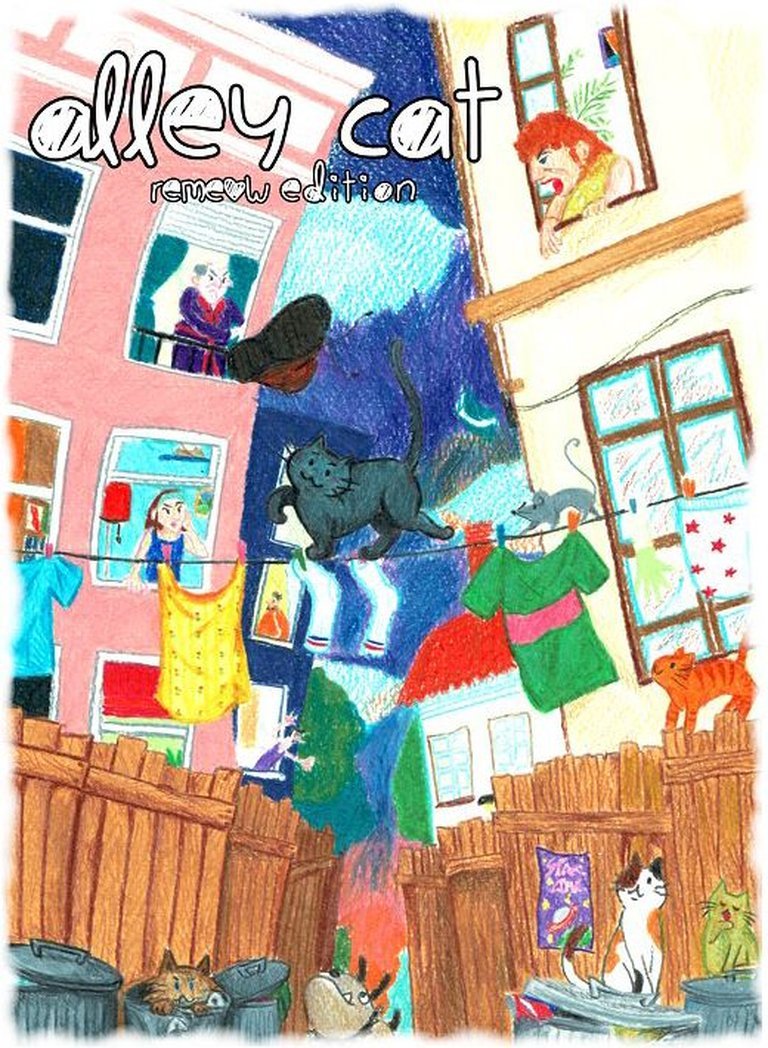
Alley Cat: Remeow Edition is an extended remake of the classic Alley Cat game, where Freddie the cat embarks on a mischievous quest to win the heart of his beloved Felicia. Navigating through various rooms, each serving as a unique mini-game with distinct objectives, Freddie must outsmart enemies like self-propelling brooms, cranky dogs, and vengeful mice. This edition combines elements from the original Atari and IBM PC versions, featuring enhanced graphics, sounds, additional rooms, a multiplayer mode for up to four players, and customizable options, all while retaining the charming, chaotic spirit of the original.
Gameplay Videos
Alley Cat: Remeow Edition – A Purr-fect Homage to a Classic
Introduction: The Legacy of a Feline Phenomenon
Few games in the early 1980s captured the whimsy and challenge of arcade-style platforming quite like Alley Cat. Developed by Synapse Software and designed by the late Bill Williams, the original Alley Cat (1983) was a quirky, side-scrolling adventure where players controlled Freddie the Cat, a mischievous feline on a quest to win the affections of Felicia by navigating treacherous back alleys, dodging brooms, dogs, and vengeful mice, and completing a series of mini-game challenges in various rooms. The game’s charm lay in its simplicity, its punishing difficulty, and its endearingly crude pixel art—a product of the technological constraints of the era.
Fast forward to 2018, and Alley Cat: Remeow Edition emerges as a lovingly crafted homage, a fan-made labor of love by Joflof Games that not only remasters the original but expands upon it in ways that honor its legacy while modernizing its mechanics. This is not merely a nostalgia trip; it is a reimagining that understands what made the original special and amplifies it for a new generation. Remeow Edition is a rare breed of remake: one that respects its roots while fearlessly innovating, blending the retro aesthetic with contemporary design sensibilities.
At its core, Alley Cat: Remeow Edition is a celebration of the golden age of arcade platformers, a time when games were defined by their tight controls, punishing difficulty, and the sheer joy of mastering a single screen’s worth of chaos. Yet, it also embraces the modern era’s emphasis on accessibility, customization, and multiplayer engagement. The result is a game that feels both timeless and fresh, a testament to the enduring appeal of simple, skill-based gameplay.
This review will dissect Alley Cat: Remeow Edition in exhaustive detail, exploring its development history, narrative quirks, gameplay mechanics, artistic direction, and its place in the broader tapestry of video game history. By the end, we will determine whether this remake is a mere curiosity for retro enthusiasts or a standout title that deserves a place in the modern gaming canon.
Development History & Context: From 8-Bit Obscurity to Modern Revival
The Original Alley Cat: A Product of Its Time
The original Alley Cat was released in 1983, a period when the video game industry was still in its infancy, yet rapidly evolving. The early 1980s saw the rise of home computers like the Atari 8-bit, Commodore 64, and IBM PC, each with its own technical limitations and strengths. Synapse Software, founded in 1981 by Ihor Wolosenko and Ken Grant, was one of the many small studios that thrived in this era, specializing in games that pushed the boundaries of what these early machines could do.
Bill Williams, the creative force behind Alley Cat, was a prolific designer known for his innovative and often eccentric games. His portfolio included titles like Necromancer (1982) and Mind Walker (1986), but Alley Cat stood out for its accessibility and humor. The game was initially prototyped by John Harris, another Synapse Software veteran, before Williams took the reins and transformed it into the beloved classic we know today.
Technologically, Alley Cat was constrained by the hardware of its time. The Atari 8-bit version, for instance, had to work within the limitations of 16KB of RAM and a 1.79 MHz processor. The IBM PC version, meanwhile, was designed for the CGA (Color Graphics Adapter), which offered a paltry 4-color palette at 320×200 resolution. Despite these constraints, the game’s tight controls, varied gameplay, and charming premise made it a standout title.
The Gaming Landscape of the Early 1980s
The early 1980s were a formative period for video games. Arcade cabinets dominated public spaces, while home computers were just beginning to gain traction. Games like Pac-Man (1980), Donkey Kong (1981), and Pitfall! (1982) set the standard for what platformers and action games could achieve. Alley Cat fit neatly into this landscape, offering a mix of platforming and mini-game challenges that appealed to both casual and hardcore players.
However, the industry was also in flux. The North American video game crash of 1983, triggered by market saturation and a glut of low-quality games, led to the collapse of many studios. Synapse Software survived the crash but eventually faded into obscurity by the late 1980s. Alley Cat, despite its cult following, remained a niche title, overshadowed by more mainstream successes.
The Birth of Remeow Edition: A Fan’s Labor of Love
Enter Joflof Games, a small indie studio with a passion for retro gaming. In 2017, they embarked on a project to remaster Alley Cat, not as a simple port, but as an enhanced remake that would introduce the game to modern audiences while preserving its original charm. The result, Alley Cat: Remeow Edition, was released on March 19, 2018, as a freeware title, embodying the spirit of fan-driven game development.
The development of Remeow Edition was guided by a deep respect for the original. Joflof Games meticulously recreated the game’s levels, mechanics, and even its quirks, while adding modern enhancements such as updated graphics, sound, and multiplayer modes. The studio also included options to simulate the original Atari and IBM PC versions, complete with their respective color palettes and aspect ratios, ensuring that purists could experience the game as it was originally intended.
One of the most significant additions was the multiplayer “versus” mode, which allowed up to four players to compete simultaneously, a feature that would have been unthinkable in the original’s era due to hardware limitations. This mode not only modernized the gameplay but also introduced a new layer of chaos and competition, making Remeow Edition a social experience in a way the original never could be.
Technological Constraints and Modern Freedoms
The original Alley Cat was a product of its technological constraints. The limited color palettes, simple sound effects, and fixed flip-screen perspective were all necessities of the hardware. Remeow Edition, by contrast, benefits from the vast processing power and graphical capabilities of modern PCs. Yet, rather than abandoning the retro aesthetic, Joflof Games embraced it, offering players the choice between modernized visuals and faithful recreations of the original’s look.
This duality is one of the game’s greatest strengths. Players can experience Alley Cat as it was in 1983, warts and all, or enjoy it with the polish of a modern indie game. The inclusion of customizable controls, aspect ratios, and even arcade cabinet support further demonstrates the developers’ commitment to accessibility and authenticity.
Narrative & Thematic Deep Dive: The Tale of Freddie the Cat
Plot Overview: A Feline’s Quest for Love
At its heart, Alley Cat: Remeow Edition is a simple story. Freddie the Cat is in love with Felicia, a feline damsel who resides in a house at the end of a treacherous alley. To win her affections, Freddie must navigate a series of obstacles, entering various rooms in the houses along the alley, each presenting a unique mini-game challenge. These challenges range from the mundane (unrolling toilet paper in the bathroom) to the absurd (grabbing rabbits out of hats in the magic room).
The narrative is minimalist, relying more on gameplay than exposition. There are no cutscenes, no dialogue trees, and no complex character arcs. Instead, the story is told through the gameplay itself, with Freddie’s actions speaking louder than words. This approach is reminiscent of early arcade games, where narrative was secondary to the experience of play.
Characters: The Cast of Alley Cat
- Freddie the Cat: The protagonist, a determined and mischievous feline whose sole goal is to impress Felicia. Freddie is the player’s avatar, and his personality is defined by his actions—whether he’s dodging brooms, outsmarting dogs, or wreaking havoc in the kitchen.
- Felicia: The object of Freddie’s affection. She serves as the game’s MacGuffin, the prize at the end of Freddie’s journey. Her role is purely symbolic; she has no agency or dialogue, existing only as a motivation for Freddie’s adventures.
- The Antagonists: The game’s obstacles are its true antagonists. Self-propelling brooms, cranky dogs, and vengeful mice stand in Freddie’s way, each representing a different challenge. These enemies are not characters in the traditional sense but rather mechanical obstacles designed to test the player’s skill.
Themes: Chaos, Persistence, and Nostalgia
Alley Cat: Remeow Edition is a game about chaos and persistence. Freddie’s journey is one of trial and error, of failing repeatedly before finally succeeding. This theme is central to the gameplay, where players must master each room’s unique challenges through repetition and skill.
The game also taps into a sense of nostalgia, not just for the original Alley Cat but for the era of arcade gaming as a whole. The fixed flip-screen perspective, the simple controls, and the punishing difficulty all evoke the golden age of gaming, when players had to rely on reflexes and memorization rather than complex strategies or narratives.
Finally, Remeow Edition explores the theme of modernization versus preservation. By offering both updated and original visuals, the game asks players to consider how they want to experience retro games. Is it better to preserve the original, warts and all, or to modernize it for contemporary audiences? Remeow Edition argues that both approaches have value, and it gives players the freedom to choose.
Dialogue and Storytelling: The Power of Silence
Alley Cat: Remeow Edition is a game that tells its story through gameplay rather than dialogue. There are no spoken words, no text boxes, and no exposition dumps. Instead, the narrative is conveyed through the player’s actions and the game’s mechanics. This approach is a throwback to the early days of gaming, when stories were simple and gameplay was king.
The lack of dialogue also allows players to project their own interpretations onto the characters. Freddie’s motivations, Felicia’s personality, and even the nature of the obstacles he faces are left open to interpretation. This ambiguity is part of the game’s charm, inviting players to fill in the gaps with their own imaginations.
Gameplay Mechanics & Systems: A Masterclass in Retro Design
Core Gameplay Loop: The Alley and the Rooms
The core gameplay of Alley Cat: Remeow Edition revolves around navigating the alley and entering the various rooms in the houses along the way. Each room presents a unique mini-game challenge, and Freddie must complete these challenges to progress toward Felicia’s house.
The alley itself is a vertical platforming challenge, with Freddie climbing up and down ladders, jumping across gaps, and avoiding obstacles like brooms and dogs. The controls are simple—players use the keyboard or gamepad to move Freddie left and right, jump, and interact with objects—but mastering them requires precision and timing.
Once inside a room, the gameplay shifts to a mini-game. These mini-games vary widely in their objectives:
– Kitchen: Smash bottles and slurp milk.
– Bedroom: Dig through bedclothes with claws.
– Bathroom: Unroll toilet paper.
– Terrace: Gobble up potted plants.
– Magic Room: Grab rabbits out of hats.
Each mini-game has its own mechanics and challenges, ensuring that the gameplay remains varied and engaging. Completing a mini-game rewards Freddie with points and allows him to progress further toward Felicia.
Combat and Obstacles: The Enemies of Freddie
While Alley Cat is not a combat-heavy game, Freddie does face a variety of obstacles that must be avoided or outsmarted:
– Self-Propelling Brooms: These sweep back and forth across the alley, forcing Freddie to time his movements carefully.
– Cranky Dogs: These enemies chase Freddie, requiring quick reflexes to avoid.
– Vengeful Mice: These small foes scurry around, adding an extra layer of chaos to the gameplay.
The game’s difficulty comes not from combat but from the precision required to navigate these obstacles. Players must learn the patterns of each enemy and master the timing of their movements to progress.
Character Progression: Lives and Points
Alley Cat: Remeow Edition features a traditional arcade-style progression system. Freddie has a limited number of lives, and losing all of them results in a game over. Players can earn extra lives by accumulating points, which are awarded for completing mini-games and collecting items.
The game also includes a scoring system, with points awarded for various actions such as smashing bottles, unrolling toilet paper, and avoiding enemies. High scores are saved, allowing players to compete for the top spot on the leaderboard.
Multiplayer Mode: A Modern Twist
One of the most significant additions in Remeow Edition is the multiplayer “versus” mode. Up to four players can compete simultaneously, each controlling a differently colored cat. The goal is to complete the mini-games faster than the other players, with the first to win a set number of rounds declared the victor.
This mode introduces a new layer of chaos and competition, transforming Alley Cat from a solitary challenge into a social experience. The multiplayer mode is a testament to the developers’ understanding of modern gaming trends, where shared experiences and competition are often as important as single-player mastery.
UI and Controls: Simple and Effective
The user interface in Remeow Edition is minimalist, reflecting the game’s retro roots. The screen displays Freddie’s score, lives, and the current room’s objective, with no unnecessary clutter. The controls are equally straightforward, with players using the keyboard or gamepad to move, jump, and interact.
The game also includes customizable control options, allowing players to remap keys or use a gamepad for a more modern feel. This flexibility ensures that the game is accessible to both retro purists and modern gamers.
Innovative Systems: Easter Eggs and Arcade Support
Remeow Edition includes several innovative features that set it apart from the original. These include:
– Easter Eggs: Hidden secrets and references that reward exploration and experimentation.
– Arcade Cabinet Support: The game can be played on arcade cabinets, complete with coin-op functionality.
– Visual and Audio Options: Players can choose between modernized graphics and sound or faithful recreations of the original Atari and IBM PC versions.
These features demonstrate the developers’ commitment to both preserving the original experience and enhancing it for modern audiences.
World-Building, Art & Sound: Crafting a Retro Aesthetic
Setting and Atmosphere: The Alley as a Character
The setting of Alley Cat: Remeow Edition is deceptively simple: a back alley lined with houses, each containing a series of rooms. Yet, the alley itself becomes a character, a treacherous gauntlet that Freddie must navigate to reach his goal. The fixed flip-screen perspective enhances this sense of place, making each screen a self-contained challenge that players must master.
The rooms within the houses are equally important, each with its own unique atmosphere and challenges. The kitchen is a place of chaos, with bottles to smash and milk to slurp. The bedroom is a cozy yet messy space, where Freddie can dig through bedclothes. The bathroom is a place of mischief, with toilet paper to unroll. These environments are simple but effective, each contributing to the game’s overall charm.
Visual Direction: Retro Meets Modern
Alley Cat: Remeow Edition offers players a choice between modernized visuals and faithful recreations of the original Atari and IBM PC versions. The modern visuals feature updated graphics with smoother animations and more detailed sprites, while the retro visuals preserve the pixelated charm of the original.
The game’s art style is a love letter to the early days of gaming, with bright colors, simple shapes, and a focus on clarity. The characters and obstacles are easily distinguishable, ensuring that players can react quickly to the challenges they face.
Sound Design: Nostalgic Beeps and Boops
The sound design in Remeow Edition is equally nostalgic. The game features a mix of modernized sound effects and faithful recreations of the original’s beeps and boops. The soundtrack is minimalist, with simple melodies that evoke the arcade era.
The sound effects are particularly effective, with each action—whether it’s smashing a bottle or unrolling toilet paper—accompanied by a satisfying audio cue. These sounds enhance the gameplay, providing feedback that helps players understand their actions’ consequences.
Reception & Legacy: From Cult Classic to Modern Revival
Critical and Commercial Reception
Alley Cat: Remeow Edition was released as a freeware title, meaning it did not have a traditional commercial release. However, it was warmly received by retro gaming enthusiasts and indie game fans alike. The game’s faithful recreation of the original, combined with its modern enhancements, earned it praise for its attention to detail and respect for its source material.
Critics highlighted the game’s tight controls, varied gameplay, and charming aesthetic. The multiplayer mode was particularly praised for its innovative take on the original formula, transforming a solitary experience into a social one. While the game did not receive widespread mainstream attention, it carved out a niche as a beloved homage to a classic.
Evolution of Reputation
Since its release, Alley Cat: Remeow Edition has gained a reputation as one of the best fan-made remakes of a retro game. Its inclusion of both modern and retro visuals, customizable controls, and multiplayer support has made it a standout title in the indie gaming scene. The game’s legacy is one of preservation and innovation, demonstrating how fan-driven projects can breathe new life into classic titles.
Influence on Subsequent Games
While Alley Cat: Remeow Edition has not directly influenced mainstream gaming trends, it serves as an example of how retro games can be successfully remastered for modern audiences. Its emphasis on preserving the original experience while adding contemporary features has inspired other indie developers to take similar approaches to their own projects.
The game’s multiplayer mode, in particular, demonstrates how classic single-player experiences can be adapted for modern social gaming. This approach has been echoed in other retro remakes, where developers seek to balance nostalgia with innovation.
Conclusion: A Purr-fect Blend of Past and Present
Alley Cat: Remeow Edition is more than just a remake; it is a celebration of retro gaming’s golden age, a testament to the enduring appeal of simple, skill-based gameplay. By faithfully recreating the original Alley Cat while adding modern enhancements, Joflof Games has created a game that appeals to both nostalgia-seeking veterans and newcomers alike.
The game’s strengths lie in its tight controls, varied gameplay, and charming aesthetic. The multiplayer mode is a standout feature, transforming a solitary challenge into a social experience. The inclusion of both modern and retro visuals ensures that players can experience the game in the way that best suits their preferences.
Alley Cat: Remeow Edition is not just a game; it is a love letter to the early days of gaming, a reminder of a time when games were defined by their simplicity and the joy of mastery. In an era dominated by complex narratives and open-world epics, Remeow Edition stands as a refreshing throwback to a time when gameplay was king.
Final Verdict: 9/10 – A Masterful Remake That Honors Its Legacy While Embracing the Future
Alley Cat: Remeow Edition is a must-play for retro gaming enthusiasts and indie game fans alike. It is a rare example of a remake that understands and respects its source material while fearlessly innovating. Whether you’re a fan of the original or a newcomer to the world of Freddie the Cat, Remeow Edition offers a delightful and challenging experience that is well worth your time.