
- Release Year: 2014
- Platforms: Windows
- Publisher: Legacy Games
- Genre: Compilation
- Game Mode: Single-player
- Gameplay: Hidden object
Description
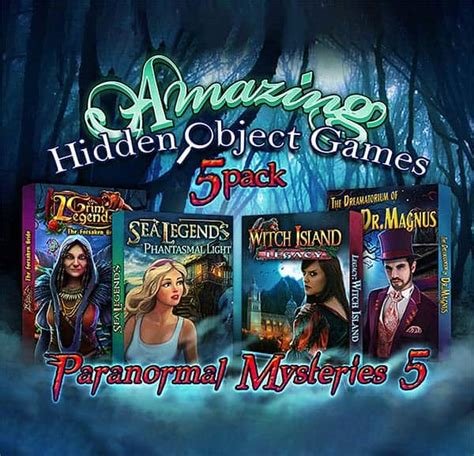
‘Amazing Hidden Object Games: Paranormal Mysteries 5’ is a compilation of five eerie hidden object games, including ‘Grim Legends: The Forsaken Bride,’ ‘Sea Legends: Phantasm Light,’ ‘Legacy: Witch Island,’ ‘The Dreamatorium of Dr. Magnus,’ and a bonus game. Set in supernatural worlds, each title blends mystery, adventure, and puzzle-solving as players uncover dark secrets, solve haunting enigmas, and explore atmospheric, otherworldly environments.
Amazing Hidden Object Games: Paranormal Mysteries 5: A Comprehensive Retrospective
Introduction: The Legacy of a Hidden Object Anthology
Amazing Hidden Object Games: Paranormal Mysteries 5 (2014) stands as a fascinating artifact in the annals of casual gaming—a compilation that encapsulates the golden age of hidden object puzzle adventures (HOPAs). Released by Legacy Games, this anthology bundles four distinct titles (Grim Legends: The Forsaken Bride, Sea Legends: Phantasm Light, Legacy: Witch Island, and The Dreamatorium of Dr. Magnus) alongside an unnamed bonus game, offering players a curated journey through some of the genre’s most evocative themes: gothic horror, maritime phantoms, arcane witchcraft, and surreal dream logic. While often overshadowed by its standalone counterparts, Paranormal Mysteries 5 serves as a microcosm of the mid-2010s HOPA boom, reflecting both the strengths and limitations of the compilation format. This review dissects the game’s development context, narrative tapestry, mechanical intricacies, and enduring legacy, arguing that it is less a cohesive masterpiece and more a time capsule of a genre at its commercial peak.
Development History & Context: The Rise of the HOPA Compilation
The Studio: Legacy Games and the Anthology Model
Legacy Games, the publisher behind Paranormal Mysteries 5, emerged as a key player in the casual gaming market during the 2010s, specializing in bundling standalone HOPAs into themed compilations. This strategy catered to an audience hungry for value-driven content, offering multiple games at a discounted price—a savvy response to the growing competition in digital storefronts like Big Fish Games and Steam. The Amazing Hidden Object Games series, of which Paranormal Mysteries 5 is the fifth installment, exemplifies this approach, with each entry grouping titles around a unifying theme (e.g., Moonlight Mysteries, Unsolved Mysteries).
The games included in Paranormal Mysteries 5 were developed by studios renowned for their contributions to the HOPA genre:
– Artifex Mundi (Grim Legends: The Forsaken Bride): A Polish studio celebrated for its dark fairy-tale aesthetics and intricate puzzles.
– Domini Games (Legacy: Witch Island): Known for blending detective narratives with supernatural elements.
– Five-BN Games (Sea Legends: Phantasm Light): A developer with a penchant for nautical mysteries and atmospheric storytelling.
– Mad Head Games (The Dreamatorium of Dr. Magnus): Specializing in surreal, dreamlike settings.
Technological Constraints and Design Philosophy
Released in 2014, Paranormal Mysteries 5 reflects the technical standards of its era. The games within the compilation were originally designed for PC, leveraging Adobe Flash or proprietary engines optimized for low-system requirements—a necessity for the casual gaming demographic. This resulted in:
– 2D Pre-Rendered Backgrounds: Lush, hand-painted environments that prioritized artistic detail over dynamic interactivity.
– Fixed Camera Angles: A point-and-click interface that emphasized scene exploration over player agency.
– Modular Puzzle Design: Reusable mini-game templates (e.g., jigsaw puzzles, lock-picking) to streamline development.
The compilation’s structure also highlights the commercial realities of the time. With no unified narrative or gameplay progression, Paranormal Mysteries 5 functions as a “greatest hits” album, offering players a sampler of disparate experiences. This lack of cohesion is both its greatest strength (variety) and weakness (fragmentation).
The Gaming Landscape of 2014
By 2014, the HOPA genre had solidified its niche, appealing primarily to older, female-identifying players seeking relaxing yet engaging experiences. The market was saturated with titles that blended hidden object scenes with light adventure mechanics, often draped in gothic or fantastical themes. Paranormal Mysteries 5 arrived amidst this boom, competing with series like Dark Parables, Mystery Case Files, and Haunted Legends.
The compilation’s “Teen” ESRB rating (for mild violence and suggestive themes) reflects the genre’s balancing act: dark enough to intrigue, but tame enough to avoid alienating its core audience. This period also saw the rise of mobile HOPAs, though Paranormal Mysteries 5 remained a PC-exclusive product, catering to players who preferred mouse-driven precision over touchscreen controls.
Narrative & Thematic Deep Dive: Four Tales of the Macabre
Paranormal Mysteries 5’s lack of a unifying narrative is compensated by the richness of its individual stories, each exploring a distinct facet of the supernatural. Below is an exhaustive analysis of each included title’s plot, characters, and themes.
1. Grim Legends: The Forsaken Bride (Artifex Mundi)
Plot Summary:
Players assume the role of a young woman (name customizable) who returns to her ancestral village to lift a curse that has transformed her sister into a swan. The narrative unfolds as a dark retelling of Swan Lake, weaving Slavic folklore with gothic horror. The protagonist discovers that the curse stems from a pact between the village elders and a malevolent forest spirit, the Leshy. To break the spell, she must navigate a labyrinth of betrayals, uncovering the village’s history of human sacrifice and forbidden love.
Themes and Motifs:
– Sacrifice and Redemption: The game interrogates the cost of tradition, with the village’s prosperity built on the suffering of its women.
– Duality of Nature: The forest is both a sanctuary and a prison, embodying the duality of nature as nurturing and predatory.
– Feminine Agency: The protagonist’s journey is one of reclaiming power in a patriarchal society that seeks to silence women (literalized through the swan transformation).
Character Analysis:
– The Protagonist: A determined but initially naive heroine, her growth is tied to her willingness to confront uncomfortable truths.
– The Leshy: A tragic antagonist, bound by ancient laws he cannot escape, adding moral complexity to the conflict.
– The Village Elder: Represents institutionalized corruption, clinging to power through fear and deception.
Dialogue and Writing:
The script leans into gothic melodrama, with dialogue that occasionally verges on purple prose (“The forest whispers secrets older than time itself”). However, the voice acting (where present) elevates the material, imbuing even minor characters with gravitas.
2. Sea Legends: Phantasm Light (Five-BN Games)
Plot Summary:
A lighthouse keeper’s daughter, Emily, investigates the sudden disappearance of ships near her isolated island home. Her quest leads her to a ghostly schooner, the Phantasm Light, crewed by the undead remnants of a 19th-century expedition. The game blends nautical horror with a time-loop mystery, revealing that the ship’s captain made a Faustian bargain with a siren to achieve immortality—at the cost of his crew’s souls. Emily must break the cycle by reuniting the captain with his lost love, whose spirit lingers in the lighthouse’s beam.
Themes and Motifs:
– The Sea as Liminal Space: The ocean serves as a threshold between life and death, reality and myth.
– Obsession and Grief: The captain’s inability to accept his lover’s death drives the tragedy, mirroring Emily’s own unresolved grief for her missing father.
– Cycles of Violence: The time-loop structure critiques humanity’s repetitive mistakes, with each iteration of the Phantasm Light’s voyage ending in disaster.
Character Analysis:
– Emily: A resourceful protagonist whose skepticism gradually gives way to acceptance of the supernatural.
– Captain Holloway: A Byronic figure, charismatic yet morally ambiguous, whose redemption hinges on Emily’s empathy.
– The Siren: A subversion of the femme fatale trope; her “villainy” stems from loneliness rather than malice.
Dialogue and Writing:
The game’s strength lies in its environmental storytelling. Logbooks and ghostly whispers convey the backstory, while the present-day dialogue is functional but unremarkable. The siren’s poetic monologues (“The sea does not forget, nor does it forgive”) stand out as highlights.
3. Legacy: Witch Island (Domini Games)
Plot Summary:
Detective Carla Graves is summoned to Witch Island, a remote community where a witch’s curse has caused the residents to vanish one by one. The game adopts a detective noir tone, with Carla uncovering a web of secrets involving a coven’s ancient ritual to maintain immortality. The twist reveals that the “witch” is a scapegoat—a woman named Elara who discovered the island’s dark secret: its prosperity is sustained by sacrificing outsiders. The final act tasks Carla with choosing whether to expose the truth (risking the island’s collapse) or perpetuate the lie.
Themes and Motifs:
– Scapegoating and Otherness: Elara’s persecution mirrors historical witch trials, framing fear of the unknown as a tool of control.
– Moral Ambiguity: The game refuses easy answers, forcing players to grapple with the consequences of justice versus stability.
– Isolation and Paranoia: The island’s claustrophobic setting amplifies the tension, with every character a potential suspect.
Character Analysis:
– Carla Graves: A hardboiled detective whose cynicism is tested by the supernatural. Her internal monologue provides dry humor (“I’ve seen weird, but this is ‘call the exorcist’ weird”).
– Elara: A tragic figure whose defiance makes her both victim and hero.
– Mayor Blackwood: Embodies institutional corruption, his charm masking ruthless pragmatism.
Dialogue and Writing:
The noir influences shine in Carla’s sarcastic asides, though the supporting cast occasionally falls into cliché. The game’s moral dilemma is its narrative crown jewel, elevating it above typical HOPA fare.
4. The Dreamatorium of Dr. Magnus (Mad Head Games)
Plot Summary:
Players enter the surreal dreamscape of Dr. Magnus, a psychologist who has trapped himself and his patients within a shared subconscious realm. The game’s structure is episodic, with each “level” representing a patient’s nightmare (e.g., a library where books rewrite reality, a clockwork city frozen in time). The protagonist, a fellow therapist, must navigate these dreams to free Magnus and his patients by confronting their repressed traumas. The meta-narrative reveals that Magnus created the Dreamatorium to escape his own guilt over a patient’s suicide.
Themes and Motifs:
– The Unconscious Mind: The game visualizes Freudian concepts, with each dream reflecting its owner’s psyche (e.g., a hoarder’s dream is a labyrinth of clutter).
– Healing Through Confrontation: Progress requires acknowledging pain, not avoiding it.
– Art as Therapy: The Dreamatorium itself is a metaphor for creative expression as a coping mechanism.
Character Analysis:
– Dr. Magnus: A flawed savior, whose hubris stems from a desire to “fix” others while neglecting his own wounds.
– The Patients: Each is a puzzle unto themselves, their dreams offering glimpses into their backstories (e.g., a war veteran’s dream is a battlefield where time loops endlessly).
– The Protagonist: Serves as the player’s avatar, their dialogue minimal to emphasize immersion.
Dialogue and Writing:
Minimalist by design, the game relies on visual storytelling. The few spoken lines are introspective, with Magnus’s journal entries providing emotional depth (“We are all prisoners of our own making”).
The Bonus Game: A Missed Opportunity
The compilation’s unnamed bonus game (often a shorter, lesser-known title) is its weakest link. Typically a generic haunted house adventure, it lacks the thematic ambition of the main four, serving as filler rather than a cohesive capstone.
Gameplay Mechanics & Systems: The HOPA Formula Deconstructed
Paranormal Mysteries 5 adheres to the HOPA genre’s established conventions while offering subtle variations across its included titles. Below is a breakdown of its core mechanics, strengths, and flaws.
Core Gameplay Loop
Each game follows a predictable but satisfying structure:
1. Hidden Object Scenes (HOS):
– Players search cluttered environments for items listed in a text prompt (e.g., “Find a rusted key, a silver locket, and a crow’s feather”).
– Variations include silhouette-based searches, interactive objects (e.g., opening drawers to reveal items), and “fragmented object” puzzles (assembling broken items from scattered pieces).
– Critique: While Grim Legends and Sea Legends excel in creative item placement, Legacy: Witch Island occasionally suffers from pixel-hunting due to poorly contrasted objects.
-
Mini-Games and Puzzles:
- Standard Fare: Jigsaw puzzles, lock-picking, pipe-connecting, and memory games.
- Standout Examples:
- The Dreamatorium’s “clockwork maze,” where players manipulate gears to align pathways.
- Sea Legends’ “siren’s melody” puzzle, requiring players to replicate a musical sequence by ear.
- Critique: Puzzle difficulty is inconsistent; Legacy’s logic puzzles are punishingly obscure, while Grim Legends’ offerings skew too simple.
-
Adventure Elements:
- Inventory-based problem-solving (e.g., using a key to unlock a door, combining items to create tools).
- Dialogue trees with limited branching (choices occasionally affect endings, as in Legacy’s moral dilemma).
- Critique: The lack of a unified inventory across games disrupts immersion, forcing players to readjust to each title’s systems.
-
Progression and Pacing:
- Linear storytelling with occasional backtracking.
- Pacing Issues: The Dreamatorium’s episodic structure feels disjointed, while Sea Legends’ nautical setting grows repetitive in its latter half.
Innovations and Flaws
-
Innovations:
- The Dreamatorium’s surreal aesthetics and psychological themes push the genre’s boundaries.
- Legacy’s moral choice system, rare in HOPAs, adds replay value.
- Grim Legends’ use of Slavic folklore offers a fresh alternative to overused Western European myths.
-
Flaws:
- Repetitive Mini-Games: The reuse of puzzle templates (e.g., the same “rotate gears” mechanic appears in three games) betrays the compilation’s budget constraints.
- Clunky UI: Inventory management is cumbersome, with no hotkey support. Sea Legends’ map system is particularly confusing, lacking clear markers for active objectives.
- Lack of Integration: The games exist in isolation; a hub world or narrative bridge (e.g., a framing device like The Dreamatorium’s therapy sessions) could have unified the experience.
Difficulty and Accessibility
- Adjustable Difficulty: Most games offer “Casual” (sparkles on hidden objects, faster hint recharge) and “Expert” (no sparkles, slower hints) modes.
- Hint Systems: A rechargeable hint button (usually a magnifying glass or eye icon) highlights an item or puzzle solution. Overuse is penalized with cooldown timers.
- Accessibility Gaps: No colorblind modes or text-to-speech options, a notable oversight given the genre’s older demographic.
World-Building, Art & Sound: Crafting Atmosphere
The compilation’s greatest triumph lies in its atmospheric world-building, with each game leveraging art and sound to immerse players in its unique setting.
Visual Design
-
Grim Legends: The Forsaken Bride:
- Aesthetic: Dark fairy-tale realism, with painterly backgrounds evoking 19th-century Eastern European folklore. The swan motifs and gnarled forest designs are particularly striking.
- Color Palette: Muted greens and browns, punctuated by the eerie glow of will-o’-the-wisps.
- Animation: Subtle but effective (e.g., leaves rustling as the Leshy moves unseen).
-
Sea Legends: Phantasm Light:
- Aesthetic: A mix of nautical realism and ghostly surrealism. The Phantasm Light’s spectral crew is rendered in translucent blues, contrasting with the warm hues of the lighthouse interior.
- Standout Scene: The underwater cave, where light refracts through floating debris, creating a hauntingly beautiful effect.
-
Legacy: Witch Island:
- Aesthetic: Noir-inspired, with heavy shadows and a limited color palette dominated by grays and deep purples. The witch’s cottage, with its glowing cauldron, is a visual highlight.
- Character Design: Carla’s trench coat and fedora reinforce the detective noir theme, though some NPCs lack distinct silhouettes.
-
The Dreamatorium of Dr. Magnus:
- Aesthetic: Surreal and fluid, with Escher-like impossible geometry. The library level, where books float in midair and pages rearrange themselves, is a masterclass in dream logic.
- Color Palette: Saturated and shifting, reflecting the instability of the dreamscape.
Sound Design and Music
-
Ambient Soundscapes:
- Grim Legends: The forest’s ambient sounds—distant howls, rustling branches—enhance the isolation.
- Sea Legends: The creaking of the Phantasm Light’s hull and the distant sound of waves create a palpable sense of dread.
- The Dreamatorium: The absence of traditional music, replaced by distorted whispers and heartbeat-like rhythms, is unsettlingly effective.
-
Musical Scores:
- Grim Legends: A mix of orchestral and folk instruments (e.g., violins, accordions), evoking Slavic melancholy.
- Sea Legends: A nautical theme with therapeutic harp and flute, shifting to dissonant strings during ghostly encounters.
- Legacy: Jazz-inspired noir music, complete with a saxophone motif for Carla’s detective theme.
- The Dreamatorium: Minimalist piano and electronic tones, reminiscent of Twin Peaks’ surrealism.
-
Voice Acting:
- Highlights: Grim Legends’ Leshy (voiced with a guttural, otherworldly tone) and Legacy’s Mayor Blackwood (a smooth-talking villain).
- Weaknesses: Some NPCs in Sea Legends deliver lines with little emotional range.
Atmosphere and Immersion
The compilation excels in creating distinct moods:
– Grim Legends feels like a Brothers Grimm tale brought to life, its darkness tempered by moments of ethereal beauty.
– Sea Legends captures the loneliness of the sea, its horror rooted in isolation rather than gore.
– Legacy’s noir setting is its strongest asset, with Carla’s sarcastic narration providing levity amid the gloom.
– The Dreamatorium is a psychedelic trip, its lack of traditional structure either captivating or alienating depending on the player’s taste.
Reception & Legacy: A Genre at a Crossroads
Critical and Commercial Reception
Amazing Hidden Object Games: Paranormal Mysteries 5 received little critical attention upon release, a common fate for compilations in an era where standalone titles dominated reviews. Player reception, as gleaned from forums and retailer feedback, was mixed but generally positive:
– Praised For:
– Value: Players appreciated the sheer volume of content, with some noting it as a “great introduction to the genre.”
– Variety: The contrasting themes prevented monotony, a frequent complaint in single-title HOPAs.
– Art and Music: The visual and auditory design of Grim Legends and The Dreamatorium were singled out for acclaim.
– Criticized For:
– Lack of Cohesion: Many felt the compilation lacked a unifying thread, making it feel like a “grab bag” rather than a curated experience.
– Technical Issues: Some reported bugs, particularly in Legacy: Witch Island, where progress could be blocked by unclear objectives.
– Repetitive Gameplay: Veterans of the genre found the puzzle designs too familiar.
Commercially, the compilation performed adequately, benefiting from Legacy Games’ marketing strategy of bundling older titles at a discount. Its presence on platforms like Amazon and eBay (where it remains available as a physical DVD) suggests a niche but enduring audience.
Evolution of the HOPA Genre
Paranormal Mysteries 5 arrived at a pivotal moment in the HOPA genre’s evolution:
– Decline of Flash: The late 2010s saw a shift away from Flash-based games, with developers adopting Unity or proprietary engines for greater flexibility.
– Rise of Mobile: Titles like June’s Journey and Criminal Case began dominating the casual market, offering free-to-play models that undercut traditional PC HOPAs.
– Narrative Sophistication: Later entries in series like Dark Parables and Eventide embraced deeper storytelling, raising the bar for world-building and character development.
In this context, Paranormal Mysteries 5 feels like a swan song for the “classic” HOPA era—a celebration of the genre’s tropes before mobile gaming and shifting player expectations forced it to evolve.
Influence and Homages
While Paranormal Mysteries 5 itself is not frequently cited as influential, its component games have left a mark:
– Grim Legends: The Forsaken Bride’s success spawned two sequels (Song of the Dark Swan, The Dark City), solidifying Artifex Mundi’s reputation for dark fairy-tale HOPAs.
– Legacy: Witch Island’s moral choice system presaged later games like Queen’s Quest, which incorporated player agency into their narratives.
– The Dreamatorium’s surrealism can be seen as a precursor to indie titles like The Static Speaks My Name, which blend psychological horror with HOPA mechanics.
Conclusion: A Flawed but Fascinating Time Capsule
Amazing Hidden Object Games: Paranormal Mysteries 5 is not a masterpiece, nor does it aspire to be. It is, instead, a snapshot of a genre in transition—a compilation that showcases the strengths (rich atmosphere, varied themes, accessible gameplay) and weaknesses (repetitive mechanics, lack of innovation, technical rough edges) of mid-2010s HOPAs. Its value lies not in cohesion but in its anthology nature, offering players a tour through some of the era’s most evocative settings and narratives.
Final Verdict:
– For HOPA Enthusiasts: A worthwhile purchase, particularly for fans of gothic horror and surreal storytelling. The inclusion of Grim Legends and The Dreamatorium alone justifies the price.
– For Casual Players: An excellent introduction to the genre, though the lack of hand-holding in Legacy may frustrate newcomers.
– For Genre Historians: An essential artifact, capturing the commercial and creative realities of the HOPA boom.
Score: 7.5/10 – A compelling but uneven compilation that shines brightest when its individual components are allowed to stand alone.
Paranormal Mysteries 5 may not have redefined the hidden object genre, but it remains a testament to the power of atmosphere and the enduring appeal of a good mystery—no matter how many times you’ve searched for a rusted key in a moonlit graveyard.