
- Release Year: 2018
- Platforms: Windows
- Publisher: Legacy Games
- Genre: Compilation
- Perspective: First-person
- Game Mode: Single-player
- Gameplay: Hidden object
- Setting: Supernatural
Description
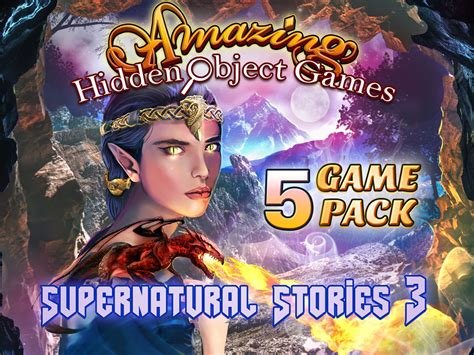
Amazing Hidden Object Games: Supernatural Stories 3 is a compilation of five hidden object adventure games that plunge players into supernatural realms. Players help Diana in ‘The Legacy: Prisoner’ escape another world by freeing a prisoner, assist Mary Gilbert in ‘Eventide 3: Legacy of Legends’ rescue her brother from a cloud wizard and prevent a flood, and join Susan in ‘Lost Lands: Ice Spell’ to combat a sudden ice age and mythical creatures. The collection also includes ‘Vengeance: Lost Love’ and the bonus game ‘Beyond the Invisible 2: Darkness Came’, offering diverse supernatural challenges and ancient legends.
Amazing Hidden Object Games: Supernatural Stories 3: Review
Introduction
In the ever-expanding universe of hidden object games (HOGs), few compilations capture the genre’s eclectic spirit quite like Amazing Hidden Object Games: Supernatural Stories 3. Released in 2018 by Legacy Games, this anthology bundles five full-fledged supernatural adventures, each a testament to the genre’s narrative depth and puzzle-driven allure. As a journalist and historian, I approach this compilation not merely as a budget bundle but as a cultural artifact—a snapshot of the HOG boom that defined casual gaming in the late 2010s. This review posits that Supernatural Stories 3 is a microcosm of the genre’s evolution: it refines established tropes (mythology, time travel, paranormal mystery) while showcasing the strategic bundling of flagship franchises (Lost Lands, Eventide, The Legacy) under a single banner. Through its curated tales of interdimensional rifts, ancient curses, and elemental chaos, the compilation offers both a gateway for newcomers and a nostalgic trip for seasoned players.
Development History & Context
Supernatural Stories 3 emerged from the fertile ground of the HOG renaissance of the mid-2010s, a period where publishers like Legacy Games specialized in curating compilations to maximize value for casual gamers. The studio, known for repackaging titles from developers like Five-BN, Artifex Mundi, and Urchin Games, leveraged its expertise in bundling to create a cohesive anthology. Technologically, the games adhered to modest constraints: Windows XP/Vista/7/8/10 compatibility, a 2.4 GHz processor, 2 GB RAM, and DirectX 9.0c. This reflects the era’s focus on accessibility—games designed to run on mid-range PCs without demanding modern hardware. The 3.82 GB storage requirement further underscores the genre’s lean aesthetic, prioritizing art assets over graphical spectacle.
The gaming landscape of 2018 was pivotal. Digital storefronts like Steam and GOG had normalized indie HOGs, while mobile platforms exploded with casual players. Legacy Games capitalized on this by offering a physical DVD (retailing for $5.99–$14.68) alongside digital downloads, catering to both traditionalists and modern consumers. The compilation’s existence also highlights a broader industry trend: the “supernatural” theme dominated HOGs, blending folklore, horror, and sci-fi to appeal to a broad audience. Supernatural Stories 3 wasn’t just a product; it was a strategic move to consolidate fragmented franchises into a recognizable brand, much like Telltale’s episodic model or Netflix’s binge-worthy packaging.
Narrative & Thematic Deep Dive
The compilation’s five games form a tapestry of supernatural storytelling, each exploring distinct themes while sharing DNA of mystery and otherworldly peril.
- The Legacy: Prisoner (Five-BN): Diana, a museum employee, pursues a guard stealing a Mayan bust only to be thrust into a parallel world. Here, she must rescue a prisoner from an ancient temple to return home. The narrative excels in weaving cultural mythology (Mayan rituals) with personal stakes, framing Diana’s journey as a metaphor for confronting the unknown. Themes of heritage and sacrifice resonate, as Diana’s “rescue” is less about liberation and more about restoring balance between worlds.
- Eventide 3: Legacy of Legends (Artifex Mundi): Botanist Mary Gilbert’s brother is kidnapped by a cloud wizard, sparking a conflict between humans and mythical “Clouders.” The plot leans into Slavic folklore—house spirits, thunder gods (Perun), and rainbow bridges—while tackling environmental cataclysm (imminent flooding). Mary’s quest to renew an ancient covenant between humans and nature echoes contemporary ecological anxieties, using fantasy as a lens for real-world stewardship.
- Lost Lands: Ice Spell (Five-BN): Susan, a recurring protagonist, faces a summer cataclysm in the Lost Lands, where life freezes and ancient forces awaken. The narrative hinges on “world-bridging” themes: Susan is the sole link between our reality and the mythic realm. The cold itself symbolizes repressed history (“ancient force awakened by a common from our world”), blending environmental dread with ancestral responsibility.
- Vengeance: Lost Love (Urchin Games): Amanda and her fiancé James encounter a miner tied to a family curse. Here, the supernatural is grounded in personal tragedy—Amanda’s brother’s sketchy activities and the miner’s haunting legend evoke generational guilt. The dialogue leans into gothic romance (“creepy miner,” “horrifying ordeal”), emphasizing love as both catalyst and vulnerability.
- Beyond the Invisible 2: Darkness Came (Graphium Studio): Unexplained abductions in Gateville force players to battle “tenebrous forces.” This entry is the most overtly horror-themed, with abductions and a “dark lair” evoking cosmic dread. It questions fear itself: “Will you become the next victim?” turning gameplay into an existential struggle against oblivion.
Collectively, these stories interrogate duality—human/supernatural, past/present, nature/technology—while reinforcing the HOG genre’s core appeal: the thrill of the hidden. Dialogues are functional but serviceable, prioritizing plot clarity over character depth, yet the themes resonate with a universality that transcends their B-movie trappings.
Gameplay Mechanics & Systems
Supernatural Stories 3 epitomizes the classic HOG loop: find hidden objects, solve inventory puzzles, and progress via narrative-driven scenes. Each game adheres to this formula but with subtle variations:
- Hidden Object Scenes: Intricately designed, with items seamlessly integrated into themed environments (e.g., Mayan artifacts in temples, frozen flora in the Lost Lands). Some scenes include “interactive” elements—clicking a torch to reveal shadows or rearranging objects to access clues—adding light dynamism.
- Puzzles & Mini-Games: Ranging from simple jigsaws to complex rituals (e.g., conducting ancient rites in The Legacy or brewing alchemical potions in Eventide 3). Beyond the Invisible introduces “touch puzzles,” where players manipulate objects in dark environments, heightening tension. The puzzles are never frustrating, aligning with the genre’s philosophy of accessibility.
- Character Progression: Minimal, as HOGs prioritize story over stats. Players collect tools (keys, maps) and companions (e.g., Aitvar the house spirit in Eventide 3), but progression is linear. This simplicity is intentional, allowing players to focus on narrative discovery.
- UI & Controls: Clean, point-and-click interfaces with clear inventory management. The Legacy Games Launcher centralizes access, though some users reported compatibility issues (e.g., one eBay reviewer noted, “The first game would not download”). No combat or RPG elements exist, maintaining genre purity.
Innovation is modest—this is a compilation, not a reinvention—but the games excel in polish. Five-BN’s Lost Lands and The Legacy offer richer exploration than Artifex Mundi’s more linear Eventide 3, yet all deliver satisfying “aha!” moments. The absence of a unified hub menu (each game launches separately) is a minor drawback, mirroring the anthology’s episodic nature.
World-Building, Art & Sound
The compilation’s strength lies in its visual and atmospheric diversity, each game crafting distinct supernatural realms:
- Art Direction: Hand-painted aesthetics dominate, with The Legacy’s Mayan temples evoking earthy browns and golds, Lost Lands’s icy landscapes in stark blues and whites, and Beyond the Invisible’s shadowy town rendered in moody greys. Character designs are stylized but expressive—Mary’s botanist attire or Susan’s practical adventuring gear grounding the fantastical. Environments are rich with detail: cluttered museum shelves, frozen villages, and cloud cities that reward scrutiny.
- Atmosphere: Achieved through contrast. Vengeance’s mining town feels oppressive, with flickering lanterns and narrow alleys, while Eventide 3’s rainbow city is whimsical and bright. Beyond the Invisible leans into horror, with fog-shrouded streets and oppressive darkness designed to unsettle.
- Sound Design: Immersive yet understated. Lost Lands’s howling winds and cracking ice create environmental texture, while Eventide’s folk-inspired score evokes Slavic mythology. Voice acting is serviceable if unremarkable, and sound effects—keys jingling, doors creaking—enhance immersion without overpowering.
This cohesive artistry transforms HOGs from simple “find the object” exercises into evocative journeys. The compilation’s greatest triumph is its variety: no two games feel alike, ensuring the 100+ dynamic scenes remain engaging throughout.
Reception & Legacy
Upon release, Supernatural Stories 3 received muted but positive reception, reflecting its niche audience. Critic reviews are scarce (MobyGames lists no scores), but user feedback on platforms like eBay and the Legacy Games store highlights its value proposition. Three of four Legacy Games store reviews awarded 5 stars (e.g., “Great package!!! Loved all 5”), while one criticized technical issues (“I can’t play one game”). eBay listings show enduring popularity, with prices as low as $1.00 for used copies, underscoring its status as a budget staple.
Commercially, the compilation thrived in the HOG niche. Bundling flagship titles like Lost Lands and Eventide (each worth $15–$20 individually) at $14.68 made it an irresistible entry point. Its legacy lies in cementing Legacy Games’ reputation as curators of quality HOGs, while the Supernatural Stories series continued with similar anthologies. The compilation also influenced the genre’s bundling trends, proving that thematic compilations could sustain franchises—Lost Lands and Eventide remain active series today.
However, it had limitations. The “bonus game” (Beyond the Invisible 2) felt tacked on, and some players noted repetitive puzzles. Yet these flaws are forgivable: in an industry dominated by live-service games, Supernatural Stories 3 preserved the HOG’s focus on self-contained, story-rich experiences.
Conclusion
Amazing Hidden Object Games: Supernatural Stories 3 is more than a mere bundle—it’s a time capsule of the HOG genre’s golden age. Through its five supernatural sagas, it encapsulates the genre’s strengths: intricate puzzles, lush art, and narratives that blend the mythic with the personal. While its gameplay lacks innovation, its thematic depth and variety ensure enduring appeal. As a compilation, it exemplifies the strategic brilliance of bundling, turning niche franchises into accessible anthologies.
For historians, it’s a vital document of casual gaming’s evolution; for players, it’s a treasure trove of affordable escapism. In a landscape saturated with monetized live games, Supernatural Stories 3 stands as a reminder of the power of self-contained, story-driven experiences. Its legacy endures not in industry-altering innovation, but in its unwavering commitment to the magic of the hidden—a testament to the timeless allure of what lies beneath the surface.