
- Release Year: 2014
- Platforms: Windows
- Publisher: Legacy Games
- Genre: Compilation
Description
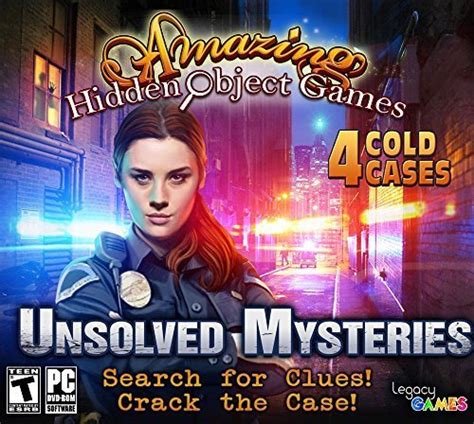
Amazing Hidden Object Games: Unsolved Mysteries is a compilation bundle featuring a collection of hidden object adventures where players investigate and solve a variety of unsolved cases. The included games, such as ‘Letters from Nowhere 2’, ‘Detective Stories: Hollywood’, ‘Red Crow Mysteries: Legion’, and ‘Golden Trails: The New Western Rush’, offer diverse settings ranging from supernatural Hollywood detective stories to mystical western trails, challenging players to find hidden clues and unravel mysteries across different narrative worlds.
Amazing Hidden Object Games: Unsolved Mysteries: Review
Introduction: The Compilation Conundrum
In the sprawling ecosystem of digital casual gaming, few phenomena were as pervasive—or as pragmatic—as the budget compilation. During the 2010s, as hidden object puzzle adventures (HOPAs) saturated storefronts like Big Fish Games and Steam, publishers sought efficient ways to move units. Enter Amazing Hidden Object Games: Unsolved Mysteries, a 2014 Windows compilation from publisher Legacy Games. This title is not a singular creative vision but a curated sampler, bundling four previously released titles—Letters from Nowhere 2, Detective Stories: Hollywood, Red Crow Mysteries: Legion, and Golden Trails: The New Western Rush—alongside a mysterious “bonus game.” My thesis is this: Unsolved Mysteries serves as a perfect artifact of its genre’s commercial peak, offering a low-risk, high-volume entry point into a world of supernatural sleuthing and item-hunting, but its legacy is that of a well-executed commodity rather than a groundbreaking work. It encapsulates an era where quantity and accessibility often trumped innovation, providing a reliable, if forgettable, fix for a dedicated player base.
Development History & Context: The Assembly Line of Mystery
The development story of Amazing Hidden Object Games: Unsolved Mysteries is, by necessity, a story of multiple studios. The compilation is assembled by Legacy Games, a publisher known for re-releasing and bundling casual titles, often from a stable of frequent partners. The four core included games originate from a handful of prolific casual studios:
- Letters from Nowhere 2 (2011) and Golden Trails: The New Western Rush (date unspecified in source, but the series began earlier) stem from developers like Boomzap Entertainment and Cerasus Media/Vendel Games respectively, known for series-driven HOPAs.
- Detective Stories: Hollywood appears to be from ERS Games or a similar studio, aligning with their output of detective-themed titles.
- Red Crow Mysteries: Legion suggests a tie-in or spin-off from the Red Crow series, likely developed by a studio specializing in paranormal investigations.
This multi-studio approach was standard for the casual compilation market. There was no singular “vision” for Unsolved Mysteries; the vision was commercial curation. The technological constraints of the era (early-to-mid 2010s) involved 2D pre-rendered or simply painted art, basic particle effects for “found” items, and UI designed for mouse-driven, low-intensity play. The gaming landscape was dominated by the “Big Fish Games” model: episodic, narrative-lite, affordable, and overwhelmingly played on PC or early tablets. Compilations like this were the box sets of the casual world, offering a sampler platter to introduce players to different “flavors” of the hidden object genre—supernatural, detective, historical, western—all under one affordable price point, typically sold digitally or in bargain bins.
Narrative & Thematic Deep Dive: A Mosaic of Mini-Mysteries
As a compilation, Unsolved Mysteries presents four distinct narrative containers, each adhering to genre conventions while exploring different thematic corners of the “unsolved” premise.
1. Letters from Nowhere 2: This entry continues the supernatural soap opera of the Letters from Nowhere series. The plot follows Audrey, a protagonist confronting a malevolent, letter-ghost entity that haunts her husband and triggers a series of murders. The narrative is a blend of domestic horror and occult mystery. Thematically, it explores the intrusion of the past (via ghostly missives) into the present, the trauma of unexplained disappearances, and the desperate search for closure. The dialogue is functional, moving the player between locations with cryptic clues, and the “unsolved” mystery is both the specific crime and the broader nature of the haunting entity.
2. Detective Stories: Hollywood: Here, the theme shifts to classic noir-inflected crime. A movie studio has suffered a triple loss: a fortune in cash, the only print of its new blockbuster, and its leading lady. The player steps into the shoes of a detective untangling a web of studio politics, greed, and deception. The narrative draws on the tropes of Tinseltown glamour masking corruption. Themes include the commodification of art and image, ambition turned deadly, and the search for truth in a world of illusions. The “unsolved” mystery is whodunit, with red herrings and suspects aplenty, resolved through traditional hidden object clue-finding and interrogations.
3. Red Crow Mysteries: Legion: This title leans heavily into paranormal procedural territory. The player, with a presumed ability to see beyond the veil, investigates cases involving Legion—a term evoking biblical, demonic forces or a collective of entities. The narrative structure is episodic case-file based. Thematically, it deals with hidden histories, occult phenomena, and the existence of a secret war between unseen forces. The “unsolved” mystery is often metaphysical: not just “who” but “what” and “why,” with answers that hint at larger, ongoing cosmic conflicts left unexplored.
4. Golden Trails: The New Western Rush: The western setting provides a historical veneer for a treasure-hunt mystery. The plot revolves around the pursuit of a legendary gold stash or family legacy tied to the American frontier. Themes of Manifest Destiny, buried treasure, outlaws, and historical justice come into play. It’s less about an unresolved crime and more about an unresolved quest—a puzzle left by ancestors. The “unsolved” mystery is the location and nature of the treasure, with the narrative serving as a guided tour through frontier landmarks and conflicts.
Thematic Through-Line: The unifying thread is the process of investigation itself. Each game frames the player as an outsider—a concerned wife, a private detective, a psychic, a treasure hunter—who must impose order on chaos by finding tangible objects (letters, film reels, occult symbols, gold coins) in cluttered environments. The “mysteries” are puzzles to be solved, not existential conundrums. The tone ranges from eerie to adventurous to gritty, but all share a core promise: diligent searching will yield answers.
Gameplay Mechanics & Systems: The HOPA Blueprint
The gameplay across all four titles follows the standardized Hidden Object Puzzle Adventure (HOPA) template that dominated the 2000s-2010s casual market.
- Core Loop: The player navigates between static, highly detailed “scenes” (a cluttered Hollywood office, a ghostly mansion, a frontier town). Each scene presents a list of 10-25 items to find from a vast, visually integrated clutter. Finding items grants points, hints, and progress. Hidden object scenes are interspersed with puzzle mini-games: jigsaw puzzles, pattern-matching games, slider puzzles, and inventory-based “use item on hotspot” puzzles.
- Progression & UI: A journal or case file tracks objectives. A hint system (limited uses or rechargeable) highlights an item. The UI is minimalist: a scene list, inventory panel, and objective tracker. There is no character stat progression; advancement is linear, gated by object finds and puzzle completions.
- Innovations & Flaws: The compilation itself is the primary “innovation”—offering variety. Individually, these titles may have minor twists: Red Crow might incorporate more “psychic vision” mechanics, Golden Trails might have more historically themed puzzles. However, the systems are famously repetitive and risk-averse. The hidden object lists often rely on pixel-hunting and semantic ambiguity (is that a “key” or a “lock pick”?). Puzzles are frequently recycled templates. The “flaw” is a lack of meaningful challenge for non-casual players, but this is by design. The games are engineered for relaxation and a sense of gradual accomplishment, not intellectual rigor. The compilation format highlights this monotony; after a few hours, the player cycles through different skins on the same core activity.
World-Building, Art & Sound: Atmospheric Efficiency
The art direction and sound design across the compilation are competent examples of budget-conscious genre aesthetics.
- World-Building & Art: Each game’s setting dictates its visual palette. Hollywood uses art deco, film reels, and glitz; Letters from Nowhere 2 employs murky, spectral color schemes with ethereal light; Golden Trails uses warm, sun-bleached tones of the Old West; Red Crow Legion favors dark, shadowy, occult-inspired environments. The art is illustrative and static, designed to be dense with objects rather than dynamic or interactive. Backgrounds are beautifully painted but serve primarily as containers for the hidden object lists. Character portraits are used in dialogue, often stylized and consistent within a series. The “world” is a sequence of beautifully illustrated, but ultimately non-interactive, dioramas.
- Sound Design: Soundtracks are typically unobtrusive, looping ambient tracks that match the theme—moody piano for detective, soaring orchestral for adventure, faint whispers for horror. Sound effects are functional: a chime for found items, atmospheric drones, and basic environmental sounds. Voice acting, if present, is usually limited to brief introductory cinematics and is often of mixed quality, typical for low-budget casual productions. The audio’s role is to reinforce mood and provide feedback, not to build a rich diegetic soundscape.
- Contribution to Experience: Together, these elements create a comforting, immersive-in-short-bursts atmosphere. The player isn’t exploring a living world but solving a visual puzzle wrapped in a thematic skin. The art provides the “vibe,” the sound provides the “texture,” but the core engagement remains the tactile satisfaction of clicking on a hidden item. The compilation’s variety is its strongest artistic asset, preventing total visual fatigue by shifting between a noir city, a haunted manor, a mystical forest, and a dusty main street.
Reception & Legacy: A Silent Bestseller
Critical reception for Amazing Hidden Object Games: Unsolved Mysteries is essentially non-existent. Metacritic shows no critic reviews, and MobyGames lists no formal critic scores. User reviews are similarly absent from major aggregators. This silence is deafening but also revealing. The game was not targeted at critics or “core” gaming press; it was aimed squarely at the vast, quiet audience of casual PC gamers—often older demographics, predominantly female—who purchased these bundles from digital storefronts or retail bundles without ever posting a review.
Its commercial reception must be inferred from the publisher’s continued output. Legacy Games released multiple sequels and thematic variations of the Amazing Hidden Object Games series through at least 2020 (Unsolved Mysteries 2 & 3 in 2015, Moonlight Mysteries, Paranormal Mysteries, etc.). This indicates a successful, sustainable business model. The compilation format worked: it de-risked purchase for consumers and allowed publishers to clear inventory or cross-promote series.
Its legacy is therefore industrial, not artistic. It represents the maturation and subsequent plateau of the HOPA genre:
1. The Bundle Standard: It cemented the “themed megapack” as a viable product, a practice that continues in various forms on digital platforms.
2. Genre Consolidation: It packaged the four primary sub-genres of HOPA at the time: supernatural horror, detective noir, historical adventure, and western/treasure hunt.
3. The Casual Canon: For thousands of players, this compilation is their introduction to games like Letters from Nowhere or Golden Trails. It serves as aarchival sampler of a specific moment in casual game design.
4. The End of an Era: The proliferation of mobile HOPAs (often free-to-play with aggressive monetization) and the declining visibility of PC casual bundles in the late 2010s mark the end of the era this compilation epitomizes. It is a last gasp of the “premium” casual PC bundle before the market shifted.
Conclusion: A Competent Artifact
Amazing Hidden Object Games: Unsolved Mysteries is not a game to be judged by the standards of narrative depth or mechanical innovation applied to titles like Half-Life or Shadow of the Colossus. It is a product, and as a product, it succeeds. It efficiently delivers approximately 20-30 hours of varied, low-stress puzzle gameplay across four distinct thematic settings for a low price point. The mystery it “solves” is simply: “What will I find next?” The true unsolved mystery is why such a commercially successful and prolific genre garners so little critical attention or historical analysis.
Its place in video game history is as a canonical example of the 2010s casual compilation boom. It is a time capsule of an entire ecosystem of development (multi-studio assembly lines), distribution (digital bundles and retail bin fodder), and consumption (the background activity of millions). For the historian, it is data: proof of the genre’s scale and stylistic range. For the player, it is a reliable, if unremarkable, source of relaxation. It does not challenge the form, but it perfectly replicates it. In the vast museum of gaming, Amazing Hidden Object Games: Unsolved Mysteries belongs not in the Hall of Masterpieces, but in the well-organized, comfortably lit, and perpetually stocked Hall of Solid, Everyday Entertainment.