
- Release Year: 2015
- Platforms: Windows
- Publisher: Legacy Games
- Genre: Compilation
- Game Mode: Single-player
- Gameplay: Hidden object
- Setting: Mystery
Description
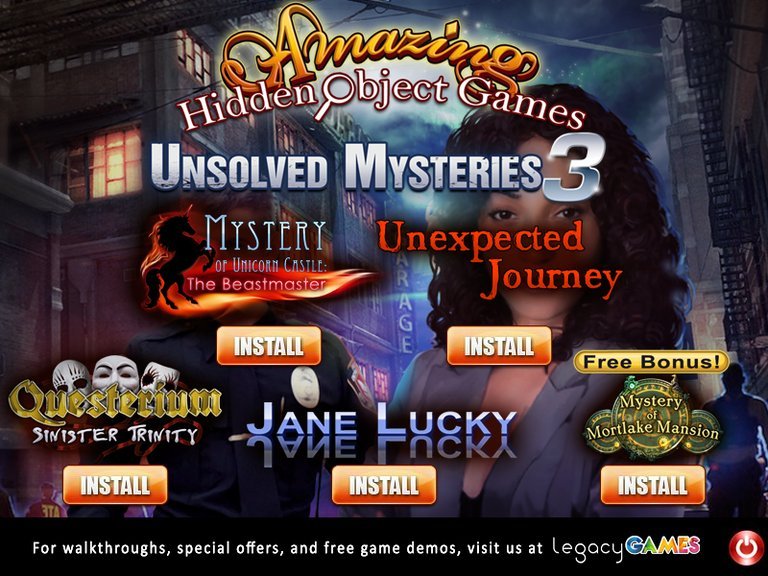
Amazing Hidden Object Games: Unsolved Mysteries 3 is a budget-priced Windows compilation released in 2015 by Legacy Games, featuring five captivating hidden object adventures: Mystery of Unicorn Castle: The Beastmaster, Unexpected Journey, Questerium: Sinister Trinity, Jane Lucky, and Mystery of Mortlake Mansion. Players dive into enigmatic worlds of puzzles, secrets, and supernatural intrigue, searching for hidden objects to unravel unsolved mysteries in this ESRB Teen-rated single-player collection from the popular Amazing Hidden Object Games series.
Amazing Hidden Object Games: Unsolved Mysteries 3: Review
Introduction
In the shadowy corridors of casual gaming history, where pixel-hunting meets pulse-pounding enigma, Amazing Hidden Object Games: Unsolved Mysteries 3 emerges as a budget beacon for seekers of the arcane. Released in 2015 by Legacy Games, this DVD-ROM compilation bundles five obscure yet evocative hidden object adventures—Mystery of Unicorn Castle: The Beastmaster, Unexpected Journey, Questerium: Sinister Trinity, Jane Lucky, and Mystery of Mortlake Mansion—into a single, affordably priced package retailing around $12 new or $7 used on secondary markets like eBay. As the third installment in the “Unsolved Mysteries” sub-series within Legacy’s sprawling Amazing Hidden Object Games franchise (which spans dozens of themed packs from Paranormal Mysteries to Moonlight Mysteries), it taps into the mid-2010s nostalgia for point-and-click puzzles amid a rising tide of free-to-play mobile titles. My thesis: While lacking the polish of premium HOGs like Mystery Case Files, this pack exemplifies the democratic charm of budget compilations, democratizing “unsolved” thrills for casual players but ultimately hindered by dated tech and formulaic execution, cementing its place as a nostalgic artifact rather than a genre innovator.
Development History & Context
Legacy Games, a purveyor of value-driven PC compilations since the early 2000s, spearheaded this release without credited in-house development, instead aggregating titles from a patchwork of Eastern European and indie studios prevalent in the casual HOG scene. Individual games hail from developers like Stella Games (Mystery of Mortlake Mansion, 2011), URSE Games (Questerium: Sinister Trinity), and others tied to Alawar or ERS Games ecosystems, reflecting the outsourced, rapid-prototyping model of Big Fish Games-inspired publishers. The creators’ vision appears rooted in thematic curation: “Unsolved Mysteries” evokes occult and exploratory narratives, aligning with the series’ prior entries (Unsolved Mysteries in 2014 bundled Letters from Nowhere 2 and Red Crow Mysteries: Legion, while the 2015 sequel continued the motif).
Technological constraints of 2015 PC gaming—Windows-only, keyboard/mouse input, DVD-5 media (as per redump.org dumps with mastering date September 8, 2015)—limited it to 2D hand-drawn scenes and pre-rendered animations, eschewing Unity or modern engines. No patches or updates noted on MobyGames, underscoring its standalone, offline nature (1 player, ESRB Teen for mild fantasy violence). The gaming landscape was transitional: HOGs peaked post-2008 recession as accessible escapes (dominating portals like GameHouse and PopCap), but faced disruption from Candy Crush clones and Steam’s free-to-play surge. Legacy’s strategy—bundling five ~2-4 hour games for impulse buys—mirrored physical retail’s decline, positioning this as a “greatest hits” surrogate for bargain-bin enthusiasts amid digital distribution’s rise.
Narrative & Thematic Deep Dive
As a compilation, Unsolved Mysteries 3 eschews a unified plot for five self-contained tales, unified by “unsolved” motifs of curses, vanishings, and supernatural pursuits. Mystery of Unicorn Castle: The Beastmaster plunges players into a medieval fantasy where a beastly curse afflicts a unicorn-guarded castle, blending Arthurian lore with beastly transformations—protagonist quests to shatter the spell, uncovering betrayals via ghostly visions. Unexpected Journey evokes nomadic peril, likely following a wayfarer ensnared in otherworldly detours (per genre norms, think Botanica-esque portal-hopping), emphasizing isolation and fateful encounters.
Questerium: Sinister Trinity delves into occult trinitarian heresy—three malevolent entities (sin, death, deception?) torment a quester, with dialogue-heavy cutscenes probing theological dread. Jane Lucky, a treasure-hunter archetype akin to Natalie Brooks, stars a plucky archaeologist raiding ancient ruins, her “lucky” escapes masking deeper conspiracies. Capping it: Mystery of Mortlake Mansion (Stella Games, 2011), a gothic standout where players inhabit an amnesiac trapped in a cursed Elizabethan manor, piecing fragmented memories amid poltergeists and family secrets.
Themes coalesce around unresolution and the uncanny: No tidy Hollywood arcs; endings tease sequels or ambiguities, mirroring real “unsolved mysteries.” Characters are archetypal—damsels, cursed lords, intrepid explorers—with stilted, translated dialogue (“The beastmaster stirs! Find the horn of purity!”) prioritizing voiceover mysticism over nuance. Subtext critiques hubris (tampering with ancients) and isolation (haunted solos), but repetition dilutes impact, favoring jump-scare tropes over psychological depth.
Gameplay Mechanics & Systems
Core loop: Standard HOG cadence—hidden object scenes (HOGs) (list/word-search hybrids amid cluttered 2D art), puzzle mini-games (sliders, match-3, rotators), and adventure progression (inventory combos, room navigation). No combat or RPG progression; “character growth” is hint/morphing-object unlocks post-scene. UI is utilitarian: Magnifier for hints (limited, refilling slowly), skip buttons after timeouts, and scene-skipping for casuals.
Innovations are scant—Mortlake’s memory-matching shines, Unicorn’s beast-taming riddles add fantasy flair—but flaws abound: hint inefficiency in dense scenes, backtracking fatigue, and sparse interactivity (click-fests sans branching paths). Loops vary per game: Jane Lucky amps action with timed relic hunts; Questerium layers trinity-themed logic puzzles. Progression gates via “HOG fatigue” (scene variety mitigates), with bonus playthroughs for achievements (collectibles, no-jump challenges). Flawed systems: Mouse-only precision taxes modern resolutions; no controller support. Overall, 10-20 hours of relaxing sleuthing, but repetitive for veterans.
- Strengths: Forgiving casual mode, morphing objects for replay.
- Weaknesses: Punitive timers in expert mode, identical puzzles across titles.
World-Building, Art & Sound
Settings span gothic mansions (Mortlake’s fog-shrouded halls), enchanted forests/castles (Unicorn’s bioluminescent wilds), exotic ruins (Jane’s Mayan temples), liminal voids (Unexpected’s dreamscapes), and infernal realms (Questerium’s shadowy altars)—a tapestry of “unsolved” locales evoking H.P. Lovecraft lite. Atmosphere thrives on dimly lit, hand-painted 2D art: Intricate foreground clutter (vintage clocks, arcane tomes) contrasts ethereal backgrounds, fostering immersion via parallax scrolling.
Visual direction favors moody palettes (purples/blues for mystery), with subtle animations (flickering candles, lurking shadows). Sound design: Orchestral swells (haunting harps for Unicorn, ominous choirs for Questerium), sparse SFX (creaking doors, ethereal whispers), and full voice acting in cutscenes—budget but evocative, enhancing unease. These elements synergize for escapism: Art’s detail rewards scrutiny, sound punctuates “eureka” moments, though dated resolutions (800×600 installer shots) feel pixelated on HD displays.
Reception & Legacy
Launch reception: Nonexistent in mainstream—zero critic/player reviews on MobyGames (as of 2025), no Metacritic aggregate (a similar 2018 Avanquest pack scores TBD). Commercial viability inferred from eBay persistence ($7-12 used) and series proliferation (47 Amazing packs, per MobyGroups). Niche appeal in casual forums/Fandom wikis, where HOG fans laud value (“five games for DVD price!”).
Reputation evolved modestly: Archived on Internet Archive (2015 Moonlight pack analog), preserved via redump.org (SHA1: f3a9bd2e758f4291b94f42f9824783a0934095d2). Influence: Exemplifies HOG compilations’ role in sustaining indie devs (ERS, Elephant Games ecosystems), inspiring modern bundles on Steam/GOG. Industry ripple: Bolstered Legacy’s output amid casual-to-mobile shift, influencing Big City Adventure-style series. Cult status as “budget relic,” evoking 2010s HOG golden age (Mystery Case Files boom).
Conclusion
Amazing Hidden Object Games: Unsolved Mysteries 3 distills the essence of mid-2010s casual gaming: Five flavorful HOGs offering ~15 hours of brain-teasing escapism, rich in thematic shadows yet chained by mechanical repetition and archaic tech. Legacy Games’ curation shines in value, but absence of innovation relegates it to niche nostalgia. Verdict: 7/10—A commendable historical footnote for HOG historians and bargain hunters, worthy of emulation for its preserved mysteries, but supplanted by superior modern revivals. In video game history, it stands as a testament to the compilation’s power in democratizing delight, forever unsolved yet eternally playable.