
- Release Year: 2004
- Platforms: Windows
- Publisher: Mediaphor Software Entertainment AG, Pointsoft S.A.
- Developer: Thinking Thing Software
- Genre: Simulation
- Game Mode: Single-player
- Gameplay: Cards, Tiles
Description
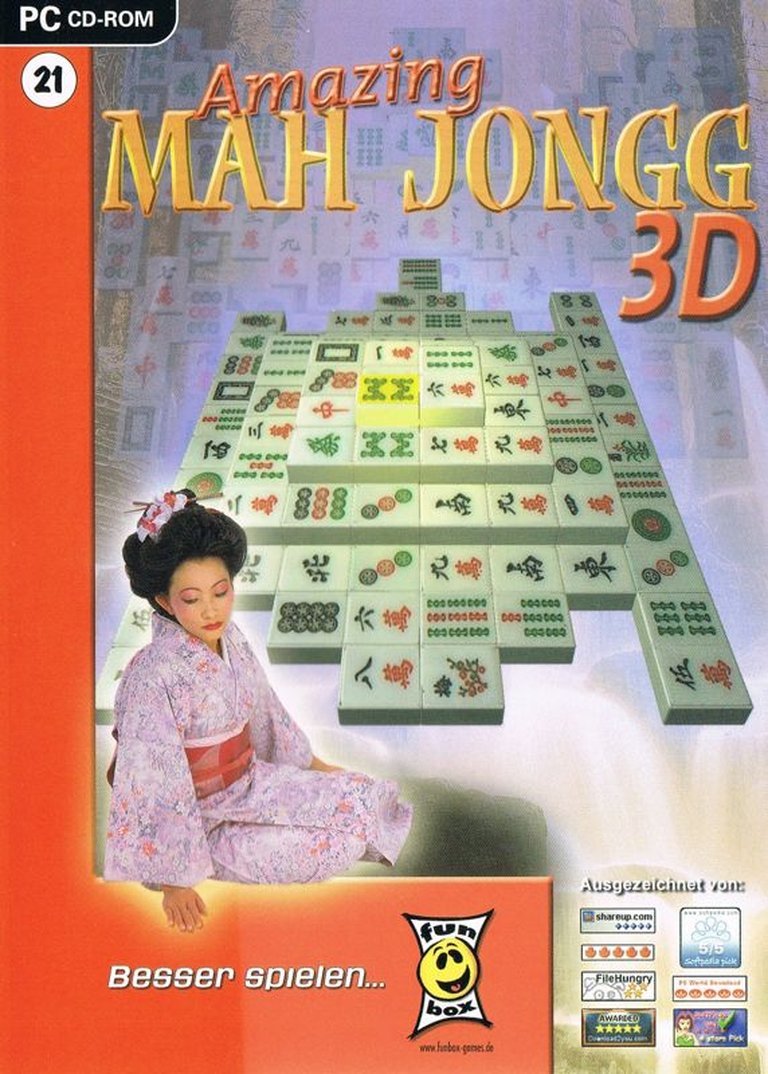
Amazing Mah Jongg 3D is a PC adaptation of the classic Mah Jongg solitaire tile-matching puzzle, featuring a fully 3D rotatable board for enhanced gameplay. With 60 different variants and over 25 customizable backgrounds and token designs, it offers a visually rich and varied take on the timeless game.
Amazing Mah Jongg 3D: A Review of a Digital Time Capsule
Introduction: The Ghost in the Machine of Casual Gaming
To approach Amazing Mah Jongg 3D is not to examine a landmark of interactive art or a pivotal commercial success. It is to perform an archaeological dig into a specific, fleeting stratum of video game history: the early-2000s budget compilation era for PC casual games. Released in 2004 by the obscure German publisher Pointsoft S.A. (and Mediaphor) and developed by the equally elusive Thinking Thing Software, this title is not a singular creative statement but a functional cog in a vast, anonymous machine designed to fill retail shelves and capitalize on a trend. Its thesis is one of aggregation: it posits that value can be derived not from innovation, but from multiplicity—bundling 60 variants and 25+ visual themes under the familiar, culturally resonant banner of “Mahjong.” For the game historian, Amazing Mah Jongg 3D is a crucial primary source, a pristine artifact that reveals the business models, technological constraints, and semantic compromises of its time. It represents the moment “Mahjong” in the Western popular consciousness was permanently, and reductively, redefined from a complex, social, four-player tile game into a solitary, click-driven puzzle. This review will argue that Amazing Mah Jongg 3D‘s true significance lies not in its mechanics or presentation, which are competent but unremarkable, but in its role as a vector for this profound cultural simplification.
Development History & Context: The Assembly Line of Pixels and Tiles
Amazing Mah Jongg 3D exists within a tangled web of corporate aggregation. Its developer, Thinking Thing Software, leaves virtually no digital footprint beyond this title and a related website (mahjongg4u.com), suggesting it was a small, possibly part-time studio operating on the periphery of the industry. The publishers, Pointsoft S.A. and Mediaphor Software Entertainment AG, were mid-tier European distributors known for budget and shareware titles.
The game’s most defining context is its inclusion in the October 2004 retail compilation Mahjongg 2, published by S.A.D. Software Vertriebs- und Produktions GmbH. As documented on MobyGames, Mahjongg 2 was not a sequel but a “budget-priced retail compilation” bundling titles like 3DJongg, Amazing Mahjongg 3D, Twilight Mahjongg, and MegaMahjongg, plus 15 shareware variants. This bundling strategy was the lifeblood of the early-2000s PC casual market. Publishers like S.A.D. acted as aggregators, licensing existing shareware titles from numerous small developers and repackaging them to create a perception of high volume for a low price (often $9.99-$19.99). Amazing Mah Jongg 3D was one such component—likely a pre-existing shareware project acquired for the bundle.
Technologically, the game was a product of its constrained era. System requirements from sources like AllWorldSoft specify a Pentium II 300 MHz, 64 MB RAM, and an 8MB 3D video accelerator. This places it squarely in the DirectX 7/8/9 transitional period. The primary technological “innovation” advertised was the “3D board that can be rotated.” However, analysis of contemporary 3D Mahjong titles like Mah-Jong Master 3D (2004) reveals this was often a simpler proposition than the name suggests. As noted in its review, the 3D effect could involve “slight tile sway effects” and a fixed camera angle that prevented “true 3D exploration,” with the rotation serving more as a visual gimmick than a deep spatial puzzle layer. Amazing Mah Jongg 3D’s 3D implementation was almost certainly in this vein: a basic wireframe or textured polygon board rotatable around a single axis, designed to create a sense of novelty rather than substantive gameplay change.
The gaming landscape of 2004 was ripe for such a product. Microsoft’s Mahjong Titans (part of Windows XP’s Plus! Pack) had already introduced the solitaire variant to millions. PopCap’s Bejeweled (2001) had proven the addictive potential of simple match-based mechanics. The market was flooded with “Super Mahjong” and “Puzzle Inlay” compilations. Amazing Mah Jongg 3D was a faceless competitor in this gold rush, its value proposition literally being “60 different variants” and “more than 25 backgrounds.” Its development history is thus one of anonymity, commercial pragmatism, and the relentless production of interchangeable content to satiate a casual audience.
Narrative & Thematic Deep Dive: The Deliberate Erasure of Story
In any meaningful literary or cinematic sense, Amazing Mah Jongg 3D has no narrative. The “plot” is the player’s self-directed journey through a series of tile layouts. There are no characters, no dialogue, no cutscenes, and no overarching story. This is not a deficiency but a foundational design choice, adhering strictly to the abstract puzzle genre established by the 1981 mainframe game Mah-Jongg and popularized by Shanghai (1986).
However, the thematic vacuum is profound and deliberate. The source material repeatedly underscores the vast chasm between the digital solitaire variant and the rich, centuries-old cultural artifact of four-player Mahjong. Academic citations on MobyGames (over 1,000) point to a deep well of historical scholarship—covering the game’s 19th-century Chinese origins, its Americanization by figures like Joseph Babcock in the 1920s, its adoption by Jewish-American communities, and its evolution into a regulated mind sport with organizations like the National Mahjongg League and the World Mahjong Organization.
Amazing Mah Jongg 3D and its ilk engage with none of this. Their “themes” are purely aesthetic and atmospheric. A “Twilight Mahjongg” variant might use a blue-purple palette to evoke quiet solitude; a “3D” version might use metallic sheens to feel modern. But these are shallow, surface-level associations. The game presents Mahjong as a visual motif and a puzzle mechanic, utterly stripped of its social ritual, gambling history, strategic partnership, and cultural weight. It is a Zen-like exercise in pattern recognition and closure, but a Zen devoid of context. This decoupling is perhaps its most significant historical impact: it helped cement in the Western mind that “Mahjong” is, by default, a solitary tile-matching game. The title is not just a game; it is an active participant in a decades-long process of semantic drift.
Gameplay Mechanics & Systems: The Engine of Endless Tiles
The core of Amazing Mah Jongg 3D is the immutable ruleset of Mahjong Solitaire (also called Shanghai Solitaire). From the description, it includes “60 different variants,” meaning 60 distinct pre-generated tile layouts (pyramids, dragons, turtles, etc.). The fundamental loop is unwavering:
1. A stacked layout of 144 standard Mahjong tiles (suited tiles 1-9 in circles, bamboos, characters; winds; dragons; bonus flowers/seasons).
2. The player identifies and clicks two identical, exposed tiles (a tile is “exposed” if it has no tile covering any part of its top or left/right sides).
3. Matched pairs are removed.
4. The goal is to clear the entire board. Strategic depth arises from planning removal order to avoid blocking essential tiles.
The “3D” element promises a twist. The board “can be rotated,” implying a free camera. This suggests a shift from traditional fixed-perspective, stacked layouts to a layout that might exist in three dimensions—perhaps a cubic or spherical arrangement where tiles are on multiple faces. Rotation would be necessary to see and access all tiles. This adds a spatial reasoning layer absent in 2D variants. However, based on the era’s technology and the description “Fixed / flip-screen” on MobyGames (a seeming contradiction with “3D”), the implementation was likely limited. It was probably a 3D-modeled board on a fixed plane that the player could rotate 90 or 180 degrees, not a fully explorable 3D space. The value was in the perception of depth and a novel viewpoint, not a radical mechanical shift.
Systems Analysis:
* Progression: Linear unlocking of layouts. No skill-based matchmaking or adaptive difficulty. “60 variants” implies 60 discrete levels or theme packs.
* UI/Features: Standard for the genre and era. Predicted features include a timer (optional), score display, “Hint” function (highlights a pair, often with a point penalty), limited “Undo,” and a “Shuffle” function to randomize remaining tiles when stuck. The inclusion of “25 backgrounds and token designs” speaks to a UI focused on visual reskinning as a primary content driver.
* Innovation (Within the Bundle): Its primary “innovation” was the 3D rotation gimmick, which was relatively rare in 2004. Most competitors like Mahjongg Deluxe or Mah Jongger were strictly 2D. It also offered a high count of variants (60), positioning itself as a value-pack.
* Systemic Flaws (Inherent to the Genre & Era):
* Unwinnability: Pre-generated layouts from this period rarely had guaranteed solutions. Players could spend significant time on an impossible board before using the Shuffle function—a major frustration.
* Replayability: Once all 60 layouts are solved, the game is “done.” Replay value came only from the desire to improve times/scores or try different visual themes.
* Lack of Modern Features: No online leaderboards, no cloud saves, no daily challenges, no achievements. A purely offline, single-player experience.
* The Shareware Shadow: Its inclusion in Mahjongg 2 means a portion of its content was likely shareware-limited, a practice that undermined the feeling of a complete purchase.
World-Building, Art & Sound: The Aesthetic of the Digital Tea House
The “world” of Amazing Mah Jongg 3D is not a diegetic environment but the sum of its aesthetic skins. There is no story-driven setting; atmosphere is constructed entirely through visuals and audio, which range from functional to mildly immersive.
- Visual Direction: A product of early-2000s PC graphical constraints. Tile designs would have ranged from attempts at authenticity (rendered traditional Chinese characters for the suited tiles) to simplified, symbolic representations (using numbers/letters for suits in some variants). The “3D” tiles were likely simple polygon models with texture maps, lacking the normal mapping or complex lighting of later titles. Animation was minimal: tile drop-in effects, a sink or fade for matches. The 25+ backgrounds provided the primary visual diversity—likely bitmap images of generic “Asian” scenes (bamboo groves, temple courtyards, mountains), abstract patterns, or solid colors. The art direction aimed for cultural recognition (you recognize the Mahjong tiles) and digital clarity (tiles must be easily distinguishable at a glance) over authentic representation or artistic cohesion.
- Sound Design: The audio palette was narrow but functional, as was standard for casual games of the period.
- Tile SFX: A consistent, satisfying click or tap on selection, and a deeper clack or chime on removal. These sounds were crucial for providing tactile feedback in the absence of physical tiles.
- Ambient Music: Looping MIDI tracks in the “New Age” or “Asian Fusion” genre—pentatonic scales, gentle synthesized flutes (shakuhachi emulations), soft percussion. This music was designed to be unobtrusive and “relaxing,” but often became repetitive and tinny. It attempted to place the player in a “calm, Eastern” headspace, relying on a generic pastiche of exoticism.
- UI Sounds: Standard interface clicks and error buzzes.
The soundscape’s contribution was to fill silence and reinforce categorization. It marked the game as a “puzzle” and a “casual” experience, not an action or strategy title.
Reception & Legacy: The Silent Success of the Assembly
Contemporary Reception:
Amazing Mah Jongg 3D received no major critical coverage. The Metacritic page for the title is blank, and MobyGames has no critic reviews for either the standalone version or its compilation (Mahjongg 2). This is definitive. It was a shelf-warmer in a saturated market. Its “reception” was purely commercial and demographic. It sold to a specific audience: casual players, older adults, the “solitaire crowd” who browsed the bargain software sections of retailers like Best Buy or Media Play. The value proposition was purely quantitative: “N games in one!” The quality of any individual variant was secondary to the feeling of getting a lot for a little.
Evolution of Reputation:
The game has no reputation to evolve. It exists in a state of archival obscurity, known only to retro PC collectors, genre completionists, and perhaps a few who bought it on a whim. It is the definition of a forgettable product. Its legacy is not as a beloved title but as a data point—a perfect specimen of a mass-market trend.
Influence on the Industry & Subsequent Games:
Amazing Mahjongg 3D was not influential. It did not pioneer mechanics, create communities, or set trends. Its influence is indirect and negative: it exemplifies the “budget compilation” model that flooded the market. This model taught publishers that one solid core mechanic (like tile-matching) could be endlessly re-skinned and repackaged to create perceived value. It contributed to the dilution of the “Mahjong” brand by reinforcing the solitary puzzle variant over the traditional four-player game.
Its true, insidious influence is cultural. By being one of countless titles bearing the name “Mahjong” that presented only the solitaire variant, it participated in—and benefited from—the complete semantic divorce of the word “Mahjong” from its historical and cultural roots. A player in 2004 encountering Amazing Mah Jongg 3D would have no conceptual link to the game’s origins in 19th-century China, its role in 1920s American parlors, or its status as a competitive mind sport. The name became a genre label: “Mahjong” = tile-matching puzzle. This simplified, ahistorical avatar of the game persists powerfully in the mobile era (e.g., Mahjong Titan, Mahjong Journey), making Amazing Mah Jongg 3D a direct ancestor of today’s app store deluge.
Place in Video Game History:
Its place is marginal but illustrative. It is a footnote in the history of casual PC gaming and a perfect specimen of the early-2000s compilation genre. Historically, its value is anthropological. It is a primary source document showing:
1. The marketing language of the era (“3D!”, “60 variants!”).
2. The technical capabilities/limitations of mid-range PC hardware (DirectX, low-poly 3D).
3. The aesthetic trends of casual games (generic “Oriental” music, stock backgrounds).
4. The final flowering of the physical CD-ROM budget compilation before digital distribution and polished casual suites (like PopCap’s) consolidated the market.
5. The culmination of a decades-long process of cultural appropriation and simplification of a traditional game.
Conclusion: A Verdict of Context, Not Quality
To judge Amazing Mah Jongg 3D on the axes of “fun” or “graphics” is to miss its point entirely. As a Mahjong Solitaire implementation, it is perfectly functional. It offers a working 3D rotation gimmick, a large number of layouts, and the basic features (Hint, Shuffle) expected of its genre. Its presentation is dated but serviceable, its soundscape typical of its time. It is neither exceptionally good nor exceptionally bad.
Its true verdict must be historical and cultural. Amazing Mah Jongg 3D is a functional artifact frozen at a crossroads. It represents the last gasp of an era where casual game value was measured in megabytes on a CD-ROM and the number of included variants, rather than in polished online ecosystems or free-to-play monetization. More importantly, it stands as a monument to the successful, near-total erasure of Mahjong’s cultural complexity in the Western digital consciousness. For every scholar citing the Sloperama timeline or the rules of the National Mahjongg League, a million players in the 2000s encountered “Mahjong” through titles like this—a colorful, solitary, ahistorical puzzle. Amazing Mah Jongg 3D did not just sell tile-matching; it sold and reinforced a misconception. In that, it is more historically significant than any brilliantly designed Mahjong Solitaire game could ever be. It is the ghost in the machine of casual gaming, a silent ambassador for a profound and lasting simplification.
Final Score: N/A (As a historical artifact: 8/10 for its perfect encapsulation of its era. As a game to play today: 4/10, relegated to nostalgia or academic curiosity.)
Recommended For: Video game historians, collectors of early-2000s casual PC compilations, and anyone studying the cultural translation and dilution of traditional games in the digital age. Not Recommended For: Players seeking a deep, modern Mahjong Solitaire experience, those interested in four-player Mahjong, or anyone frustrated by dated interfaces and the lack of quality-of-life features.