
- Release Year: 2012
- Platforms: Windows
- Publisher: MDNA Games
- Developer: MDNA Games
- Genre: Adventure
- Perspective: 1st-person
- Game Mode: Single-player
- Gameplay: Graphic adventure, Puzzle elements
- Setting: Europe
Description
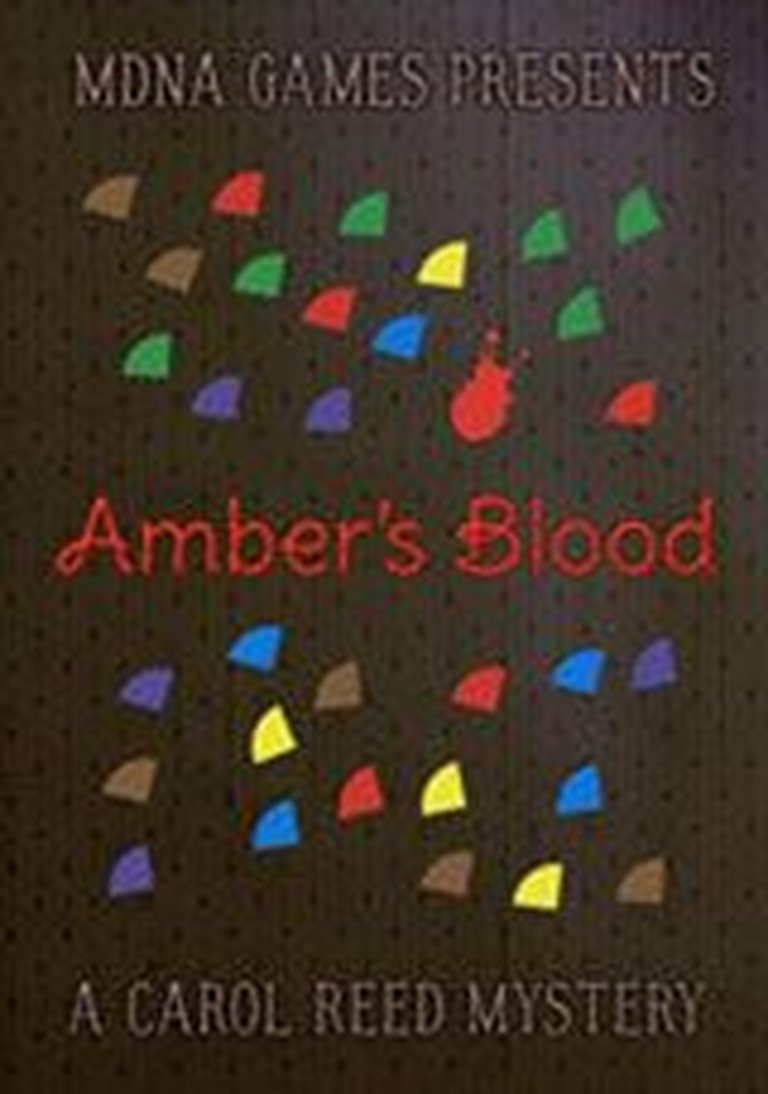
Amber’s Blood: A Carol Reed Mystery is the eighth installment in the adventure series, set against a European backdrop. While on a break from her cases in Sweden, detective Carol Reed is asked by her friend Stina to investigate a peculiar issue with her grandfather’s obituary, which rapidly escalates into a complex mystery involving murder, insanity, and ancestral secrets. Through point-and-click gameplay, players explore various locations, interrogate suspects, and solve inventory-based and logic puzzles to unravel the tangled narrative.
Gameplay Videos
Amber’s Blood: A Carol Reed Mystery Guides & Walkthroughs
Amber’s Blood: A Carol Reed Mystery Reviews & Reception
adventureclassicgaming.com : The menu options are refreshingly simplistic.
Amber’s Blood: A Carol Reed Mystery: A Hidden Gem of Narrative-Driven Adventure
Introduction: The Quiet Power of a Pedigreed Puzzler
In the vast, often noisy ecosystem of video games, where graphical fidelity and action-packed set pieces frequently dominate the conversation, there exists a serene and intellectually demanding corner: the classic point-and-click adventure. Within this niche, the Carol Reed Mystery series by Sweden’s MDNA Games has long been a cherished, if quiet, institution for aficionados of the form. Amber’s Blood, the eighth mainline entry released in February 2012, stands as a compelling testament to the enduring appeal of a well-wrought mystery, executed with consistent craft and a steadfast commitment to its core design pillars. This review will argue that Amber’s Blood is not merely another competent slideshow adventure but a masterclass in environmental storytelling, intricate plotting, and puzzle integration, representing the series’ narrative zenith despite operating within a technically and aesthetically conservative framework. Its legacy is that of a profoundly satisfying, if understated, achievement in the Golden Age of indie adventure gaming.
Development History & Context: The Norrköping Notebook
To understand Amber’s Blood, one must first understand its creator and its context. The game was developed by MDNA Games, a studio founded by Mikael Nyqvist and his wife Eleen in 2004 in Norrköping, Sweden. Nyqvist’s background was in short film production, a lineage visibly inherited by the games’ signature aesthetic: a world built not from 3D polygons, but from meticulously staged and shot high-resolution still photographs. This approach, while limiting in terms of animation, granted the series an unparalleled sense of place, turning the real streets, buildings, and landscapes of Norrköping and its environs into authentic, palpable characters in themselves.
The game was built using the Wintermute engine, a common tool for 2D adventure games at the time, which efficiently supported the series’ node-based, “slideshow” movement system. This system, where players click directional arrows to transition between static camera positions, was a conscious design choice that prioritized atmospheric composition and clarity of environmental clues over the more dynamic, but potentially distracting, free-roaming 3D movement. Released in early 2012, Amber’s Blood arrived in a transitional era for adventure games. The genre was experiencing a significant resurgence thanks to digital distribution (Steam, GOG) and the success of titles from Telltale Games, but the market was also shifting toward more cinematic, choice-driven narratives. MDNA Games, by contrast, doubled down on the classic, puzzle-centric, inventory-heavy model that defined the genre’s 1990s heyday. The studio’s prodigious output—roughly one Carol Reed game per year—was a feat of consistent, focused development, building a loyal community hungry for its particular brand of “cozy” Nordic noir.
Narrative & Thematic Deep Dive: A Web of Blood, Secrets, and Polio
The genius of Amber’s Blood lies not in its premise, which seems deceptively simple—”look into a problem with an obituary”—but in the exponentially escalating complexity and moral murkiness of the mystery it unveils. The narrative is a slow-burn onion, where each layer peeled back reveals not a clean answer, but a deeper, more distressing question.
The inciting incident is a request from Carol’s friend Stina. While sorting her late father’s belongings, Stina found an obituary for her grandfather, Alfons Larson, dated October 1, 1999. This conflicts with her childhood memory of his death occurring decades earlier. What begins as a clerical error investigation swiftly becomes a journey into a dysfunctional family’s buried history.
The trail is masterfully constructed through documentary evidence—obituaries, medical licenses, newspaper clippings, coded letters—which the player, as Carol, must locate, assemble, and interpret. The key figures emerge:
* Alfons Larson, MD: A licensed physician whose license was revoked in 1935. His records point to the Broxtowe Psychiatric Institution for the criminally insane. He is revealed, through his own “collector’s card” and a chilling letter, to be a wife-murderer and arsonist who burned down the Miranda Hospital where he worked. Yet, the narrative constantly subverts expectations; Alfons’s violence is later contextualized as a tragic, desperate act stemming from a catastrophic side effect.
* Julian Milius: An “insane painter” and Alfons’s closest friend, institutionalized at Broxtowe the day before Alfons. His artwork, particularly a gazebo painting and abstract shapes, becomes a critical map and code key. His exhibition is a pivotal clue site.
* Amber: The titular enigma. She is Alfons’s A+ blood type, his test subject (“B+ subject”), and the intended recipient of his life’s work: a cure for polio. Her photograph appears in an advertisement (“Amber’s er”), and her ultimate location must be deduced from a series of clues. Her relationship to Alfons is one of exploitative medical experimentation, yet also a twisted form of guardianship.
* Stina: The client whose simple request unravels the horrifying truth about her own grandfather. The climax reveals that Stina’s own mother or aunt (implied to be Alfons’s daughter, who recovered from polio) was the one who killed Alfons’s wife due to the insanity induced by Alfons’s untested polio cure on her as a child. Stina’s family history is literally one of murder, madness, and stolen medical science.
The central themes are potent: the corrupting nature of ambition (Alfons’s obsession with his cure), the intergenerational trauma of secrets, and the ethical abyss of “greater good” scientific experimentation. The game’s title, Amber’s Blood, is a devastating double entendre: it refers literally to Amber’s blood type being crucial to the plot, and metaphorically to the bloodshed and spilled secrets that stain the Larson family lineage. The resolution, where Carol must piece together Alfons’s final hiding places (a towel dispenser clue, a chest in Broxtowe’s attic) to find the formula, delivers a chilling verdict: the scientific breakthrough came at an unimaginable human cost, and the pursuit of its legacy continues to poison those who stumble upon it.
Gameplay Mechanics & Systems: The Elegant Cage
Amber’s Blood operates with a rigid, learnable, and deeply satisfying gameplay loop that will be instantly familiar to veteran adventure gamers but remains accessible to newcomers through a robust tutorial.
Core Loop & Navigation: The game is strictly node-based first-person. Each location is a static photo from which players click arrows (forward, back, left, right) to change the camera angle. A map screen is auto-populated with new locations as clues are discovered, allowing for non-linear travel once a path is unlocked. This system creates a deliberate, contemplative pace. You are not exploring a free world but solving a spatial and logical puzzle grid of Norrköping.
Inventory & Puzzle Design: This is the game’s primary mechanical engine. The inventory, accessed at the top of the screen, holds dozens of items (the walkthrough notes “about 59 items to use or combine”). Puzzles are almost exclusively inventory-based (use A on B, combine C and D) or logic-based (deciphering codes, aligning mechanisms). The design philosophy is one of absolute integration: every item has a single, logical purpose within the narrative context. Finding a “loop bolt” in one windmill to access a ledge in another feels like genuine detective work, not arbitrary object matching. Notable puzzle highlights include:
* The sign language/numeric keypad puzzle in the Board of Medicine archives, requiring the player to interpret a visual chart.
* The blue box combination lock at Stina’s attic, solved with a date learned from Archives research.
* The abstract shape puzzle using a cardboard template over Julian Milius’s painting to decode a color sequence for a safe.
* The multi-stage clock puzzle at Carol’s home, which requires synthesizing clues from a windmill wall, a film, and a note—a perfect capstone to the investigation.
Hint System & User Interface: The game includes a built-in, spoiler-free hint system accessed via Carol’s notebook in the inventory. The “Hints” page provides tiered guidance, from vague objectives to specific next steps, allowing players to avoid external walkthroughs. The UI is clean and functional, with clear icons for look, grab, use, and talk. Dialogue with characters (Stina, Henry Milius, the receptionist, Amber) uses a topic-select notepad, another series staple that focuses conversations on relevant clues.
Critiques of the System: The very consistency of the design can also be its weakness. The lack of ambient animation or living NPCs (characters are still photos with cycled expressions) can feel dated, as noted by Adventure’s Planet, which called the presentation “flat.” The puzzles, while logically sound, can sometimes feel repetitive in their basic “use item on hotspot” structure. More importantly, the game is highly linear in narrative reveal. You cannot truly get “stuck” in a dead-end; the clue chain is a golden thread leading you from one location to the next, which some players may find restrictive compared to more open-ended adventures.
World-Building, Art & Sound: The Photographic Realism of Norrköping
If the narrative is the brain of Amber’s Blood, its world is its soul, and it is here the game achieves something remarkable.
Visual Direction & Setting: The use of real, high-resolution still photographs is not a budget compromise but a profound aesthetic statement. Every screen is a carefully composed shot of a real location in and around Norrköping. You explore the cobblestone streets, the industrial riverfront, the gothic Broxtowe Psychiatric Institution, the rustic windmills, and the coastal boat graveyard. This grants the game an authentic, grounded texture that rendered 3D environments of the era often lacked. You are not exploring a “video game Sweden” but a hyper-realistic slice of a real place. The walkthroughs and reviews repeatedly note how these images could serve as a tourism brochure for Norrköping. The “flip-screen” transitions between nodes, while static, create a staccato, analytical rhythm that mirrors Carol’s methodical investigation—the player is constantly reassembling the scene from different angles.
Sound Design & Music: The audio complements the visuals perfectly. The musical score is described by Adventure Classic Gaming as “pleasant,” “never too dominant or dramatic but still gives an aura or ambience of mystery which complements the game.” It is primarily mood-setting ambient and melodic tracks that swell subtly during discoveries but never overwhelm. The voice acting is a highlight, with Sara Louise Williams providing a natural, understated performance as Carol. The other characters, often voiced by Swedish actors with local accents, add to the authentic feel. The sound design—a creaking door, distant seagulls, the hum of a refrigerator—is used sparingly but effectively to punctuate moments of discovery or tension.
Atmosphere Synthesis: The marriage of photographic realism, measured pacing, and subtle audio creates an atmosphere of methodical, pervasive unease. The subject matter—murder, insanity, familial betrayal—is dark, but the beautiful, sun-drenched (or mist-shrouded) Swedish settings create a stunning dissonance. You are solving a horrific tragedy amid some of the most picturesque landscapes in Europe. This juxtaposition is the game’s unique atmospheric signature: a cozy mystery with profoundly disturbing bones.
Reception & Legacy: A Cult Critical Darling
Upon its release in February 2012, Amber’s Blood received a positive but not spectacular critical reception, aggregating to a 73% score on MobyGames from five critic reviews. The praise was consistently focused on its narrative strength and puzzle integration, while criticism centered on its conservative presentation.
- The Praise: GameBoomers awarded it a stellar 91%, declaring the story a “standout” that is “chock full of clues that tantalize.” Adventure Classic Gaming gave it 4/5 stars, praising its “intriguing and macabre mystery” and the use of Norrköping’s scenery. Adventure Gamers (3.5/5) offered the most balanced appraisal, noting that while the gameplay and visuals felt “dated,” this simplicity allowed the “compelling mystery” to shine, with a “rewarding conclusion” full of “ah ha!” moments.
- The Critique: Adventure’s Planet (53/100) was the outlier, finding the movement “confusionary,” the graphics “flat” due to a lack of animation, and the puzzles “too simple and predictable.” This highlights the genre’s evolving expectations; for those seeking innovation in interface or visual dynamism, the game felt like a step back. For traditionalists, its consistency was its strength.
Its commercial performance is not publicly quantified, but its place in the #11,949 spot out of ~27,000 games on MobyGames and its collection by only 6 players suggests it remained a deep-cut title within a dedicated niche. Its legacy is twofold:
1. As a Series Peak: Many reviewers and fans consider Amber’s Blood one of the strongest, if not the strongest, entries in the long-running Carol Reed series. Its mystery is tighter, its twists more earned, and its thematic cohesion more complete than many predecessors.
2. As a Genre Anchor: In an era where adventure games were increasingly becoming “interactive movies,” Amber’s Blood stood as a vigorous defense of the classic, puzzle-forward, inventory-heavy design. It proved that a game could be utterly conventional in mechanics yet utterly captivating in execution, purely through a great story and clever puzzles. Its influence is likely felt more in sustaining the audience for traditional adventures than in pioneering new mechanics.
Conclusion: A Definitive Verdict on a Masterful Mystery
Amber’s Blood: A Carol Reed Mystery is a game that understands its purpose with absolute clarity. It does not seek to reinvent the adventure genre; it seeks to perfect a specific, beloved subset of it. It is a game for patient detectives who enjoy the tactile pleasure of organizing items in an inventory, the “click” of a puzzle falling into place after careful deduction, and the slow, satisfying accretion of clues in a notebook.
Its flaws are etched into its DNA: the static visuals, the occasionally repetitive puzzle verbs, the linear clue path. Yet, these are the trade-offs for a design philosophy that prioritizes clarity, logic, and narrative cohesion above all else. The mystery of Alfons Larson, Amber, and the cursed polio cure is one of the most compelling and morally complex in the adventure game canon, unfolding over roughly 10-15 hours of engrossing play across the photorealistic backdrop of Sweden.
In the grand tapestry of video game history, Amber’s Blood will not be remembered as a revolution. It will be remembered as a magnum opus of tradition. It is the epitome of a “game journalist’s game”—deeply intelligent, meticulously constructed, and rewarding precisely the kind of engaged, thoughtful play it demands. For those who believe the adventure genre’s heart still beats strong in its classic form, Amber’s Blood is an essential, near-flawless heartbeat. It is not just a worthy addition to the Carol Reed library; it is the library’s shining, photorealistic jewel.