
- Release Year: 2017
- Platforms: Linux, Macintosh, Nintendo Switch, Windows
- Publisher: Krillbite Studio AS, Soedesco B.V.
- Developer: Krillbite Studio AS
- Genre: Action
- Perspective: 1st-person
- Game Mode: Single-player
- Gameplay: Puzzle elements, Stealth
- Setting: 1990s
- Average Score: 50/100
Description
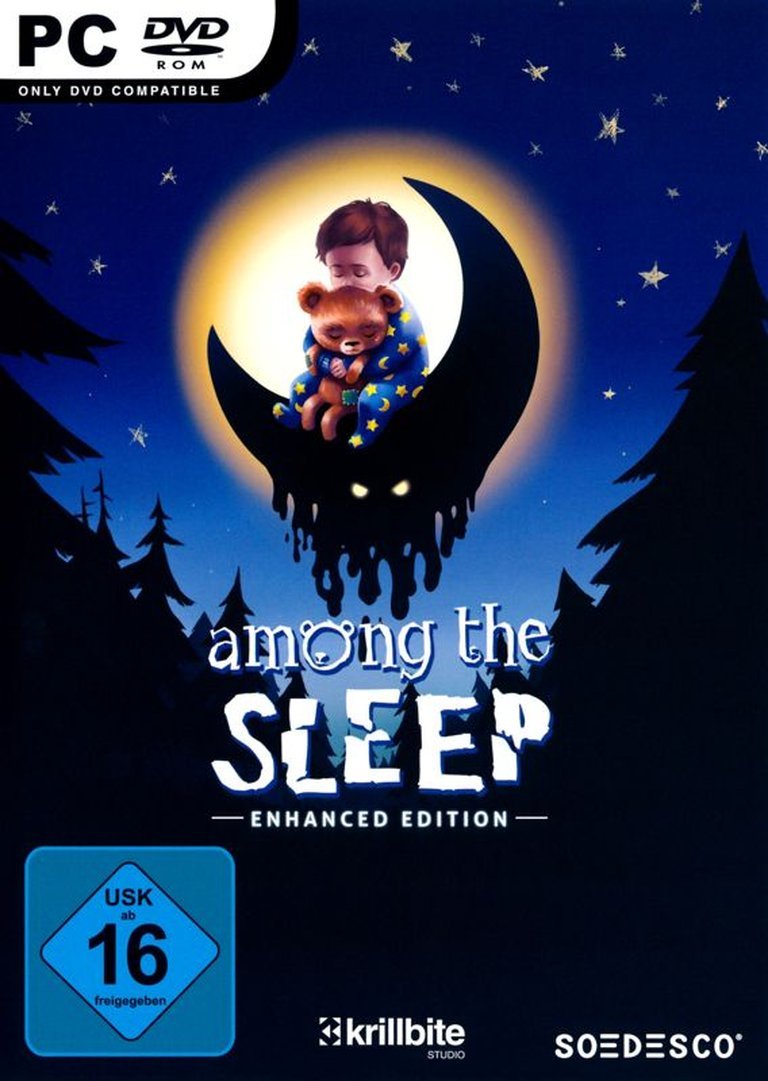
Among the Sleep: Enhanced Edition is a first-person horror adventure set in the 1990s, where players control a terrified toddler named David during and after his second birthday celebration at home with his mother Zoey, interrupted by a tense visit from his divorced father. The game transitions into surreal dream worlds featuring a gingerbread house-like hub, where the child crawls through eerie environments, solves enhanced puzzles, evades threats via stealth, and collects haunting memories, all with improved visuals, new dialogue, selectable pajamas, an integrated art book and soundtrack, and a behind-the-scenes museum level.
Gameplay Videos
Where to Buy Among the Sleep: Enhanced Edition
Among the Sleep: Enhanced Edition Cracks & Fixes
Among the Sleep: Enhanced Edition Guides & Walkthroughs
Among the Sleep: Enhanced Edition Reviews & Reception
metacritic.com (50/100): Among the Sleep benefits from a fresh setting and the odd spooky set-piece, but it’s let down by disappointingly generic puzzles and stilted gameplay. It takes a number of baby steps in the direction of Firewatch and Gone Home, but it’s got a lot of growing up to do before it deserves to be mentioned in the same breath.
nintendolife.com : Among the Sleep benefits from a fresh setting and the odd spooky set-piece, but it’s let down by disappointingly generic puzzles and stilted gameplay. It takes a number of baby steps in the direction of Firewatch and Gone Home, but it’s got a lot of growing up to do before it deserves to be mentioned in the same breath.
monstercritic.com (50/100): Among the Sleep benefits from a fresh setting and the odd spooky set-piece, but it’s let down by disappointingly generic puzzles and stilted gameplay. It takes a number of baby steps in the direction of Firewatch and Gone Home, but it’s got a lot of growing up to do before it deserves to be mentioned in the same breath.
Among the Sleep: Enhanced Edition: Review
Introduction
Imagine crawling through the suffocating darkness of your own home, where everyday furniture looms like monolithic skyscrapers, and the simple act of reaching a doorknob demands precarious stacks of chairs and toy trains. This is the disorienting, primal terror of Among the Sleep: Enhanced Edition, a 2017 remaster of Krillbite Studio’s 2014 indie horror darling that thrusts players into the unsteady viewpoint of a two-year-old child named David. Born from a Kickstarter triumph and Norwegian Film Institute backing, the game carved a niche in the burgeoning “walking simulator” era, predating hits like Gone Home and Firewatch by blending psychological horror with childlike vulnerability. Its legacy endures as a bold experiment in empathy-driven terror, challenging players to relive childhood nightmares through blurred vision, wobbly locomotion, and sentient toys. Yet, while its atmosphere lingers like a half-remembered bad dream, executional stumbles temper its ambitions. This Enhanced Edition elevates the original with refined visuals, new content, and developer insights, solidifying it as a cult classic worth revisiting—but not a masterpiece that redefines the genre.
Development History & Context
Krillbite Studio, a tiny Norwegian indie outfit founded in the early 2010s, birthed Among the Sleep amid a perfect storm of crowdfunding fervor and supportive national arts funding. Development kicked off in 2011, securing initial grants from the Norsk Film Institutt (NFI)—225,000 NOK in May, another 200,000 NOK in October, followed by 400,000 NOK in March 2012 and 820,000 NOK in November. This public backing underscored Norway’s cultural investment in games as art, positioning Krillbite alongside peers like Dreamfall creators. A pivotal April 2013 Kickstarter shattered expectations, raising $248,358 against a $200,000 goal, unlocking stretch goals: Oculus Rift support, backer-involved DLC (the Prologue), and commentary tracks.
Built on Unity, the game navigated mid-2010s indie constraints—modest budgets meant no AAA polish, relying on atmospheric minimalism over spectacle. Released May 29, 2014, on PC (Windows, OS X, Linux), it hit amid the indie horror boom (Outlast, Amnesia), but innovated with its toddler protagonist, inspired by real child perspectives to evoke powerlessness. Console ports followed (PS4 2015, Xbox One 2016), but the Enhanced Edition—launched November 2, 2017, on PC and May 29, 2019, on Switch/PS4/Xbox One by Soedesco—addressed criticisms. Publishers Krillbite and Soedesco iterated with improved visuals, optimized performance, selectable pajamas, enhanced puzzles, new dialogue, an integrated art book/soundtrack, and a museum level unveiling cut concepts (like a scrapped “bad ending” with Teddy as “The Nightmare”). In a landscape shifting toward narrative adventures (What Remains of Edith Finch), this remaster reflected indie maturation, polishing a proof-of-concept into a definitive artifact.
Narrative & Thematic Deep Dive
Among the Sleep‘s story unfolds in a 1990s Norwegian home, a sunlit facade cracking under familial strain. Protagonist David, a toddler on his second birthday, witnesses muffled parental discord: divorced father Justin (implied visitor) denied access by mother Zoey, whose raised voice blurs David’s vision—horror through infantile senses. Zoey gifts a sentient teddy bear (Teddy, from Justin), but her disdainful glance hints at resentment. Playtime with a music box, pink elephant, storybook, and toy train segues into night: Teddy’s abduction leads to a washing machine rescue, shadowy Harald (closet figure), and surreal dreamscapes via a cavernous playhouse hub.
The core quest: collect four “memories” (Zoey’s pendant, music box, storybook, elephant) stored in gingerbread-house containers, unlocking the path home. Pursued by Hyda (troll-like feminine monster, humming Trollmors Vuggesang), Heap (glowing-eyed coat creature), and Harald, David navigates an underground playground, marsh-forest mansion, and closet labyrinth. Climax: Heap rips Teddy’s arm; David plummets into floodlit void, witnessing Zoey’s wine-bottle transformation into monsters—revealing fears as projections of maternal alcoholism, abuse, and divorce trauma. Reality snaps back: Zoey, drunk and apologetic, shoves David; Justin arrives, promising Teddy’s repair, implying custody shift.
The Prologue DLC (integrated) prequels this: thawing frozen dolls in a winter house amid parental flashbacks (Zoey’s neglect-fueled drinking, Justin’s slap). Enhanced Edition adds new dialogue deepening Teddy’s curiosity, Zoey’s fragility, and David’s innocence. Themes pierce deep: childhood vulnerability weaponized against adult horrors (addiction, custody battles); blurred reality vs. imagination; parental failure as monstrous. No overt exposition—dialogue sparse, muffled—mirrors toddler cognition, evoking The Babadook‘s grief-metaphor. The museum’s alternate ending (Teddy as cannibalistic Nightmare stewing memories) teases darker whimsy, cut for tonal fit. Masterful subtlety crafts emotional gut-punch, though linearity curbs replayability.
Gameplay Mechanics & Systems
No combat defines Among the Sleep: pure survival horror via evasion, exploration, and toddler physics. Core loop: crawl (faster than toddler-waddle walking), climb/push objects (chairs for doorknobs, boxes for ledges), interact/throw/hold items (inventory-limited), hug Teddy for dim flashlight. Running tires David (he falls), enforcing stealth—monsters trigger vision blur, grating audio, lullabies; hide under furniture or flee to checkpoints (pacifier restart post-game-over).
Linearity prevails: house intro to dream-hub (circular door, memory slots), four levels (playground, mansion-forest, closets, finale), tubes return to hub. Puzzles innovate toddler-scale: stack toys for height, unplug washer, use memories/Teddy’s arm as keys. Enhanced Edition refines: smarter AI, less finicky physics, optional pajamas (cosmetic progression). UI minimal—HUD-free immersion, intuitive grabs. Flaws persist: repetitive hide-fetch, backtracking induces “lost” frustration despite beacons; short runtime (3-4 hours) exposes thin progression. Prologue adds doll-thawing (music/TV vs. wind). Stealth shines in tension, but generic puzzles (push-block tropes) underwhelm. VR support (stretch goal) amplifies nausea-vulnerability, though clunky controls frustrate. Innovative toddler sim elevates “walking sim” to “tottering sim,” flaws notwithstanding.
World-Building, Art & Sound
Set in 1990s suburbia morphing into nightmarish id, worlds blend mundane terror with surrealism. David’s house: warm nursery contrasts infinite closet-coats; dream-realms warp playgrounds into chasms, mansions into vine-choked ruins, closets into fleshy corridors—child-logic scales amplify dread (giant toys, endless stairs). Gingerbread hub ties memories thematically, floodlights pierce abyssal dark.
Enhanced visuals (Unity-upgraded): crisper textures, dynamic lighting, improved shadows/particles heighten unease; Switch port holds 30fps adequately, though downgraded fidelity dulls some glow. Art direction: chunky, low-poly stylization evokes toys, with distorted perspectives (tilted horizons, warped walls) mimicking kid-vision.
Sound design cements immersion: muffled adult voices, creaking floors, heartbeat pulses; Teddy’s warm baritone contrasts monster-grunts, Trollmors Vuggesang‘s haunting hum. Integrated soundtrack (ambient drones, lullabies) and art book (museum) reward explorers. Atmosphere peaks in solitude—distant thuds, vision-blur build paranoia—making homes “uncanny valleys” of familiarity-turned-hostile.
Reception & Legacy
Launched to hype (previews hailed toddler gimmick), original scored mixed: Metacritic 66/100 PC (7/10 GameSpot/Polygon, 4/10 Eurogamer), OpenCritic 23% recommend. Praised: atmosphere, narrative innovation (“Wonderfully eerie childlike anxiety”—IGN); critiqued: simplistic puzzles, weak scares, brevity (“Busywork”—Nintendo Life 5/10 Switch Enhanced). Sold 100k+ by March 2015; Steam Very Positive (88% from 7k+ reviews), awards (Nordic Best Artistic 2015, Norwegian GOTY 2014).
Enhanced Edition mirrored: MobyGames 50% critics/3/5 players; Switch Nintendo Life 50% (“Baby steps to Firewatch”). Steam persists Very Positive (93% recent). Legacy: pioneered child-protagonist horror (Siren 2‘s toddler predates but less empathetic), influencing The Last Guardian‘s vulnerability, Little Nightmares‘ scale-horror. Boosted Norwegian indie scene (Krillbite’s World to the West). No industry-shaker commercially, but culturally: academic citations (MobyGames), parenting discussions (T-rated mild violence, psychological depth for 13+). Evolved from gimmick to empathetic benchmark, museum level preserves dev-history.
Conclusion
Among the Sleep: Enhanced Edition distills childhood’s fragile lens into 3-4 hours of haunting potency: surreal worlds, empathetic mechanics, and unflinching family themes transcend indie origins. Krillbite’s polish—refined gameplay, extras—masks original’s thin spots (repetitive puzzles, tame scares), yielding a cohesive, if compact, experience. Not revolutionary like P.T. or profound as What Remains of Edith Finch, it claims a vital niche in horror history: first major toddler-sim, proving vulnerability trumps violence. Verdict: Recommended for atmospheric adventure fans (8/10)—a flawed gem deserving preservation, evoking fears we outgrow but never escape. Play with headphones; hug your own Teddy after.