
- Release Year: 2004
- Platforms: Windows
- Publisher: Davilex Games B.V.
- Developer: Team6 Game Studios B.V.
- Genre: Driving, Racing
- Perspective: 1st-person
- Game Mode: Single-player
- Gameplay: Open World, Sandbox, Vehicle simulator
- Setting: Amsterdam, City
- Average Score: 55/100
Description
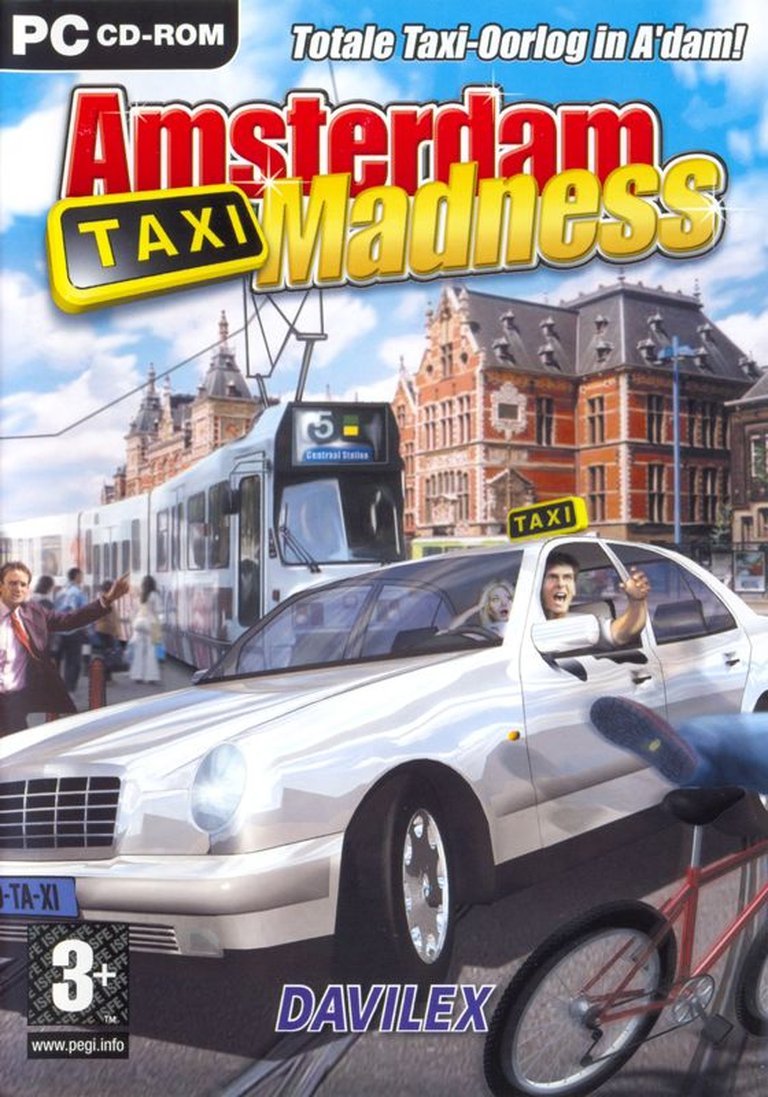
Amsterdam Taxi Madness is a chaotic open-world driving game set in the bustling streets of Amsterdam, where players take on the role of a taxi driver tasked with delivering passengers to iconic landmarks like Central Station, the Anne Frank House, and Rembrandt Square. The game features narrow streets, treacherous canals, and quirky power-ups such as snow-shovels to clear traffic, rockets to destroy obstacles, and jumps to leap over bridges. Players must navigate the city’s unique challenges, including speed controls, celebrity missions, and explosive collisions, all while avoiding the infamous red light district and coffee shops. With a mix of sandbox freedom and arcade-style madness, the game offers a humorous and fast-paced take on urban taxi driving.
Gameplay Videos
Amsterdam Taxi Madness Free Download
Amsterdam Taxi Madness Guides & Walkthroughs
Amsterdam Taxi Madness Reviews & Reception
mobygames.com (64/100): Average score: 64% (based on 1 ratings)
myabandonware.com (46.6/100): Developed by Team6 in collab with Davilex so…. expect a LOT of jank.
Amsterdam Taxi Madness: A Chaotic Love Letter to Arcade Driving
Introduction: The Forgotten Gem of Dutch Gaming
Amsterdam Taxi Madness (2004) is a game that defies easy categorization—a frenetic, physics-defying taxi simulator that blends open-world driving with arcade-style mayhem. Developed by Team6 Game Studios and published by Davilex Games, it emerged during a peculiar era of budget racing games, where realism took a backseat to sheer, unadulterated fun. While it never achieved the mainstream acclaim of contemporaries like Midtown Madness or Crazy Taxi, Amsterdam Taxi Madness carved out a niche as a cult curiosity—a game that embraced its jankiness, celebrated its absurdity, and offered a uniquely Dutch twist on the taxi-driving genre.
This review aims to dissect Amsterdam Taxi Madness in its entirety: its development history, its chaotic gameplay, its quirky representation of Amsterdam, and its legacy as a relic of early 2000s gaming. Was it a misunderstood masterpiece, or a bug-ridden mess? The truth, as with most things in life, lies somewhere in between.
Development History & Context: The Rise and Fall of Davilex Games
The Studio Behind the Madness
Amsterdam Taxi Madness was the product of Team6 Game Studios, a Dutch developer known for its work on racing and simulation titles. The game was published by Davilex Games, a company with a fascinating, if tumultuous, history in the European gaming market.
-
Davilex’s Origins & Peak (1986–2003):
Founded in 1986, Davilex initially focused on accounting software and edutainment before pivoting to video games in the late ’90s. Their breakthrough came with the Racer series—a line of budget-friendly, region-specific racing games tailored to different European markets:- A2 Racer (Netherlands)
- Autobahn Raser (Germany)
- London Racer (UK)
- Paris-Marseille Racing (France)
These games were not critically acclaimed, but they sold exceptionally well, capitalizing on localized humor, familiar landmarks, and arcady gameplay. Autobahn Raser alone sold over 100,000 copies in Germany, earning a “Gold” award from the VUD.
-
The Decline (2003–2005):
By the early 2000s, Davilex attempted to expand into licensed properties (Knight Rider, Miami Vice) and multiplatform releases, but poor reception and financial struggles led to their demise in 2005. Amsterdam Taxi Madness, released in September 2004, was one of their final games—a swan song of sorts, embodying both their strengths (localized charm, arcade fun) and weaknesses (technical instability, rushed development).
Technological Constraints & the Gaming Landscape of 2004
-
Engine & Physics:
The game utilized Havok Physics and the Open Dynamics Engine (ODE), which allowed for destructible traffic, ragdoll-like collisions, and exaggerated vehicle behavior. However, these engines were not optimized for stability, leading to frequent crashes (a recurring complaint in reviews). -
Competition & Market Position:
In 2004, the racing genre was dominated by:- Simulators (Gran Turismo 4, Need for Speed: Underground 2)
- Arcade Racers (Burnout 3: Takedown, Midtown Madness 3)
- Open-World Sandboxes (Grand Theft Auto: San Andreas)
Amsterdam Taxi Madness didn’t compete with these giants in polish or depth. Instead, it leaned into its niche: a low-budget, localized, chaotic taxi game that prioritized short bursts of fun over long-term engagement.
Narrative & Thematic Deep Dive: A Taxi Driver’s Tour of Amsterdam
Plot & Structure (Or Lack Thereof)
*Amsterdam Taxi Madness* is **not a story-driven game**. There is no overarching narrative, no character development, and no grand finale. Instead, it operates on a **mission-based structure** where players:
1. **Pick up passengers** (ranging from tourists to Dutch celebrities).
2. **Drive them to landmarks** (Central Station, Anne Frank House, Rembrandt Square).
3. **Avoid (or embrace) chaos** along the way.
The game’s “story” is **Amsterdam itself**—a living, breathing (if slightly exaggerated) cityscape.
Themes & Satirical Undertones
While not a deep narrative experience, the game **subtly satirizes** Dutch culture and urban life:
– **Tourism & Stereotypes:**
Missions involve ferrying **Dutch celebrities** (soccer coaches, the royal family) to iconic locations, playing into **national pride and clichés**.
– **The “Madness” of Amsterdam:**
The game **exaggerates** the city’s infamous traits:
– **Narrow streets** (leading to constant near-misses).
– **Canals** (requiring absurd jumps over bridges).
– **Coffee shops & the Red Light District** (present but not interactive—likely due to PEGI 3 rating).
– **Traffic Anarchy:**
The game **mockingly depicts** Amsterdam’s chaotic traffic, where **bikes, trams, and cars collide** in a symphony of honks and explosions.
Dialogue & Localization
- The game features Dutch voice acting (for celebrities) and English text, making it a regional curiosity rather than a global release.
- The mission descriptions are riddled with typos and grammatical errors, hinting at rushed localization—a common issue in Davilex’s later titles.
Gameplay Mechanics & Systems: Chaos by Design
Core Gameplay Loop
-
Pick Up a Passenger:
- Customers appear at random locations (marked on the mini-map).
- Some are time-sensitive, adding urgency.
-
Drive Like a Maniac:
- No traffic rules apply—running red lights, driving on sidewalks, and ramming other cars is encouraged.
- Speed cameras flash if you drive too fast, issuing speeding tickets (a minor penalty).
-
Avoid (or Exploit) Obstacles:
- Canals require jumping over bridges (using the “jump” power-up).
- Narrow streets force precise maneuvering (or creative shortcuts).
- Traffic can be destroyed (via rockets or collisions) or shoved aside (with the snow-shovel power-up).
-
Deliver the Passenger:
- Success grants money and unlocks new missions.
- Failure results in a frustrated customer and a restart.
Power-Ups & Absurdity
The game’s **most defining feature** is its **over-the-top power-ups**, which include:
– **Snow-Shovel:** Lets you **push cars out of the way** like they’re made of paper.
– **Rockets:** **Blow up traffic** in spectacular fashion.
– **Boost:** **Uncontrollable speed** (useless in Amsterdam’s tight streets).
– **Jump:** **Leap over canals** (essential for shortcuts).
– **Money:** **Instant cash** (because why not?).
These power-ups **encourage reckless play**, turning the game into a **physics playground** rather than a serious simulator.
Special Missions & Celebrity Cameos
-
Dutch Celebrities:
Some missions involve ferrying real-life Dutch figures (e.g., soccer coaches, actors) to their “landmarks.”- This adds a meta, almost surreal layer—imagine picking up Johan Cruyff and racing him to the Amsterdam Arena.
-
Time Trials & Challenges:
Later missions introduce strict time limits, forcing players to master shortcuts and power-ups.
Flaws & Technical Issues
-
Crashes & Instability:
The most infamous issue—players reported frequent freezes, especially when replaying levels.- A FOK!games review noted: “The game consistently crashed my system after replaying the same level multiple times.”
-
Unbalanced Difficulty:
- Early missions are too easy.
- Later missions spike in difficulty due to unforgiving time limits.
-
Poor AI & Pathfinding:
- Traffic cars sometimes glitch through buildings.
- Passengers occasionally spawn inside walls.
-
Multiplayer (LAN/Internet):
- Broken on modern systems (e.g., Windows 10+ struggles to host servers).
- Works on Windows XP, making it a relic of its time.
World-Building, Art & Sound: A Postcard from Amsterdam
The City as a Character
Amsterdam Taxi Madness lovingly (if inaccurately) recreates the Dutch capital:
– Landmarks:
– Central Station
– Anne Frank House
– Rembrandt Square
– Red Light District (toned down for PEGI 3)
– Coffee Shops (present but non-interactive)
- Atmosphere:
The game captures the city’s vibe—canals, bikes, trams, and narrow streets—but exaggerates it for gameplay.- Real Amsterdam is not this chaotic, but the game’s version feels alive.
Visual Style: Low-Poly Charm
-
Graphics:
- Early 2000s 3D—low-poly models, basic textures, but colorful.
- Draw distance is short, leading to pop-in.
- Car physics are floaty, making collisions more comedic than realistic.
-
Art Direction:
- The game embrace its budget limitations, opting for cartoonish exaggeration over realism.
- Explosions are over-the-top, cars crumple like paper, and jumps defy gravity.
Sound Design: Honks, Explosions, and Dutch Accents
-
Music:
- Upbeat, generic racing tunes—nothing memorable, but fits the arcade tone.
-
Sound Effects:
- Car horns, screeching tires, and explosions dominate.
- Dutch voice acting (for celebrities) adds authenticity.
-
Ambient Noise:
- City chatter, tram bells, and canal sounds create a living backdrop.
Reception & Legacy: The Cult of the Janky Taxi Game
Critical Reception (2004)
-
FOK!games (64/100):
- Praised its short, fun bursts of gameplay.
- Criticized its instability (“The game crashed my system multiple times“).
- Recommended it only for casual players (“Play for 15 minutes, then move on“).
-
Player Scores (2.7/5 on MobyGames):
- Mixed reactions—some loved the chaos, others hated the bugs.
Commercial Performance & Obscurity
- Not a major seller—Davilex was already in decline by 2004.
- Fell into obscurity after Davilex’s collapse.
- Rediscovered by abandonware enthusiasts in the 2020s.
Legacy & Influence
-
A Time Capsule of Early 2000s Gaming:
- Represents the budget racing game boom of the era.
- Shows how localized games could thrive in niche markets.
-
Influence on Later Taxi Games:
- Taxi Simulator (2022) and Taxi Chaos (2021) owe a debt to its arcade roots.
- Crazy Taxi’s spirit lives on in its power-ups and reckless driving.
-
A Cult Classic for the Wrong Reasons:
- Not a “good” game by modern standards, but its jankiness is part of its charm.
- Speedrunners and glitch hunters have found new life in its broken physics.
Conclusion: A Flawed, Forgotten, but Fascinating Relic
Amsterdam Taxi Madness is not a masterpiece. It is buggy, unbalanced, and visually dated. Yet, it is also a fascinating time capsule—a game that embraced its limitations and turned them into strengths.
Final Verdict: 6.5/10 – “A Beautiful Mess”
✅ Pros:
– Unique setting (Amsterdam is rarely featured in games).
– Absurd, fun power-ups (snow-shovel physics are hilarious).
– Short, addictive missions (great for quick play sessions).
– Nostalgic charm (a relic of early 2000s arcade racing).
❌ Cons:
– Frequent crashes (especially on modern systems).
– Unbalanced difficulty (too easy, then too hard).
– Repetitive gameplay (lacks depth for long sessions).
– Technical jank (AI glitches, physics oddities).
Who Should Play It?
- Fans of arcade racers (Crazy Taxi, Midtown Madness).
- Dutch gaming historians (a rare localized gem).
- Glitch enthusiasts (the physics are a playground).
- Casual players (best in short bursts).
Where Does It Stand in Gaming History?
Amsterdam Taxi Madness is not essential playing, but it is an important footnote—a game that proves not every title needs to be polished to be memorable. In an era of hyper-realistic simulators and open-world epics, its unapologetic chaos is refreshing.
Final Thought:
If you stumble upon Amsterdam Taxi Madness in an abandonware archive, give it a try. Just save your work first—because it will crash.
Rating Breakdown:
– Gameplay: 7/10
– Graphics & Sound: 5/10
– Replayability: 6/10
– Stability: 4/10
– Charm & Uniqueness: 9/10
Overall: 6.5/10 – “A Flawed Diamond in the Rough”