
Description
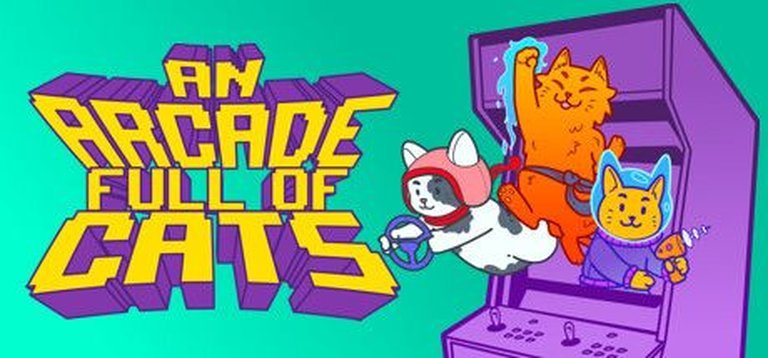
An Arcade Full of Cats is a free-to-play hidden object puzzle game where players journey through time and space across various arcade-inspired settings from gaming history. Using a point-and-click interface, the goal is to seek and collect adorable feline companions in fixed-screen environments, offering a relaxing, wholesome experience with a minimalist, hand-drawn aesthetic as part of Devcats’ ‘Full of Cats’ series.
Gameplay Videos
Where to Buy An Arcade Full of Cats
An Arcade Full of Cats Guides & Walkthroughs
An Arcade Full of Cats Reviews & Reception
metacritic.com (77/100): Anyway, this game is fun.
wasdland.com (95/100): This game is pure cozy vibes.
An Arcade Full of Cats: A Purr-fectly Crafted Tribute to Nostalgia and Feline Whimsy
Introduction: A Meow-velous Anachronism
In the vast, often-overlooked landscape of indie casual gaming, few titles arrive with such a specific, heartwarming, and instantly comprehensible pitch as An Arcade Full of Cats. Released gratis on Steam in November 2023 by the enigmatic studio Devcats, this “ultimate pet’em up hidden object game” represents a potent confluence of niche genre, heartfelt homage, and viral-ready aesthetic. At first glance, it is a simple,甚至 whimsical diversion: a point-and-click adventure where one finds cats hidden in stylized arcade scenes. Yet beneath its fur lies a sophisticated exercise in evocation, accessibility, and community-focused design that has resonated profoundly with players, earning an “Overwhelmingly Positive” rating from nearly 8,000 Steam users. This review posits that An Arcade Full of Cats is more than a charming novelty; it is a masterclass in minimalist design that leverages potent nostalgia, universal affection for felines, and a altruistic business model to create a culturally significant piece of interactive comfort food. It successfully bridges generational gaming memory with modern casual play patterns, securing its place as a minor but enduring classic in the “cozy game” canon.
Development History & Context: The Devcats’ Niche Kingdom
The Studio and Its Vision
Devcats, serving as both developer and publisher, operates with a focused, almost artisanal identity. The studio’s entire public-facing portfolio, as evidenced by MobyGames and Steam, revolves exclusively around the “Full of Cats” franchise—a series of hidden object games each themed around a different locale or concept (A Building Full of Cats, A Castle Full of Cats, A Tower Full of Cats, etc.). This singular focus reveals a deliberate niche strategy, positioning Devcats as the definitive curator of a very specific experience: the hand-drawn, cat-centric hidden object adventure. Their vision, articulated in the game’s description, is one of tribute—a “whisker-worthy” homage to the arcade era, filtered through a lens of feline affection.
Technological Constraints and The Godot Engine
The game was built using the Godot engine, a popular, open-source choice for indie developers due to its lightweight nature and lack of licensing fees. This aligns perfectly with the game’s “Free To Play” model and modest system requirements (1 GB RAM, 512MB VRAM). The technological constraints were not a limitation but a guiding philosophy: the game’s pixel-art visuals and fixed/flip-screen presentation are not just an aesthetic choice but an efficient one, ensuring the game runs on nearly any PC, including low-spec systems and the Steam Deck, as noted by community reports. This accessibility in performance mirrors its accessibility in gameplay and price.
The 2023 Gaming Landscape
Launched in late 2023, An Arcade Full of Cats entered a market saturated with “cozy games” and “hidden object” titles. However, it distinguished itself through two key factors: its thematically unified, historically-inspired setting and its publisher’s pre-existing brand consistency. While competitors like the Travellin Cats series (also noted in similarity lists) offer geographical exploration, Devcats doubled down on a single, potent nostalgic era—the arcade golden age from 1980 to 2000. This timeframe encompasses the birth of iconic genres, the evolution of cabinet art, and the shared cultural memory of a generation now seeking comfort in its youth. The game’s release also coincided with the continued mainstreaming of the “cozy game” genre on platforms like Steam, where user tags such as “Relaxing,” “Wholesome,” and “Cozy” were already highly valued.
Narrative & Thematic Deep Dive: Time Travel, Tribute, and Tailored Tales
The narrative of An Arcade Full of Cats is delivered with a light, almost tangential touch, serving primarily as a framing device for the core hunting gameplay. Players assume the roles of Leo and Fofiño, two protagonists inexplicably stranded in a “feline-infused version of the arcade era.” Their goal is simple: traverse five distinct “whisker-worthy arcades,” each representing a year between 1980 and 2000, to collect batteries and power a time machine back to the present.
Plot as a Vehicle for Nostalgia
The plot is less a traditional story and more a guided tour through curated nostalgia. Each of the five scenarios is a “catified rendition of classic arcades.” While the source material does not detail specific layouts or titles, the concept implies a transformation of famous or archetypal arcade environments: a Space Invaders cabinet now housing cat aliens, a Pac-Man maze where the pellets are cat treats and the ghosts are feline specters, a fighting game stage populated by cat martial artists. This “catification” operates on two levels: it injects the universal appeal of cats into historically male-dominated (in terms of marketing and player perception) gaming spaces, and it softens the often-challenging, competitive imagery of arcades into something whimsical and safe. The narrative’s theme is reclamation through affection—taking the sometimes-daunting, noisy, competitive aura of the arcade and filling it with comforting, non-judgmental creatures.
Characters and Dialogue: Minimalist but Effective
Leo and Fofiño are ciphers, defined only by their shared mission. Dialogue is likely sparse, given the game’s point-and-click, hidden-object nature. Their effectiveness lies in their lack of definition; they become avatars for the player’s own nostalgic curiosity. The true “characters” are the arcade machines, the decor, and the hundreds of hidden cats themselves. Each cat is a small narrative nugget—a cat dressed as a space invader, a cat operating a crane game, a cat playing a rhythm game. Their variety tells a story of a world where cats have seamlessly integrated into and gently mocked the human hobby of video games.
Underlying Themes
1. Nostalgia as a Sanctuary: The game doesn’t just reference the past; it rebuilds it as a safe, happy, and comprehensively feline space. This speaks to a modern desire to revisit formative cultural touchstones without the associated pressures or disappointments.
2. The Democratization of Gaming History: By making its arcade era cute and accessible, Devcats removes the intimidation factor of gaming’s early history. It invites players who might never have entered a smoky 1980s arcade to explore its aesthetic in a pressure-free environment.
3. Altruism and Community: This theme is not woven into the game’s fiction but is central to its real-world impact. The existence of the DLC, TimeWarp Trouble, and the developer’s noted support for cat shelters (mentioned in reviews) transforms the act of playing and spending money into a form of charitable participation. The game’s universe and its real-world effect are aligned in their mission to “collect” and care for cats.
Gameplay Mechanics & Systems: The Zen of the Search
The core loop of An Arcade Full of Cats is elegantly simple and deliberately devoid of traditional “gamey” pressures.
Core Loop and Hidden Object Design
Players are presented with a detailed, static, hand-drawn scene of an arcade interior. The primary objective is to scan this environment to find a set number of hidden cats per level. These cats are not merely camouflaged; they are cleverly integrated into the scene’s geometry, props, and other pixel art elements. A cat might be a shadow under a chair, the shape of a cloud in a background poster, or the silhouette of a stuffed animal on a shelf. The search is the entire game. There is no timer, no penalty for incorrect clicks (or very minimal), and no fail state. This design philosophy prioritizes player agency and relaxation over challenge. The “challenge” is self-imposed: the completionist’s desire to find every last feline, including those that are extraordinarily well-hidden, as some reviews note.
Progression and Meta-Game
Progression is linear and scene-based. Completing one arcade scenario (finding its cats) unlocks the next, moving the timeline forward. The meta-goal is collecting “batteries” (presumably found as part of the cat hunt or as scene completions) to advance the time machine narrative. There is no character progression, stat upgrade, or skill tree. The entire “progression” is the player’s own growing familiarity with the art style, improving their visual search pattern, and the satisfaction of checking off completed scenes. This is a pure “collectathon” experience, where the collection is both the means and the end.
UI and Interface: Point-and-Click Perfection
The interface is the epitome of “Mouse only” design. The cursor may highlight interactive elements or change when over a hidden cat. A click selects or finds a cat, accompanied by a satisfying, likely cute sound effect. A counter typically displays “Cats Found / Total Cats.” A hint system exists (as noted in reviews), but its implementation is key: it is likely non-intrusive and possibly limited, respecting the player’s agency to solve the visual puzzle themselves. The minimalist UI contributes entirely to the “cozy” and “relaxing” tags; no health bars, no score multipliers, no confusing menus.
Innovation and Flaws: A Deliberate Balance
An Arcade Full of Cats innovates not by inventing new mechanics, but by perfecting a specific, anxiety-free application of old ones. Its innovation is thematic and tonal. It takes the hidden object genre—often associated with frantic timed modes or convoluted storylines in casual “mystery” games—and strips it to its contemplative core. The “flaw” some might identify is the potential for repetition. The core loop is identical across all five scenarios. However, the game mitigates this through immense variety in visual density and artistry. Each scene is a new, densely packed diorama to explore. For players who enjoy this specific activity, repetition is not a bug but a feature—a form of digital mindfulness. The only real flaw, as cited by a Metacritic user review, is that some cats can be “a bit too hidden,” bordering on pixel-hunting without sufficient contextual clues. This can lead to brief frustration, though the optional hint system is a salve.
World-Building, Art & Sound: A Synth-Soaked, Pixel-Perfect Paradigm
Visual Direction and Art Style
The game’s world is its greatest asset. Using a “hand-drawn” pixel art style, Devcats constructs five distinct arcade environments that are both instantly recognizable as belonging to the 1980-2000 era and brilliantly transformed by their feline inhabitants. The art is colorful, vibrant, and incredibly dense. Every inch of the screen is populated with details: classic cocktail cabinets, retro posters, neon signs, ticket redemption counters, and of course, cats in every conceivable pose and costume. This density is a double-edged sword—it creates a joyfully overwhelming “busyness” that rewards careful observation but can also make subtle cats difficult to discern. The visual storytelling is implicit: the arcade is a living, purring ecosystem where humans are either absent or secondary to the cat patrons and staff.
Sound Design and Musical Score
The audio experience receives effusive praise in user reviews, described as “eargasmic melodies,” “synth-wave soundtrack layered with meows,” and “soul-soothing synths.” The soundtrack is almost certainly composed of original chiptune-inspired tracks that mimic the soundfonts and melodic structures of 8-bit and 16-bit era game music, but with a laid-back, lo-fi, or vapor-wave twist. This musical choice does heavy thematic lifting: it immediately grounds the player in the nostalgic timeframe while the inclusion of meows and other cat sounds (“chirping chip-tunes”) reinforces the playful, cat-centric premise. The sound design for finding cats is likely a collection of cute, positive audio cues that provide instant, satisfying feedback. Together, the visuals and music create an atmosphere that is simultaneously retro and relaxing—a “neon-soaked ancestor’s” dream of a happy arcade.
Atmosphere and Player Experience
The culmination of these elements is an atmosphere of wholesome nostalgia. It is not a gritty, realistic recreation of 1980s arcades (with their smells of ozone and stale popcorn, and sounds of competition), but a idealized, cozy, and friendly version. The “cozy” and “family-friendly” tags are paramount. The game feels safe, warm, and inviting, like a childhood memory viewed through a soft, cat-filled filter. This is its genius: it taps into the positive emotional resonance of an era while filtering out any negative connotations, creating a pure, positive interactive space.
Reception & Legacy: From Free Gem to Franchise Pillar
Critical and Commercial Reception at Launch
Formal critic reviews are notably absent from aggregators like MobyGames and Metacritic, a common fate for small, free-to-play indie titles. However, user reception is astronomically positive. Steam data shows an “Overwhelmingly Positive” rating (98% positive) from over 7,700 reviews, with a Steambase Player Score of 98/100. Metacritic’s user score, based on a small sample, is “Generally Favorable” at 7.7. The consensus across reviews (from Steam, Metacritic, and sites like Hitpoint Reviews and wasdland.com) praises its charm, relaxing gameplay, beautiful art, and fantastic soundtrack. Common points of critique are the potential for repetitive gameplay and the extreme hiddenness of some cats. The price point (Free) and the charitable aspect of DLC sales are repeatedly highlighted as major positives that elevate the experience beyond mere entertainment.
Commercial Performance and Visibility
Estimates from GameRebellion suggest sales of 380k units. This figure is staggering for a free-to-play title and represents massive reach, likely driven by word-of-mouth, the popularity of the “cats” and “cozy” tags, and the appeal of its no-cost entry barrier. Its presence on Steam, with full language support for 16 languages, has given it significant international visibility.
Evolution of Reputation and Franchise Context
An Arcade Full of Cats is not a standalone phenomenon but a keystone in the Devcats franchise. It follows A Building Full of Cats (2022) and precedes titles like A Park Full of Cats and A Shelter Full of Cats. Its release helped solidify the “Full of Cats” brand as a reliable mark for quality in its niche. The success of this specific “arcade” theme likely informed the development of other location-based entries. Its reputation has evolved from “another cat hidden object game” to “the quintessential arcade-era cat game,” a distinction it earns through its focused thematic commitment and superior polish.
Influence on the Industry
Its direct influence on major industry trends is minimal, operating as it does in a quiet, deliberate corner of the market. However, its influence is demonstrable in two ways:
1. Proof of Concept for Hyper-Focused Franchises: Devcats demonstrates that a studio can build a sustainable brand and audience by iterating on a single, well-defined core concept across multiple thematic settings.
2. Altruistic Model as Marketing: The integration of real-world charity (supporting cat shelters via DLC) into the monetization of a free game is a powerful community-building and goodwill-generating strategy that other indie developers may seek to emulate. It turns a transaction into a shared mission.
3. The “Pet’em Up” Sub-Genre: By coining and owning the term “pet’em up,” Devcats helps categorize and market a specific type of collectathon hidden object game centered on animals, potentially making it easier for like-minded players to discover such experiences.
Conclusion: A Purrmanent fixture in the Cozy Pantheon
An Arcade Full of Cats is a deceptively simple game that achieves remarkable emotional and commercial success through impeccable focus. It understands its audience—players seeking low-stress, visually delightful, and thematically rich experiences—and caters to them with almost unnerving precision. The development team’s decision to use Godot for broad compatibility, to embrace a free-to-play model with optional charity-focused DLC, and to pour such evident love into every pixel of its arcade dioramas has created a game that feels both generous and deeply personal.
Its lack of complex systems or dramatic narrative is not a failing but the source of its strength. In an industry often obsessed with scale, complexity, and player adrenaline, An Arcade Full of Cats is a reassuring monument to the power of quiet, collectible joy. It is a game that asks for nothing more than your attention and your eye for detail, and in return, it offers a warm, nostalgic, and unapologetically cute escape. The Steam community’s overwhelming affection—summed up in reviews calling it “pure cozy vibes” and “adorable point-and-click puzzle adventure”—is not just approval of a product, but celebration of a feeling.
Final Verdict: An Arcade Full of Cats is an essential experience for fans of hidden object games, pixel art enthusiasts, nostalgic gamers, and, of course, cat lovers. It transcends its genre标签 to become a touchstone of the modern “cozy game” movement, proving that profound player satisfaction can be built on the simplest of loops, wrapped in a powerful theme, and distributed with generosity. It is, without a doubt, the cat’s pajamas.