
- Release Year: 2021
- Platforms: Macintosh, Windows
- Publisher: Xand arts
- Developer: Xand arts
- Genre: Adventure
- Perspective: Third-person
- Gameplay: Visual novel
- Setting: Fantasy
Description
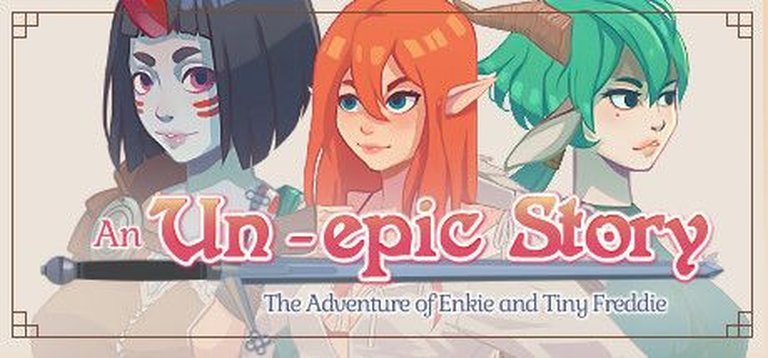
Set in a whimsical fantasy realm, ‘An Un-epic story: The adventure of Enki and Tiny Freddie’ is a kinetic visual novel that follows the reluctant partnership between Enki, a brash young elf, and Freddie, a timid half-giant, as they team up to hunt a river monster for a bounty. Their misadventure is filled with comedic mishaps, tentacled threats, societal prejudice, and the blossoming of a yuri romance, all delivered with witty dialogue, absurd situations, and anime-style illustrations.
Gameplay Videos
Where to Buy An Un-epic story: The adventure of Enki and Tiny Freddie
An Un-epic story: The adventure of Enki and Tiny Freddie Guides & Walkthroughs
An Un-epic story: The adventure of Enki and Tiny Freddie Reviews & Reception
xandart.itch.io : I laughed the whole grandchild! Enki is certainly crazy, but makes you laugh heartily.
An Un-epic story: The adventure of Enki and Tiny Freddie: Review
Introduction: The Charm of the Un-Epic
In an industry perpetually obsessed with scale, world-ending stakes, and protagonists carved from monumental archetypes, a title like An Un-epic story: The adventure of Enki and Tiny Freddie arrives not as a whisper, but as a deliberate, cheerful corrective. This 2021 release from the solo/indie studio Xand arts is a kinetic visual novel that wears its premise as a badge of honor. It asks: what happens when a classic fantasy “adventure” is less about saving the world and more about twovery different people surviving a messy, tentacle-filled river job and accidentally forging a profound bond? This review will argue that An Un-epic story is a masterclass in focused, indie visual novel storytelling. Its significance lies not in groundbreaking mechanics or a sprawling narrative, but in its expert distillation of character-driven comedy, queer romance, and fantasy parody into a tightly-woven, warmly illustrated package that exemplifies the creative potential of accessible tools like Ren’Py. It is a microcosm of a specific, thriving corner of the indie scene—one that prioritizes emotional resonance and specific niche appeal over mass-market grandeur.
Development History & Context: The Power of “Small”
The Studio and Vision: Xand arts represents the archetypal modern indie developer: a creator-driven project, likely helmed by a single passionate individual (the “Xand” moniker) or a very small team. The development vision, as articulated in the official descriptions and devlog, was explicitly “cozy” and “fascinating,” aiming to deliver a “good mood and positive” experience. There is no pretense of epic scale; the goal was a short, “horny adventure” (to use the developer’s own colorful phrasing) with heart, wit, and a clear focus on a yuri (girls’ love) romance between its two protagonists.
Technological Constraints as Creative Catalysts: The game was built in Ren’Py, the free, open-source visual novel engine that has democratized the genre. This choice is fundamental to understanding the title’s place in history. Ren’Py removes significant technical barriers, allowing creators to focus almost exclusively on script, art, and music. For An Un-epic story, this meant resources could be channeled into its core strengths: dialogue and illustration. The system requirements (as listed on Steam) are minimal—a 1GHz processor and 1GB RAM—reflecting its 2D, text-and-image nature. This accessibility is a feature, not a bug, enabling distribution on platforms like itch.io and Steam with near-zero friction.
Gaming Landscape of 2021: The game’s July 2021 release placed it in a unique moment. The visual novel genre had seen a significant surge in Western mainstream awareness, partly fueled by pandemic-era lockdowns and the success of titles like Doki Doki Literature Club! and Steins;Gate on Steam. Simultaneously, platforms like itch.io were flourishing as homes for niche, creator-owned content, particularly in the “ecchi” and yuri spaces. An Un-epic story entered this ecosystem not as a disruptor, but as a confident participant, offering a concise, well-polished product that understood its target audience and served it directly. Its dual release on both itch.io (the indie haven) and Steam (the mass-market PC storefront) was a savvy strategy to maximize reach within its niche.
Narrative & Thematic Deep Dive: Deconstructing the “Adventure”
Plot Synopsis & Structure: As a kinetic novel, the narrative is entirely linear with no player choices. The plot is straightforward, unfolding over the course of a single, chaotic day and the following morning:
1. The Setup: Elven hunter Enki, defined by her overconfidence and a checkered professional past, is denied a solo contract to kill a river monster by a pragmatic guildmaster. The condition: she must partner with Freddie, a timid, físicamente imposing half-giant, to secure the prize.
2. The Complication: The river expedition is a comedy of errors. Enki’s “hot-blooded behavior” clashes with Freddie’s cautious nature. They face environmental hazards (the cold river), a literal tentacled monster, and the social friction of an elf and a half-giant working together.
3. The Mystical Turn: After (presumably) completing the monster task, they wake the next morning with strange, unexplained marks on their hands. This introduces a secondary, magical mystery that shifts the story from a simple monster-hunt parody to something involving “mystical powers” that “enter the fray.”
4. The Resolution & Bond: The duo, now “newly-minted girlfriends” (a key phrase used in both Steam and itch.io descriptions), must deal with this new threat together, their partnership forged in the fires of shared absurdity and burgeoning romantic/emotional connection.
Character Analysis:
* Enki: The classic “lone wolf” archetype subverted. She is not a noble, brooding hero but a “young, overconfident, loner elf” whose personality is her primary obstacle. Her journey is one of learning to rely on and value someone different from herself. Her “hot-blooded” nature provides the primary source of comedic conflict.
* Freddie: The name “Tiny Freddie” is an immediate, ironic juxtaposition against her half-giant heritage. She embodies timidity and caution, a reluctant anchor to Enki’s impulsiveness. Her character arc involves finding her own strength and voice within the partnership.
* Their Dynamic: The core of the narrative is the “opposites attract” trope, executed with a focus on platonic-to-romantic development. The “blossoming feelings” are framed as a natural consequence of shared adversity and vulnerability, not a supernatural force. The speed with which they become “girlfriends” (by next morning) is a narrative shorthand fitting the short format, emphasizing the intensity of their shared experience.
Themes:
1. Subverting Epic Tropes: The title is the thesis. There is no chosen one, no dark lord, no grand destiny. The stakes are a local nuisance (a river monster) and a personal mystery (the hand marks). The “tavern” is not a nexus of world-saving quests but a place of mundane prejudice and bureaucratic denial.
2. Prejudice and Found Family: The friction between elf and half-giant is a clear metaphor for racial/cultural prejudice. Their forced partnership becomes a vessel for challenging these biases, ultimately forming a “found family” unit in a single day.
3. Queer Romance as Narrative Center: This is not a side plot or optional route. The entire story is built to culminate in the romantic bond between Enki and Freddie. Their queerness is intrinsic to the narrative’s “un-epic” premise—their love story is the epic, however small its scale.
4. The Absurdity of “Adventuring”: The narrative consistently undercuts adventure genre conventions. The monster is likely a fussy hazard, the “mystical powers” are an inconvenient morning-after complication, and the heroes are deeply flawed, unprofessional individuals. The “absurd situations” and “references to memes and tropes” (as per the itch.io blurb) create a comedic, self-aware tone.
Dialogue & Tone: The writing prioritizes wit and snappy banter over high fantasy gravitas. The developer’s note about “references to memes and tropes” suggests a postmodern, fourth-wall-adjacent humor that keeps the tone light and relatable. This conversational style is essential for making the rapid character development feel organic within the short runtime.
Gameplay Mechanics & Systems: The Architecture of a Kinetic Novel
Core Loop: There is no gameplay in the traditional sense. The “loop” is: read text -> view static illustration/background -> advance text. As a kinetic novel, it is a pure, passive narrative experience. The player’s only agency is in the pacing of their read.
Combat & Progression: Absent. The “combat” with the river monster is described, not enacted. Character “progression” is emotional and relational, not statistical. There are no stats to manage, no inventory to sort, no skill trees to navigate. This is a deliberate design choice that channels all creative energy into the script and art.
User Interface (UI): The interface is the standard, minimalist Ren’Py framework: a text box at the bottom, a history log, save/load/auto/quick-menu functions, and settings for text speed and volume. It is functional, invisible, and perfectly suited to the medium. The UI’s simplicity ensures zero friction between the player and the story.
Innovation & Flaws:
* Innovation: Its innovation is in focus and execution. Within the rigid, choice-less kinetic novel format, it maximizes impact through dense, character-revealing dialogue and a high frequency of illustrations (over 30 for a ~2-hour story). These CGs are not just rewards but integral storytelling beats, visually punctuating key emotional and “spicy” moments.
* Flaws: The format’s inherent limitations are its own flaws. Players seeking interactivity will find nothing here. The linearity means no replay value beyond re-experiencing the story. The “spicy” (ecchi) scenes, while developer-acknowledged and tagged, are static images with text. For some, this may feel like a bait-and-switch if expecting more explicit content (the developer clarifies on itch.io: “spicy erotic CG but no full nudity,” best considered “horny adventure” rather than “hentai”). The short length (VNDB lists 1h 5m from one vote) is a feature for some and a bug for others expecting deeper narrative or more content.
World-Building, Art & Sound: A Cozy, Hand-Drawn Fantasy
Setting & Atmosphere: The world is a low-fantasy, parodic version of a medieval European tavern-and-river adventure. There are no grand cities, ancient ruins, or deep lore dumps. The setting is implied through context: a guild system, fantasy races (elf, half-giant), and a magical undercurrent. The atmosphere is deliberately “cozy” and comedic. The fantasy elements serve as a familiar stage for the character comedy and romance, not as a world to be explored. The “mystical powers” mystery adds a slight layer of supernatural intrigue but remains character-focused.
Visual Direction: The art style is explicitly “Anime / Manga” (per MobyGames) and “hand-drawn” (per Steam tags), created in Clip Studio Paint. This is a crucial selling point. The 30+ illustrations provide visual variety and personality, breaking up the text and giving concrete form to Enki’s fiery expressiveness and Freddie’s gentle stature. The character designs are clearly defined and appealing within the genre’s conventions. The color palette and linework likely lean towards a bright, clear, and inviting aesthetic to match the “positive vibes” goal, avoiding the darker tones of more serious fantasy or horror VNs.
Sound Design: Source material provides no explicit details on sound design or music. Given the Ren’Py engine and indie budget, it is almost certain the game uses:
* Default or freely licensed ambient soundscapes (river sounds, tavern murmur) to set scenes.
* A small set of repeating, mood-appropriate musical tracks (likely orchestral fantasy or gentle acoustic pieces) for background.
* Standard Ren’Py sound effects for UI interactions.
* Possibly no voice acting, consistent with its price point and scope.
The sound design, while not a highlighted feature, would be functional and atmospheric, supporting the cozy and comedic tone without drawing attention to itself.
Reception & Legacy: A Niche Success Story
Critical & Commercial Reception at Launch:
* Critical: There is a striking absence of professional critic reviews on aggregators like MobyGames. This is typical for micro-budget, niche indie VNs. The discourse exists almost entirely in player reviews and community spaces.
* Commercial/Player: The reception is positive but small-scale.
* Steam: “Mostly Positive” (75% of 20 user reviews) as of the latest data. This indicates a satisfied core audience with some detractors, likely over expectations of “ecchi” content depth or the very short length.
* itch.io: A higher 4.8/5 star rating from 4 ratings. This platform’s audience is more aligned with indie and niche creators, suggesting stronger approval from its intended crowd.
* VNDB: A 4.5/10 average from 2 votes (one 7, one 2). This polarized score hints at the divisive nature of its specific blend of comedy, romance, and ecchi within the more critical VN voter base.
* Collectibility: On MobyGames, it is “Collected By” only 2 players, underscoring its status as a deep-cut title.
Evolution of Reputation: Its reputation has likely stabilized as a “cult favorite” within specific online circles—particularly those interested in yuri VNs, indie Ren’Py games, and lighthearted fantasy parody. The developer’s active engagement (responding to comments on itch.io) and the clear satisfaction of its target audience suggest a healthy, if modest, long-tail presence. It is not a “forgotten” game to its fans but remains virtually invisible in broader gaming discourse.
Influence on the Industry: An Un-epic story is unlikely to have direct, measurable influence on major studios or trends. Its importance is symbolic and demonstrative:
1. The Accessible Indie VN Pipeline: It showcases the complete, viable path from a solo creator’s idea (using Ren’Py and Clip Studio Paint) to a commercially released product on major platforms (Steam, itch.io).
2. Niche Market Viability: It proves there is a paying market for very specific, short-form, genre-blending content (fantasy-comedy-yuri-ecchi) that AAA publishers would never greenlight. Its $4.99 price point and “short & sweet” branding are a direct model for this approach.
3. Content-Warnings as Marketing: Its transparent, upfront tagging (LGBTQ+, Mature, Female Protagonist, Ecchi) is a best practice for niche creators, building trust with their specific audience and avoiding backlash from misunderstanding.
Its legacy is as a successful, self-contained artifact of the 2020s indie visual novel boom—a game that knows exactly what it is, who it’s for, and executes that vision competently within its self-imposed constraints.
Conclusion: A Definition in Miniature
An Un-epic story: The adventure of Enki and Tiny Freddie is not a game that will reshape the industry or dominate “best of” lists. Its genius is in its modesty. It is a testament to the power of a clear, focused vision executed with competent craft within an accessible framework. By rejecting epic scale, it finds its epic in the tiny, seismic shifts of a relationship forged over absurdity and tentacles. Its strengths—witty dialogue, appealing hand-drawn art, a warm and inclusive romantic core, and a tight, parody-tinged narrative—are perfectly aligned with its format and audience. Its weaknesses—zero interactivity, short length, and niche subject matter—are the inevitable flip side of those same focused choices.
In the grand tapestry of video game history, its thread is a faint but distinct one. It belongs to the lineage of indie visual novels that flourished in the late 2010s and 2020s, empowered by engines like Ren’Py and storefronts like Steam and itch.io. It is a game that prioritizes specific joy over universal appeal. For its target player—someone seeking a quick, funny, queer, and gently spicy fantasy read—it delivers precisely on its promises. As a historical artifact, it is a perfect case study: a small, bright, and unapologetically un-epic story that found its audience and, in doing so, quietly affirmed the enduring vitality of the creator-driven, niche-focused visual novel. It may not be epic, but in its own humble corner of the medium, it is unequivocally successful.