
- Release Year: 2004
- Platforms: Windows
- Publisher: George Moromisato
- Developer: George Moromisato
- Genre: Strategy, Tactics
- Perspective: Top-down
- Game Mode: Single-player
- Gameplay: 4X, Business simulation, Managerial, Turn-based
- Setting: Futuristic, Sci-fi
- Average Score: 68/100
Description
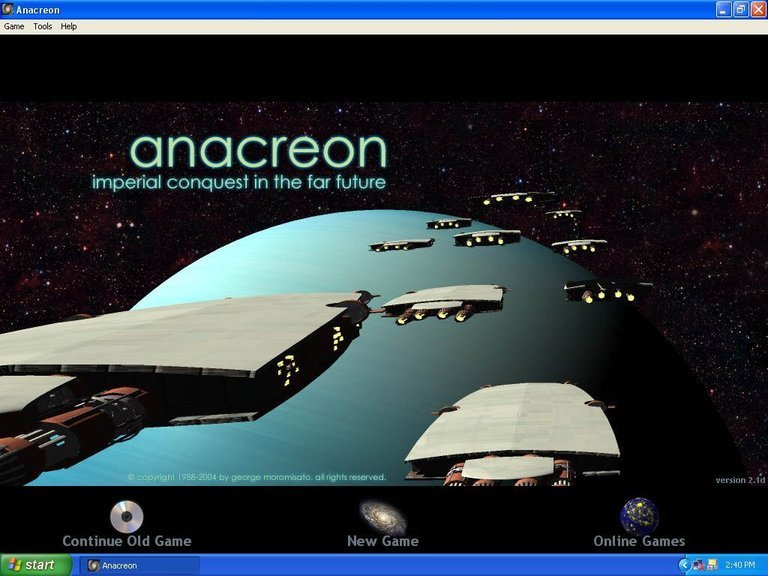
Anacreon: Imperial Conquest in the Far Future is a turn-based strategy game set in a vast sci-fi universe, where players command a star empire, managing economies, resources, and defenses across multiple planets. Inspired by Isaac Asimov’s Foundation series, the game challenges players to explore unknown regions, establish trade routes, and engage in diplomacy or warfare to expand their dominion. As a modern remake of the classic DOS title Anacreon: Reconstruction 4021, it features a graphical, mouse-driven interface while retaining the original’s deep 4X and managerial gameplay, offering both single-player and multiplayer scenarios.
Anacreon: Imperial Conquest in the Far Future Patches & Updates
Anacreon: Imperial Conquest in the Far Future Reviews & Reception
mobygames.com (68/100): A shareware remake that adds a graphical, mouse-driven interface while retaining the original’s concept of turn-based, strategy gaming at a cosmic level.
Anacreon: Imperial Conquest in the Far Future – A Timeless Strategy Masterpiece Revisited
Introduction: The Legacy of a Galactic Conquest Classic
In the vast cosmos of strategy gaming, few titles have left as indelible a mark as Anacreon: Imperial Conquest in the Far Future. Released in 2004 as a modernized remake of the 1987 DOS classic Anacreon: Reconstruction 4021, this game is a testament to the enduring appeal of deep, turn-based empire management. Designed by George Moromisato, the original creator, this Windows iteration retains the soul of its predecessor while introducing a graphical, mouse-driven interface that bridges the gap between retro charm and contemporary accessibility.
Anacreon is more than just a game—it’s a living museum of 4X (eXplore, eXpand, eXploit, eXterminate) strategy design, a genre it helped pioneer. Its influence echoes through modern titans like Master of Orion, Galactic Civilizations, and Stellaris, yet it remains a unique experience, unburdened by the flashy distractions of modern gaming. This review will dissect Anacreon: Imperial Conquest in the Far Future with the precision of a fleet admiral analyzing a battle plan, exploring its development, narrative depth, gameplay mechanics, and lasting legacy.
Development History & Context: From DOS to Windows, A Labor of Love
The Birth of a Classic
Anacreon: Reconstruction 4021 emerged in 1987 from the mind of George Moromisato, a visionary developer working under the banner of Thinking Machine Associates. Written in Turbo Pascal, the original game was a text-based, turn-based strategy experience that tasked players with rebuilding a shattered galactic empire. Inspired by Isaac Asimov’s Foundation series, Anacreon was a bold attempt to simulate the complexities of interstellar governance, resource management, and warfare on a scale few games had attempted.
The original game was a product of its time, constrained by the technological limitations of the MS-DOS era. Its interface was sparse, its graphics nonexistent, and its mechanics reliant on keyboard inputs. Yet, beneath this austere exterior lay a game of remarkable depth, one that demanded strategic foresight and meticulous planning. It was, in many ways, a game for the patient and the analytical—a niche that it carved out with confidence.
The Remake: A Modern Renaissance
Fast forward to 2004, and George Moromisato, now a seasoned developer with credits on titles like Transcendence, returned to his magnum opus. Anacreon: Imperial Conquest in the Far Future was not merely a port but a lovingly crafted remake, designed to introduce the game to a new generation while preserving the core mechanics that made the original a cult classic.
The transition from DOS to Windows was more than a technical upgrade—it was a philosophical one. The remake introduced a graphical interface, mouse support, and a more intuitive UI, but it retained the turn-based, top-down perspective that defined the original. The game’s shareware model ensured accessibility, while the inclusion of eight original scenarios and an additional eleven in the Scenario Pack provided ample content for both newcomers and veterans.
Technological Constraints and Innovations
The original Anacreon was hamstrung by the hardware of the late 1980s. The 2004 remake, while not pushing the boundaries of modern graphics, leveraged the power of contemporary PCs to streamline the experience. The ability to store more than 9,999 units of a resource or ship type in a single fleet or planet was a game-changer, eliminating the bottlenecks that plagued the original. This seemingly minor tweak had profound implications for strategy, allowing players to amass fleets of weaker ships to overwhelm smaller, more powerful adversaries—a tactic that was previously impractical.
The remake also benefited from Moromisato’s experience in game design. The UI, while still functional rather than flashy, was a vast improvement over the original’s text-based interface. Contextual menus, tooltips, and a more organized presentation made the game’s complexity more approachable without dumbing it down.
Narrative & Thematic Deep Dive: The Story of Empires Rising from Ashes
A Galaxy in Ruins
Anacreon is not a game driven by a linear narrative. Instead, it thrives on emergent storytelling, where the player’s actions shape the fate of their empire. The game’s premise is simple yet compelling: the galaxy is in ruins, a once-great civilization lies in tatters, and it is up to the player to rise from the ashes and forge a new empire.
The scenarios provided in the game serve as the stage for this drama. Each scenario presents a unique starting condition—whether it’s a small cluster of star systems or a sprawling galaxy on the brink of war. The player’s role is that of a totalitarian ruler, a figure who must balance the needs of their people with the demands of conquest. There are no formal victory conditions, no scripted endings—just the endless cycle of expansion, conflict, and survival.
Themes of Power and Survival
At its core, Anacreon is a meditation on power. The game’s themes are dark and unapologetic, reflecting the ruthless nature of galactic conquest. The player is not a benevolent leader but a ruler who must make tough decisions—whether to exploit a planet’s resources to the point of exhaustion, to betray an ally for strategic gain, or to crush a rebellious population under the boot of martial law.
The game’s inspiration from Asimov’s Foundation series is evident in its exploration of cyclical history and the rise and fall of civilizations. Like Hari Seldon’s psychohistory, Anacreon challenges the player to navigate the unpredictable currents of galactic politics, where every decision has ripple effects that can be felt across generations.
Characters and Diplomacy
While Anacreon lacks the character-driven narratives of modern RPGs, it does feature a system of planetary governors and diplomatic interactions that add depth to the experience. Governors can be promoted or exiled, their loyalty tested by the player’s actions. Diplomacy is a tool, not a crutch—alliances can be forged and broken, treaties signed and violated, all in the name of survival.
The game’s lack of a traditional story is not a weakness but a strength. It allows the player to craft their own narrative, to become the architect of their empire’s destiny. Whether through war, trade, or deception, the player’s choices define the story, making each playthrough a unique tale of ambition and conquest.
Gameplay Mechanics & Systems: The Art of Galactic Micromanagement
The Core Loop: Turn-Based Empire Building
Anacreon is a turn-based strategy game at its heart, where each turn represents a year in the life of your empire. The core gameplay loop revolves around managing planets, building fleets, exploring unknown regions, and engaging in diplomacy or warfare. The game’s depth lies in its micromanagement—every planet must be optimized for production, every fleet must be carefully composed, and every resource must be allocated with precision.
The turn-based nature of the game allows for deep strategic planning. Players must consider the long-term implications of their actions, balancing immediate needs with future goals. A decision to strip-mine a planet for trillum (the game’s equivalent of fuel) might provide a short-term boost to your fleet, but it could leave the planet barren and useless in the long run.
Resource Management: The Lifeblood of Empire
Resources are the lifeblood of Anacreon, and managing them is a constant challenge. The game features four primary resources:
– Chemicals: Used in the production of supplies and other goods.
– Metals: Essential for constructing ships and infrastructure.
– Supplies: The backbone of your economy, used to sustain populations and build fleets.
– Trillum: The rare and finite fuel that powers your interstellar ships.
Each planet has its own resource profile, with some rich in metals and others abundant in trillum. The player must establish trade routes to distribute these resources efficiently, ensuring that no planet is left wanting. The scarcity of trillum adds a layer of tension to the game—once depleted, it cannot be replenished, forcing players to make tough choices about which planets to exploit and which to preserve.
Fleet Composition and Combat
Combat in Anacreon is a mix of strategy and numbers. The game features five types of warships, two transport classes, and two grades of ground troops, each with its own strengths and weaknesses. Ships range from slow warp-driven vessels to fast jump drives, and the player must carefully consider the composition of their fleets to counter enemy threats.
Fleet battles are resolved automatically, with the attacker having limited control over the engagement. The defender’s forces are arranged in orbits, and the attacker can choose which orbits to target. However, the outcome is largely determined by the numerical superiority of the fleets involved. This might seem simplistic, but it reinforces the game’s focus on preparation and strategy—victory is won not on the battlefield but in the planning stages.
Planetary Defense and Megastructures
Defending your empire is as important as expanding it. Anacreon offers a variety of planetary defenses, from minefields to star gates, each with its own range and potency. The construction of these defenses is a balancing act—over-investing in defenses can drain resources needed for expansion, while under-investing can leave your empire vulnerable to attack.
The game also features a range of space megastructures, including artificial planets and star gates. These structures are expensive to build but can provide significant strategic advantages, such as faster travel between star systems or increased resource production.
Diplomacy and Espionage
Diplomacy in Anacreon is a double-edged sword. Alliances can provide temporary security, but they can also be broken when it suits your interests. Espionage adds another layer of complexity, allowing players to gather intelligence on enemy movements or sabotage their operations. These systems are not as deep as those in modern 4X games, but they add a welcome layer of intrigue to the experience.
World-Building, Art & Sound: A Minimalist Masterpiece
The Galaxy as a Canvas
Anacreon’s world-building is understated but effective. The game’s galaxy is a vast, procedurally generated expanse, filled with star systems, planets, and cosmic phenomena. Each planet has its own climate, resource profile, and potential for development, making exploration a rewarding experience.
The game’s art style is minimalist, with a focus on clarity and functionality. Planets and fleets are represented by simple icons, and the star map is a clean, top-down grid. This aesthetic might seem dated by modern standards, but it serves a purpose—every visual element is designed to convey information quickly and efficiently, allowing the player to focus on strategy rather than spectacle.
Sound and Atmosphere
The sound design in Anacreon is similarly understated. The game features a subtle ambient soundtrack that enhances the sense of isolation and grandeur inherent in galactic conquest. Sound effects are minimal but effective, with the hum of engines and the distant echoes of battle adding to the atmosphere.
The game’s lack of voice acting or elaborate soundscapes is not a detraction but a deliberate choice. Anacreon is a game about strategy, not immersion, and its sound design reflects this philosophy. The absence of distractions allows the player to focus on the task at hand—building an empire.
Reception & Legacy: A Cult Classic’s Enduring Influence
Critical Reception: A Game Ahead of Its Time
The original Anacreon: Reconstruction 4021 was met with mixed reviews upon its release. Critics praised its depth and innovation but criticized its clunky interface and lack of polish. Jerry Pournelle of BYTE magazine famously described it as “filled with excellent ideas, mostly well implemented, and then spoiled by inattention to some vital detail.” Despite these flaws, the game developed a devoted following, thanks to its unparalleled strategic depth.
The 2004 remake fared better, with players appreciating the modernized interface and improved usability. While it never achieved mainstream success, it solidified Anacreon’s reputation as a cult classic—a game for those who craved complexity over flash.
Influence on the 4X Genre
Anacreon’s influence on the 4X genre cannot be overstated. Many of the mechanics that are now standard in games like Master of Orion and Galactic Civilizations were pioneered in Anacreon. The game’s focus on resource management, fleet composition, and planetary development set a template that subsequent titles would follow.
The game’s emphasis on micromanagement and long-term strategy also influenced later titles, particularly those in the grand strategy genre. Games like Crusader Kings and Europa Universalis owe a debt to Anacreon’s approach to empire-building, where every decision has far-reaching consequences.
The Future of Anacreon
George Moromisato’s commitment to Anacreon has not wavered. In 2012, he began beta-testing Anacreon 3, a web-based version of the game designed to be accessible on mobile devices and tablets. This new iteration promises to bring the game to an even wider audience, ensuring that its legacy continues well into the future.
Conclusion: A Timeless Strategy Experience
Anacreon: Imperial Conquest in the Far Future is more than just a remake—it’s a testament to the enduring power of deep, thoughtful strategy gaming. In an era where many games prioritize spectacle over substance, Anacreon stands as a reminder of what makes the 4X genre so compelling: the thrill of building an empire from scratch, the tension of managing scarce resources, and the satisfaction of outmaneuvering your rivals through sheer strategic brilliance.
The game’s minimalist presentation and lack of modern polish might deter some players, but for those willing to invest the time, Anacreon offers a rewarding experience that few modern strategy games can match. It is a game that demands patience, foresight, and a willingness to embrace complexity—qualities that are increasingly rare in today’s gaming landscape.
For fans of classic strategy games, Anacreon is a must-play. For newcomers, it is a challenging but ultimately rewarding introduction to the depths of 4X strategy. And for historians of the genre, it is a vital piece of the puzzle—a game that helped shape the very foundations of interstellar conquest.
Final Verdict: 9/10 – A Masterclass in Strategy Gaming
Anacreon: Imperial Conquest in the Far Future is not just a game—it’s a legacy. It’s a reminder of a time when strategy games were unapologetically complex, when every decision mattered, and when the thrill of conquest was measured not in flashy cutscenes but in the quiet satisfaction of a well-executed plan. For those who seek a challenge, who crave depth over spectacle, Anacreon is a journey worth taking. The galaxy awaits—will you rise to the challenge?