
- Release Year: 1999
- Platforms: Windows
- Publisher: DreamCatcher Interactive Inc., Friendware, Gremlin Interactive Australia Pty Ltd., hemming GmbH
- Developer: Megamedia Australia
- Genre: Strategy, Tactics
- Perspective: Diagonal-down
- Game Mode: LAN, Online PVP, Single-player
- Gameplay: Hero units, Naval combat, Real-time strategy, Resource Management
- Setting: Classical antiquity, Europe, Fantasy
- Average Score: 85/100
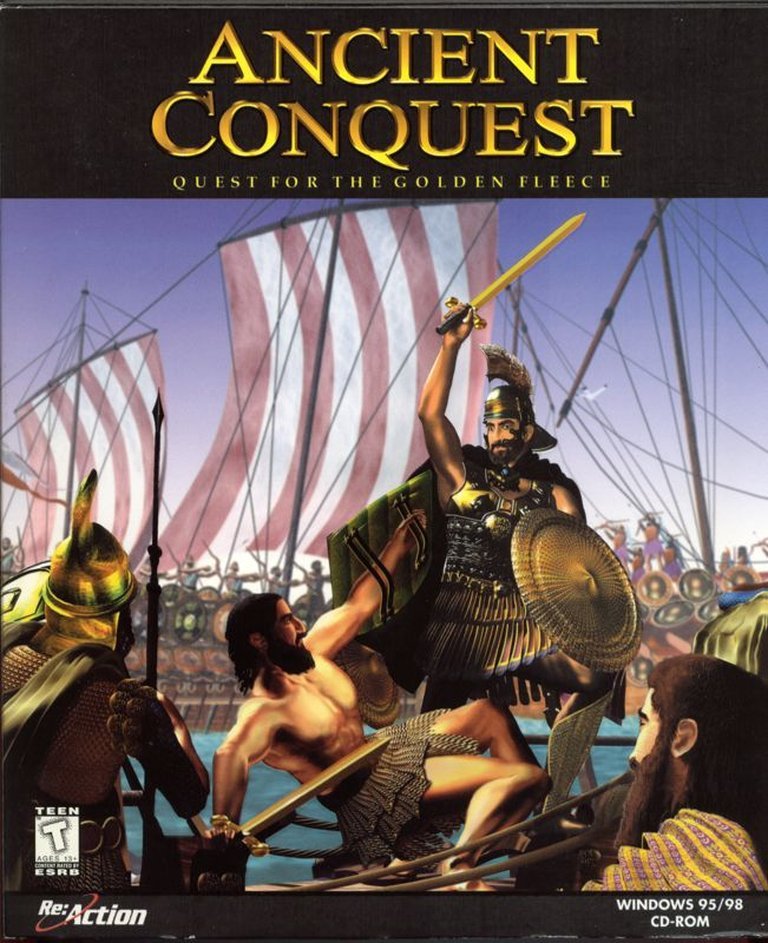
Description
Ancient Conquest: Quest for the Golden Fleece is a real-time naval strategy game set in mythical ancient Greece, drawing inspiration from the legend of Jason and the Argonauts. Players must build and command fleets, starting with the ship Argo, while leveraging the powers of heroes like Hercules and Odysseus to acquire the Golden Fleece. The game blends resource management, tactical combat on sea and land, and fantasy elements, as players battle monsters, wizards, natural disasters, and the forces of Persia and Barbarians using ancient magic and upgraded weaponry.
Gameplay Videos
Ancient Conquest: Quest for the Golden Fleece Free Download
Ancient Conquest: Quest for the Golden Fleece Cracks & Fixes
Ancient Conquest: Quest for the Golden Fleece Reviews & Reception
gamesreviews2010.com (85/100): a must-play for fans of the genre.
Ancient Conquest: Quest for the Golden Fleece Cheats & Codes
PC
Press [Enter] during game play, type one of the following codes, then press [Enter] again.
| Code | Effect |
|---|---|
| exiton | 50,000 amber and 30,000 fish |
| boreas | Toggle full map |
| cloud | Clear clouds from current screen |
| weather | Set wind direction; 1 is east, 8 is southeast; 0 for no wind |
| outmapobj | Unknown |
| vobla | Unknown |
| greens | Unknown |
Ancient Conquest: Quest for the Golden Fleece: A Scholarly Review of a Mythological RTS Curio
Introduction: Charting the Uncharted Waters of a Forgotten RTS
In the vast, often homogenous sea of late-1990s real-time strategy (RTS) titles, few games dared to set their sails as far from the conventional currents as Ancient Conquest: Quest for the Golden Fleece. Released in April 1999 by the obscure Australian developer Megamedia, this game promised a heady brew: the tactical depth of the burgeoning RTS genre fused wholesale with the operatic grandeur of Greek mythology. Its premise was immediately captivating—command the fleet of Jason, recruit legendary heroes like Hercules and Odysseus, and battle not mere human armies but cyclopes, harpies, and the wrath of gods themselves—all in real-time. Yet, for every critic who celebrated its thematic audacity, another lamented its archaic mechanics and technical limitations. This review posits that Ancient Conquest is a fascinating, deeply flawed artifact—a game whose visionary core was tragically undermined by the technological and design constraints of its era and its developer’s limited resources. It stands not as a lost classic, but as a compelling “what if,” a bold experiment in genre fusion that ultimately sank under the weight of its own ambitions and the towering shadow of its contemporaries.
Development History & Context: The Obscure Studio and a Crowded Genre
The game was developed by Megamedia Australia, a studio with a scant footprint in the historical record. Their prior and subsequent credits (including titles like Submarine Titans and Admiral: Sea Battles) reveal a persistent fascination with naval and tactical warfare, suggesting Ancient Conquest was a natural, if ambitious, evolution of their niche expertise. The development team, as listed in the credits, was a compact group of 54 individuals, with key design and programming duties handled by Andriy Doroshchuk, Evgeny Palchikov, and Sergei Shevyryov. This small-scale development contrasts sharply with the behemoth studios behind the era’s defining RTS games.
The game emerged into a hyper-competitive landscape. 1997-1999 was the golden age of the RTS, dominated by Blizzard’s Warcraft II (1995) and StarCraft (1998), and Ensemble Studios’ Age of Empires (1997) and its seminal sequel Age of Empires II: The Age of Kings (1999). These titles set the standard for tight balance, polished interfaces, and deep tech trees. Ancient Conquest, arriving in early 1999, was already entering a genre being rapidly refined. Its vision of a myth-centric, naval-primary RTS was radically different from the historical or sci-fi foundations of its rivals, but it competed directly with their mechanical sophistication. Published by DreamCatcher Interactive (known for bringing niche and European titles to North America) and several European partners, it was clearly positioned as a low-to-mid-budget alternative, a fact ultimately reflected in its technical execution and critical reception.
Narrative & Thematic Deep Dive: Mythology as Mechanic, Not Just Window Dressing
Where Ancient Conquest most clearly divorces itself from its peers is in its narrative scaffolding. The plot is a straightforward adaptation of the Argonautica: the player, as a Greek commander, must build the ship Argo and retrieve the eponymous Golden Fleece from Colchis. However, the game’s genius lies in how it mechanizes mythology. The 14-mission campaign is not a series of abstract skirmishes but a “heroic journey” populated by canonical elements.
Heroes as Faction-Units: Figures like Hercules, Jason, Odysseus, and Perseus are not merely named units with high stats; they are central, collectible assets with unique active and passive abilities. Recruiting them is a primary objective, and their mythic powers—Hercules’ strength, Odysseus’ cunning—are directly applicable to gameplay challenges, from breaching fortifications to avoiding hazards.
The World as a Mythological Threat: The “enemies” are not just Persian or Barbarian fleets (a historical nod to the Greco-Persian Wars). The environment and narrative are populated by canonical monsters: harpies that swoop from the sky, medusas that petrify, cyclopes that smash, minotaurs in labyrinth-like terrains, and dragons. Natural disasters are framed as “acts of the gods.” This transforms resource gathering and exploration from a mundane base-building chore into a perilous expedition into a dangerous, enchanted world. The need to “learn and employ ancient magic,” as the official description states, suggests a tech tree that is less about stone-to-iron progression and more about unlocking divine favors and spells.
Thematic Cohesion: The game’s setting—”Classical antiquity” fused with “Fantasy”—is not a mishmash but a deliberate choice. It allows for a consistent rule-set where magic, monsters, and heroes coexist with trireme-style ships and ancient siege weapons. The narrative goal (obtain the Fleece) is a singular, powerful motivator, giving the campaign a focused quest-like structure uncommon in the genre’s often sprawling sandbox campaigns. This approach treats Greek myth not as aesthetic dressing but as the fundamental law of its game world, a distinction that makes its thematic integration more profound than the historical pastiche of Age of Empires.
Gameplay Mechanics & Systems: Naval Focus, Flawed Execution
The core innovation is the primacy of naval warfare. While land combat exists, the game’s maps are archipelagos and coastal regions. The starting unit is the legendary Argo. Economy and warfare are inextricably linked to the sea: resources like fish and amber are harvested from the water or coastal zones, and expansion is achieved via ship-to-ship boarding, ramming, and ranged combat. This focus on tactical, vessel-based engagements—where ships have distinct roles (biremes, triremes, support craft) and can be upgraded with weaponry—is its most noted strength. As FileFactory Games observed, it creates “complex and ultimately more enjoyable sea battles than similar games such as Age Of Empires.”
However, the systems supporting this focus are where the game falters critically.
-
Economy & Resource Gathering: Resources are simplified: gold (from trade/treasure), wood (for ships/buildings), food (from fishing/hunting), and “amber” (a special resource for advanced technologies/heroes). The mention of “Lewiatan paws” (likely a translation quirk for “Leviathan”) as a resource from Gamepressure hints at exotic resource nodes. The economy is functional but rudimentary, lacking the intricate production chains of Age of Empires or the balanced resource scouting of StarCraft. This simplicity can streamline the early game but leads to a shallow, predictable late-game economy.
-
Hero & Magic System: Heroes are powerful force multipliers, but their implementation is opaque. The “12 magical technologies” unlocked via temples are poorly explained in most reviews, with the PC Player (Germany) critic specifically citing “undurchsichtige” (non-transparent) mechanics. The magic system feels tacked-on rather than integrated, a point of friction rather than fluidity.
-
AI & Difficulty: This is the game’s most universally panned aspect. Critics from Adrenaline Vault (“the opponent are dümmer als Kriegsgott Mars erlaubt” – dumber than the war god Mars would allow) to PC Games (“Von Künstlicher Intelligenz kann nicht die Rede sein” – There can be no talk of artificial intelligence) lambaste the AI as feeble and predictable. It fails to provide a strategic challenge on higher difficulties, rendering the campaign’s potential depth moot for seasoned players. The AI’s inability to effectively utilize the naval mechanics or coordinate with monsters defeats the purpose of its elaborate scenario design.
-
User Interface & Control: The “umständliche Befehlsmenüs” (cumbersome command menus) noted by PC Joker are a recurring complaint. The point-and-select interface, while standard, is reportedly clunky, with poor group management and a lack of hotkeys or modern QoL features. This “archaic” feel, as Adrenamine Vault states, makes it feel “like a title released about two years after its kind would have fit in.” The interface becomes a barrier to enjoying the strategic nuances of naval combat.
-
Campaign & Scenario Design: The 14-campaign missions and 40 standalone scenarios are a major selling point, offering variety. Reviews praise the “abwechslungsreiche Missionen” (varied missions) and “interesting individual missions” (Imperium Gier). The inclusion of a scenario editor is a significant plus, suggesting the developers intended a community-driven longevity that the flawed core gameplay could not support.
In summary, the gameplay is a tale of two halves: a brilliant, focused naval/mythological combat core shackled to a simplistic economy, a broken AI, and an unintuitive interface.
World-Building, Art & Sound: A 2D Time Capsule
Ancient Conquest is visually a pure 2D isometric game, a deliberate choice likely born of technical constraints and a desire for a classic “strategy map” aesthetic. The graphics are described by GameStar as “schnelle, aber allzu simple” (fast but all too simple) and by PC Action as “fast a Zumutung” (almost an imposition). Sprites are small, animations (especially for boarding actions and monster attacks) are called “läppisch” (silly) by PC Games. However, within these constraints, there is a certain charm. The artist team (Viktor Sylak, Andriy Kardash, et al.) created a consistent, if spartan, visual language that clearly differentiates Greek triremes from Persian galleys, heroes from common soldiers, and sea monsters from mundane sharks. The “iso-Optik” (isometric look) of PC Joker is functional and runs on low-end systems (Pentium 133-200MHz), a pragmatic strength for its target market.
The sound design is noted as functional but unremarkable. The music by Andrei Vasylenko is specifically called “nervige Begleitmusik” (annoying background music) by PC Joker, a sentiment echoed in player forums, though it can be disabled. Sound effects for cannon fire, boarding actions, and monster roars are serviceable but lack the impact of genre leaders. The voice work for heroes (credited to Sean Spitzer, Josh Johnson, etc.) is minimal, likely limited to brief unit acknowledgments, failing to leverage the epic narrative potential.
The atmosphere is thus constructed primarily through setting and concept rather than audiovisual splendor. The player feels they are in a mythic world because the units and objectives say so, not because the graphics and sound immerse them. This creates a cognitive disconnect—the mind is presented with Homeric epic, but the senses receive a competent but dated 1999 RTS presentation.
Reception & Legacy: A Polarized Niche Oddity
At launch, Ancient Conquest received a polarized and ultimately middling reception. The aggregated MobyGames critic score of 61% (based on 14 reviews) masks a dramatic range:
* The Positive (80-89%): Hacker (89%), Power Unlimited (82%), and GamePro (80%) championed its “distinctive setting and challenges” and “exemplary AI” (though this praise for AI is in direct contrast to most other reviews). They saw a creative, fun, and well-priced ($20-30 DM/€) niche product.
* The Middling (58-68%): GameStar (58%) and Imperium Gier (68%) acknowledged the solid naval combat and interesting missions but cited average graphics and routine strategy.
* The Negative (38-43%): The German press (PC Player 43%, PC Action 41%, PC Games 38%) and Adrenaline Vault (40%) were scathing, condemning the “verwirrende Steuerung” (confusing controls), “gräßliche Technik” (terrible tech), and “dumb” AI. They saw an outdated, mechanically poor game unworthy of its price, even as a budget title.
Its commercial performance is obscure but likely modest, given its publisher (DreamCatcher specialized in distribution, not blockbusters) and its rapid descent into obscurity. It has no modern remaster, no active community, and its official multiplayer services are defunct. Its legacy is one of profound obscurity and minimal influence. It did not spawn a series. Its specific blend of real-time strategy and active mythological monsters was not replicated in any major title. While later games like Age of Mythology (2002) successfully married mythology and RTS, they did so with the engine, balance, and polish of the Age of Empires series, leaving Ancient Conquest as a forgotten, more ambitious predecessor that lacked the technical pedigree to succeed. It exists now as a curio for retro RTS collectors and historians studying the genre’s divergent paths.
Conclusion: A Sunken Treasure of Ambition
Ancient Conquest: Quest for the Golden Fleece is a game of magnificent aspirations and catastrophic execution. Its thesis—to build an RTS where mythology is the operating system, not the screensaver—was revolutionary for its time. The focus on naval combat as the primary theater of war, the incorporation of heroes and monsters as core gameplay elements, and the campaign structured as a literal heroic quest represent a design philosophy centuries away from the resource-optimization focus of StarCraft or the civilization-building of Age of Empires.
However, this vision was shipwrecked on the reefs of its developer’s limitations. The AI is not just flawed; it is fundamentally broken, removing any strategic depth from confronting its most unique enemies. The user interface is a needless hassle. The 2D graphics, while clean, are artistically and technically outclassed. These are not minor quibbles; they are foundational failures that cripple the experience.
Therefore, its place in history is not as a classic to be played, but as a critical lesson and a tantalizing “what if.” It demonstrates the genre’s potential for thematic depth and narrative integration years before it became mainstream. It proves that an RTS could be about something other than symmetrical faction warfare. For the professional historian, it is an essential case study in how a brilliant central concept cannot save a game without the robust systems and polish to support it. It is a sunken galleon, full of imagined treasure, resting on the ocean floor of gaming history—visible to those who dive deep, but too compromised to ever sail again. Its final verdict is one of poignant failure: a game that conquered our imagination but lost the war for quality.