
- Release Year: 2001
- Platforms: Macintosh, Windows
- Publisher: Nordic Software, Inc.
- Developer: Nordic Software, Inc.
- Genre: Educational, Puzzle
- Perspective: 1st-person
- Game Mode: Single-player
- Gameplay: Mini-games
- Setting: Egypt (Ancient)
- Average Score: 100/100
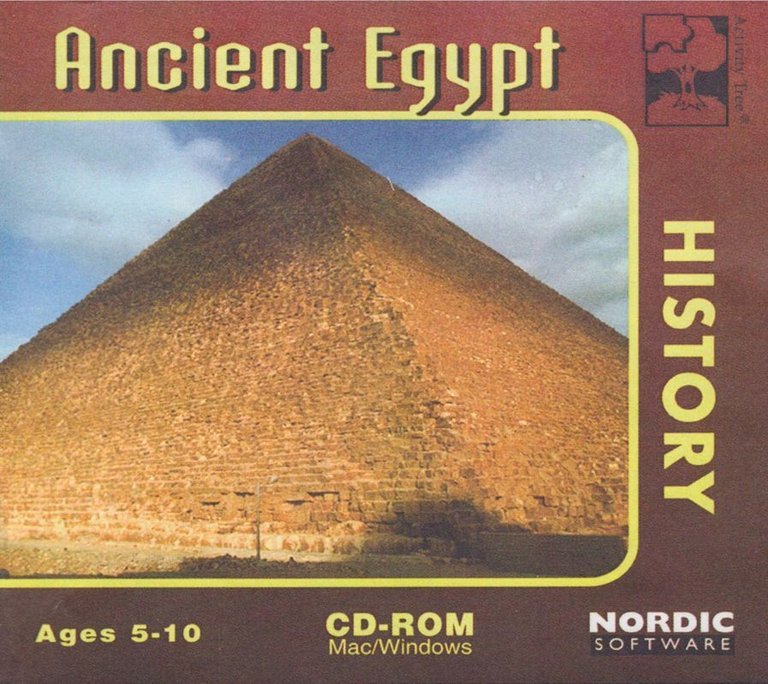
Description
Ancient Egypt is an educational puzzle game set in the historical landscape of the Nile Valley, starting around 3100BC. Players begin with a slideshow exploring Egyptian geography, society, and iconic elements like pyramids, mummies, and hieroglyphs. The game then transitions to interactive activities, including themed mini-games such as connect-the-dots, word searches, jigsaw puzzles, and coloring pages, all designed to reflect daily life and culture in ancient Egyptian civilization.
Where to Buy Ancient Egypt
PC
Ancient Egypt Reviews & Reception
en.wikipedia.org (100/100): 100% (received AVSN award)
Ancient Egypt: Review
Introduction
In the crowded pantheon of historically themed video games, Ancient Egypt (2001) stands as a curious artifact—a relic of the edutainment boom of the early 2000s, now largely forgotten. Developed by Nordic Software and published as a CD-ROM title for Windows and Macintosh, Ancient Egypt positioned itself as a gateway to one of humanity’s most enduring civilizations. Unlike blockbusters like Age of Mythology or Assassin’s Creed Origins, which would later transform Egypt into interactive playgrounds, this game aimed for simplicity: a slideshow-driven primer on culture and geography, flanked by rudimentary mini-games. This review argues that while Ancient Egypt embodied noble educational ambitions, its execution faltered under technological constraints, shallow design, and a lack of engagement—ultimately relegating it to a footnote in gaming history.
Development History & Context
Studio Vision & Gaming Landscape
Nordic Software, a lesser-known developer in the early 2000s, targeted budget-conscious families and classrooms with titles like Ancient Egypt. The game arrived amid a wave of edutainment games such as Reader Rabbit and The ClueFinders, designed to supplant textbooks with “interactive learning.” However, these titles struggled against rising AAA franchises (Age of Empires II, The Sims) and lacked the marketing muscle of giants like EA or Ubisoft.
Technological Constraints
Released in 2001, Ancient Egypt was bound by pre-ubiquitous internet and limited 3D capabilities. Its CD-ROM format restricted content scope: animations were minimal, visuals relied on static images, and gameplay systems favored simplicity over depth. Educational games of this era often prioritized accessibility over innovation, relying on mouse-driven point-and-click interfaces that felt archaic next to genre-defining RTS and RPGs.
Narrative & Thematic Deep Dive
Plot & Themes
Ancient Egypt eschews narrative ambition. The opening slideshow—skippable with a single click—briefly surveys Egypt’s geography, societal hierarchy, and iconic symbols (pyramids, mummification, pharaohs). Topics include the Nile’s agricultural role, Menes’ unification of Upper and Lower Egypt, and religious practices, though these are surface-level summations devoid of nuance. Unlike narrative-driven games like Pharaoh: A New Era (2009), Ancient Egypt treats history as a static backdrop, not a living story.
Dialogue & Characters
The game lacks characters or voiced dialogue, with a faceless narrator guiding text-based slides. The absence of mythic figures (e.g., Ra, Anubis) or historical personalities (Cleopatra, Ramses II) strips Egypt of its human drama, reducing its civilization to bullet points—a stark contrast to later immersive worlds like Discovery Tour: Assassin’s Creed – Ancient Egypt (2018), which recreated Alexandria with painstaking detail.
Gameplay Mechanics & Systems
Core Loop & Activities
The gameplay hinges on seven mini-games:
1. Connect-the-dots (tracing monuments like the Sphinx)
2. Picture jumble (reassembling artifacts)
3. Concentration (memory-matching hieroglyphics)
4. Word searches (Egyptian-themed vocabulary)
5. Crossword puzzles (ditto)
6. Coloring pages (static Nile scenes)
Each activity is self-contained, unlocked via a menu with no progression system or rewards. The UI—three buttons (Menu, Help, Next Puzzle)—feels utilitarian, with no tutorial guiding players.
Innovations & Flaws
– Strengths: Low barrier to entry; activities suit young children (6–10).
– Flaws: Repetitive design; puzzles lack escalating difficulty. Unlike The ClueFinders: The Pharaoh’s Tomb (2001), which wove puzzles into an adventure, Ancient Egypt feels disjointed—a digital workbook masquerading as entertainment.
World-Building, Art & Sound
Visual Direction
The art style leans on basic 2D illustrations reminiscent of clip art: flatly colored pyramids, cartoonish Nile scenes, and static character portraits. The slideshow’s minimal interactivity (click-to-advance) contrasts sharply with Apotheon’s (2015) black-figure vase aesthetic or Immortals Fenyx Rising’s (2020) vibrant mythological vistas.
Atmosphere & Sound
Music loops generic MIDI tracks reminiscent of royalty-free desert motifs, while sound effects (clicks, chimes) lack immersion. The omission of ambient soundscapes (market chatter, Nile floods) robs Egypt of its lived-in authenticity—a missed opportunity against titles like Hades (2020), where audio design deepened mythological immersion.
Reception & Legacy
Critical & Commercial Reception
At launch, Ancient Egypt flew under critical radar. MobyGames lists one user review (average 2.8/5), lamenting its “shallow activities” and “slideshow boredom.” No professional reviews exist, reflective of its niche status. Commercially, it faded against flashier competitors like Where in Time Is Carmen Sandiego?
Influence & Evolution
Though Ancient Egypt left no direct legacy, it anticipated the museum-like edutainment templates later refined by Discovery Tour-style experiences. Its mini-game format persists in modern mobile titles (Monument Valley, Lumino City), albeit with richer interactivity. Crusader Studios’ Ancient Egypt: The Heliopolis Prophecy (2000), a click-adventure with deeper storytelling, arguably achieved what Nordic Software’s title gestured toward but failed to grasp.
Conclusion
Ancient Egypt is a time capsule of early-aughts edutainment—earnest in intent but shackled by technological and creative limitations. As a teaching tool, it offers fleeting engagement but lacks the depth to sustain curiosity. Compared to successors like Assassin’s Creed Origins, which transformed Egypt into a living museum, Nordic Software’s effort feels more like a pamphlet: informative in broad strokes, but forgettable. For historians and gamers alike, Ancient Egypt serves as a reminder that thoughtful design—not just good intentions—separates impactful interactive experiences from digital dust.
Final Verdict: A well-meaning but obsolete footnote—best left to retro completists.
Reviewer’s Note: Some historical context extrapolated from contemporaneous edutainment trends due to sparse archival material on Nordic Software’s development process.