
- Release Year: 1984
- Platforms: Antstream, Commodore 64, Windows
- Publisher: Guildhall Leisure Services Ltd., Llamasoft Ltd.
- Developer: Llamasoft Ltd.
- Genre: Action
- Perspective: Side view
- Game Mode: Single-player
- Gameplay: Platforming, Shooting, Tactical
- Setting: Fantasy, Futuristic, Sci-fi
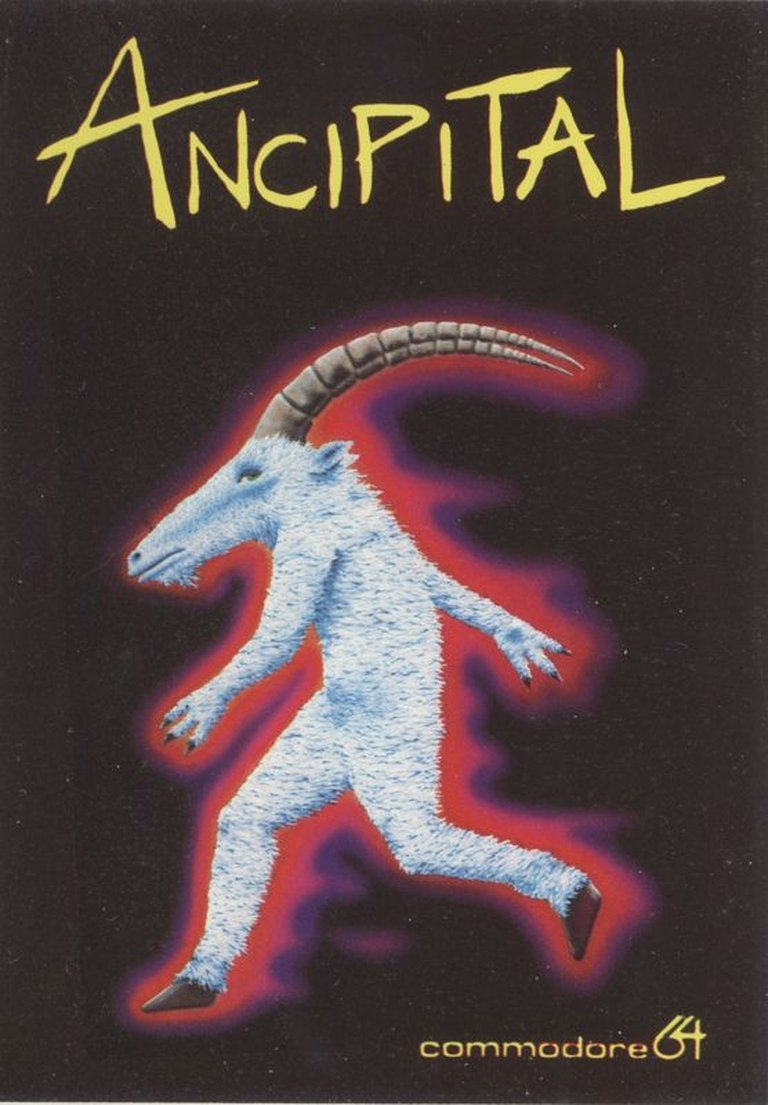
Description
Ancipital is a 1984 Commodore 64 action game developed by Llamasoft, set in a bizarre fusion of fantasy and sci-fi environments. Players control a two-legged yak-like creature that shoots projectiles, such as bananas, to navigate through 100 single-screen levels organized in a 10×10 grid, with gameplay focused on tactical planning as shooting enemies alters walls and floors, and strategically opening these walls replenishes health and dictates progression.
Ancipital Free Download
PC
Ancipital Guides & Walkthroughs
Ancipital Reviews & Reception
mobygames.com : This is one of my all-time favourites games for the commodore 64.
mobygames.com : This is one of my all-time favourites games for the commodore 64.
everygame.tumblr.com : Ancipital is a overdesigned, confusing, flawed bit of Llamasoft nonsense that I… kind of love???
gamesreviews2010.com : Ancipital is a surreal and addictive game that defies easy categorization.
almostafamine.blogspot.com : Ancipital is a weird game.
Ancipital Cheats & Codes
Commodore 64
| Code | Effect |
|---|---|
| POKE 18679,173 | Lives |
| SYS 16384 | Restart Game |
Ancipital: A Tactical Ballet in a Psychedelic Fever Dream
In the annals of 1980s video game history, few titles encapsulate the manic, idiosyncratic genius of a single auteur quite like Llamasoft’s Ancipital. Released for the Commodore 64 in September 1984, this game is not merely a product of Jeff Minter’s imagination but a direct expression of it—a sprawling, 100-screen puzzle-box wrapped in the trappings of a chaotic shoot-’em-up. To the casual observer, it is an indecipherable cacophony of flying yak-men, banana projectiles, and violently shifting gravity. To the committed few, it is a masterclass in constrained, systemic design—a game where every decision echoes across a interconnected web of rooms, where planning is not just advantageous but existential. This review will dissect Ancipital not as a nostalgic curio, but as a deliberate, deeply flawed, and profoundly influential experiment in interactive systems. Its legacy is not one of mass popularity, but of a stubborn, brilliant thesis: that the deepest strategic pleasures can emerge from the most bizarre and forbidding interfaces.
1. Development History & Context: The Hairy Years in Full Flower
Ancipital arrived at a pivotal moment for both its creator and the home computer software scene. Jeff Minter, operating under the Llamasoft banner, was by 1984 a established if unconventional voice. Following the arcade-inspired Attack of the Mutant Camels (1983) and the ambitious but divisive Sheep in Space (1984), Minter was refining a signature aesthetic: psychedelic visuals, absurdist humor, and gameplay mechanics that prioritized novel physical systems over genre conventions. The Commodore 64, with its powerful VIC-II graphics chip and SID sound chip, was the ideal canvas for this vision, offering the horsepower for colorful sprites and, crucially for Minter, complex sound routines.
The technological constraints were significant. The C64’s 64KB of memory and limited CPU speed demanded ruthless optimization. Minter, coding in 6502 assembly (as evidenced by the reverse-engineered source code available on GitHub), employed sophisticated compression (Exomizer) to fit the game’s vast array of room-specific logic, sprite data, and sound routines. This technical tightrope walk explains some of the game’s visual austerity—the screens are often sparse, with minimal backgrounds, not as an artistic choice initially but as a necessity to keep the frame rate acceptable amidst the chaos.
Ancipital also emerged into a crowded market. The “multi-screen adventure” genre, typified by Jet Set Willy (1984), was a dominant force on the ZX Spectrum and C64. These games tasks players with navigating interconnected screens while avoiding enemies and collecting objects. Minter’s innovation was to subvert the genre’s core verbs. Instead of pure navigation and collection, Ancipital made room alteration the primary objective. Walls were not static obstacles to be jumped over, but dynamic barriers that had to be opened through screen-specific actions, and once opened, they were permanently altered. This was a radical twist: progression was not about moving through space, but about permanently changing it.
Furthermore, the game was steeped in Minter’s personal mythology. The lore, detailed in the manual,irled from Brian Aldiss’s Helliconia novels—a source of inspiration for the Ancipital’s goat-like, shaggy form—into Minter’s own pantheon of villains (the Zzyaxians) and in-jokes (the “Magic Goats,” the cameo by “Neil from The Young Ones”). This was not a game designed for mass-market accessibility; it was a jeu d’esprit, a personal manifesto wrapped in a challenging puzzle. Its 1984 release placed it at the tail end of the “golden age” of bedroom coding, where singular visions like Minter’s could still find publishers (Llamasoft itself, with distribution by Guildhall Leisure) and a receptive, if niche, audience.
2. Narrative & Thematic Deep Dive: A Saga of Hairy Oppression and Psychedelic Rebellion
Ancipital’s narrative is delivered not through in-game text or cutscenes, but through the dense, comic-book prose of its instruction manual. This is a deliberate choice that aligns with the game’s mechanics: the story is something you read, not something you watch. It is an elaborate, tongue-in-cheek satire of space opera and genocide allegories.
The protagonist is the Ancipital life-form: “a cross between a humanoid and a goat, walking erect but possessing long, curving horns and a thick, shaggy coat of white hair.” Their origin story is one of brutal victimhood. On their homeworld, they were enslaved and nearly exterminated by “a hairless humanoid creature” (a clear, ironic parallel to humanity). Salvation arrives in the form of “Yak-Shoggoth XXVII, a Galactic hippie,” who embodies Minter’s own psychedelic, anti-establishment persona. The Ancipitals are whisked away, only to be promptly enslaved again on Zzyax Prime by the “fiendish Zzyaxians,” a stand-in for all cosmic evil (“responsible for just about everything evil in the Galaxy, from the H-bomb to the sending in of baiters at the end of a wave in Defender”).
The inciting incident is a desperate alliance with humanity. A volunteer force of Ancipitals is teleported into a Zzyaxian “weapons-research outpost” saturated with a hallucinogen that leaves humans catatonic but only causes “mild visual and auditory disturbances in the long Ancipital skull.” Their mission: “to enter and render harmless each of the 100 rooms therein.” The manual explicitly states they are provided only with a “sketchy map.”
Thematically, the narrative is a parody of heroic sacrifice and imperialist tropes. The “evil Zzyaxians” are a generic, almost comical evil. The Ancipitals’ weaponry is absurd (bananas, later changing per level), and their adversary in the base is a menagerie of Minter’s typically bizarre creations (floating skulls, cassette-shooters, lighters burning jeans). The story frames the gameplay loop—entering, clearing, and “de-activating” rooms—as a vital, galaxy-saving commando raid. This juxtaposition of epic stakes with ludicrous aesthetics is pure Minter. It rejects the gritty, serious sci-fi of the era, replacing it with a psychedelic, anarchic vision where the hero is a goat-man and the primary tool is a fruit-based projectile. The “Hallucinogenic” gas of the base is a perfect metaphor: the entire experience is designed to be a disorienting, mind-bending trip.
Crucially, the story provides context, not closure. There is no final boss battle against the Zzyaxian emperor. The narrative justification ends with the Ancipitals entering the base. The “game” is the base itself—a concrete manifestation of the Zzyaxians’ warped science. The thematic core, therefore, is systemic confrontation. The player is not avenging a linear plot but dismantling an elaborate, hostile system—one room at a time, by understanding and manipulating its rules. The lack of a traditional story arc forces focus entirely onto the systemic interaction, reinforcing the game’s true thesis: the narrative is the gameplay logic.
3. Gameplay Mechanics & Systems: The Architecture of Constrained Choice
Ancipital’s genius and most infamous barrier reside in its mechanics, a dense lattice of interlocking rules that demand a shift from reflexes to rigorous planning. The core loop is deceptively simple: you control an Ancipital within a single-screen room. Your goal is to open all four walls (or as many as possible) and then exit before a 16-second timer expires, which activates the opened portals. There are 100 such rooms, arranged in a 10×10 grid. The HUD displays your coordinates, a local map of adjacent walls, strength (health) as purple camels, and a completion percentage.
The revolutionary mechanic is the wall-opening system. Walls are of three types:
1. Impervious: Never open. Static barriers that define the navigable map.
2. Locked: Indicated by a colored camel icon. Require the collection of a matching “Camel Key” found within another room to become passable.
3. Normal: Indicated by a colored arrow (white=strongest, progressing through blue, red, etc., to open). These can be damaged by performing a room-specific action.
This is where the game transforms from shooter into tactical puzzle. Each of the 100 rooms has a unique, unstated rule for damaging its Normal walls. As the manual cryptically states: “It is up to you to discover the ways of opening walls in each room.” The methods vary wildly:
* Shooting Targets: Most common. Enemies or objects must be shot; their corpses or projectiles fall toward the wall you are currently standing on (or, in some variants, away from you to hit an opposite wall), causing screen shake and weakening the wall.
* Collision/Touch: Some objects must be physically touched by the Ancipital, causing them to fall and damage a wall.
* Firing at Walls Directly: In rare cases, you must shoot the wall itself.
* No Firing: Some rooms are “puzzle” rooms where shooting is forbidden or suicidal, forcing pure navigation and object manipulation.
* Power-Dependent: Late-game, with the “GOATS” power-up (collecting five Magic Goats spells out G-O-A-T-S on the HUD), walls can be opened simply by jumping on them. This is mandatory for 100% completion, as rooms cleared once are empty and have no targets to shoot.
The gravity/flip mechanic is the key to navigating the four-sided plane. The Ancipital can walk on any surface. Pressing the joystick toward a wall causes a standard jump to that opposite surface. The critical Jump-Turn (press FIRE + joystick toward a perpendicular wall while in mid-air) allows switching from, say, the floor to the ceiling or left wall. This is Nina to move between walls that are not directly opposite. It is a skill-based maneuver with inertia; a mistimed jump-turn results in slamming into a wall and instant death. This control scheme is the source of much frustration (“walking into a wall is fatal”), but it is also the source of fluid, athletic movement once mastered.
Two meta-systems govern the larger adventure:
1. The Camel Keys: There are six colored camels hidden in specific rooms. Collecting one adds three to your life total and permanently unlocks a color of Locked wall on the global map, opening new pathways. Since you can only open walls in a room before you leave it for the first time, keys must be collected early and deliberately.
2. Health Economy: The masterstroke of design, praised by player reviewer René Pedersen, is that every time you open a Normal wall, your strength (health) is replenished by a small amount (three camels’ worth, capped at ten). This creates a constant, desperate resource loop: do you spend your health opening a wall now for the immediate regeneration, knowing it might be a door to a dangerous room? Do you save a wall opening for a future emergency health top-up? The health bar also decays slowly over time (“natural entropic reduction”), adding pressure.
The timer (16 seconds per room) is a relentless metronome. You can stay indefinitely to shoot and open walls, but once you leave, the room is permanently cleared—all enemies, objects, and keys vanish. You cannot return to open missed walls unless you have the GOATS power. This makes initial room completion a high-stakes puzzle of optimization: which walls must be opened? Which keys must be grabbed? Which enemies must be shot in which order? A single, poorly planned exit from a critical room can permanently strand you, blocked by Locked walls.
Finally, the “Body Bomb” (pressing ‘B’) is a desperate, costly reset. It kills your current Ancipital but instantly opens all Normal walls in the current room. It’s a tactical escape hatch for when you’re trapped in a room you cannot complete, but using it loses a life and forfeits the room’s score and items. It is, as the manual advises, a “last-ditch measure.”
Synthesis: The game’s depth lies not in the chaotic shooter action, which is often overwhelming and unfair, but in the preparation for that action. Pedersen’s review rightly calls it “the computer game equivalence of chess—with a limited number of choices—making you plan ahead instead of learning a strategy.” Each room is a discrete puzzle with a finite set of solutions. Success requires mapping the grid, memorizing room solutions (or using hints—the game includes a ‘H’ key that provides a cryptic tip for the current screen), managing the global health economy, and sequencing your path to collect keys and goats efficiently. The shoot-’em-up skin is merely the means of interacting with this vast, logical, and brutally unforgiving puzzle.
4. World-Building, Art & Sound: A Deliberately Grotesque Canvas
Ancipital’s audiovisual presentation is a perfect reflection of its gameplay: chaotic, technically modest, but imbued with a fierce, unmistakable identity.
Visual Design: Minter’s sprite work is iconic and divisive. The Ancipital itself is a shaggy, bipedal yak-goat, rendered in a limited set of chunky pixels. Its animation is functional—walking, jumping, flipping—but its silhouette is clear from all four orientations, a practical necessity given the four-way gravity. The enemies are a parade of Minterian surrealism: floating skulls, cassette tapes, lighters, llamas, cigarettes, and “Phagorian” beasts. They are simple, often monochromatic, and lack detailed animation, but they are instantly recognizable in their absurdity. The environment is the true star. Each of the 100 rooms has a stark, thematic border—skull & crossbones, cigarette papers, lighters, geometric patterns—that defines its visual identity with minimal assets. The walls themselves are textured bands, with open doorways appearing as vibrant, shimmering yellow portals. The aesthetic is one of intentional crudeness; the “dull backgrounds” noted by Pedersen are a consequence of memory limits, but they also focus attention entirely on the gameplay elements. The “odd” graphics are not a failed attempt at realism but a stylistic embrace of the grotesque and cartoonish, echoing the game’s satirical tone. The manual’s cover by Steinar Lund perfectly captures this vibe: a psychedelic, primitive depiction of the hairy hero.
Sound Design: Jeff Minter famously coded his own sound drivers, and Ancipital’s audio is a highlight. The most famous feature is the “Phil Collins module”—a persistent, driving drum rhythm that plays in every room, providing a relentless, almost hypnotic pulse. This is not melodic music but percussive texture, designed to induce a trance-like state conducive to the repetitive, rhythmic task of shooting and opening walls. Firing sounds are varied and often comically loud “bonk” or “pew” effects, changing per room. The sound is “nothing to write home about” in a traditional sense—no catchy tunes—but it is perfectly suited to the game’s atmosphere: oppressive, mechanical, and psychedelic. The optional stroboscopic effects (toggleable with F1) further the sensory overload, making Ancipital a genuinely trippy experience on a CRT monitor. The sound, like the graphics, is not about polish but about creating a cohesive, immersive feeling—one of being inside a buzzing, hostile machine.
Atmosphere & Setting: The “Fantasy/Sci-fi” tag is accurate but inadequate. The setting is the Zzyaxian weapons-research outpost, a place of surreal, non-Euclidean geometry (the four-sided gravity) and biological/technological horror. The hallucinogenic air justifies the bizarre enemy designs. The atmosphere is one of claustrophobic intensity (each room is a confined cell), systemic paranoia (every wall is a potential barrier or gateway), and psychedelic disorientation. The manual’s backstory sells it as a galactic war, but the gameplay experience is more akin to dismantling a deranged, living puzzle. This dissonance between epic lore and claustrophobic execution is quintessential Minter.
5. Reception & Legacy: Critical Darling, Player Divide, and a Design Touchstone
Contemporary Reception (1984-1985): Ancipital was a critical success, garnering an 81% average from seven contemporary critics. Home Computing Weekly and Computer and Video Games awarded perfect scores, with CVG proclaiming it “a game any self-respecting Commodore owner should immediately go out and grab… it will keep you intrigued for months.” The praise centered on its originality, depth, and the sheer audacity of its central concept. Personal Computer Games noted, “It is not just the usual Minter shoot-’em-up because you have to actually think about this game.” The Zzap! 64 award (Top 64 #10) cemented its cult status.
However, the player reception was, and remains, sharply divided. The sole substantial player review on MobyGames (by René Pedersen, 2008) is a passionate defense, calling it “the best tactical shooter I have ever played” and a game “any modern designer should look up.” Yet, the low average player score (2.9/5) and the “Almost a Famine” blog review (2024) calling it “overdesigned, confusing, flawed” highlight the chasm. The game’s greatest strength—its uncompromising, system-driven depth—was also its primary barrier. As the blog post notes, “The first 16 rooms… isn’t enough to unlock what this game has to offer. You have to get beyond the first 32 rooms, before the deeper game mechanism unveils.” Many players never made it that far, bounced by the steep learning curve, the punishing “walk into a wall” death, and the sheer cognitive load of 100 unique room puzzles.
The Gary Penn Anomaly: A fascinating historical footnote comes from the “Every Game I’ve Finished” blog. It reveals that legendary journalist/developer Gary Penn’s career allegedly began by being the first to complete Ancipital and submitting a complete room-by-room guide to Personal Computer Games. The magazine only published a snippet, and the full guide is lost. This anecdote is instructive: Ancipital was so dense and inscrutable that completing it was newsworthy. It wasn’t just a game to be played; it was a problem to be solved and documented. The game’s manual included a blank map, explicitly inviting the player to become a cartographer and archivist. This meta-layer—the player as detective, mapper, and strategist—was part of the intended experience, but one too demanding for most.
Long-Term Legacy: Ancipital faded into relative obscurity compared to Minter’s more accessible titles like Attack of the Mutant Camels or later, the Tempest clone NX. Its influence is subtle, weaving through the DNA of systemic game design rather than spawning direct clones. It is a precursor to the “immersive sim” philosophy of dense, interactive spaces where player agency is defined by understanding and manipulating rules. Its 100-screen interconnected grid, permanent state changes, and resource management (health-from-doors) foreshadow the design of games like Outer Wilds (2019) or the “metroidvania” genre’s emphasis on permanent world alteration.
Its most significant legacy is as a cautionary tale and a benchmark. It demonstrates the thrilling potential—and commercial risk—of a design built entirely around a single, brutal mechanical thesis. For game designers, it is a masterclass in:
* Constraint-Driven Depth: Limiting player verbs (shoot, jump-turn, move on walls) and creating a vast, varied puzzle space from those few tools.
* Meaningful Resource Loops: The health-from-doors system creates a constant tension between short-term survival and long-term path optimization.
* Player-as-Collaborator: The game’s opacity forces the player to document, strategize, and think on a macro scale. It is not a passive experience but an active research project.
Its flaws are equally instructive: the failure to communicate core mechanics (room-specific solutions are entirely esoteric), the interface clutter on the C64’s small screen, and the disconnect between the chaotic action and the calm planning required. These are the reasons it remains a cult artifact, not a classic. It is too smart, too strange, and too demanding for the mainstream, a perfect artifact of Minter’s “art games” era before the term was co-opted.
6. Conclusion: The Unflinching Verdict
Ancipital is not a game for everyone. It is deliberately obtuse, visually abrasive, and mechanically punishing. Its learning curve is a cliff face, and its 100-room marathon demands a commitment few modern gamers are willing to give. Its sound is a repetitive drumbeat, its graphics “technically not very good,” and its control scheme can feel like wrestling an epileactic goat.
And yet, it is one of the most intellectually rigorous and thematically cohesive games ever made for the Commodore 64. Its tactical depth is genuine and profound. The “chess” analogy holds: it reduces each decision to a binary choice (which wall to open from where) but stacks those decisions across a vast, interconnected board, creating a cascade of consequences that must be anticipated. The genius is in the health regeneration from opening doors—a tiny rule that transforms every action from a simple step toward progression into a calculated investment in your own survival.
It is the ultimate “designer’s game.” Jeff Minter did not set out to please a crowd; he set out to prove a point about systemic depth and playerdeductive reasoning. In this, he succeeded brilliantly. Ancipital is a flawed masterpiece, a game whose vision is so pure and uncompromising that it inevitably alienates as many as it enlightens. It stands as a testament to the fact that the most innovative game design often comes from the margins, from creators working with severe constraints and a singular, unmarketable vision.
Its place in history is secure not as a beloved classic, but as a cult milestone—a psychedelic Rubik’s Cube of game design. It is a game that asks not “Can you shoot the enemies?” but “Should you shoot that enemy now, from this wall, preserving your health for the locked blue door in the southeast quadrant two rooms over?” For the patient few who answer that question, Ancipital offers a depth of strategic satisfaction rarely matched in the medium. It is, in the truest sense, an overlooked classic—overlooked because it demands to be worked for, not just played. It is a demanding, chaotic, brilliant, and utterly unique artifact of a bygone era of game development, and its complex, grimy, hairy heart still beats with a fiercely intelligent rhythm.