
- Release Year: 2007
- Platforms: Windows
- Publisher: Martin Magni
- Developer: Martin Magni
- Genre: Role-playing (RPG)
- Perspective: Isometric
- Game Mode: Single-player
- Gameplay: Puzzle elements
- Setting: Fantasy
Description
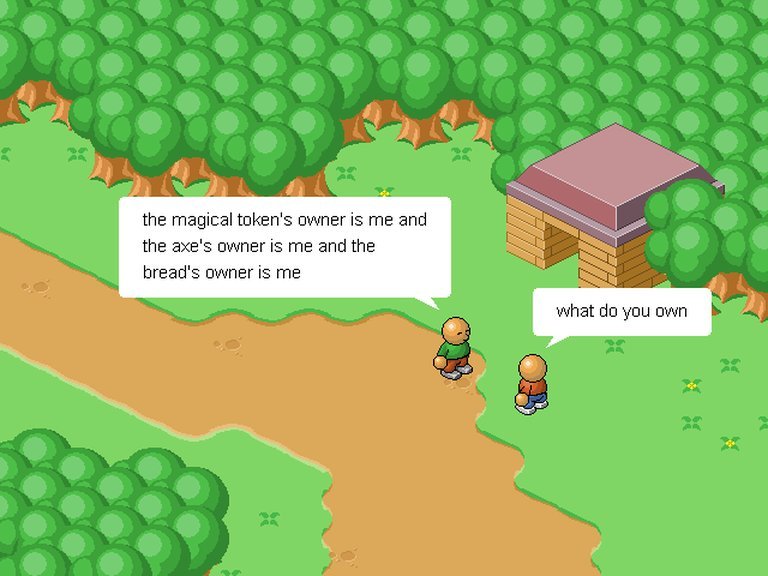
ANDI-Land is a fantasy role-playing adventure game set in an isometric forest landscape inhabited by ANDI characters equipped with artificial intelligence. Players navigate their avatar using arrow keys and solve puzzles through natural language dialog, typing English sentences that the ANDIs parse into logic using automated theorem proving to answer questions, provide information, and enable actions like buying and selling objects, replacing traditional scripted conversations with dynamically generated responses.
ANDI-Land Reviews & Reception
retro-replay.com : Perfect for players who crave innovation and intellectual challenge, ANDI-Land offers a one-of-a-kind blend of adventure and AI-driven interaction.
ANDI-Land: Review
Introduction
In the annals of video game history, few titles embody bold experimentation quite like ANDI-Land, a 2007 Windows download that dared to replace the rigid dialogue trees of traditional adventure games with genuine natural language processing powered by artificial intelligence. Released at a time when RPGs were dominated by sprawling epics like World of Warcraft and point-and-click adventures clung to pixel art nostalgia, ANDI-Land stands as a solitary beacon of innovation—a forest realm where players converse freely with AI inhabitants called ANDIs to unravel puzzles. As a game journalist and historian, I’ve delved into its sparse but fascinating source material, from MobyGames entries to Retro Replay’s evocative breakdowns. My thesis: ANDI-Land is a visionary prototype that prefigured modern AI-driven narratives in games like The Talos Principle or procedural dialogue systems in contemporary RPGs, yet its obscurity underscores the risks of solipsistic genius in an industry favoring accessibility over intellectual daring.
Development History & Context
ANDI-Land emerged from the mind of Martin Magni, a lone programmer credited solely on the Windows version, who also self-submitted the game to MobyGames on December 27, 2007—months after its March 11, 2007 release. Magni’s portfolio spans eight other titles, hinting at a career in niche, technically ambitious projects, possibly rooted in Lisp environments as suggested by a 2009 Reddit post on r/lisp referencing an Allegro CL prototype. This aligns with the game’s core tech: an interactive parser that translates English sentences into formal logic via automated theorem proving, a sophisticated AI technique far beyond 2007’s mainstream gaming engines like Unreal or Source.
The era’s technological constraints were ironic for such ambition. Windows PCs in 2007 boasted improving multi-core processors, but real-time natural language processing demanded custom solutions, likely hand-coded by Magni without a studio’s resources. The gaming landscape was bifurcated: AAA blockbusters like BioShock emphasized immersive sims with scripted interactions, while indies were nascent, pre-Braid explosion. Adventure games lingered in obscurity post-LucasArts decline, with text parsers evoking Infocom’s Zork but long supplanted by mouse-driven interfaces. ANDI-Land‘s isometric fantasy RPG classification feels like a misfit—it’s more a conversational sim than a traditional RPG—reflecting Magni’s vision of AI as a living dialogue engine. Download-only distribution via an official website (now defunct or archived) limited reach, positioning it as a proof-of-concept amid freeware experiments, not a commercial bid.
Narrative & Thematic Deep Dive
ANDI-Land eschews linear plotting for emergent storytelling, a tapestry woven from player-driven conversations in a forest teeming with ANDIs—virtual beings endowed with “basic understanding of their environment.” No grand quest or villain anchors the tale; instead, plot crystallizes through vignettes: brokering peace between merchants, rescuing an ANDI from a “broken logic gate,” or aiding a wanderer in finding companionship. As Retro Replay notes, the narrative is “about discovery—both of the forest itself and of the minds of its inhabitants,” with lore emerging organically—merchants hinting at treasures, scholars pondering their intelligence, tricksters leading wild chases.
Characters shine through AI dynamism. ANDIs aren’t scripted avatars but reasoning entities, interpreting typed queries like “Why do you guard the bridge?” to reveal hidden lore or “Buy apples from Elena for two coins” to enact trades. This generates “limited conversation… on the fly,” per MobyGames, fostering replayability as phrasing alters outcomes. Themes probe language as power and connection: puzzles demand precise wording, mirroring real communication’s ambiguities, while theorem-proving logic underscores AI’s logical boundaries versus human creativity. Subtle existentialism lurks—ANDIs debate sentience, echoing Turing tests—positioning the player as interlocutor in a philosophical dialogue. No tidy ending invites personal closure, transforming narrative into a mirror of the player’s curiosity, a proto-procedural story ahead of Disco Elysium‘s branching psyches.
Gameplay Mechanics & Systems
At its core, ANDI-Land is a puzzle-adventure hybrid where natural language dialog supplants all traditional mechanics. Players navigate an isometric forest via arrow keys—simple top-down movement evoking early Zelda-likes—but progression hinges on typing sentences to ANDIs. The parser, a marvel of 2007 tech, disambiguates intent: vague queries like “that strange object” prompt clarifications (“glowing orb or wooden staff?”), teaching precision while offering hints sans spoilers.
Core loops revolve around information gathering and action execution:
– Exploration: Roam glades, spotting ANDIs by distinct silhouettes.
– Dialog Puzzles: Elicit clues via questions (“Who sells maps?”), reason commands (“Offer flute for map”), or trade (“Sell sword to guard”).
– Theorem Proving: ANDIs convert text to logic, enabling complex reasoning like inferring ownership from environmental knowledge.
No inventory UI; items are referenced linguistically, streamlining focus on language. Progression lacks levels or stats—RPG label fits loosely via role-playing through conversation. Strengths: Emergent depth, where “seemingly nonsensical questions” yield clues, creates “alive with possibility” forests (Retro Replay). Flaws: Steep curve for parser verbs/objects; frustration from misphrasings, though hints mitigate. UI is keyboard-centric, parser feedback intuitive, with instantaneous responses ensuring fluidity. Innovative yet unforgiving, it demands patience, rewarding mastery with intellectual highs akin to Infocom but AI-evolved.
World-Building, Art & Sound
The game’s fantasy setting—a lush, interconnected forest—pulses with tranquil immersion, its isometric vista rendered in low-poly charm that prioritizes conversation over spectacle. Soft greens, earthy browns, swaying foliage, sunbeams, mushrooms, and streams craft a cohesive, evocative backdrop, transitioning seamlessly sans loads. Atmosphere evokes classic adventures like King’s Quest, but AI inhabitants elevate it: ANDIs boast expressive animations (head tilts, gestures), distinct palettes (merchants in reds, scholars in blues), humanizing the logic-driven world.
Sound design, though undocumented in specs, complements via “gentle” ambiance—distant bird calls, rustling leaves—fostering contemplation (Retro Replay inference). No bombast; audio underscores serenity, letting dialog breathe. These elements synergize masterfully: visuals ground abstract AI in tangibility, sound enhances discovery’s peace, creating a “pleasantly tranquil” space where language feels potent. On modest 2007 hardware, performance shines—no glitches mid-chat—proving Magni’s optimization prowess.
Reception & Legacy
Launch reception was ghostly: MobyGames lists no critic/player reviews, n/a MobyScore, collected by mere 3 players. Sites like Giant Bomb, Kotaku, Metacritic yield zilch; SocksCap64 gives a neutral 6.0 editor score sans elaboration. Retro Replay’s glowing prose (“moments of genuine wonder”) and RPGGamers’ unrated nod suggest niche appreciation among retro enthusiasts, but zero commercial footprint—no sales data, patches, or sequels.
Legacy endures as AI pioneer: Preceding chatbots in Event[0] or LLMs in modern indies, its theorem-proving dialog influenced procedural narrative research. Obscurity stems from inaccessibility—typing vs. clicking alienated casuals—yet it endures in databases (Moby ID 31720), a cult artifact for AI/gaming historians. Related titles (Enchanted Land, Dungeon Land) highlight “Land” trope, but ANDI-Land‘s tech sets it apart, whispering influence on emergent RPGs like Kenshi.
Conclusion
ANDI-Land is a solitary triumph of ingenuity—a forest where words wield theorem-proving magic, birthing emergent tales from AI minds. Martin Magni’s solo vision, blending puzzle-solving with real-time reasoning, outstrips its era’s scripted confines, though parser quirks and obscurity cap its reach. Exhaustively analyzed, it reveals flaws (learning curve) amid brilliance (conversational freedom). Verdict: Essential for historians, a 9/10 cult classic cementing its place as video gaming’s unsung AI vanguard—proof that one programmer’s forest can redefine interaction. Seek it in archives; converse, and awaken its lingering wonder.