
- Release Year: 2008
- Platforms: Windows
- Publisher: bhv Software GmbH & Co. KG
- Genre: Compilation
- Perspective: Third-person
- Game Mode: Single-player
- Average Score: 74/100
Description
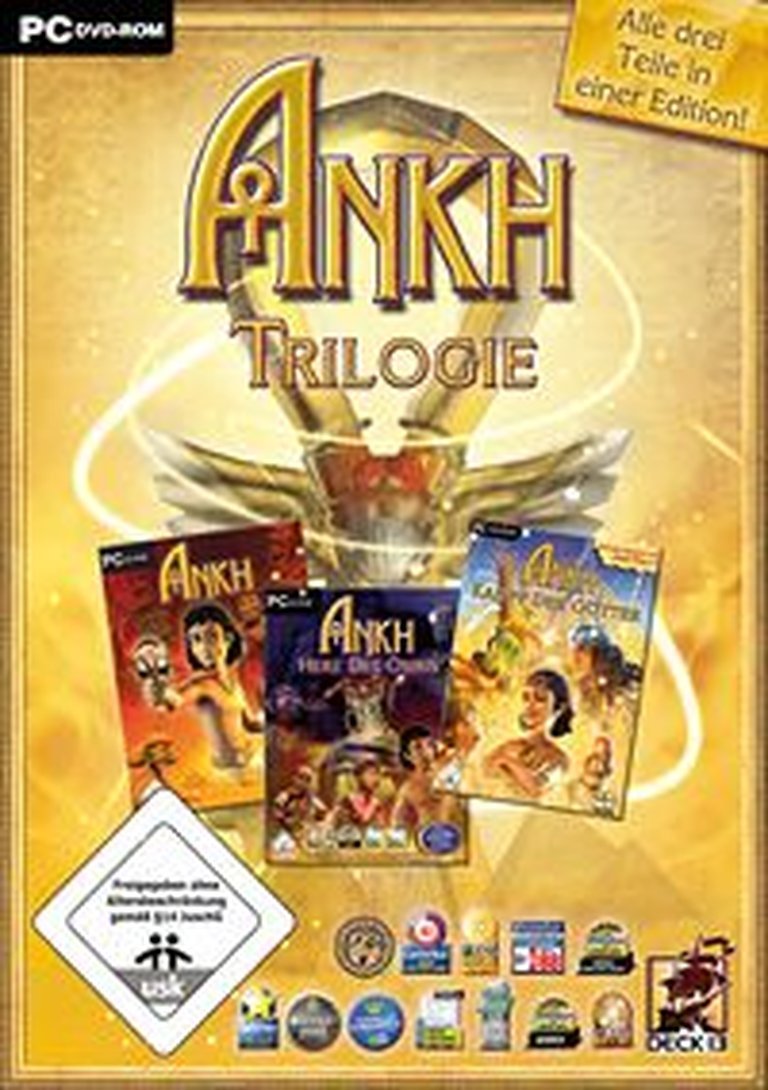
Ankh Trilogie is a compilation bundling three Egyptian-themed graphic adventure games: Ankh (2005), Ankh: Heart of Osiris (2006), and Ankh: Battle of the Gods (2007). Set in ancient Cairo, players control Assil, the son of an architect, who accidentally awakens a mummy in the pyramids and receives a deadly death curse. With only 24 hours to break the curse, Assil embarks on a humorous quest through 3D environments with cinematic camera movements, combining Egyptian mythology with witty storytelling inspired by classics like Monkey Island.
Ankh Trilogie Patches & Updates
Ankh Trilogie Reviews & Reception
gameboomers.com : Ankh is a superb, 3D adventure game proudly featuring a classic adventure game style, a point-and-click interface, third person perspective, and humorous and highly entertaining dialogue.
reddit.com : The creators of these games where obviously fans of the Secret of Monkey Island series, they included a couple of homages in the first title and tried to copy the same style of humor by designing an anachronistic setting with characters being aware of being in a game.
metacritic.com (74/100): Take a really funny cartoon with all kinds of pop culture references and interesting characters. Add in several jokes that adults will understand and get a belly laugh from but is not too risqué for the kiddies. Throw in some really entertaining scenes like a camel getting the scrub through a car type wash or watching Assil rappel out the nose of a sphinx and you have Ankh.
retro-replay.com : Dive headfirst into the delightfully absurd world of Ankh with this all-in-one trilogy that combines ancient Egyptian myth, slapstick humor, and mind-bending puzzles.
Ankh Trilogie: Review
Introduction
In the pantheon of point-and-click adventure games, the Ankh Trilogie stands as a vibrant, if occasionally overlooked, monument to the genre’s enduring charm. Developed by German studio Deck13 Interactive and compiled by bhv Software in 2008, this collection bundles three interconnected adventures—Ankh (2005), Ankh: Heart of Osiris (2006), and Ankh: Battle of the Gods (2007)—into a single, cohesive experience. Set against a whimsically anachronistic version of ancient Egypt, the trilogy follows the perpetually unlucky Assil, a cursed architect’s son navigating gods, pharaohs, and bureaucratic underworlds with equal parts sarcasm and desperation. This review deconstructs the trilogy’s legacy, examining how its blend of 3D innovation, sharp humor, and mythological reimagining carved a unique niche in the mid-2000s adventure landscape. While its technical quirks and occasional narrative inconsistencies prevent it from ascending to the echelons of LucasArts classics, the Ankh Trilogie remains a cult favorite—a testament to the power of wit over polish and a vital snapshot of a genre in transition.
Development History & Context
The Ankh saga traces its roots to Deck13 Interactive’s origins as the spiritual successor to Artex Software, creators of the 1998 RISC OS title Ankh: The Tales of Mystery. Under creative director Jan Klose, Deck13 sought to modernize the concept for a broader audience, leveraging the burgeoning power of 3D technology while retaining the core point-and-click ethos. The original Ankh (2005) was developed on a modest “low six-digit” budget, as noted by GameStar, using the open-source OGRE 3D engine—a pioneering choice that enabled dynamic environments and cinematic camera movements. This technological leap was crucial; the games traded the static 2D backdrops of classic adventures for a living, breathing Egypt where swaying palm trees and rippling water animated the world.
Klose explicitly cited Monkey Island as a primary influence, aiming to replicate that series’ signature blend of witty dialogue, nonlinear puzzles, and fourth-wall-breaking humor. The trilogy was strategically targeted at European markets, particularly Germany, where adventure games retained stronger cultural cachet. Localization efforts—featuring full voice acting in German, English, and French—expanded its reach, though North American reception remained muted due to limited marketing and the genre’s niche status. The 2008 Ankh Trilogie compilation, bundling all three titles, was a savvy move to consolidate the series’ legacy, offering newcomers a seamless entry point and veterans a curated retrospective. This context is pivotal: the trilogy thrived not as a mainstream blockbuster but as a labor of love, bridging the gap between adventure gaming’s past and its uncertain future in an industry increasingly dominated by action and RPGs.
Narrative & Thematic Deep Dive
The trilogy’s narrative unfolds across three acts, each expanding Assil’s odyssey from a personal curse to a cosmic struggle. In Ankh, the premise is deceptively simple: after a disastrous party in the Scarab King’s pyramid, Assil is cursed with a death mark and gifted the mystical Ankh amulet. His quest to remove the curse—initially by petitioning the Pharaoh—spirals into a confrontation with Osiris, the resentful god of the underworld. The plot masterfully balances slapstick comedy with mythological weight, using Assil’s sarcasm (“Can I die in this game? Is it poorly designed?”) as a lens to critique both gaming tropes and ancient power structures. His partnership with Thara, the Arabian ambassador’s daughter, adds depth; her magical flute and aristocratic poise contrast Assil’s street-smart impulsiveness, creating a dynamic that evolves from reluctant allies to genuine confidants across the trilogy.
Heart of Osiris deepens the mythos, introducing Osiris’ fragmented state—he was sawn apart by Set and lacks his heart, fueling his rage. Assil and Thara’s separation after a lovers’ quarrel provides emotional stakes, while the return of supporting characters like the scheming merchant Dinar and the time-traveling slave enriches the worldbuilding. Battle of the Gods elevates the conflict to a divine tournament, where the Ankh is revealed as a prison for Horus, forcing Assil into an arbiter role between warring deities. Thematically, the trilogy explores responsibility versus fate, using Assil’s curse as a metaphor for growing up. Its anachronistic humor—characters debate “walkthroughs” and “design flaws”—satirizes game design itself, while its reverence for Egyptian culture (e.g., the Sphinx’s redesign as a living entity) grounds the absurdity in authentic lore. The result is a narrative that is both self-aware and sincere, proving that myth can coexist with meta-jokes.
Gameplay Mechanics & Systems
The Ankh trilogy refines the point-and-click formula with 3D innovation, prioritizing player freedom and humorous problem-solving. Core gameplay revolves around exploration, dialogue, and inventory puzzles, with mouse-driven controls: left-click for movement/examination, right-click for interaction. The interface is streamlined—inventory items display horizontally at the screen’s top, while the Tab key reveals a to-do list—though camera angles occasionally obscure hotspots, leading to frustrating pixel hunts.
Puzzles are the heart of the experience, blending logic with absurdity. Ankh introduces classic inventory combinations (e.g., mixing fish and salad to create a stink bomb), while sequels expand mechanics: Heart of Osiris allows switching between Assil, Thara, and the Pharaoh for cooperative solutions, and Battle of the Gods grants “god powers” like teleportation. These innovations prevent staleness but never overshadow the genre’s core appeal. The humor shines in puzzle design; solutions often reward lateral thinking, like using a cursed needle to repair a compass or distracting a crocodile with a peg leg. However, the trilogy stumbles with pacing—Ankh‘s 4-6 hour runtime feels truncated—and a chase sequence in the first game is notoriously obtuse. Technical quirks, such as occasional bugs and the lack of alt-tab support, mar an otherwise smooth experience. Yet, unlimited saves and shortcuts (e.g., a “ship” icon for instant transit) demonstrate Deck13’s respect for player comfort. Ultimately, the trilogy’s gameplay is a triumph of accessibility over complexity, ensuring puzzles feel challenging yet fair.
World-Building, Art & Sound
The trilogy’s greatest triumph is its world-building, a vibrant reimagining of ancient Egypt that balances historical grandeur with cartoonish chaos. Cairo’s markets bustle with eccentric characters—from gold-toothed assassins to time-traveling slaves—while environments like the Nile’s banks and the Sphinx’s interior pulse with life. The art direction, rooted in a comic-book aesthetic, uses exaggerated character designs and dynamic lighting to create a playful, immersive world. Early entries favor rustic textures, but Battle of the Gods introduces ethereal godly realms with glowing runes and particle effects, reflecting the narrative’s escalating scope.
Sound design elevates this atmosphere. Dynamedion’s soundtrack, winner of “Best German Soundtrack 2005,” melds traditional Egyptian instruments with orchestral flair, shifting from upbeat market tunes to tense, mystical melodies during divine encounters. Voice acting is exceptional: Oliver Rohrbeck’s German dub of Assil crackles with sarcastic charm, while Thomas Danneberg’s dual roles as the mummy and souvenir dealer add gravitas and humor. English performances, though occasionally flat, maintain the comedic spirit. Environmental details—creaking ferries, rustling palms—enhance immersion, making the world feel lived-in despite its fantastical elements. The trilogy’s visual and audio cohesion creates a timeless charm, proving that stylized art can trump photorealism in evoking emotion.
Reception & Legacy
Upon release, the trilogy polarized critics. The original Ankh earned acclaim in Germany, selling 100,000 units and winning awards like 4Players‘ “Best German Game.” Internationally, reviews were mixed: GameSpot praised its “bouncy musical score” and humor but criticized “repetitive puzzles,” while Adventure Gamers noted its “charming atmosphere” but lamented short length. Metacritic scores reflect this divide—74 for PC, 61 for DS—highlighting technical flaws in ports. Commercially, however, the trilogy thrived, with combined sales exceeding 500,000 units by 2009, solidifying its status in European markets.
Over time, the trilogy’s reputation has evolved from a niche curiosity to a cult classic. It is now recognized as a key example of the European adventure renaissance, alongside titles like Deponia, reviving interest in humor-driven point-and-clicks. Its legacy is twofold: it preserved the genre’s spirit amid industry shift toward action games, and it inspired Deck13’s pivot to action-RPGs like Lords of the Fallen. Modern re-releases—2015’s Anniversary Edition on Steam and 2019’s GOG.com DRM-free version—introduced it to new audiences, while modding communities ensure accessibility. Though it lacks the acclaim of Monkey Island, the Ankh Trilogie endures as a heartfelt love letter to adventure gaming’s past, proving that humor and heart can transcend technical limitations.
Conclusion
The Ankh Trilogie is a flawed but essential artifact of adventure gaming history—a testament to the genre’s capacity for joy and innovation. Its 3D environments, sharp wit, and mythological reimagining create a world that is both absurd and enchanting, while Assil’s sarcastic narration and Thara’s magical prowess anchor the trilogy in relatable emotion. Technical hiccups and pacing issues prevent it from achieving perfection, but its humor, puzzles, and artistry ensure a consistently entertaining experience. For newcomers, it remains an accessible entry point into classic adventure mechanics; for veterans, it is a nostalgic reminder of a genre that refused to die. In an industry obsessed with scale and spectacle, the Ankh Trilogie stands as a humble masterpiece—a celebration of creativity over polish and a loving ode to the enduring power of a good puzzle. It may not redefine gaming, but it rediscovers the magic in the mundane, ensuring that Assil’s curse, much like the games themselves, remains a delightful and unforgettable journey.