
- Release Year: 2006
- Platforms: Windows
- Publisher: Koch Media GmbH (Austria), Sunflowers Interactive Entertainment Software GmbH
- Genre: Special edition
- Game Mode: LAN, Online Co-op, Single-player
- Average Score: 79/100
Description
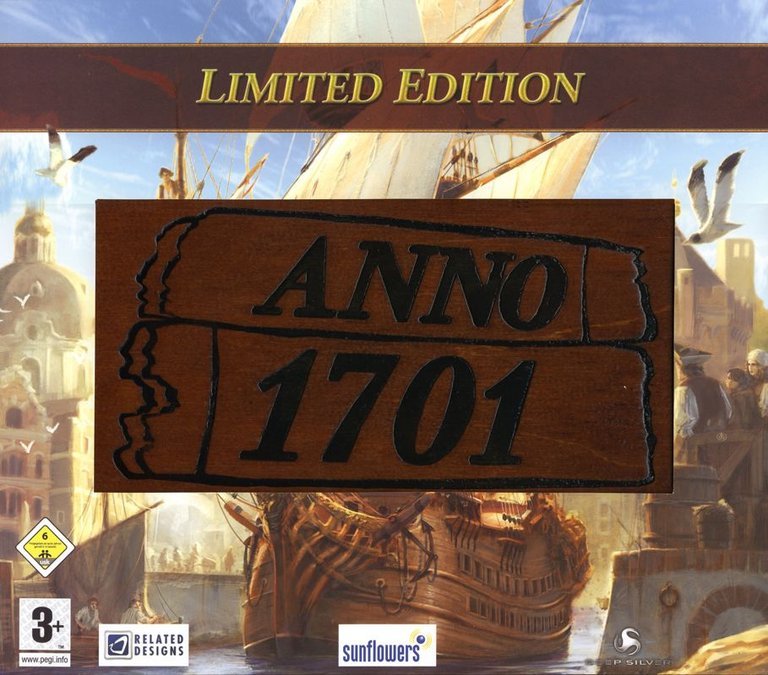
Anno 1701 (Limited Edition) is a real-time strategy and city-building game set in the 18th-century New World, where players establish, expand, and manage prosperous colonies through economic simulation, trade, and diplomacy. Part of the acclaimed Anno series, this special edition includes exclusive physical bonuses such as an art book, soundtrack DVD, signed drawings, and other collectibles, enhancing the immersive colonial experience.
Anno 1701 (Limited Edition) Cracks & Fixes
Anno 1701 (Limited Edition) Patches & Updates
Anno 1701 (Limited Edition) Reviews & Reception
metacritic.com (79/100): Great game at a great price. Easy to pick up for inexperienced gamers and complicated enough to please the hardcore RTS fan.
retro-replay.com : The pacing feels deliberate, allowing newcomers to learn the ropes while providing veterans with deep, complex systems to master.
Anno 1701 (Limited Edition) Cheats & Codes
PC
While playing the game, rename your warehouse to one of the following case-sensitive names to activate the cheat function.
| Code | Effect |
|---|---|
| BonanzaCreek | 100,000 Gold |
| Linlithgow | Warehouse filled with tools |
| SiliconValley | All research completed |
| ParadiseCity | Warehouse filled with custom goods |
| MariaDelTule | Trees and Plants |
Anno 1701 (Limited Edition): Review
Introduction: A New World in a Box
In the mid-2000s, the German game studio Related Designs faced a monumental task: to evolve a beloved national institution, the Anno series, into the third dimension while maintaining the intricate economic soul that made its predecessors, Anno 1602 and Anno 1503, global bestsellers. The result was Anno 1701 (marketed as 1701 A.D. in North America), a title that not only succeeded in this transition but also set the visual and mechanical template for the series’ future. The Limited Edition, restricted to just 17,001 copies worldwide, represents a time capsule of this pivotal moment—a premium physical artifact containing the game, an art book, a signed print, a soundtrack, and other memorabilia. This review argues that Anno 1701 stands as a landmark in the city-building and real-time strategy genres, a game that perfected the art of economic simulation while exposing the perennial tension between peaceful construction and military conquest that would define its successors. Its legacy is cemented not just in sales records but in its foundational role in a franchise that continues to thrive today.
Development History & Context: Forging a New Engine
The development of Anno 1701 was fraught with challenges from the outset. Following the success of the first two titles by Max Design, a dispute between the publisher Sunflowers Interactive and Max Design prevented Related Designs from accessing the source code for Anno 1503. This forced the Mainz-based studio to build their new title, initially codenamed Anno 3 and briefly imagined as the more combat-focused Anno War, from the ground up. The team grew from 10 to 25 developers, operating under a then-staggering budget of €10 million, making it the most expensive German game ever produced at the time.
The core technical feat was the creation of a new 3D engine, customized from Related Designs’ earlier No Man’s Land engine. This shift from 2D isometrics to a fully realized 3D world with an isometric diagonal-down perspective allowed for dynamic water simulations, advanced lighting and shadow systems (notably the “Beauty Shader”), and detailed, animated flora and fauna. Crucially, the developers engaged in an “annolysis”—a survey of over 5,000 players—which directly influenced key design decisions, such as the return of the nuanced tax system from Anno 1503 and the addition of camera alignment and the ability to look behind buildings. Veteran series creator Wilfried Reiter also joined as a game design consultant, ensuring continuity with the franchise’s core philosophy. After approximately 18 months of intensive development, the game went gold in early October 2006 and launched on October 26 in Germany.
Narrative & Thematic Deep Dive: The Governor’s Burden
Unlike many real-time strategy games of its era, Anno 1701‘s narrative is not delivered through lengthy, non-interactive cutscenes but is woven directly into the campaign missions and emergent gameplay. The player assumes the role of a European governor commissioned by the fictional Queen Marybeth to establish profitable colonies in the “New World”—a fictionalized Caribbean archipelago. The narrative unfolds across 15 missions grouped into five chapters, charting a progression from humble exploration to colonial dominance.
The plot is a tapestry of classic colonial era tropes: initial contact with indigenous tribes like the Iroquois (led by Tetonka), treacherous negotiations with rival European powers (the English, French, and especially the cunning French Admiral Francois Bataille), and bitter conflicts with pirates like the sadistic Captain Red. Supporting characters like the Free Trader Fergus Flynn and the scientist Hanna Marell provide quests and context, creating a sense of a living, political world. Thematically, the game is an unflinching simulation of 18th-century mercantilism and imperialism. The core mechanic of advancing citizens through five rigid social classes—Pioneer, Settler, Citizen, Merchant, and Aristocrat—mirrors the period’s stark social hierarchies and the colonial belief in linear progress through resource accumulation and consumption. The requirement to fulfill ever-more-luxurious needs (from cloth and faith to tobacco, chocolate, and jewelry) to maintain population happiness and tax revenue directlycomments on the unsustainable, exploitative nature of colonial economies.
The expansion, The Sunken Dragon, continues the narrative in a pseudo-sequel campaign. Tasked by friend Finn Hallqvist to retrieve the mythical “Eye of the Dragon,” the player ventures into Asian-inspired islands, introducing a layer of mystical adventure and new cultural aesthetics while maintaining the core themes of exploration and rivalry. This narrative bifurcation—between grounded colonial economics and pulp adventure—highlights the series’ flexibility in blending historical simulation with romanticized storytelling.
Gameplay Mechanics & Systems: The Elegant Grind
At its heart, Anno 1701 is an exercise in systemic balance and exponential growth. The gameplay is a loop of foundational complexity: establish a harbor, build resource chains (wood → sawmill → planks; grain → mill → flour → bakery → bread), satisfy citizen needs to upgrade housing, and expand to new islands for scarce resources. The genius lies in how these chains interlock; a shortage of tools halts construction, which in turn stalls resource production, leading to citizen downgrades, plummeting tax income, and systemic collapse.
Population & Economy: The five-tier citizen system is the game’s central pillar. Each tier has cumulative needs (e.g., Pioneers need food & town center; Settlers add cloth & church; Citizens add school & tobacco, etc.). Happiness is visualized on individual houses via progress bars and facial expressions. The revolutionary tax slider allows direct control: low taxes (dark green) encourage growth and upgrades, while high taxes (orange/red) increase revenue but cause unrest and emigration. This creates a constant, nervous tension between maximizing immediate income and ensuring long-term prosperity.
Exploration & Trade: A fog-of-war covers the map, requiring exploration ships to scout islands. Key resources like tobacco, hops, or cocoa are terrain-specific, forcing multi-island empires. Trade is multi-layered: automated convoys between your own islands, direct bartering with AI opponents at their harbors, and interactions with neutral parties. The Free Trader offers high-reward fetch quests, while four native cultures (Aztecs, Indians, Iroquois, Chinese) trade unique colonial goods (ivory, jade, furs) for items from your economy. Diplomacy with AI rivals is personality-driven; some are warlike, others trade-focused, affecting their early-game behavior.
Lodge & Espionage: A major innovation is the Lodge, unlocked early and expanded via research. It allows non-military sabotage: the spy reveals enemy islands, the poisoner can trigger plagues, and the demagogue incites worker revolts. This “soft power” layer adds strategic depth, letting players weaken rivals without costly war.
Warfare: This is the game’s most criticized and flawed system. Naval combat involves frigates (fast, for scouting) and galleons (heavy, for broadsides). Land combat includes infantry, dragoons (cavalry), and artillery, all transported by ship. The core issue is a glaring historical inaccuracy: ships have a longer attack range than coastal defense towers, allowing them to bombard harbors with impunity. As one player critic noted, this makes port blockades brutally effective and defense nearly futile, creating a “win more” scenario where economic dominance translates directly into military invincibility. Military units also incur ongoing maintenance costs, tying warfare irrevocably to economic health.
World-Building, Art & Sound: A Luminous 18th-Century Dream
Anno 1701’s transition to 3D was not merely a technical upgrade but an aesthetic revolution. The isometric 3D engine renders lush, colorful islands with dense vegetation, winding rivers, and, most notably, a seamless ocean with realistic reflections, wave physics, and ship wakes. The “Beauty Shader” adds a warm, painterly glow to the entire scene. Zooming from a strategic overview to street-level reveals charming details: citizens going about their routines, smoke from chimneys, animals roaming (though notably inaccurate, with gorillas and elephants in the Caribbean), and bustling market animations. The visual design draws from Gothic and Renaissance architecture, giving European-style settlements a cohesive, period-evoking look.
The soundscape is equally impressive, marking a series first with a fully orchestral score. Composed by Tilman Sillescu of Dynamedion and performed by the Brandenburg State Orchestra under Bernd Ruf, the 32-track soundtrack blends late-Romantic swells with Baroque harpsichord and minuet rhythms. The main theme, “A New World,” establishes a heroic, adventurous tone, while calmer tracks like “Apples in Trees” accompany peaceful settlement-building. The music dynamically shifts during events like battles or discoveries. Ambient sounds—hammering forges, creaking ships, market chatter—are layered procedurally, creating a persistent, reactive soundscape. Voice acting, in German and English, supports the campaign with distinct characterizations.
The Limited Edition‘s physical contents deepen this immersion. The art book reveals concept sketches, color studies, and rejected designs, showcasing the artistic process behind the vibrant in-game world. The framed, signed print and postcards serve as tangible artifacts of this digital universe, while the 5.1 surround soundtrack DVD allows fans to experience the score as intended.
Reception & Legacy: A Foundational Success
Critical Reception: Anno 1701 received “generally favorable reviews,” with a Metacritic score of 79/100. Critics universally praised its unparalleled economic depth and addictive “just one more turn” quality. IGN (8.2) highlighted its significant graphical and presentational leap over predecessors. GameSpot (7.6) lauded its gratifying resource chains. However, the steep learning curve was a common hurdle, and the AI—while personality-driven—was criticized for simplistic strategic behavior, particularly in warfare and pathfinding. The Eurogamer review (7/10) noted its laborious pacing and niche appeal.
The Limited Edition itself, as a collector’s item, was not widely reviewed separately, but its physical components were noted as lavish and thematically cohesive.
Commercial Success: The game was a monumental commercial hit, particularly in its home market. Pre-orders reached ~1 million globally, with 450,000 units in Germany alone. It sold over 200,000 copies in German-speaking countries within its first two weeks, becoming the fastest-selling German PC game ever at that time. It ultimately sold 320,000 units in Germany in 2006, finishing the year as the second-best seller behind World of Warcraft. By 2007, global sales exceeded 1 million copies. This success underscored the series’ stronghold in the German/European strategy market and its appeal to a broad demographic, including a notably high percentage of female players.
Legacy & Influence: Anno 1701 is a pivotal bridge in the series. It established the 3D isometric template that would be refined in the acclaimed Anno 1404 (2009) and the modern masterpiece Anno 1800 (2019). Its innovations—the tax slider, Lodge espionage, personality-driven AI, and multiplayer support for up to four players—became enduring series staples. The focus on a single, cohesive historical era (the 18th century) with a consistent aesthetic, as opposed to the fragmented settings of 1503, defined the “golden era” of the franchise.
The game’s life was extended by the Sunken Dragon expansion, which added a campaign and Asian-themed content. Its legacy was solidified by the Anno 1701: History Edition in 2020, a official remaster by Ubisoft featuring 4K support, widescreen fixes, and updated multiplayer, proving the enduring demand for this classic. Furthermore, a vibrant modding community continues to produce custom content and compatibility patches, ensuring the game remains playable on modern systems.
Conclusion: The Archetypal Anno
Anno 1701 (in any edition) is a game of profound contradictions. It is a breathtakingly beautiful and deeply complex economic simulator that captures the addictive thrill of building a microcosm from scratch. It is also a game whose warfare mechanics feel like an awkward, historically inaccurate afterthought—a system to be endured rather than enjoyed, where naval supremacy so dominates that it trivializes land-based conflict. This tension between serene city-building and clumsy combat is the very essence of the Anno series at this stage.
The Limited Edition elevates the experience from a digital product to a curated historical document. For collectors and historians, the physical artifacts—the art book, the signed print, the soundtrack—are invaluable windows into the creative process behind this landmark title. They transform the game from a mere piece of software into a celebration of its world.
Placed in the canon of video game history, Anno 1701 is not the most innovative or critically adored strategy game of its time. It is, instead, the definitive crystallization of a specific, beloved subgenre: the peaceful, economic, and visually rich empire-builder. It perfected the formula of its predecessors and provided the robust 3D foundation for all future Anno titles. Its commercial triumph demonstrated the massive, enduring appeal of slow-burn strategic depth over action-packed immediacy. For anyone seeking to understand the evolution of city-building games or the specific charm of German strategy design, Anno 1701 is an essential, playable, and beautifully preserved artifact. Its limited-edition packaging is the perfect tribute to a game that, for all its flaws, let players architect their own luminous, bustling corner of the 18th century—one careful resource chain at a time.