
- Release Year: 2015
- Platforms: Windows
- Publisher: Ubisoft Entertainment SA
- Developer: Blue Byte Mainz, Blue Byte Studio GmbH
- Genre: Simulation, Strategy, Tactics
- Perspective: Diagonal-down
- Game Mode: Single-player
- Gameplay: Business simulation, City building, construction simulation, Managerial, Modular building, Real-time tactical
- Setting: Futuristic, Sci-fi
- Average Score: 72/100
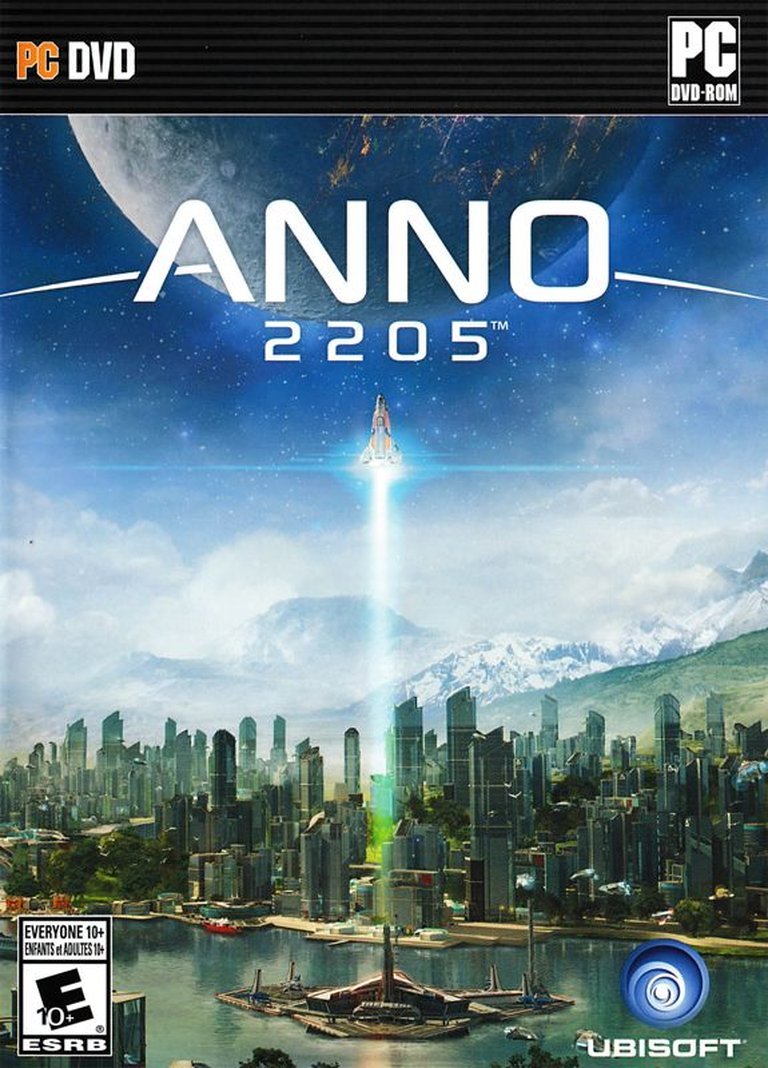
Description
Anno 2205 is a sci-fi city-building and economic simulation set in the year 2205, where players manage a megacorporation to colonize Earth’s diverse biomes and establish a lunar base. By balancing production chains, resource logistics, and technological advancements, they aim to secure humanity’s energy future amid planetary resource scarcity and population growth.
Gameplay Videos
Where to Buy Anno 2205
PC
Anno 2205 Free Download
Anno 2205 Mods
Anno 2205 Guides & Walkthroughs
Anno 2205 Reviews & Reception
metacritic.com (72/100): Aside from the sea battles, Anno 2205 is, without a doubt, the best entry in the series yet.
ign.com : Anno 2205 made me feel like a high-powered CEO exploiting the wonders of the 23rd century with a staff of thousands of ungrateful children.
monstercritic.com (73/100): An ideal gateway into the city management sim, but with too little room for forward-planning.
Anno 2205: Review
Introduction: A Futuristic Divisive Pivot
The Anno series stands as a titan in the city-building and economic simulation genre, renowned for its deep, intricate webs of production, trade, and citizen management across historical settings from the Renaissance to the Age of Exploration. With Anno 2205, released in 2015, developer Blue Byte took a bold leap into science fiction, aiming to reimagine the formula for a new era. The result is a game of striking visual ambition and streamlined accessibility that simultaneously alienated many long-time fans. This review will argue that Anno 2205 is a fascinating but flawed experiment: a title that successfully modernized the series’ presentation and broadened its appeal at the significant cost of the strategic depth, systemic tension, and emergent narrative that previously defined the franchise. It remains a pivotal, if uneven, stepping stone—one whose legacy is felt in both the missteps it made and the foundations it laid for the later triumphant return of the series with Anno 1800.
Development History & Context: Streamlining the Future
Anno 2205 was developed by Blue Byte Studio GmbH, specifically its Mainz studio—the same team responsible for the acclaimed Anno 1404 and Anno 1701. Following the well-received Anno 2070 (2011), which had already introduced a future setting and ecological faction mechanics, the decision was made to push further into the 23rd century. Creative Director Dirk Riegert and his team sought to create a more approachable, visually-oriented experience, consciously moving away from what they perceived as the “elitist” complexity of older entries, which often required external spreadsheets and obscure knowledge to optimize.
The gaming landscape of 2015 was fertile for a new city-builder. The disastrous launch of SimCity (2013) had left a void, and Cities: Skylines (2015) was gaining traction with its deep simulation and mod support. Anno 2205 entered this arena with a clear design philosophy: focus entirely on single-player, eliminate randomly generated maps in favor of hand-crafted, large-scale districts, and simplify the often Byzantine logistics of its predecessors. Technologically, the game leveraged an updated engine to support its signature feature—seamless transitions between multiple persistent “sessions” (separate maps representing Earth’s temperate zones, the arctic, and the Moon). The introduction of modular building upgrades and a user-friendly, icon-driven interface were direct responses to criticisms of the text-heavy, spreadsheet-like UI of Anno 2070.
From a business model perspective, Ubisoft’s involvement was unmistakable. The game launched with a announced Season Pass, and its development included planned DLC from the outset—a point of contention for some players. The closed beta was ultimately cancelled, with pre-order bonuses offered instead, a decision that hinted at the publisher’s tight control over the release schedule and monetization.
Narrative & Thematic Deep Dive: A Story Forgotten
The narrative framework of Anno 2205 is delivered through the “Lunar Licensing Program,” a campaign integrated into the game’s “Continuous Mode.” The premise is an impending global energy crisis caused by depleted terrestrial resources. The solution: harness helium-3 from lunar deposits to power fusion reactors and secure humanity’s future. The player is the newly appointed CEO of a fledgling megacorporation, competing against five rival corporations (including the antagonistic “Council of the Moon” led by Krisztian Lanik, a disgruntled lunar colonist with a goatee and a grudge) for dominance and the right to build the first functional fusion reactor.
Thematically, the game touches on classic science fiction concepts: corporatization, colonization, and the ethics of expansion. However, the treatment is superficial. The conflict with the lunar