
- Release Year: 2002
- Platforms: Windows
- Publisher: Akella, ASCARON Entertainment GmbH
- Developer: ASCARON Entertainment GmbH
- Genre: Simulation, Sports, Strategy, Tactics
- Perspective: Text-based / Spreadsheet
- Game Mode: Hotseat, Single-player
- Gameplay: Business simulation, Managerial
- Setting: Football (European), Soccer
- Average Score: 61/100
Description
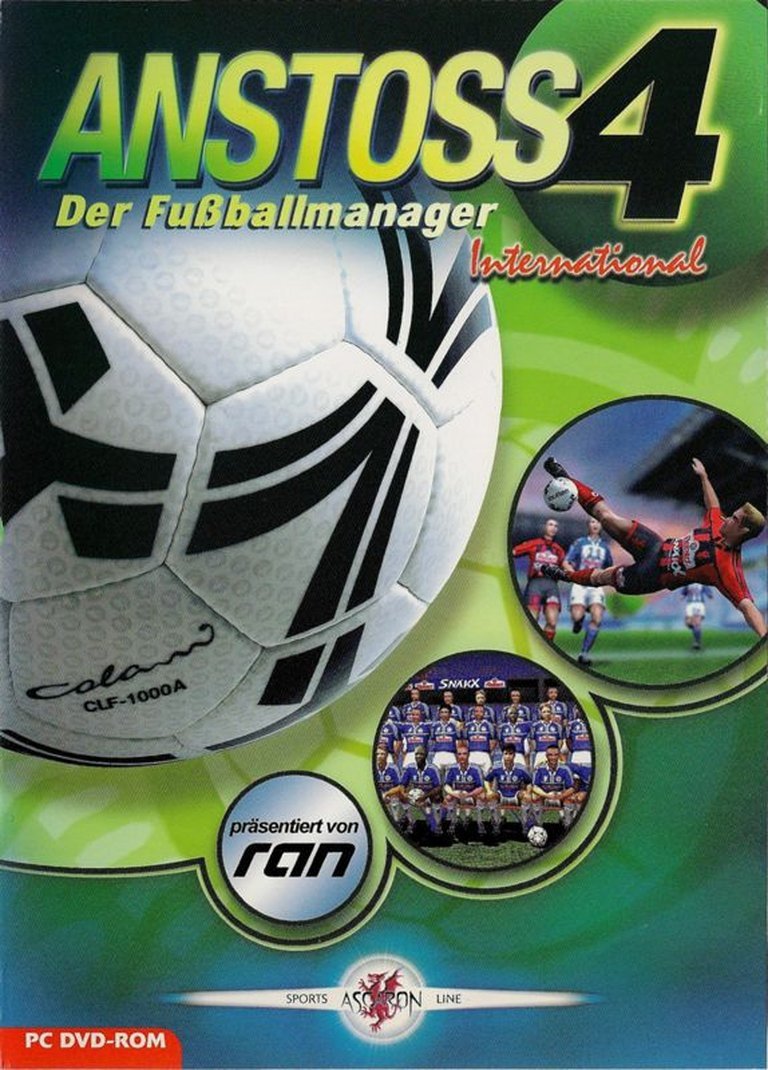
Anstoss 4: Der Fußballmanager – International is the fourth entry in the German Anstoss soccer manager series, where players act as a football club manager handling team strategy, player transfers, and matches under strict budget constraints set by the club president to avoid dismissal. It simplifies the economic aspects from its predecessor Anstoss 3, reintroduces the scene mode for match presentation from Anstoss 2, and offers full 3D visuals alongside text-based commentary in a spreadsheet-style interface focused on simulation and tactics.
Anstoss 4: Der Fußballmanager – International Cracks & Fixes
Anstoss 4: Der Fußballmanager – International Reviews & Reception
retro-replay.com : Takes the classic elements of soccer management and refines them with a sharper focus on realistic constraints and player agency.
hall9000.de (50/100): Hat durchaus Potential zum kultigen Managerspiel aufzusteigen, obwohl es durchaus auch Schwächen besitzt.
Anstoss 4: Der Fußballmanager – International: Review
Introduction
Imagine stepping into the pressure cooker of a soccer boardroom, where every transfer negotiation and tactical tweak could spell glory or relegation—welcome to Anstoss 4: Der Fußballmanager – International, the ill-fated fourth chapter in Germany’s premier soccer management series. Born from the legacy of Anstoss (known internationally as On the Ball), a franchise that once rivaled British giants like Championship Manager with its quirky humor, deep business simulation, and obsessive realism, this 2002 release promised to elevate the genre amid a booming early-2000s sports sim landscape. Yet, what emerged was a game crippled by technical woes, marking a low point for developer Ascaron Entertainment. My thesis: Anstoss 4 is a noble but bungled experiment in accessibility and realism, whose bugs and half-baked features overshadowed innovative budgetary constraints, ultimately dooming it to infamy while paving the way for redemption in its successor.
Development History & Context
Ascaron Entertainment GmbH, a German studio founded in the mid-1990s, had built its reputation on the Anstoss series since 1993’s DOS/Amiga original. By 2002, the franchise was a cultural touchstone in Germany, boasting expansions like Anstoss 2: Verlängerung! and spin-offs such as Anstoss Action (2001), which decoupled the 3D match engine for direct intervention. Anstoss 4 arrived in a competitive era dominated by Sports Interactive’s Football Manager (formerly Championship Manager) series, EA’s burgeoning FIFA empire, and rivals like Fussball Manager 2003. Technological constraints of the time—Windows 98/Me era hardware requiring Pentium III processors, 128MB RAM, DirectX 8.1, and modest 32MB VRAM—pushed developers toward hybrid 2D/3D interfaces, menu-driven spreadsheets, and CD/DVD-ROM distribution.
The vision, led by project manager and lead game designer Guido Eickmeyer (with contributions from Heiko Köhler, Ingo Bertram, and programmers like Matthias Schiller and Maik Delitsch), aimed to streamline the series’ notorious complexity. Unlike Anstoss 3‘s freewheeling finances, Anstoss 4 restricted player agency via presidential budgets, targeting newcomers while retaining tactical depth. However, turmoil defined development: a complete code rewrite deemed Anstoss 3‘s codebase “too confused,” a rushed 12-month cycle, and the defection of star designers Gerald Köhler and Rolf Langenberg to EA Sports, where they influenced FIFA Manager. Pre-release, Ascaron faced a lawsuit from EA over licensing, forcing a last-minute scramble to anonymize player names and crush initial CD production. With 92 credited personnel (including 3D implementation by “Scotty” Maik Delitsch), the game launched November 29, 2002, for Windows, supporting 1-4 players via split-screen, keyboard/mouse input, and an expansive database of 145 countries—ambitious, but undermined by unpatched bugs that rendered it “nearly unplayable.”
Narrative & Thematic Deep Dive
As a managerial sim, Anstoss 4 eschews scripted plots for emergent storytelling, where your career arc—from obscure lower-league coach to European contender—unfolds through dynamic simulations. No protagonists or dialogue trees exist; instead, “characters” are procedurally generated managers, presidents, scouts, and over 10,000 players (anonymized post-EA lawsuit), defined by stats like “effective strength” and “stamina.” Themes revolve around realism versus fantasy: the president’s iron-fisted budgets symbolize boardroom politics, forcing trade-offs between star signings and fiscal prudence. Ignore limits on salaries or transfers, and face sacking—a narrative punctuation mark that resets your story.
Deeper motifs echo German soccer culture: Eingespieltheit (team cohesion, lamented as absent by critics), fan pressure, and long-term empire-building (e.g., stadium expansions or going public). Off-field events—media interviews, contract haggling, youth academy breakthroughs—craft personal tales, like turning a mid-table minnow into champions under duress. Reviews noted a “staubtrocken” (dust-dry) tone, lacking Anstoss 3‘s wit (famously personified by “Kaiser” commentary), but this austerity underscores themes of professional grind. International scope adds geopolitical flavor: manage Russian (Спартак: Футбольный Менеджер) or minor-league sides, where financial regulations vary, mirroring global football’s disparities. Ultimately, the narrative critiques unchecked ambition—much like Ascaron’s own rushed release.
Gameplay Mechanics & Systems
At its core, Anstoss 4 loops through weekly cycles: scout talent, negotiate transfers within budgets, set training regimes (team-wide or positional), tweak tactics (formations, pressing, etc.), and simulate matches. Innovation shines in economics: presidents dictate salary/transfer caps, curbing Anstoss 3‘s excess while emphasizing strategy—overspend, and infrastructure crumbles. Two key attributes (“effective strength,” stamina) simplify progression for beginners, with youth development, assistant delegation, and international leagues (add four per nation) adding depth.
Match presentation offers flexibility:
– Full 3D mode: Real-time polygonal action, criticized as “unspectacular” with “hässliche Gesichter” (ugly faces) and illogical animations.
– Scene mode (revived from Anstoss 2): Cinematic highlights (goals, saves) with dramatic angles.
– Text mode: Spreadsheet-style commentary, expanded but “boring” per reviewers.
UI/Interface: Praised as “gestraffte Bedienung” (streamlined), with color-coded menus for rosters, finances, and editors—intuitive for veterans, accessible for newbies. Flaws abound: bugs caused crashes, incompatible saves, and illogical AI; reduced features (no team cohesion) shrank scope versus predecessors. Multiplayer (split-screen) and editor tools promised replayability, but long load times from the vast database frustrated. Core loop satisfies tacticians, but bugs eviscerated flow, making it a “Fehlermonster” (bug monster).
| Mechanic | Strengths | Weaknesses |
|---|---|---|
| Economy | Realistic budgets add tension | Too restrictive, lacks depth |
| Tactics/Training | Comprehensive options | Missing cohesion metric |
| Matches | Multiple views | 3D poor; text dull |
| Progression | Career mode, intl. leagues | Buggy saves, AI glitches |
World-Building, Art & Sound
The “world” is a global soccer ecosystem: 145 nations, customizable leagues, dynamic transfers, and stadiums evolving via upgrades (e.g., sponsor naming rights). Atmosphere builds through procedural events—rain-slicked pitches, roaring crowds (sprite-based), evening lights—but immersion falters. Visuals: Functional 2D menus prioritize clarity (icons, tabs for finances/rosters); 3D matches use basic polygons, smooth tackles/headers, weather effects, yet suffer dated textures, repetitive scenes, and grotesque models. Critics called it “nicht schön anzusehen” (not pretty to watch), prioritizing utility over spectacle.
Sound design receives scant mention, implying minimalism: likely ambient stadium noise, basic commentary (absent live calls, per reviews), and interface beeps. No FMV or voice acting noted; focus stays on simulation hum. These elements contribute a clinical vibe, enhancing managerial detachment but alienating fans craving Anstoss‘s charm—effective for spreadsheet strategists, lackluster for immersion seekers.
Reception & Legacy
Launched to lukewarm commercial prospects (no sales figures, but low collection by 7 MobyGames users), Anstoss 4 earned a dismal MobyScore of 6.6/10 (critics 65% from 8 German outlets: GameStar 79%, Computer Bild Spiele 46%). Reviews hammered bugs—”countless” crashes, unplayable states—alongside “langweilig” (boring) matches, reduced features, and 3D flops. Fans decried it as series nadir: “Abstiegsjahr” (relegation year), drier than Fussball Manager 2003. Player scores averaged 3/5 (no text reviews).
Legacy soured initially: Ascaron abandoned patches for Anstoss 4: Edition 03/04 (2003, 7.6/10), fixing bugs, ditching 3D, adding finances/public offerings—proving Anstoss 4 a prototype. It split fandom; Köhler’s EA exodus fueled FIFA Manager, while series continued (Anstoss 2005). Influence: Highlighted pitfalls of rushed rewrites, budget sim evolution (presidential oversight echoed in modern FMs). Today, a cautionary tale in German gaming history, revived in Anstoss Classics (2021), underscoring resilience amid bankruptcy (Ascaron 2009).
Conclusion
Anstoss 4: Der Fußballmanager – International embodies ambition derailed: streamlined menus and fiscal realism innovated, but bugs, absent depth, and subpar 3D doomed a series pinnacle to nadir. In video game history, it occupies a pivotal limbo—not revolutionary like Anstoss 2, nor enduring like Football Manager—but a gritty artifact of early-2000s sim evolution, redeemed by its Edition successor. Verdict: 6.5/10—play for history buffs or masochists; skip for modern thrills. A flawed kickoff that nearly ended Germany’s soccer manager dynasty.